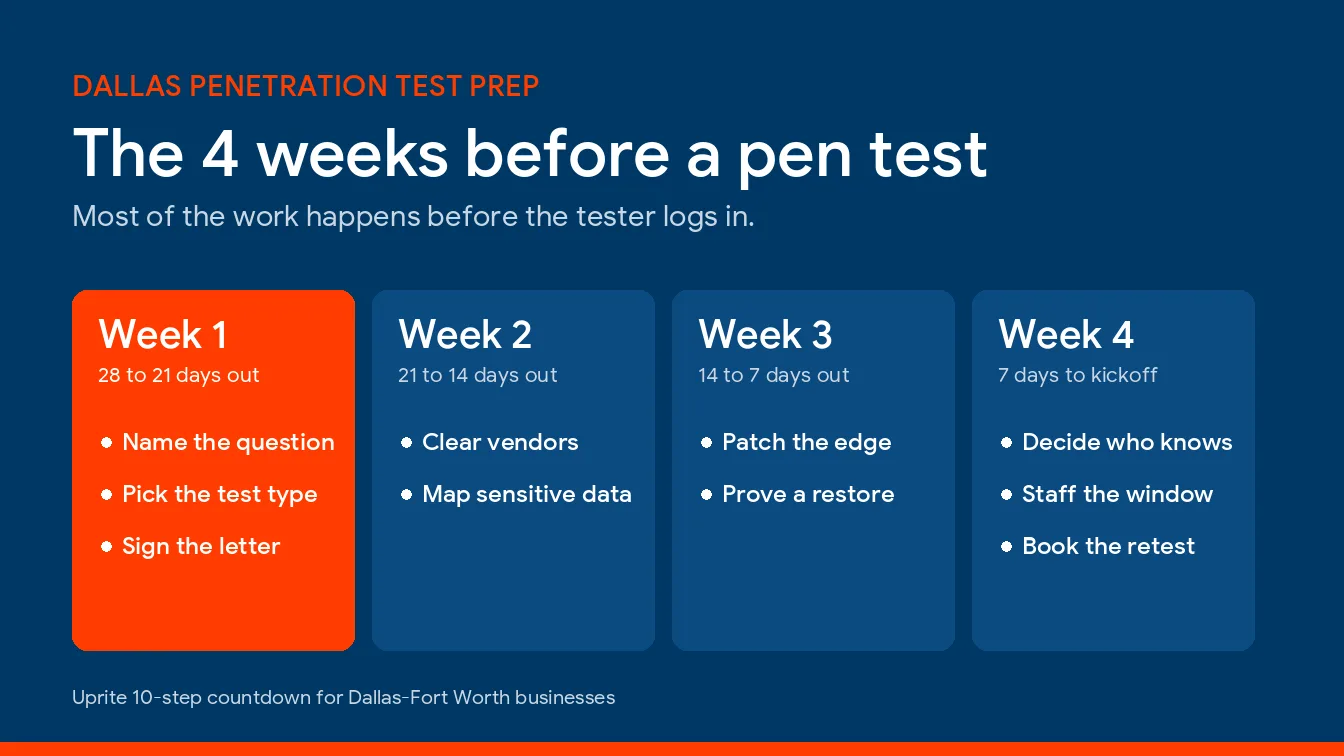
To prepare for a penetration test, decide what question it must answer, sign a scope letter, clear every third party, patch your internet-facing gear, test a restore, and book the fix and retest time. Start 3 to 4 weeks ahead.
As a vCIO at Uprite, I help clients get ready for these tests, and penetration testing is part of our cybersecurity services in Dallas, so I’m not a neutral party. On a typical engagement for a 30- to 80-person Dallas company, the tester works for 3 to 5 days, while the preparation around those days takes closer to 4 weeks and decides how useful the report turns out to be.
The month before a penetration test is mostly paperwork. Texas Penal Code Section 33.02 makes access without the owner’s consent an offense, so the signed scope letter and each hosting vendor’s written approval come first. CISA’s exploited vulnerabilities catalog gained 64 firewall and remote access flaws in the year to November 13, 2026, so that equipment gets patched next. A test restore, 2 named contacts, and a booked retest finish the list.
What does preparing for a penetration test actually involve?
Preparing for a penetration test is the planning done before any testing traffic is sent. NIST SP 800-115 treats it as the first phase of a security test. In plain terms, you decide what the tester may attack, collect written permission from every owner, fix the cheap findings, and line up the people who’ll act on the report.
The countdown below is the one I send Dallas clients about a month out, with the snag I run into most often at each step in the last column.
| Step | Finished when | Days before kickoff | Common snag |
|---|---|---|---|
| 1. Name the question | One sentence says why you’re testing and who reads the report | 28 | 3 people want 3 different tests |
| 2. Pick the test type | External, internal, web app, or cloud is chosen, with or without a login | 25 | Buying an external test when the worry is a stolen staff login |
| 3. Sign the scope letter | Systems, dates, tester IP addresses, and banned actions are signed | 21 | The signer doesn’t own half the systems listed |
| 4. Clear third parties | Every host, colo, and SaaS vendor has agreed in writing | 14 | A hosted line-of-business app vendor takes 10 business days to answer |
| 5. Mark the sensitive data | The tester knows where SSNs, patient files, and card data live | 14 | Nobody knows which share holds the payroll exports |
| 6. Patch the edge | Firewall, VPN, and remote access gear is on current firmware with MFA | 10 | A firmware update needs a maintenance window nobody booked |
| 7. Prove a restore | A real restore worked and fragile systems are listed | 7 | The backup job reports success but has never been restored |
| 8. Decide who’s told | Your monitoring provider and managers know only what they need | 5 | The SOC blocks the tester on day 1 and the test stalls |
| 9. Staff the test window | 2 contacts, a stop word, and a change freeze are set | 3 | The only admin is on vacation that week |
| 10. Book the aftermath | Readout call, fix hours, and retest date are on calendars | Before day 1 | The report lands and sits in an inbox for a quarter |
Steps 1 to 3 are decisions, and the letter is the one with legal weight
Name the one question the test has to answer (step 1)
The question decides the test. If the worry is whether someone on the internet could reach client tax files, that’s an external test of your public addresses and portals. If the worry is how far one phished front-desk login could get, that’s an internal test that starts from a staff account, and it usually needs more tester days.
Sometimes a regulation supplies the question. The FTC Safeguards Rule at 16 CFR 314.4(d)(2) asks covered financial firms, which include tax preparers, mortgage brokers, and auto dealers, for a penetration test every year and a vulnerability assessment every 6 months unless they monitor their systems continuously. Firms that hold data on fewer than 5,000 consumers are exempt from that part of the rule. If an insurer is the reason, read the renewal question word for word, since carriers phrase it differently. Our pen test and cyber insurance guide covers what carriers tend to ask for.
Pick the test type and what the tester starts with (step 2)
An external test shows what a stranger on the internet can reach. An internal test starts inside your network and shows how far one infected laptop could spread. For a 40-person office in Irving or Richardson, I usually recommend an internal test that begins with an ordinary staff login, because a stolen password is a common way for real intrusions to start at companies that size.
You may not need a penetration test yet. If you’ve never run a vulnerability scan, a scan is cheaper and will find the missing patches that a tester would otherwise bill you to find. Our penetration testing vs vulnerability scanning breakdown explains when each one makes sense.
Put the scope and the rules in a signed letter (step 3)
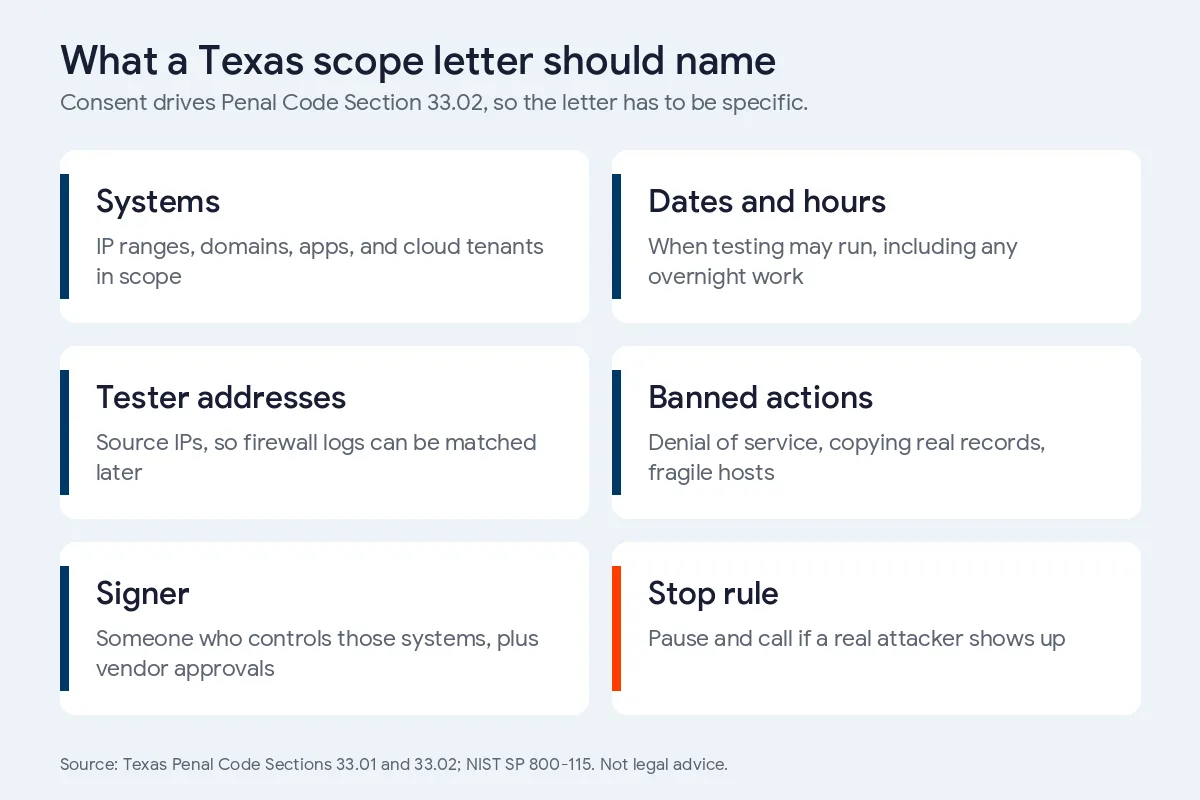
This is the step where Texas law matters. Texas Penal Code Section 33.02 makes it an offense to knowingly access a computer system without the effective consent of the owner, and Section 33.01 says consent isn’t effective when it’s used for a purpose other than the one it was given for. I’m not a lawyer and this isn’t legal advice, but it’s the reason we don’t let a tester touch any system that isn’t named in the letter.
The letter we use names the systems by IP address, domain, and application. It sets the test dates and hours and lists the addresses the tester will work from, so your firewall logs can be matched later. It spells out banned actions such as denial of service or copying real customer records, and it’s signed by someone who controls those systems, usually the owner or an officer. We also write in what happens if the tester finds signs of a real attacker. Testing pauses, and the tester calls your named contact before doing anything else.
Steps 4 to 7 get your systems and vendors ready
Get written approval from everyone who hosts your systems (step 4)
Your signature covers what you own or control, and Section 33.01 defines an owner to include anyone with title to the property or the right to restrict access to it. In practice that list includes your colocation provider, the vendor that hosts your practice management or ERP system, and whoever runs your website. Each of them needs to agree in writing before the tester touches their side.
The big cloud platforms publish their own terms. Microsoft’s penetration testing rules of engagement let you test your own tenant without notifying Microsoft first, but they still prohibit things like denial-of-service testing, and the page gets revised, so read it the week you test. In our experience the slowest reply comes from the smaller hosted app vendors, so we send those requests on the first day of prep.
Tell the tester where the sensitive data lives (step 5)
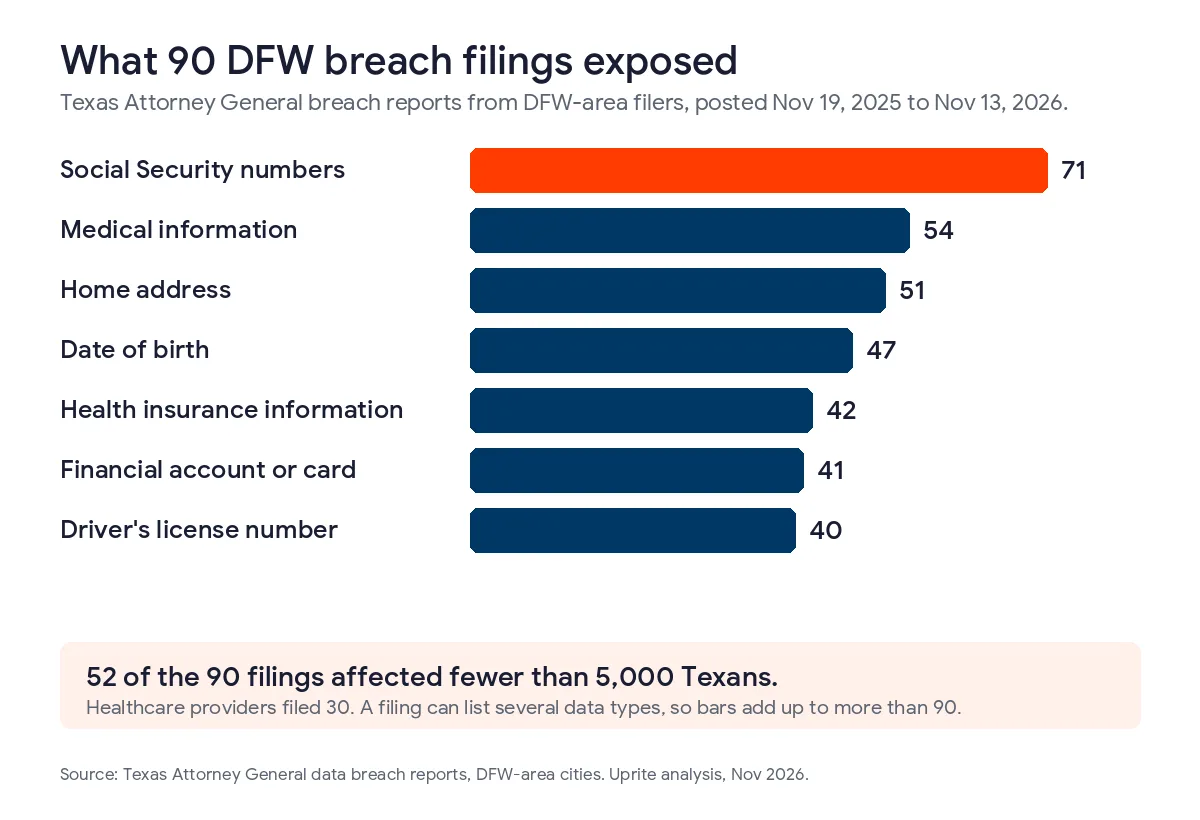
A tester with 5 days should spend them near the data that would hurt you most. To see which data that tends to be locally, I pulled the Texas Attorney General’s data breach report list for filers based in Dallas-Fort Worth area cities, covering reports posted from November 19, 2025 through November 13, 2026. There were 90 filings in that window. Social Security numbers were involved in 71 of them, medical information in 54, financial account or card numbers in 41, and driver’s license numbers in 40.
Small organizations made up a large share of the list. In 52 of the 90 filings, fewer than 5,000 Texans were affected, and healthcare providers filed 30 of them. A filing is only required once a breach reaches 250 Texans under Business and Commerce Code Section 521.053, so smaller incidents never show up there at all.
We ask clients for a short written answer about where Social Security numbers, patient files, and card data sit, including the shares, apps, and mailboxes involved. With that list, the tester can try to reach the payroll export folder on purpose. That single finding usually tells an owner more than 40 low-severity notes about the guest Wi-Fi.
Patch the edge before the tester sees it (step 6)
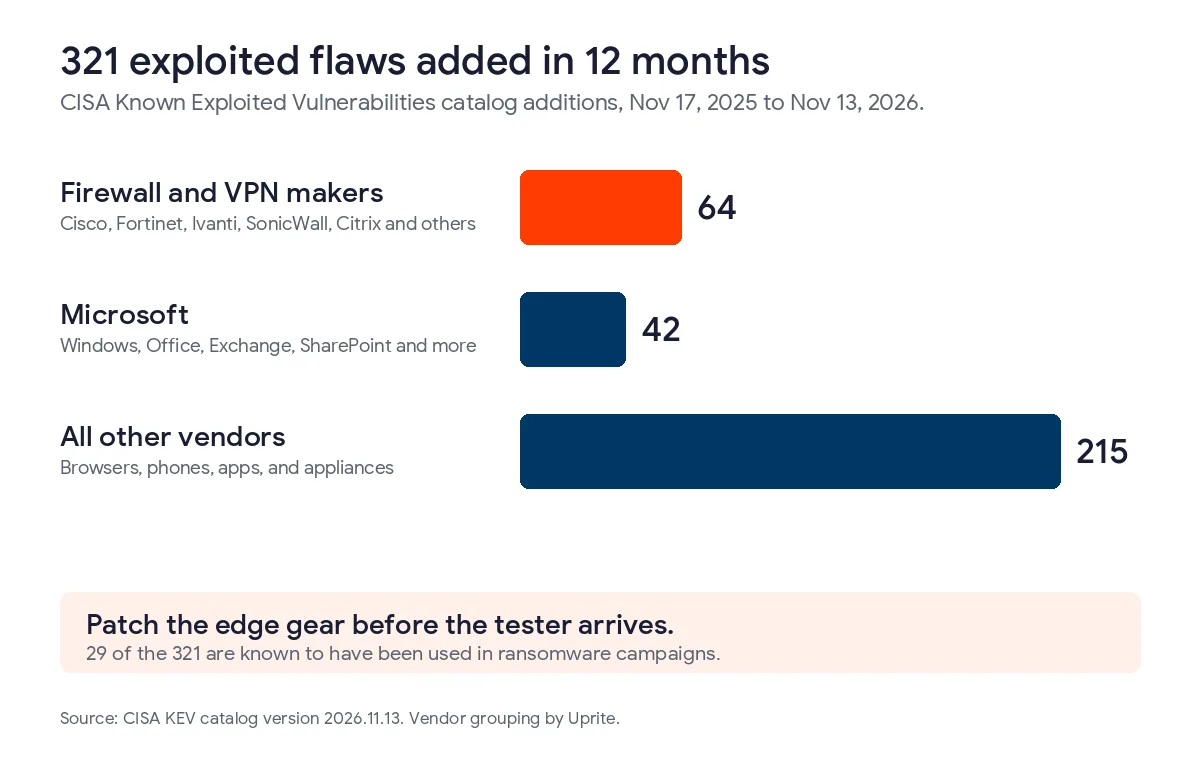
Firewalls and VPNs come first because attackers go after them first. CISA added 321 entries to its Known Exploited Vulnerabilities catalog between November 17, 2025 and November 13, 2026, and 64 of them were in products from Cisco, Fortinet, Ivanti, SonicWall, Citrix, and other makers of firewall and remote access equipment. Microsoft products accounted for another 42. Every entry on that list is a flaw that has been used in real attacks.
Some prep guides tell you to fix everything before the test, and I don’t agree with that advice. If you fix every known issue, you pay a tester to confirm your scan results. We have clients update the edge equipment, turn on MFA for every admin and remote access account, and remove default passwords, and then we leave the rest for the tester to find.
Prove a restore works and list fragile systems (step 7)
CISA’s #StopRansomware Guide tells organizations to keep offline, encrypted backups of critical data and to test backup procedures regularly, and the week before a penetration test is a convenient time to do that. I ask for one real restore of a file share or virtual machine, with the time it took written down, since a backup console that reports success hasn’t shown that the data comes back.
Old servers are the other reason for this step. According to Microsoft’s lifecycle page, extended support for Windows Server 2012 R2 ended in October 2023 and the last paid security update year ended October 14, 2026, yet I still find those machines in Dallas server closets running payroll or a line-of-business database. They go into the scope letter with a note to test gently or skip them, and a fresh backup is taken the day before testing. Our disaster recovery services in Dallas page covers how we run restore tests.
Steps 8 to 10 cover people and the weeks after the report
Decide who knows, including your monitoring provider (step 8)
Who should know the test is happening? Fewer people than you’d think. The CIS Controls v8.1 guidance on penetration testing says only a few people in an organization should know, with one person named as the main contact if something goes wrong. On my projects that’s usually the owner, the IT lead, and any manager whose team might notice odd logins. If phishing emails are in scope, I get HR’s sign-off in writing before the first one goes out.
Your monitoring provider is the hard call. Leave them out and you learn whether they’d catch a real intruder. The risk is that they block the tester’s addresses on the morning of day 1, and on a 5-day test that’s 20% of what you paid for gone. My compromise is to tell one senior person at the provider and nobody on their analyst floor. If you use managed detection and response in Dallas, ask before signing how the provider will treat alerts from the tester’s addresses. If nobody watches your network overnight yet, our 24/7 security monitoring page explains what that coverage looks like.
Staff the test window (step 9)
For the test window I want 2 names and 2 cell numbers on the client side. One person can call a pause, and the other can restart a server in the evening if one goes down. We agree on a stop word, and when anyone says it, testing stops. I also ask clients to hold off on nonurgent changes that week, since a firewall rule someone pushes on Wednesday can make Thursday’s results impossible to read.
Do you need a security analyst on staff to do this? You don’t, and most companies your size don’t have one. BLS occupational data counts 7,080 information security analysts in the Dallas-Fort Worth metro in May 2025, earning a mean of $133,790 a year. A 60-person company can’t usually carry that salary, which is why the 2 names on my contact sheet tend to be someone from the IT provider and the office manager or controller.
Book the readout, the fix time, and the retest (step 10)
If testing ends on a Friday, I book the readout call for the following week, block 2 or 3 days of IT time right after it for the critical findings, and put a retest on the calendar about 30 days out. Our guide to reading a penetration test report shows how testers usually rank findings. CIS also warns that the report can work as step-by-step directions for breaking in, so I keep copies to the 2 or 3 people doing the fixes. File one copy with your security records as well, since a dated report and fix log help show a program was maintained under Business and Commerce Code Chapter 542, the SB 2610 safe harbor. Our Texas SB 2610 guide walks through its tiers.
Who should wait before booking a penetration test?
I postpone a fair number of test requests, usually for one of these reasons.
- No vulnerability scan has ever been run.
- Microsoft 365 or the VPN still accepts a password alone.
- Nobody can list the public IP addresses, domains, and cloud tenants the letter has to name.
- A firewall replacement or office move is less than 60 days away.
In those cases I’d start with our network assessment, which produces the device inventory and network diagram the scope letter needs, or a cybersecurity risk assessment if you want the gaps ranked by business impact.
Planning a test for next quarter? Send us the question it has to answer and a rough list of the systems involved, and we’ll send back a prep list for your environment along with a quote for that scope.
Request a Penetration Test QuoteQuestions Dallas companies ask before a pen test
How far ahead should I start preparing?
Plan on 3 to 4 weeks, and spend the first week on vendor approvals because those take the longest. In the countdown above, the letter is signed 21 days out and third parties are cleared by day 14, which leaves 2 weeks for patching, a restore test, and staffing the test window.
Is it legal to hire someone to hack my own network?
Hiring someone to test your own network is legal in Texas when the owner of each system consents and the tester stays within that consent. Penal Code Section 33.02 makes access without the owner’s effective consent a Class B misdemeanor at its base level, so the signed scope letter and each vendor’s approval are what separate a test from an offense.
Do I give the tester a login or let them start cold?
I’d give them an ordinary staff login for most office tests, since one phished password is how a lot of small-company incidents start. A cold external test answers a narrower question about what a stranger can reach from the internet, and it fits best when the worry is a public web app or client portal.
Can a pen test take down our systems?
It’s uncommon, partly because most scope letters ban denial-of-service testing and Microsoft’s rules ban it on its cloud. When something does fail, it’s usually one of the old servers from step 7 that nobody listed as fragile.
Should we fix everything we know about first?
Fix the CISA catalog entries that match your firewall, VPN, and Microsoft products, turn on MFA, and change default passwords. Leave everything else alone, because a test that only rediscovers last month’s scan results isn’t worth the fee.
Does Texas SB 2610 require a penetration test?
Chapter 542 never uses the words penetration test. Since September 1, 2025, it has barred exemplary damages against a Texas business with fewer than 250 employees that maintained a qualifying cybersecurity program, and for 20 to 99 employees the baseline is CIS Implementation Group 1. The CIS v8.1 guide puts all 5 of its penetration testing safeguards in Groups 2 and 3, so a company that size doesn’t need a test to qualify, while one with 100 to 249 employees should check whether its chosen framework calls for testing.