No Texas or federal law makes a pen test a condition of buying cyber insurance. Carriers ask about testing on the application instead, and which form a Dallas business gets can decide whether the question shows up at all.
The question tends to land on an office manager or a controller in Dallas a few weeks before renewal. Uprite runs scoped penetration testing in Dallas as part of our cybersecurity work, and we get asked about this a lot, so we went to the paperwork. We downloaded 7 carrier forms from Travelers, AXIS, and At-Bay, read the Texas safe harbor law and the federal rules that touch testing, and counted 12 months of North Texas breach filings with the Texas Attorney General.
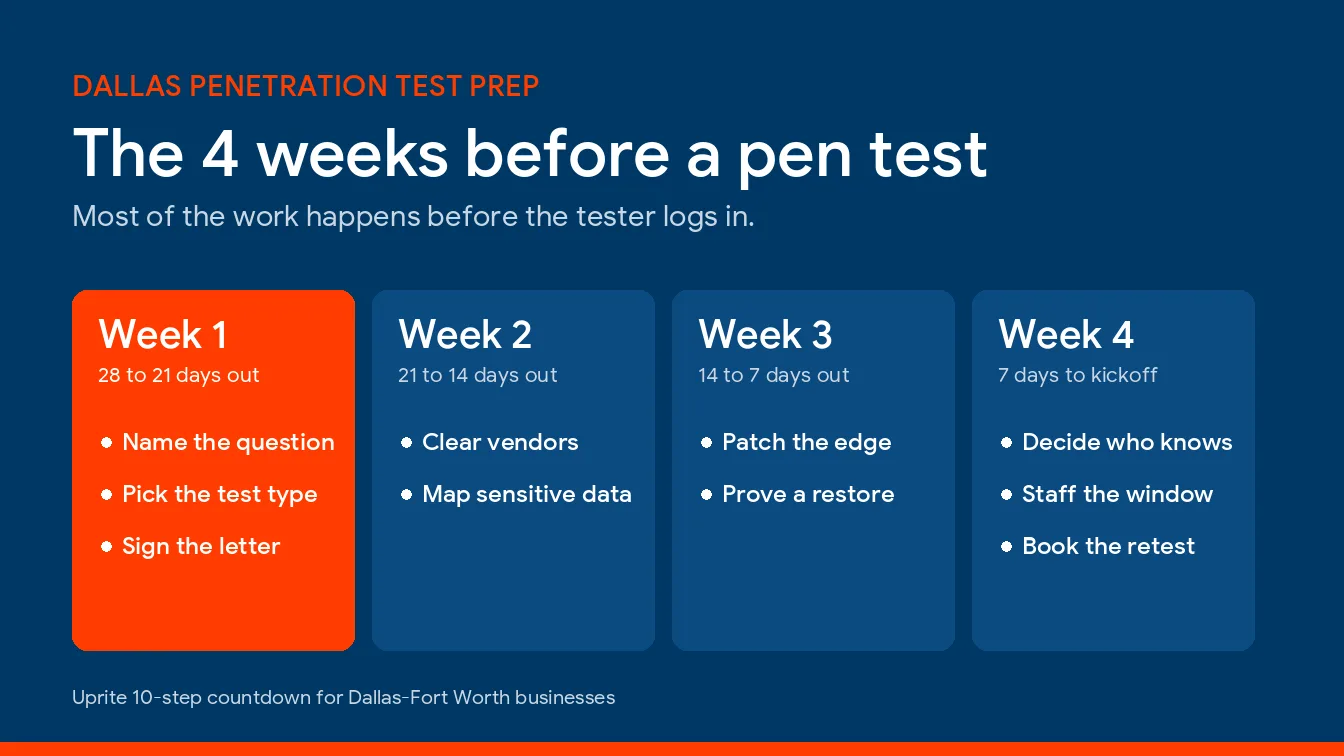
Cyber insurance doesn’t legally require a pen test. Travelers’ short form for companies with $50 million or less in revenue has no testing question at all, while its long form asks about annual pen testing and whether a third party does it. AXIS asks how often you test each kind of system and lists Never as an answer. Of the rules we checked, only the FTC Safeguards Rule requires an annual pen test today, for firms like tax preparers. If your carrier or that rule puts a test on the calendar, our pen test preparation checklist walks through the 4 weeks before it.
Does cyber insurance require a pen test?
A penetration test is a person, with your written permission, trying to break into your network or apps the way an attacker would and then writing down what worked. HHS described pen tests in its 2025 HIPAA proposal as tests that find weaknesses “by mimicking real-world attacks.” A vulnerability scan is different. It’s software that checks your systems against a list of known flaws, and nobody tries to get in.
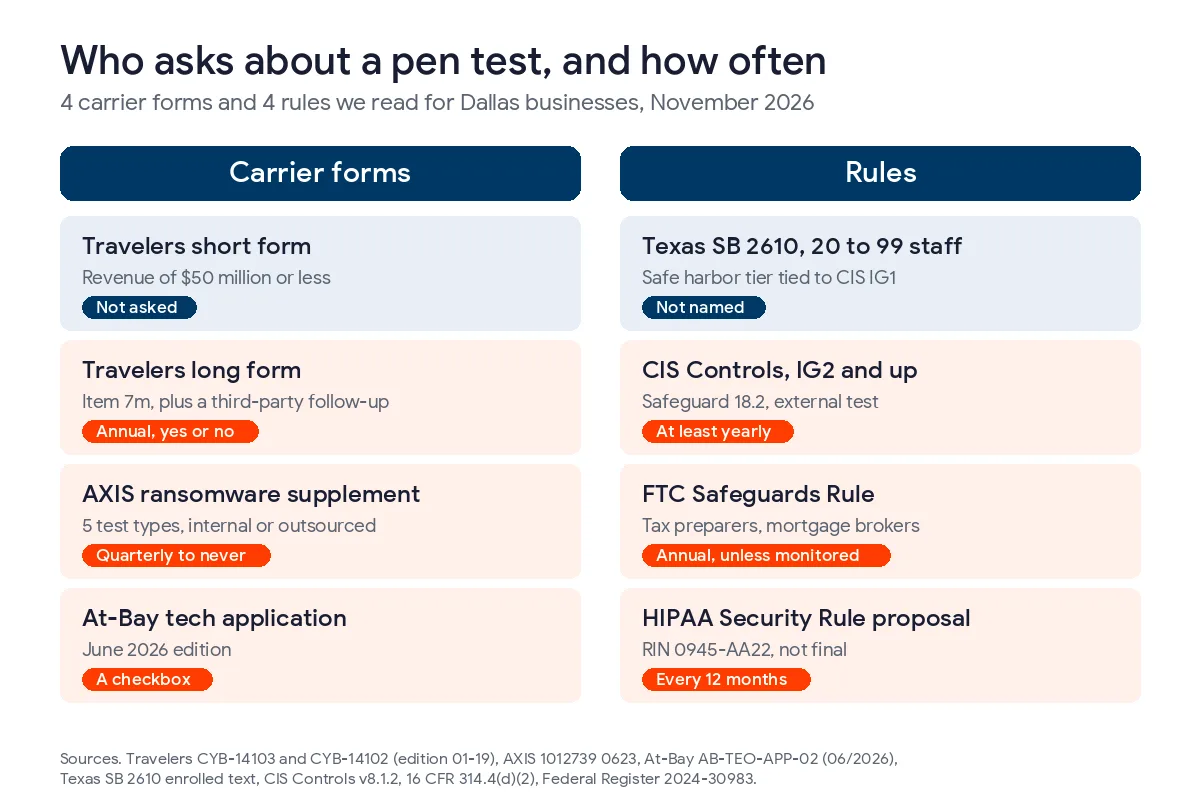
We found no Texas statute and no federal rule that makes a pen test a condition of buying a cyber policy. The carriers handle it through the application. Some forms ask a yes or no question, some ask for a frequency, and one form we read doesn’t ask at all. The table lists the wording we found.
| Form | Testing question as printed | How you answer |
|---|---|---|
| Travelers CyberRisk Short Form Application, CYB-14103, edition 01-19 | None. It lists 9 controls, from firewalls and patching to MFA on remote email, and none of them is a pen test | Not asked |
| Travelers CyberRisk Application, CYB-14102, edition 01-19 | “Annual penetration testing,” then “is such testing conducted by a third party service provider?” | Yes or no, twice |
| AXIS Cyber Ransomware Supplemental Application, 1012739 0623 | “The Applicant conducts regular penetration testing?” for external network, internal network, social engineering, physical, and web app testing | Quarterly, 2 times a year, annually, ad hoc, or never, plus internal or outsourced |
| At-Bay Technology and Cyber Insurance Application, AB-TEO-APP-02, June 2026 | “Regular Penetration Tests” is 1 of 5 boxes in a list of security controls, next to antivirus and MFA | Check the box or leave it blank |
Travelers posts both of its forms on its CyberRisk applications page. AXIS publishes the ransomware supplement as a PDF, and At-Bay hosts its technology and cyber application on its own site. Both Travelers forms still carry a January 2019 edition date, and the At-Bay form is written for technology companies. Your broker may hand you a newer version or a different carrier entirely, so check the form you actually sign.
Why might a smaller Dallas company never see the question?
Size changes the form. Travelers says its short form “will only be accepted for Applicants with revenues of $50,000,000 or less and assets of $500,000,000 or less.” Plenty of small and mid-sized companies in Dallas, Richardson, and Irving sit under that line. The short form asks about firewalls, antivirus, patching, backups, an incident response plan, a disaster recovery plan, vendor security, and MFA. It asks nothing about penetration testing.
The long form is where the question appears. Item 7m reads “Annual penetration testing,” and item 7n asks about annual network security assessments, each with a follow-up about whether an outside firm did the work. So 2 companies buying from the same carrier can face different questions because one of them crossed a revenue line.
The AXIS supplement goes further than either Travelers form. It splits testing into 5 types and asks for a frequency on each one. A company that only tests its outside network once a year would mark annually for external and never for the rest. That is a perfectly normal answer to give, and the form prints never as a choice.
What are you signing when you answer?
The signature page on the AXIS small business application has the applicant represent that “No facts or information material to the risk proposed for insurance have been misstated or concealed.” It also says that “Any policy the Insurer issues will be issued in reliance upon these representations.” In other words, the testing box you check is part of what the policy rests on.
That’s why we wouldn’t mark a pen test as done when the only thing that ran was a monthly scan. A carrier that finds the difference after a breach has a reason to dispute the claim. Our post on why cyber insurance claims get denied in DFW covers how application answers come back up at claim time. If the honest answer is no, write no. AXIS and Travelers both print it as an option.
Which Texas and federal rules actually name a pen test?
We checked 4 rules a Dallas business might fall under. Only 1 of them requires a pen test today.
| Rule | Does it name a pen test? | Who it reaches |
|---|---|---|
| Texas SB 2610, Business and Commerce Code chapter 542 | No. The bill text never uses the word. Its 20 to 99 employee tier points to CIS Implementation Group 1, which has no pen test safeguard | Texas businesses with fewer than 250 employees that hold sensitive personal information |
| CIS Controls v8.1, Control 18 | Yes, from Implementation Group 2 up. Safeguard 18.2 calls for an external test “no less than annually” | Anyone who adopts the framework at IG2 or IG3 |
| FTC Safeguards Rule, 16 CFR 314.4(d)(2) | Yes. Annual pen testing unless you have effective continuous monitoring | Non-bank financial firms such as tax preparers, mortgage brokers, and auto dealers that finance |
| HIPAA Security Rule proposal, January 2025 | Yes, at least once every 12 months, by a qualified person. Still a proposal | Covered entities and business associates, if HHS finalizes it |
The Texas piece is worth a closer look. SB 2610 took effect September 1, 2025, and it bars exemplary damages after a breach if the business had a qualifying cybersecurity program in place. For 20 to 99 employees, the program needs “the requirements of the Center for Internet Security Controls Implementation Group 1.” For 100 to 249 employees, it needs to conform to a full framework such as NIST or the CIS Controls. We read the CIS Control 18 safeguards in version 8.1.2. Safeguards 18.1 through 18.3 start at IG2, and 18.4 and 18.5 start at IG3. So a 60-person company in Plano can meet the IG1 tier without ever buying a pen test. Our Texas SB 2610 compliance checklist breaks down each tier.
The FTC rule is stricter. The text of 16 CFR 314.4(d)(2) says testing “shall include continuous monitoring or periodic penetration testing and vulnerability assessments.” If a firm lacks “effective continuous monitoring,” it has to run “annual penetration testing of your information systems” and vulnerability assessments “at least every six months.” The rule doesn’t spell out what effective monitoring looks like. A tax office in Garland that pays for 24/7 security monitoring should still ask whoever reviews its program whether that service counts.
The HIPAA change is the one healthcare offices keep asking us about. HHS published the proposal in the Federal Register on January 6, 2025. The proposed text reads “Penetration testing must be performed at least once every 12 months.” When we checked the Federal Register in November 2026, the proposal was still the only document filed under its regulation number, RIN 0945-AA22. There’s no final rule yet, so nothing in it binds a Dallas clinic today. PCI DSS also has its own testing schedule for businesses that store or process card data, which your payment processor or assessor can confirm.
What do North Texas breach filings show?
Texas law makes a business report a breach to the Attorney General when it affects 250 or more Texans, and the office posts those reports on its data breach reporting page. We pulled the list on November 9, 2026 and kept the reports posted between November 7, 2025 and November 6, 2026. That left 276 filings from Texas-based organizations. We then kept the ones based in Dallas, Fort Worth, and the surrounding cities. 87 of the 276 came from North Texas, which is a little under a third.
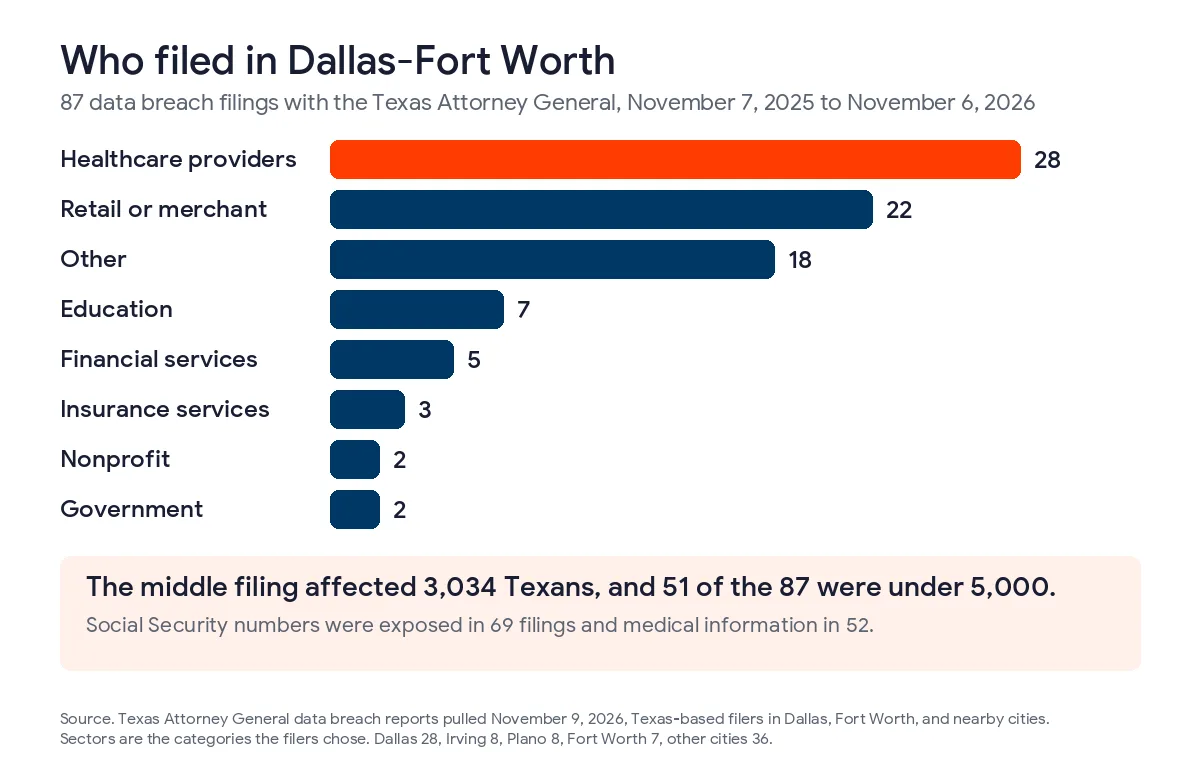
Healthcare providers filed 28 of the 87. Retail or merchant businesses filed 22, and 18 checked the Other box. Social Security numbers were exposed in 69 of the filings, and medical information turned up in 52. Dallas itself accounted for 28 reports, followed by Irving and Plano with 8 each and Fort Worth with 7.
Most of these weren’t big companies. The middle filing affected 3,034 Texans, and 51 of the 87 affected fewer than 5,000. At least 4 were law offices, filed under Other or Retail because the form has no legal category. Travelers also has a healthcare supplement that asks whether the applicant audits its HIPAA controls at least once a year and whether an outside firm does the audit. A Dallas clinic holding patient records should expect testing questions from more than one direction. If you don’t know what a test should even cover, a cybersecurity risk assessment in Dallas is a cheaper first step and tells you where to point a tester.
What should you hand your broker?
An underwriter wants dates and scope, not a 90-page report. If you’ve had a test, a short packet for the broker works better, and we’d put 4 items in it.
- The carrier form and the exact question number you’re answering, so nobody guesses which version you signed.
- The signed scope from the tester, with the systems tested and the test dates.
- A one-page summary of findings ranked by severity, with an owner and due date for each fix.
- Retest results showing the serious findings were closed.

If you’ve never had a test, the packet changes. Send your last 2 scan reports with dates, a note on where MFA is turned on, the last time you restored a backup as a drill, and the month you plan to test. To budget for that month, see our breakdown of pen test costs in Dallas. Our cyber insurance renewal checklist for DFW businesses covers the rest of the questionnaire, and our comparison of pen testing and vulnerability scanning explains what each report can and can’t prove.
Our honest view is that a pen test is a poor first purchase for a company that hasn’t put MFA on email and remote access or tested a restore. A tester will find those gaps early, and you’ll pay for days of work to learn what a checklist already told you. Fix those, then test. If your form asks the question and you want a straight answer on what you need, send us the form and your last scan. Our cyber insurance readiness service for Dallas-Fort Worth handles the full application if you’d rather hand it off.
Questions Dallas businesses ask about pen tests and cyber insurance
Do Texas businesses need a pen test to get cyber insurance?
No. We read 7 forms from Travelers, AXIS, and At-Bay, and none makes a pen test a condition of coverage. The Travelers short form for companies with $50 million or less in revenue doesn’t ask about testing at all.
Is a vulnerability scan good enough to answer yes?
Not when the form says penetration testing. Travelers lists annual pen testing and annual network security assessments as separate items, and AXIS asks for internal and external scan frequency in one section and pen testing in the next. Answer each one with the work you actually did.
Does SB 2610 make Texas companies run pen tests?
No. The law never mentions pen testing. Businesses with 20 to 99 employees qualify for its safe harbor at CIS Implementation Group 1, which has no pen test safeguard. Testing enters at IG2, which some companies with 100 to 249 employees may pick as their framework.
Which Dallas businesses have a legal testing requirement right now?
Firms under the FTC Safeguards Rule, such as tax preparers and mortgage brokers, need an annual pen test unless they run effective continuous monitoring. Businesses that take cards follow PCI DSS. The HIPAA testing rule for medical offices is still only a proposal.
Will a pen test lower my cyber insurance premium?
Nothing we read says so. The 7 forms ask whether you test, and none of them prints a credit or a discount next to the question. Your broker can tell you whether the carrier quoting you prices it in, and that’s worth asking before you buy a test for the premium alone.
What happens if I answer no?
AXIS prints never as one of its frequency choices, and Travelers gives a plain yes or no box, so the forms expect some people to say no. What the underwriter does with that answer isn’t written anywhere we looked. We’d send dated scans, a note on MFA, and the date of your last backup restore along with it.
Send us the testing question from your cyber insurance form and your most recent scan. We’ll tell you whether you need a pen test, a scan, or neither before renewal.
Talk to a security expert