A penetration test for a Dallas-Fort Worth business usually costs about $3,750 to $18,750 in 2026. That range is 3 to 15 tester-days at $156.20 an hour, which is the median of 442 federal ceiling rates for penetration testers.
We built that range from public data, and it isn’t our price list. Uprite runs pen tests and quotes each one by scope, so your number comes from your systems. This guide sticks to cost. What the work covers is on our penetration testing in Dallas page. Every figure below links to a source you can check, and the planning days are our own assumptions, labeled as such.
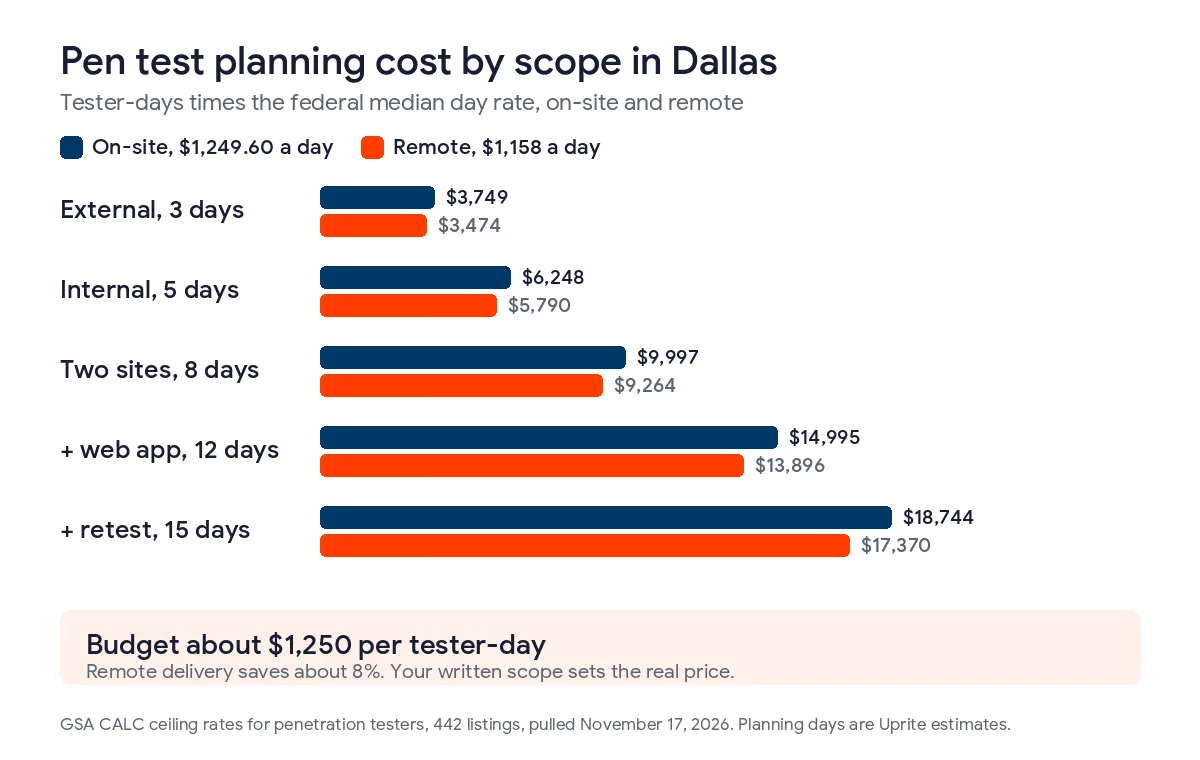
Plan on roughly $1,250 for each day a tester works on-site, or about $1,160 for remote days. A small external test takes about 3 days, two DFW offices about 8, and a web portal plus a retest pushes it to 15. CMMC Level 2 doesn’t require a pen test. A yearly test can be required by FTC rules for financial firms or by PCI DSS for card merchants, and Texas SB 2610 only gets there at the 100-employee tier.
What does a penetration test cost in Dallas in 2026?
Think of a penetration test as a break-in you hire and sign off on in advance. A tester tries to get into your network or application the way an attacker would, then writes up how far they got and how to close the gaps. The price is days of tester time multiplied by a day rate, so we priced both.
For the rate we used GSA’s CALC database, which lists the hourly ceilings vendors agreed to for federal work. We pulled every penetration tester rate on November 16, 2026. Their median came out to $156.20, or $1,249.60 for an 8-hour day. The 54 rates for virtual work have a lower median of $144.75, which is $1,158 a day. Below, both rates are applied to 5 scopes we see often in North Texas.
| Scope | Planning days | On-site at the median rate | Remote at the virtual median |
|---|---|---|---|
| External test of a small internet footprint | 3 | About $3,750 | About $3,450 |
| Internal test of one office | 5 | About $6,250 | About $5,800 |
| External plus internal across two DFW sites | 8 | About $10,000 | About $9,250 |
| Network plus one customer portal or web app | 12 | About $15,000 | About $13,900 |
| All of the above, then a retest once fixes are in | 15 | About $18,750 | About $17,350 |
The planning days are our estimates for companies with 20 to 200 employees. A real quote starts from a scope document listing your addresses, offices and applications, and that document sets the final number. Its job is to give your CFO a planning figure before any vendor gets involved.
Why do we price from federal tester rates?
No public source lists what Dallas pen testing firms charge private clients. CALC is the largest public set of actual tester rates we could find, with 442 listings from 143 vendors. Half of the rates fall between $125.82 and $195.19 an hour. Rates run from $57.34 at the bottom to $320.56 at the top. You can check any of them in GSA’s pricing tool.
We cut the data a few ways that matter to a Dallas buyer, and some of the results surprised us. Vendor size barely moves the price. The 310 rates from small businesses have a median of $155.43, and the 132 from larger firms come in at $157.03, so a big name doesn’t automatically mean a higher rate. Where the tester works matters more. Work at the customer’s site has a median of $157.40, and virtual work has a median of $144.75, about 8% lower.
Experience moves the rate the most. Junior testers, with 0 to 3 years listed, sit at a $133.43 median, and testers with 8 or more years sit at $192.97. A test staffed by senior people can cost 45% more for the same number of days, so ask who will do the hands-on work and get that name in the quote. The 19 listings that require a security clearance have a median of $173.53, which matters if you’re a defense supplier asked to use cleared staff.
Waiting won’t lower the price either. The next-year ceiling in the same listings has a median of $159.78, and the typical increase is 2.9%. If you push the same test into 2027, plan on about 3% more.
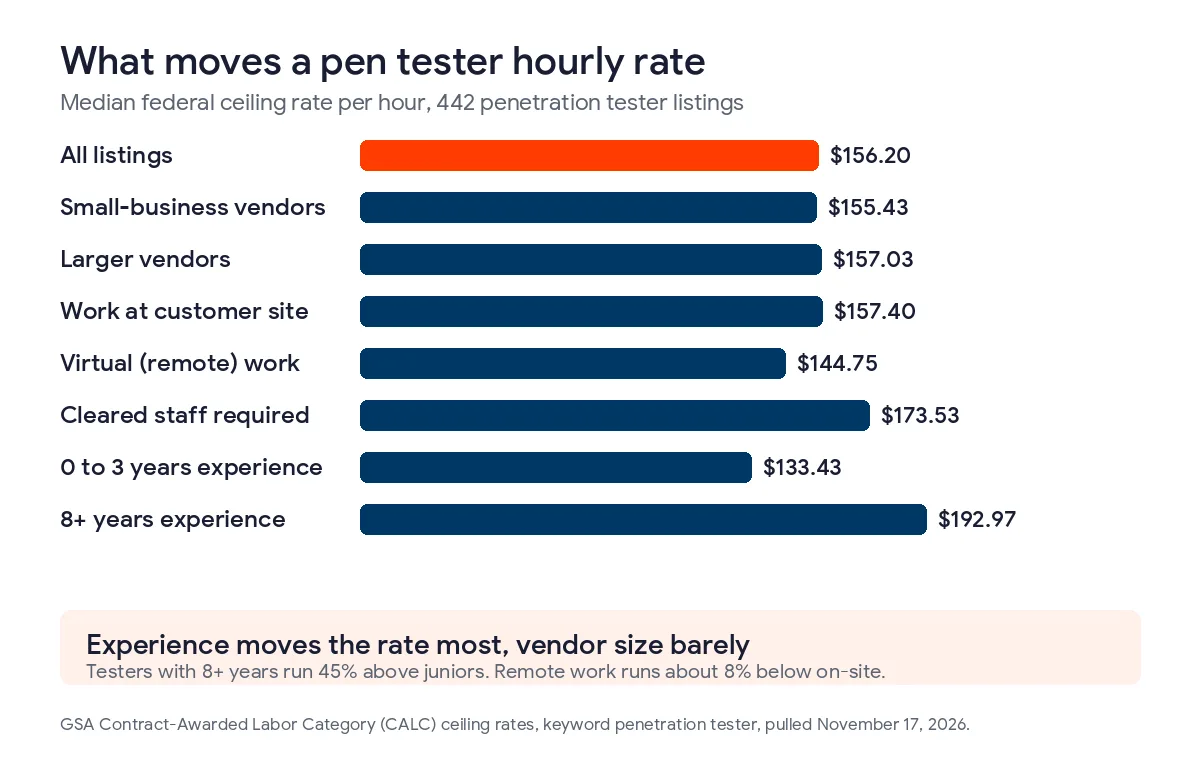
These are federal ceilings, so a private client can pay less and a small boutique can charge more. We still think they’re the most honest public yardstick available.
Is it cheaper to hire a security analyst in Dallas?
For a test, usually not. BLS counts 7,080 information security analysts in the Dallas-Fort Worth-Arlington metro, with a mean wage of $64.32 an hour or $133,790 a year, according to its Occupational Employment and Wage Statistics for May 2025. Add benefits at the 43% rate in the BLS Employer Costs for Employee Compensation data and one analyst costs roughly $191,300 a year.
A full 15-day test at the median rate is about $18,750, close to 10% of that loaded salary. They’re also different jobs. An analyst spends the year defending your network, and a tester spends a few days attacking it from the outside. Most companies with 20 to 200 people need the outside view once a year and the defense all year. You also want the person testing your controls to be someone other than the person who built them.
Which rules make a Dallas business buy a pen test?
Texas doesn’t require private companies to pen test. A federal rule, the card industry, a defense contract or an insurer might. The table shows the ones we see most often in DFW, including two that people often think require a test but don’t.
| Rule or trigger | Does it require a pen test | Who it reaches in DFW |
|---|---|---|
| FTC Safeguards Rule, 16 CFR 314.4(d)(2) | Yes, once a year with a vulnerability assessment each half-year, or neither if you run effective continuous monitoring | CPA practices, mortgage brokers, auto dealers, tax preparers and other non-bank financial firms |
| FTC small-firm exception, 16 CFR 314.6 | No, the testing clause doesn’t apply | Financial firms with customer information on under 5,000 consumers |
| PCI DSS v4.0.1, Requirement 11.4 | Yes, internal and external testing at least every 12 months and after significant changes | Businesses in scope for card data, depending on how they take payments |
| CMMC Level 2 | No, it matches NIST SP 800-171 R2, which calls for vulnerability scanning | Most defense suppliers that handle controlled unclassified information |
| CMMC Level 3, CA.L3-3.12.1e | Yes, at least annually or after significant security changes | A small set of contracts with the most sensitive defense data |
| Texas SB 2610, 20 to 99 employees | No, the CIS Controls IG1 safeguards include no penetration testing | Texas firms under 250 employees that want the punitive damages safe harbor |
| Texas SB 2610, 100 to 249 employees | Depends on the framework you pick, and CIS IG2 adds external pen testing | The same firms at the larger headcount tier |
Fort Worth and Grand Prairie defense suppliers ask us about the CMMC rows the most. Under 32 CFR 170.14, Level 2 is identical to NIST SP 800-171 R2. That standard asks you to scan for vulnerabilities, and it doesn’t ask for a penetration test. The pen test requirement appears at Level 3, in requirement CA.L3-3.12.1e. If someone tells you a Level 2 assessment needs a pen test, ask them to point to the clause. A prime contractor can still require one in your subcontract, so read your flow-down terms. Where Level 2 stands right now is on our CMMC compliance in Dallas page.
The SB 2610 rows confuse people for a different reason. Chapter 542 of the Texas Business and Commerce Code ties the safe harbor to headcount. A firm with 20 to 99 employees has to follow the CIS Controls Implementation Group 1 safeguards, and the CIS Controls put penetration testing in Control 18, which starts at Implementation Group 2. A 60-person firm can qualify without a pen test. Our Texas SB 2610 compliance guide goes through all three tiers.
You’ll find the FTC rule text in 16 CFR 314.4, and section 314.6 holds the small-firm carve-out. The PCI Security Standards Council writes the card testing standard, and the bank that processes your cards sets the evidence it accepts. We aren’t lawyers, so confirm where you fall with yours. Insurers are a separate source of requests. If a renewal form asked about testing, our guide to cyber insurance requirements in Dallas covers what carriers usually accept.
What does a breach cost compared with a test?
Texas law gives a company 30 days to report a breach involving 250 or more Texans to the Attorney General, who posts every report on a public data breach report list. We pulled that list on November 6, 2026 and kept the 85 notices from organizations with a DFW address, filed from April 2025 through early November 2026. Dallas had 29 of them, and Irving and Plano had 8 each. Healthcare providers filed 28, the largest group.
What stood out to us were the dates. In the 75 notices that listed both a start date and a discovery date, the median gap was 81 days. For nearly 3 months, someone was inside and nobody noticed. A pen test is the cheapest way to find the opening yourself, before an attacker does.
What raises or lowers a Dallas pen test quote?
Scope accounts for almost all of the difference between quotes. One vendor may have priced 10 systems while another priced 40, so check that two quotes cover the same job before you compare totals. These are the drivers we see move DFW quotes the most.
- How many public IP addresses and internet-facing systems are in scope, because every one needs its own discovery and testing hours.
- Where the tester begins, outside the network, inside it, or in both places.
- How many offices are in scope, because a Dallas headquarters and a Fort Worth yard on separate networks add days.
- Customer portals and custom web apps, which take far longer than a firewall.
- Remote versus on-site delivery, worth about 8% in the federal rate data.
- Retest terms, meaning a retest priced into the first quote or billed later as a second visit.
The office count raises DFW quotes more often than people expect. Many companies here grew by opening a second site across the metroplex, often with its own firewall and its own forgotten server. Remote testing helps with this. A small appliance shipped to each site lets the tester work inside both networks without driving I-30 twice. We schedule around month-end close and payroll week so the test doesn’t collide with your busiest days.
How do Dallas companies cut the cost of a pen test?
Do the cheap work before the expensive work. If a tester bills $1,250 a day to confirm a missing patch your own scanner flagged last month, you’ve paid test rates for a scan. The cheaper order is to inventory your devices, scan them, fix what the scan finds, and then pay a tester to look for what’s left.
None of those steps costs as much as a day of testing. We run a free network assessment that produces a device list with ranked findings. Our cybersecurity risk assessment in Dallas decides which systems belong in scope at all. Ongoing scanning comes with managed security services in Dallas, starting at $40 per user per month, and every plan is listed on our pricing page. If you’re a critical infrastructure operator, CISA’s Cyber Hygiene services will scan your internet-facing systems for free.

A quote under $1,000 is almost certainly a vulnerability scan, since that’s less than one tester-day at the median. We sell scans too, and they’re worth having, but a scan only lists known weaknesses while a test shows what an attacker could do with them. Our comparison of penetration testing vs vulnerability scanning explains which one to buy first. If a quote names no tester, lists no hours and describes no method, treat it as a scan.
Retests are the line item people forget. A finding isn’t closed until someone confirms the fix worked, and a separate visit 3 months later usually costs more than building it into the first quote. For the rest of the security budget, see our cybersecurity cost guide for Dallas. Our Houston version of this guide runs the same math on Houston wages.
What belongs in a Dallas pen test proposal?
Before you sign a proposal, check it for the 7 items below. If one is missing, ask the vendor for a revised proposal in writing.
- Every target in scope, including IP addresses, applications and offices, plus every system that’s excluded
- The testing window and hours, and an emergency contact at both companies
- Who the tester is and how many years they’ve done this work
- The testing method, mapped to a public standard like NIST SP 800-115
- An example report from a past engagement, with client details removed
- Retest terms, including how long after the report you can still use it
- Written permission to test, signed by the person who owns the systems
Ask every provider about independence, including us. When the company that runs your IT also tests it, that company is grading its own work. Some of our clients use us for both, so we keep the tester separate from the team that manages the network and quote scanning and testing as separate purchases.
Questions DFW companies ask about pen test budgets
How much does a penetration test cost in Dallas?
Expect $3,750 to $18,750 in 2026, based on 3 to 15 tester-days at a $156.20 hourly median. An external-only test of a small footprint costs the least. Two offices, a web portal and a retest push it toward the top, and your written scope sets the actual price.
Is a remote penetration test cheaper than an on-site one?
Usually, by about 8%. Virtual work in GSA’s CALC data has a median of $144.75 an hour, compared with $157.40 for work at the customer’s site. Internal testing can still be done remotely with a small appliance plugged into each office network.
Does CMMC Level 2 require a penetration test?
No. Under 32 CFR 170.14, Level 2 matches NIST SP 800-171 R2, which requires vulnerability scanning but not penetration testing. The annual pen test appears at Level 3 as requirement CA.L3-3.12.1e. Your prime contractor can still require one in the subcontract, so check your flow-down clauses.
Do we need a pen test to qualify for the Texas SB 2610 safe harbor?
Not at the 20 to 99 employee tier, because CIS Controls IG1 has no penetration testing safeguards. Firms with 100 to 249 employees need full conformance with a framework they choose, and CIS IG2 does include external testing. Firms under 20 employees follow the lighter statutory list.
What does a retest usually cost?
We plan 1 to 3 days for a retest, which is about $1,250 to $3,750 at the median rate. That’s our own estimate, not a published figure. It costs less when it’s in the original quote and the same tester comes back, because they already know your network.
Does Uprite perform penetration tests in Dallas?
Yes. Our team performs the testing, and each engagement is priced from its own scope. Before the test we help define targets and prepare your staff, and afterward we turn the findings into a remediation list and follow it to closure. If we already run your IT, we’ll explain how the tester stays separate from your support team.
Did an insurer, a prime contractor or an auditor ask you for a pen test? Send us the request. We’ll reply in writing with whether you’re ready for a test, what to clean up first and how we’d scope it. On average we respond within 5 minutes.
Talk to a Security ExpertWould a phone call be easier? Leave your number on our contact page.