A vulnerability scan is software that lists the known flaws on your systems, while a penetration test is a person with written permission trying to break in, and most Dallas businesses should scan first.
We sell and run both for clients across Dallas, and we get the same question every renewal season. An insurer, a bank, or a big customer sends a form that asks for a “pen test,” and the owner wants to know whether a scan will do. Scanning is part of our cybersecurity services in Dallas from $40 per user per month. Penetration testing in Dallas is quoted separately because it is mostly a person’s time. Our penetration testing cost guide for Dallas shows how those hours add up.
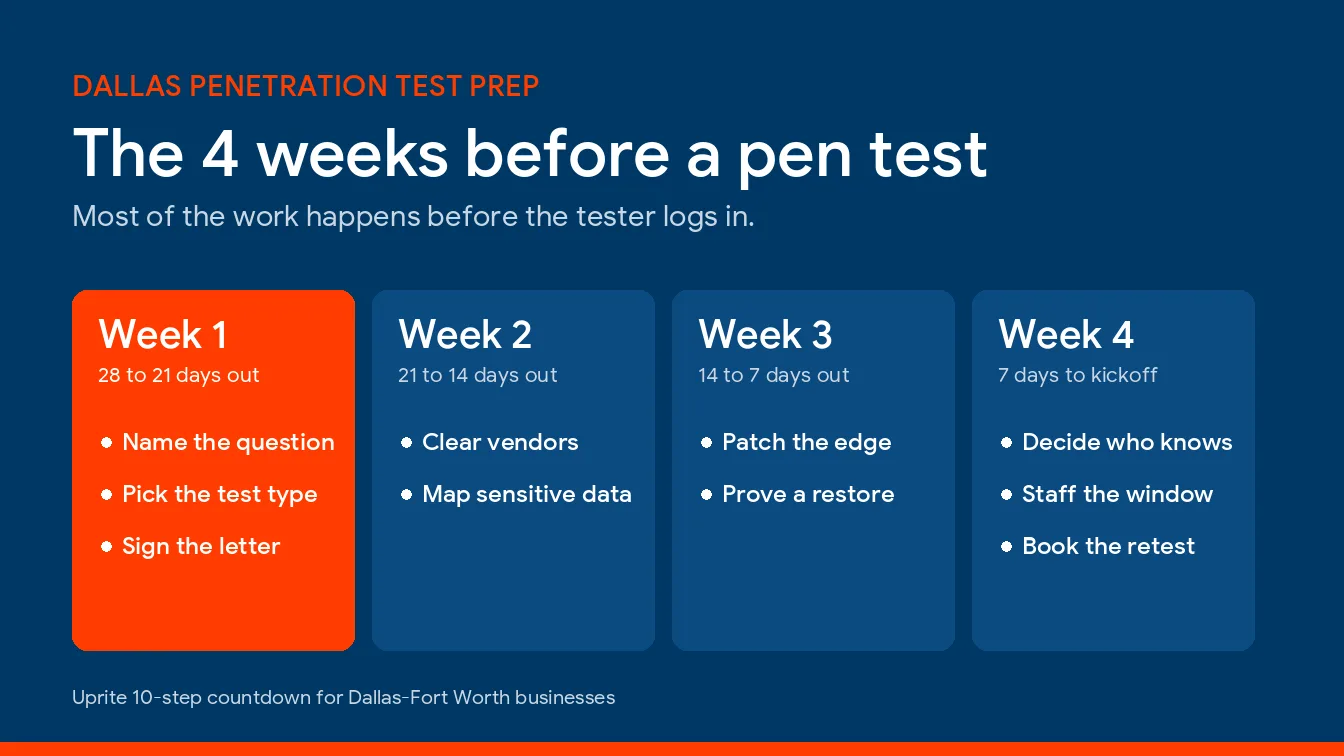
Scans are cheap, frequent, and automated, and they catch flaws that already have a public CVE number. Penetration tests cost thousands because a tester spends days trying to get in. Dallas firms with no recent inventory should start with a scan or a free network assessment. Buy a test when the FTC Safeguards Rule, PCI DSS, an insurer, or a customer contract asks for one, and ask who will actually do the testing. Once you have booked one, use our checklist for how to prepare for a penetration test.
What is the difference between a penetration test and a vulnerability scan?
A vulnerability scan checks your devices, servers, and websites against databases of published flaws and gives you a ranked list of what needs patching. A penetration test starts where the scan stops. A tester with a signed scope tries to use those flaws, plus weak passwords and loose permissions, to show how far a real intruder could get.
NIST describes both in SP 800-115, the Technical Guide to Information Security Testing and Assessment. Scanning is in the chapter on finding and identifying targets. Penetration testing is in the chapter on validating vulnerabilities, and NIST lays it out in 4 phases that run from planning through discovery and attack to the final report.
| Question | Vulnerability scan | Penetration test |
|---|---|---|
| Who does the work? | Scanning software, reviewed by an analyst | A named tester working from a written scope |
| What does it prove? | That a known flaw is present | Whether the flaw can be used and what it leads to |
| How often? | Monthly, quarterly, or continuously | Once a year or after a major change |
| What do you get? | A long list sorted by severity | A written attack story with fixes in priority order |
| What does it cost in Dallas? | Included in our security plans from $40 per user per month | Usually $3,700 to $18,700 depending on scope |
Our pricing page lists the plan rates. If you’re building a full security budget, our guide to cybersecurity costs in Dallas shows where scanning and testing sit next to monitoring, backup, and training.
What did the City of Dallas attack show about testing?
It showed that a recent penetration test doesn’t stop an attacker who logs in with a valid account. The city’s own after-action report on the May 2023 ransomware attack says that in February 2023 the city finished a 2-week penetration test with CISA. The report calls it a Red Team exercise and says it looked at the network from outside and inside.
On April 7, 2023, the Royal ransomware group got in through a city service account that connected to a server. The report says the group then moved around for about 4 weeks using legitimate remote management tools and took data before it launched the ransomware on May 3. The city later budgeted $8.5 million for recovery.
We don’t read that as a failed test. A penetration test describes the network on the days the tester was working. A stolen service account password has no CVE number, so no scanner would have flagged it either. What catches that kind of entry is monitoring of sign-ins and unusual tool use, which is a separate service from both scanning and testing. We compare the options in our post on MDR vs EDR for Dallas businesses.
Why does a scanner still find so much?
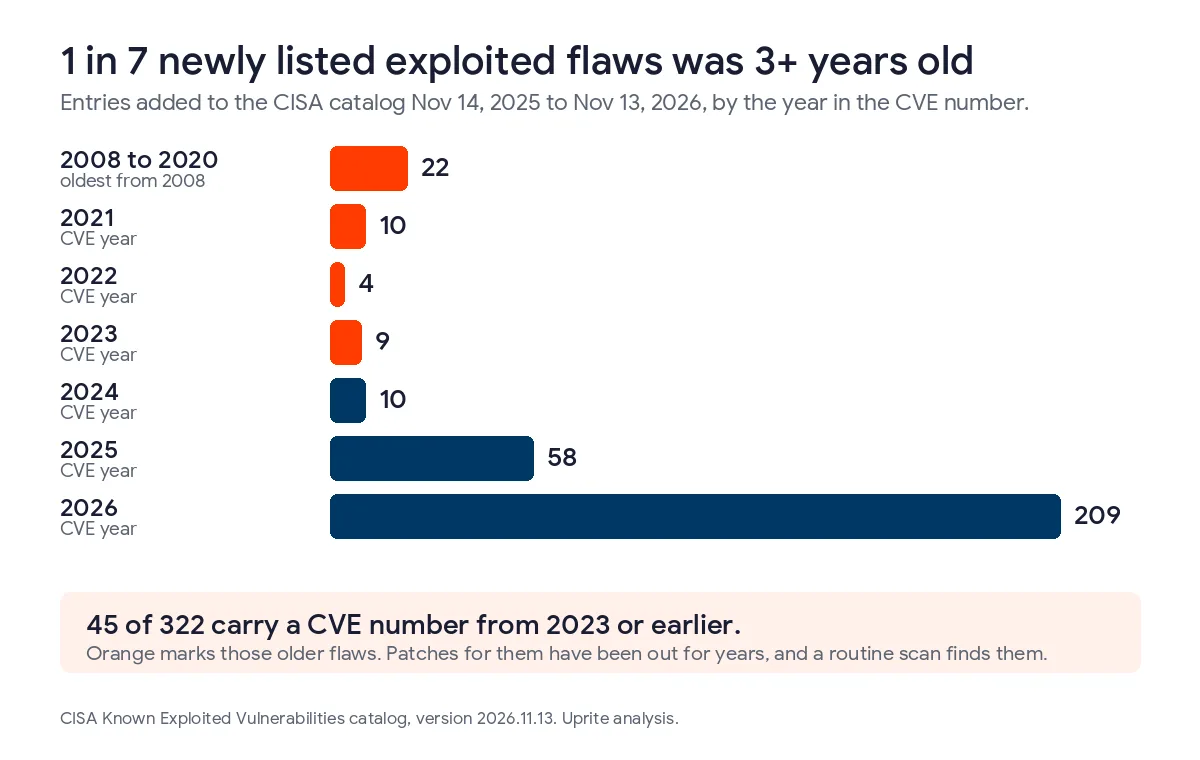
Because old flaws keep getting used. CISA publishes the Known Exploited Vulnerabilities catalog, a list of flaws that attackers are confirmed to be using. We pulled version 2026.11.13 on November 16, 2026. It has 1,781 entries, and 322 were added between November 14, 2025 and November 13, 2026.
We sorted those 322 by the year in each CVE number. 209 were from 2026 and 58 from 2025, which is what you’d expect. But 45 of them, or 14%, carried a CVE number from 2023 or earlier. 22 were from 2020 or earlier, and the oldest dated to 2008. Those are flaws with patches that have been out for years, and a basic scan finds them on the first run.
The vendor list looks a lot like a typical Dallas office. Microsoft accounted for 42 of the 322, Cisco for 22, and Fortinet for 12. We counted 90 entries, about 28%, in firewalls, VPN gateways, remote access tools, and file transfer servers from vendors such as Fortinet, Ivanti, SonicWall, Citrix, and Palo Alto Networks. Those devices face the internet, so an external scan sees them the same way an attacker does.
Verizon’s 2026 Data Breach Investigations Report found that exploited vulnerabilities started 31% of breaches, the largest share of any entry point, while credential abuse started 13%. Scanning works on the first group. The second group is closer to what happened at the city, and it’s where a tester or a monitoring team earns the money.
Which one should a Dallas business buy first?
That depends on your size and who regulates you. We used the Bureau of Labor Statistics Quarterly Census of Employment and Wages for Dallas County in 2025. It counts 2,188 law offices with an average of 9.3 employees, 1,544 dental offices with 7.1, and 2,737 physician offices with 14.0. Offices that size usually don’t have anyone whose job is the network. For them we’d start with our free network assessment, which builds the device list a scan or a test needs anyway.
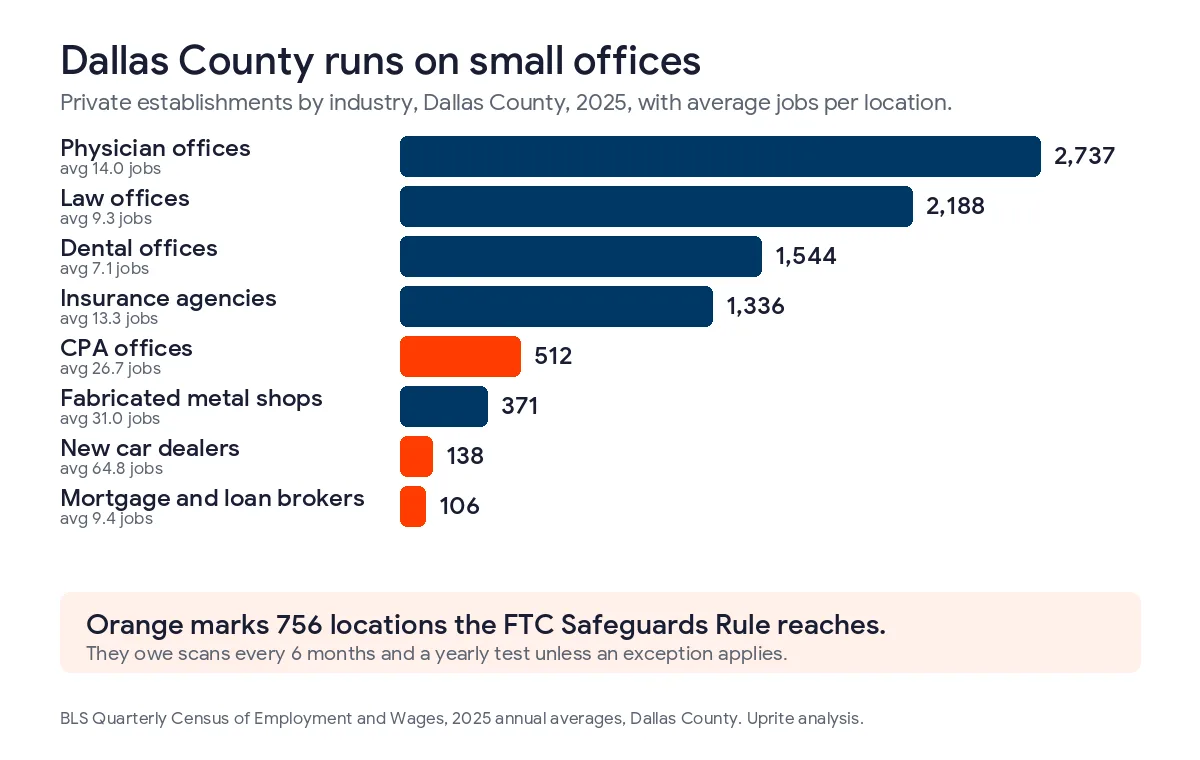
The same data shows 512 CPA offices, 138 new car dealers, and 106 mortgage and loan brokers in the county. That’s 756 locations in businesses the FTC Safeguards Rule covers, through tax preparation, auto financing, and lending. The rule expects vulnerability assessments at least every 6 months and a penetration test every year, unless the firm runs continuous monitoring or holds data on fewer than 5,000 consumers. Our guide for Dallas financial services firms covers the rest of that rule.
Manufacturers are a different case. Dallas County has 371 fabricated metal shops averaging 31 employees and 271 computer and electronics plants averaging 97. Many of them have machines on the same network as the office. We scan those networks with a list of controllers to leave alone and test the office side after the shift ends. Defense suppliers should also read our page on CMMC compliance in Dallas, because NIST SP 800-171 asks for periodic scanning but not a penetration test.
The Texas Attorney General’s data breach list shows who is getting hit. Between November 7, 2025 and November 6, 2026 it posted 68 notices from organizations in the Dallas area. 38 of them covered fewer than 5,000 Texans, and 23 came from medical providers. Most of them were ordinary local businesses, not big companies.
Which rules ask for a scan, a test, or both?
Several do, but we haven’t found a Texas law that makes a private company buy a penetration test. The requirement usually comes from a federal rule, the card brands, or a contract.
| Rule | Scanning | Penetration testing |
|---|---|---|
| FTC Safeguards Rule, 16 CFR 314.4(d)(2) | At least every 6 months | Every year, unless continuous monitoring is in place |
| PCI DSS v4.0.1, Requirement 11 | Every 3 months, internal and external | Every 12 months and after significant changes |
| NIST SP 800-171 Rev 2, control 3.11.2 | Periodically and when new flaws appear | Not required by the control |
| HIPAA Security Rule | Every 6 months in the proposed rule | Yearly in the proposed rule |
| Texas SB 2610 | No set interval | Not required |
The FTC text is in 16 CFR 314.4, and the small-firm exemption is in section 314.6. Counting your consumer records is worth doing before you pay for a test. That’s our reading of the rule, and your attorney should confirm it for your firm.
Card rules come from the PCI Security Standards Council, and your payment processor decides what proof it will accept. The HIPAA intervals are only in the January 2025 proposed rule, and a McDermott client alert reports that final action is now projected for July 2027.
Senate Bill 2610 protects Texas businesses with fewer than 250 employees from punitive damages after a breach if they kept a qualifying security program. For firms with 20 to 99 employees the program has to include the CIS Controls Implementation Group 1, and firms with 100 to 249 have to follow a recognized framework such as the NIST Cybersecurity Framework. Neither tier names a penetration test. Regular scanning is one of the easiest ways to show the program was real, and our SB 2610 compliance guide explains the tiers.
How can you tell a real penetration test quote from a relabeled scan?
Look at the hours. GSA’s federal labor rate data put the median penetration tester rate at $155.78 an hour when we checked it in November 2026. At that rate a $1,000 quote pays for about 6 hours, which isn’t enough to plan, test, and write up even a small office. Our range of $3,700 to $18,700 covers 3 to 15 tester days.
A real quote names the tester, lists the systems in scope and the ones left out, says whether a retest is included, and shows a sample report. The sample should read like a sequence of steps from the first foothold to the furthest point reached. If it reads like a spreadsheet of CVE numbers with severity colors, you are looking at scanner output.
Ask who signs the authorization letter, too. It has to be someone who owns the systems, and if a cloud provider or landlord owns part of the network they may need to approve it. If the company that manages your network also offers to test it, ask how the tester is kept separate from the people who set things up.
What order works best for a Dallas business?
We use the same order for almost every client because it keeps the expensive part focused on things software can’t find.
- List every device, server, website, and cloud account, including the old machines in the back room and the laptops that only connect from home.
- Run internal and external scans at least every quarter, or every month if you can keep up with the fixes.
- Patch or remove what the scans find, starting with anything that appears in CISA’s catalog.
- Book the penetration test once the scan results are mostly clean, and scope it to what your regulator, insurer, or customer asked for.
- Have the tester retest the fixes and keep the retest letter with the report.
Timing matters in practice. We don’t schedule tests for CPA clients in the weeks before a tax deadline, and we avoid month-end close for anyone in finance. An office move or a new line-of-business system changes the network enough that you should scan again before anyone tests.
Uprite has supported Texas businesses since 1999, and our bias is toward scanning first. That isn’t the right call for every firm. If you already scan monthly, someone owns the fix list, and an insurer wants a report by a deadline, go straight to the test. If the request came from your carrier, our guide on whether cyber insurance requires a pen test in Dallas covers what the renewal form is really asking. Our cyber insurance readiness guide for Dallas-Fort Worth shows what carriers tend to ask for, and our cybersecurity risk assessment guide for Dallas covers the paperwork that usually comes first. For the Texas-wide version of this topic, see penetration testing vs vulnerability scanning for Texas small businesses.

What Dallas owners ask before they buy
Can a vulnerability scan replace a penetration test?
Not when a rule or contract asks for a test by name. A scan reports known flaws, and a test shows what a person can do with them. The FTC Safeguards Rule and PCI DSS treat them as separate requirements with separate intervals.
How often should a Dallas business scan for vulnerabilities?
Every quarter at minimum, and monthly if you have the staff to fix what turns up. PCI DSS sets the quarterly floor for card data and the FTC rule sets 6 months for covered financial firms. Old flaws keep appearing in CISA’s catalog, and frequent scans are how you catch them.
What does a penetration test cost in Dallas?
Most small and mid-sized Dallas firms should plan for roughly $3,700 to $18,700. That’s 3 to 15 tester days at the $155.78 median federal rate. An external-only test of a small office sits near the bottom of the range, while internal, external, and web application work with a retest lands near the top.
Did the City of Dallas have a penetration test before its 2023 ransomware attack?
Yes. The city’s after-action report says it finished a 2-week penetration test with CISA in February 2023, and Royal got in about 2 months later through a service account. A test only covers the days it runs, so sign-in monitoring still matters.
Is a $1,000 penetration test worth buying?
Usually not as a penetration test. At $155.78 an hour that price covers about 6 hours of work, so you are most likely buying an automated scan with a different name on the report. It may still be a fine scan. Ask for a sample report and the tester’s name before you decide.
Does Uprite do both scanning and penetration testing in Dallas?
Yes. Scanning runs inside our security plans, and we perform penetration tests ourselves as separately quoted projects. We’ll write the scope, fix known gaps before the test starts, and track the findings until the retest closes them. If we already manage your network, we’ll explain how the tester stays independent.
Send us the form or email that’s asking for a test, from your insurer, auditor, or customer. We’ll tell you in writing whether a scan covers it or you need a penetration test, what to fix first, and what a sensible scope looks like. Our average first response time is 5 minutes.
Talk to a Security ExpertIf you’d rather call or email, go to our contact page. If you want ongoing monitoring along with the testing, take a look at managed security services in Dallas.