Most Dallas title and mortgage companies should budget $150 to $250 per user per month for managed IT in 2026, which works out to about $1,225 to $1,750 a month for a typical 7-person title office.
Microsoft licensing, the yearly penetration test, and long-term file storage are billed on top of that. I’m the CTO at Uprite, and when we scope IT services for title companies in Dallas, the seat count is the easy part of the quote. The harder question is whether the office is above or below 5,000 consumers under the FTC Safeguards Rule, because that one number decides whether a written risk assessment, an annual penetration test, and scans every 6 months are required. This guide prices a title or mortgage office from federal pay data for Dallas County, the federal rule text, and the Texas record rules that set how long closed files have to be kept.
The average title and settlement office in Dallas County had about 7 employees in 2025, and those employees earned an average of $108,715 a year. At $175 to $250 a seat, managed IT for that office runs $1,225 to $1,750 a month. An office that holds customer information on 5,000 or more consumers also owes an annual penetration test and a written risk assessment, which adds roughly $6,560 to $10,110 a year at the low end of Dallas scope. Most active title offices cross that line within a few years, because Texas makes them keep escrow records for 3 years and insurability files for 15.
How much does IT cost a Dallas title company per month?
Title company IT cost is the monthly price of supporting every person in the office, including escrow officers, closers, examiners, and front desk staff, plus the yearly security work that federal rules add for companies handling consumer financial data. In Dallas in 2026 that monthly price usually lands between $150 and $250 per user.
We set the range from our own pricing and our Texas MSP pricing index, which puts most Dallas-Fort Worth businesses between $150 and $175 per user before any compliance work. Our Fully Managed IT plan is published at $138 per user on the Uprite pricing page. A title office sits above the general market because it falls under the FTC Safeguards Rule, and the extra documentation and testing take real hours each year. Our guide to GLBA compliance IT cost in Texas explains why Safeguards scope moves a seat into the $175 to $250 band.
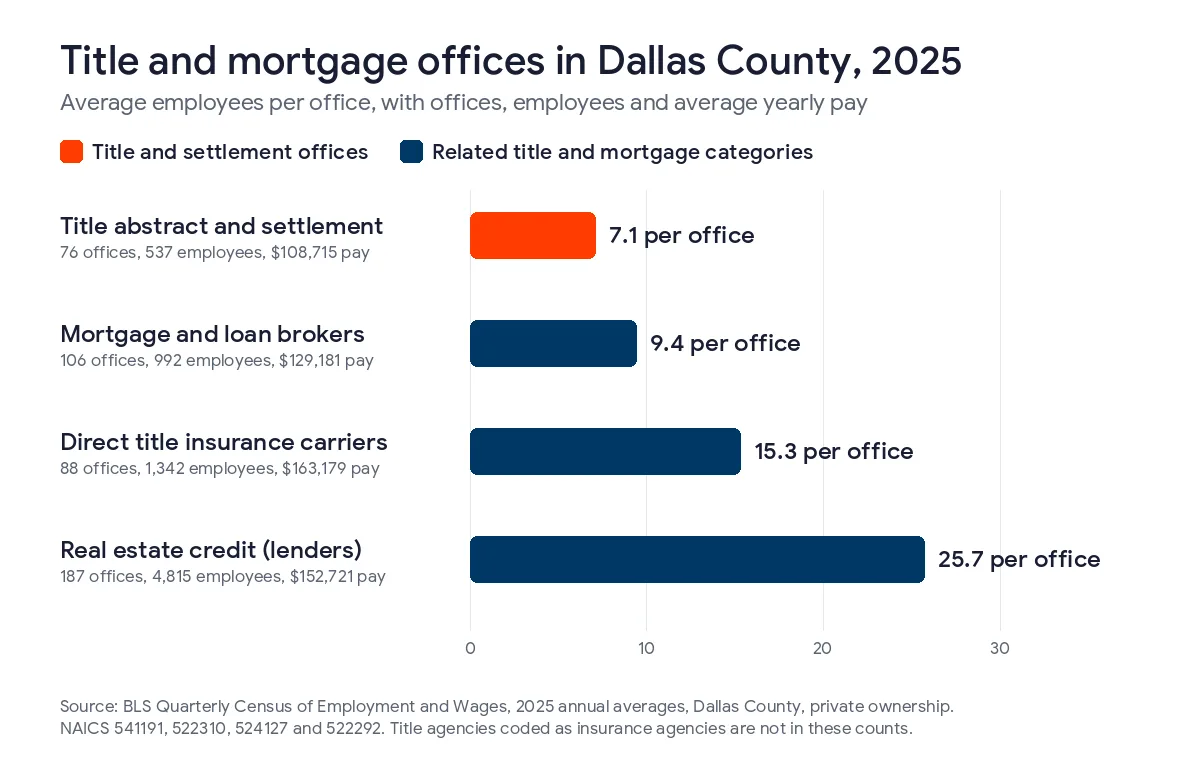
Headcount is the other half of the math. The Bureau of Labor Statistics Quarterly Census of Employment and Wages counted 76 title abstract and settlement offices in Dallas County in 2025, with 537 employees between them. That’s about 7 people per office. Employment in the category rose 12.8% from 2024, while the number of offices only went from 74 to 76, so existing offices are adding staff. We used 7 seats as the typical office in the table below.
| Office size | What it usually looks like | Per user per month | Monthly total | Yearly total |
|---|---|---|---|---|
| 3 staff | A branch or small escrow office with 1 closer | $150 to $200 | $450 to $600 | $5,400 to $7,200 |
| 7 staff | The Dallas County average for title and settlement offices | $175 to $250 | $1,225 to $1,750 | $14,700 to $21,000 |
| 12 staff | Several closers, an examiner team, and in-office closings every day | $175 to $250 | $2,100 to $3,000 | $25,200 to $36,000 |
| 25 staff | Usually 2 offices, often one in Collin or Denton County | $175 to $250 | $4,375 to $6,250 | $52,500 to $75,000 |
| 50 staff | Several branches with underwriter audits and lender security questionnaires | $200 to $250 | $10,000 to $12,500 | $120,000 to $150,000 |
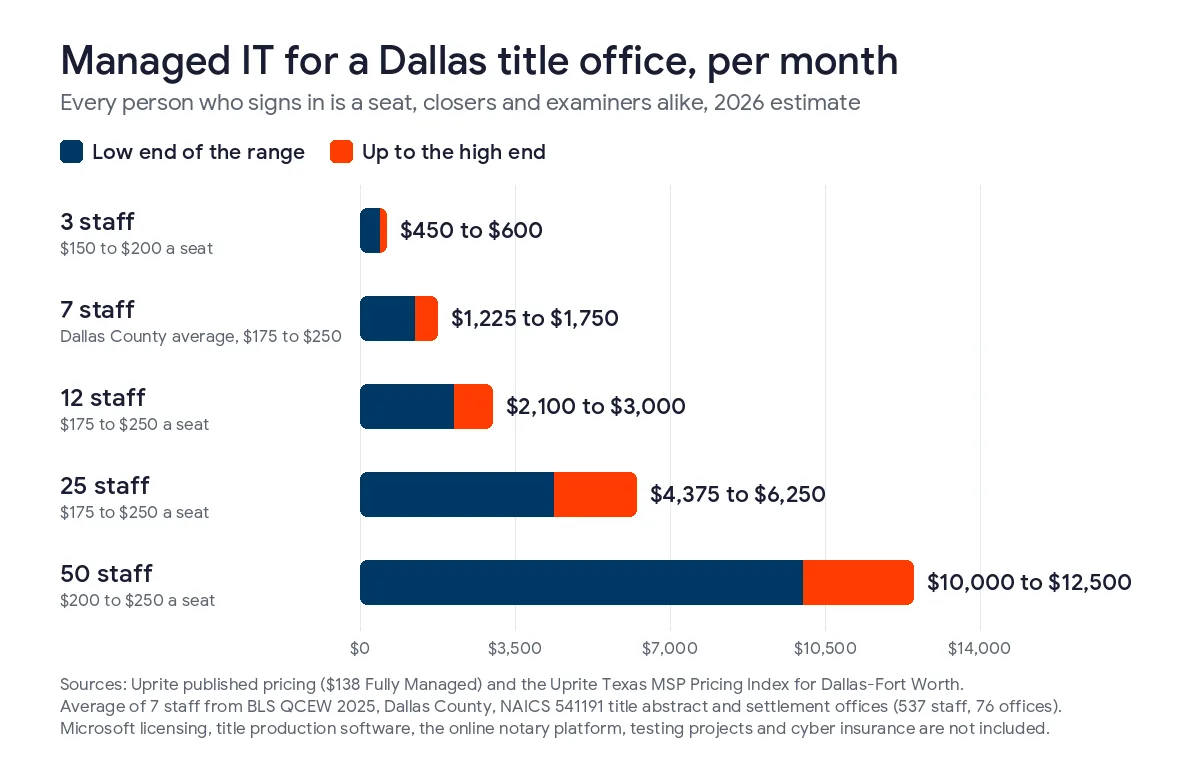
These are our estimates for planning, not quotes. Microsoft 365 licensing, title production software such as SoftPro, ResWare, or Qualia, a remote online notarization platform, and cyber insurance are all separate invoices. We include them in the comparison steps further down so they don’t get lost.
Why the 5,000-consumer line changes the budget
The FTC Safeguards Rule covers title and settlement work directly. Its definitions list an entity that provides real estate settlement services as a financial institution, and a mortgage broker as another. The same section says a consumer who obtains real estate settlement services from you has a continuing customer relationship with you, under 16 CFR 314.2. In plain terms, the buyers and sellers at your closing table count as customers, and so does each borrower a broker arranges a home loan for.
Every covered company needs a Qualified Individual, multi-factor authentication, encryption, and a written information security program under 16 CFR 314.4. A smaller company gets a break on 4 items. Under 16 CFR 314.6, a company that maintains customer information on fewer than 5,000 consumers doesn’t have to do the following.
- A written risk assessment, under 314.4(b)(1)
- Annual penetration testing and vulnerability scans at least every 6 months, under 314.4(d)(2), unless it runs continuous monitoring instead
- A written incident response plan, under 314.4(h)
- A yearly written report from the Qualified Individual to the board or a senior officer, under 314.4(i)
Those 4 items are where most of the yearly compliance spend goes, so the line matters. The catch for title companies is that the count covers information you maintain, not just this year’s files. Here is a rough example. Say an office closes 30 residential files a month, and each file has 2 to 4 individual buyers and sellers. That’s 720 to 1,440 consumers a year. Since Texas requires escrow records to be kept for 3 years and insurability files for 15, that office passes 5,000 consumers somewhere between year 4 and year 7 of keeping records.
My honest read is that almost every established title office in Dallas is over the line, even the small ones. A brand new mortgage broker or a commercial-only title shop may stay under it for a while. If you’re not sure where you stand, count the individuals in your retained files before you accept or reject a quote that includes the testing work.
The yearly costs that sit outside the monthly rate
Managed IT covers support, device management, security tools, and backups. Some Safeguards work is a separate project each year. The figures below come from our Dallas cost guides, which build their ranges from public labor rates, and they assume a single office with fewer than 25 people.
| Item | How often | Dallas cost for a small office | Who needs it |
|---|---|---|---|
| Penetration test | Every year | About $3,750 for a small external test, up to $18,750 for larger scopes | Offices at 5,000 or more consumers without continuous monitoring |
| Written risk assessment by an outside firm | Every year, or after a major change | About $2,810 to $6,360 for fewer than 25 staff | Offices at 5,000 or more consumers |
| Vulnerability scans | At least every 6 months | Often included in a managed security plan | Offices at 5,000 or more consumers without continuous monitoring |
| Qualified Individual | Ongoing | Included when your MSP takes the role, or a vCISO retainer | Every covered office |
| Security monitoring on top of in-house IT | Monthly | From $40 per user | Offices that keep their own IT person |
The pen test figure comes from our penetration testing cost guide for Dallas, and the assessment figure comes from our Dallas cybersecurity risk assessment guide. A larger office that wants its own security lead can compare retainers in our vCISO cost guide for Dallas. The $40 figure is our published security plan for companies that keep their own IT staff, described on our managed security services page for Dallas.
Wire fraud controls belong in the budget too. Callback verification, an email security filter, and sign-in alerts on every mailbox that touches a closing are cheap compared with one diverted wire. Our separate guide on wire fraud prevention for Dallas title companies walks through the closing-day steps, and our guide on title company IT security in Dallas covers which regulator expects what. For sign-ins, CISA recommends phishing-resistant multi-factor authentication wherever a business can deploy it.
Texas record rules make storage a long-term line item
The Texas Department of Insurance sets how long title records have to be kept. Its Procedural Rule P-32 requires escrow accounting documentation, such as signed settlement statements, disbursement sheets, invoices, and check copies, to be kept for at least 3 years. Evidence of insurability, including commitments, title reports, title opinions, and run sheets, has to be kept for at least 15 years. Title policies are kept indefinitely, and the same periods apply to files stored electronically.
Remote online closings add one more archive. Texas requires an online notary to keep the electronic record of each notarization for at least 5 years under Government Code 406.108. The Secretary of State’s online notary record-keeping guidance says that includes the original audio and video recording plus a backup copy. Video adds up fast compared with scanned PDFs.
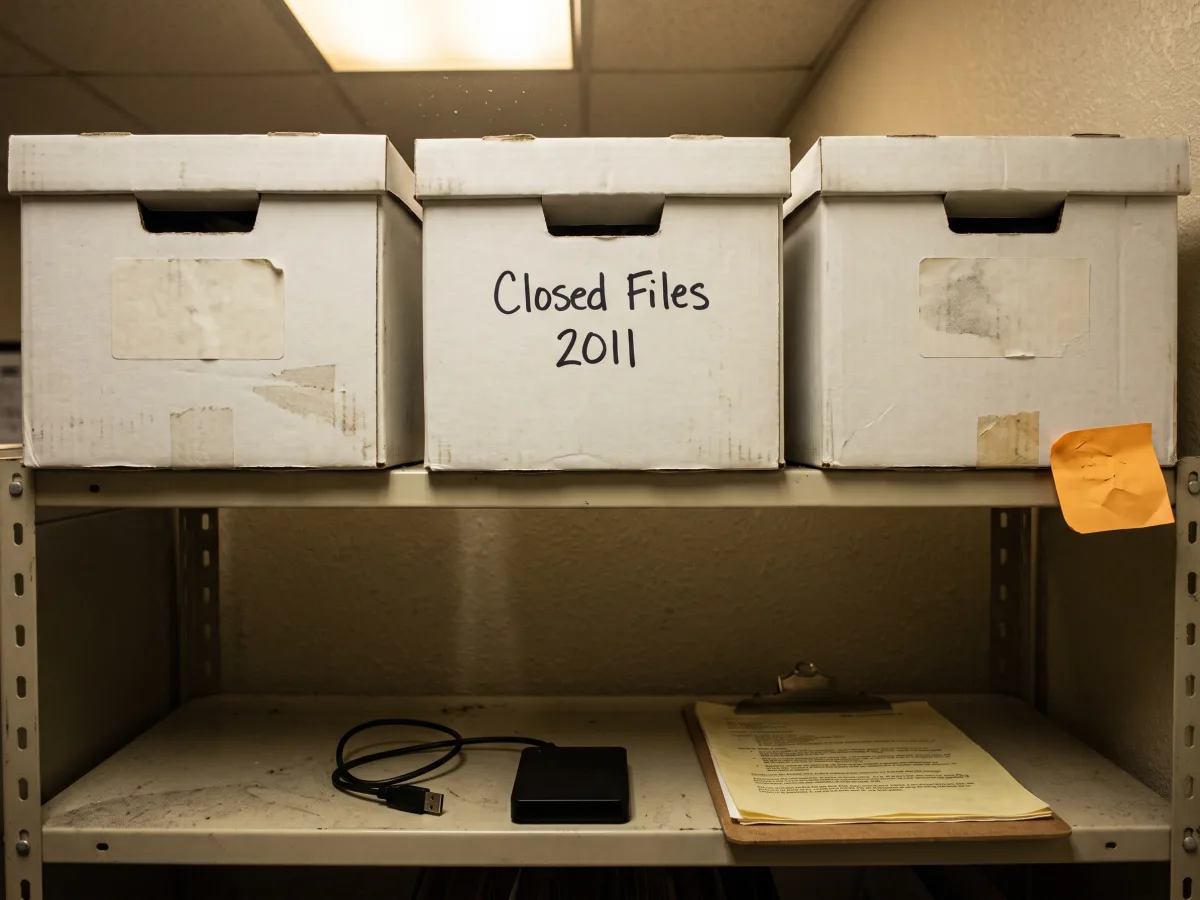
The storage itself is rarely the expensive part. The cost shows up when nobody has ever tried to restore a 12-year-old file, or when the only copy of the closing videos sits with a notary platform you stopped paying. We ask every title client 2 questions. Where does each record type live, and when did someone last restore one? Our Fully Managed plan includes a timed restore test every quarter, and our disaster recovery page for Dallas explains what that test checks.
What an outage costs on a closing day
Federal pay data makes downtime easy to price. Title abstract and settlement employees in Dallas County averaged $108,715 a year in 2025, according to the same QCEW release. That’s about $52.27 an hour in wages. The BLS employer compensation survey for June 2026 found private employers spending $46.89 an hour on total compensation for every $32.82 in wages. At that ratio, an hour of a title employee’s time costs about $74.67 once benefits are counted.
A half-day outage at a 7-person office is 28 paid hours, or about $2,091. That’s more than a full month of managed IT at the top of our range, and it doesn’t count a closing that misses its funding deadline. Examiners alone make the point, since the Dallas-Fort Worth metro had 2,140 title examiners, abstractors, and searchers in May 2025, earning a mean of $31.66 an hour before benefits.
Is in-house IT cheaper for a title office?
For most Dallas title offices it isn’t, and the gap is wide. A computer user support specialist in the Dallas-Fort Worth metro earned a mean of $63,030 in May 2025. With benefits at the BLS ratio, that’s about $90,051 a year for one person who can’t cover vacations, nights, or a closing that runs late.
| Option for a 7-person title office | Yearly cost | What you still need to add |
|---|---|---|
| Managed IT at $175 to $250 per user | $14,700 to $21,000 | Licensing and the yearly pen test and risk assessment |
| One in-house support specialist | About $90,051 with benefits | Security tools, backups, after-hours coverage, and a Qualified Individual |
| In-house person plus managed security | About $90,051 plus $3,360 for security at $40 per user | The yearly testing work |
Managed IT for the whole office costs 16% to 23% of one loaded salary. An in-house hire starts to make sense somewhere past 50 staff, and even then we’d usually pair that person with outside security monitoring rather than ask one employee to be the help desk, the backup admin, and the Qualified Individual.
How mortgage companies differ from title offices
Mortgage brokers in Dallas County run a little larger and pay more. QCEW counted 106 mortgage and nonmortgage loan broker offices in 2025 with 992 employees, or about 9 per office, at an average of $129,181 a year. A half-day outage at a 9-person broker costs about $3,194 in loaded pay. Their software stack centers on a loan origination system such as ICE Encompass rather than title production software.
Licensed mortgage bankers also report to the Texas Department of Savings and Mortgage Lending. Under 7 Texas Administrative Code 57.210, a mortgage banker has to file a written report within 30 days of becoming aware of a reportable incident. For a security event that triggers notices to other agencies, it also owes a root cause analysis within 120 days. Writing that analysis is technical work, and it’s easier when an IT partner already has the logs.
A broker with no in-person closings can sometimes use a remote-only plan. Our IT Pro plan starts at $110 per user for teams of 12 or more, and IT Essentials starts at $91 for smaller teams, both without onsite visits. Brokerages that also run real estate agents should look at our real estate IT cost guide for Dallas, which deals with how agent seats are counted.
How to compare 2 IT quotes for a title company
- Count every person who signs in, including closers who work from home and part-time staff, and check that both quotes use the same number.
- Ask whether the Qualified Individual role is included, and who signs the yearly report.
- Check whether the annual penetration test and vulnerability scans are priced inside the plan or quoted as separate projects.
- Ask where escrow files, insurability files, and closing videos are stored, and how often a restore is tested.
- List the separate invoices, such as Microsoft licensing, title production software, the notary platform, and cyber insurance, so the totals compare fairly.
A quote that looks $40 a user cheaper often leaves out item 2 or item 3. That gap usually shows up later as a project invoice or an audit finding. Our managed IT services in Dallas page lists what our plans include, so you can line it up against any other proposal.
Questions Dallas title and mortgage owners ask about IT cost
Is $100 per user enough for a Dallas title company?
Usually not for full coverage, because $100 a user rarely includes the testing and documentation the Safeguards Rule expects from a title office. Our co-managed plan starts at $100 for offices that already have an IT person, and fully managed coverage for a title office generally lands between $175 and $250.
Does the FTC Safeguards Rule apply to Texas title agents?
Yes, it does. The rule lists companies that provide real estate settlement services as financial institutions, and Texas title agents provide those services. Mortgage brokers are listed too. Bank-owned title or mortgage affiliates may fall under a banking regulator instead, so check who examines you.
Do we really need a penetration test every year?
You need one if you hold customer information on 5,000 or more consumers and don’t run continuous monitoring. That’s most established title offices. A small external test in Dallas starts around $3,750, and the rule also calls for vulnerability scans at least every 6 months.
How long does a Texas title company have to keep closing files?
TDI Procedural Rule P-32 sets 3 years for escrow accounting records, 15 years for evidence of insurability such as commitments and run sheets, and no end date for title policies. Online notarization recordings have their own 5-year rule, plus a backup copy.
Can a small mortgage broker use a remote-only IT plan?
Often it can, if nobody signs documents in the office. Our remote IT Essentials plan starts at $91 per user for teams under 12. If you hold closings or keep paper files onsite, a plan with onsite support is the safer fit.
What does a half-day outage cost a 7-person title office?
About $2,091 in paid time, using Dallas County’s 2025 average title office pay of $108,715 and the BLS benefits ratio. That figure leaves out any closing that slips past a funding deadline, which is usually the larger cost.
Send us your headcount and the number of files you close each month. We’ll tell you where you sit against the 5,000-consumer line and give you a monthly price for your whole office.
Get a Title Company IT Quote