
Under the GLBA Safeguards Rule, a Texas title company should document its Qualified Individual, risk assessment, safeguards and test results, training and vendor records, incident response plan, annual report, and retention schedule.
Most title agents I talk to already know the rule exists. Few have the paper. That gap is the whole problem. When an underwriter’s auditor, a lender’s vendor questionnaire, or a regulator asks for proof, the controls are often there. The documents aren’t. This guide is the documentation side of our IT services for title companies in Dallas, written for owners, escrow managers, and operations leads at title offices from Uptown and Preston Center out to Frisco, Plano, and Fort Worth. It walks through each element of the rule, the record that proves it, and the Texas rules that change how long you keep things.
Name 1 person who owns the program. Write a risk assessment that says how each risk is fixed or accepted. Keep reports that prove MFA, encryption, access reviews, and testing. File your vendor contracts and reviews. Write an incident plan, then report on all of it once a year. Build a retention schedule that squares TDI’s 15-year rule for evidence of insurability with the federal 2-year disposal rule.
Does the GLBA Safeguards Rule apply to a Texas title company?
Yes, in practice. The FTC’s Safeguards Rule covers non-bank financial institutions, and its own list of examples names any entity that provides real estate settlement services. A Texas title agent that runs escrow and closings fits that description, and Texas law separately puts title agents under the Department of Insurance for GLBA purposes.
That’s 2 regulators for 1 office. Know which one says what. The example sits in 16 CFR 314.2, which names an entity that provides real estate settlement services as a financial institution. On the insurance side, the GLBA itself, at 15 U.S.C. 6805, hands enforcement for anyone providing insurance to the state insurance authority. Texas took that job in Insurance Code Chapter 601. Section 601.052 tells TDI to implement the federal safeguards standards, and 601.101 tells it to enforce them. Under 601.102, the Attorney General, after conferring with TDI’s commissioner, can seek up to $3,000 per violation of the chapter, or up to $250,000 for a pattern or practice.
Here’s the honest part. TDI’s privacy rules in 28 TAC Chapter 22 deal with privacy notices, opt-outs, and health information. We looked. We couldn’t find a Texas rule that lists safeguards elements the way the FTC rule does. So when a Texas title office asks “what exactly do we have to write down,” the FTC’s list in 16 CFR 314.4 is the most detailed written answer available, and it’s the one auditors tend to borrow. Treat this as an IT guide, not legal advice, and run the jurisdiction question past your underwriter’s counsel.
Another Texas wrinkle. The state’s general data security duty in Business and Commerce Code 521.052 doesn’t apply to GLBA financial institutions, but the breach notice rules in 521.053 still do. We cover the threat side, and which rule reaches mortgage and escrow shops, in our post on title company IT security in Dallas.
The records the Safeguards Rule expects
The rule’s working parts sit in 16 CFR 314.4, paragraphs (a) through (j). Each row below pairs one of them with the record that shows you did it. The last column is where we usually find the gap at a 10 to 30 person title office.
| What the rule requires | Section | The record to keep | Where title offices usually come up short |
|---|---|---|---|
| A Qualified Individual who runs the program | 314.4(a) | A written designation, and if it’s a vendor, a named senior person who oversees that vendor | “Our IT company handles it” with no person named anywhere |
| A written risk assessment | 314.4(b) | Criteria for rating risks, how each risk is mitigated or accepted, and the date it was last redone | A vendor’s generic template with the title plant and closing software left out |
| Access controls and a data inventory | 314.4(c)(1) and (2) | A list of systems that hold customer data and a dated access review for each | Former closers still active in the closing platform or the shared mailbox |
| Encryption in transit and at rest | 314.4(c)(3) | Encryption reports for laptops, servers, and email, or a signed approval of a compensating control | Scanned closing packages sitting unencrypted on a file server |
| Multi-factor authentication for everyone | 314.4(c)(5) | An MFA coverage report, plus written sign-off for any exception | MFA on email but not on the closing software or remote access |
| Secure disposal and a retention policy | 314.4(c)(6) | A retention schedule and destruction logs for paper and old drives | No schedule at all, so everything is kept forever |
| Change management and user activity logging | 314.4(c)(7) and (8) | A change log and retained sign-in and file access logs | Logs exist but nobody reviews them or keeps them |
| Testing | 314.4(d) | An annual penetration test and vulnerability scans every 6 months, or proof of continuous monitoring | A scan from 2 years ago and no pen test |
| Training and qualified staff | 314.4(e) | Training completions with dates, and proof the people running the program keep their skills current | New hires who never took the course |
| Service provider oversight | 314.4(f) | A vendor list, contract clauses requiring safeguards, and periodic reviews | E-recording, remote notary, and closing platforms missing from the list |
| A written incident response plan | 314.4(h) | The plan, covering the 7 areas the rule lists, plus notes from a walk-through | A plan written for ransomware that says nothing about a hijacked escrow mailbox |
| An annual written report | 314.4(i) | A signed report to the owners or senior officer on program status and material risks | Never written, because there’s no board |
That’s 12 rows for 8 paragraphs because paragraph (c) alone carries 8 safeguards. We’ve left out (c)(4), which covers in-house software, and (j), which gets its own section below. Paragraph (g), which says to adjust the program as things change, doesn’t need its own document. It shows up as dates. A risk assessment last touched in 2023 tells an auditor more than any policy does.
A note on the annual report. Plenty of title agencies don’t have a board, and the rule allows for that. If there’s no board or equivalent body, the Qualified Individual reports to a senior officer responsible for the program. Write it anyway. It’s 1 page. It’s also the page a lender’s vendor review is most likely to ask for.
Does the 5,000-consumer exception help a small title agency?
Less than most owners hope. Here’s why. Under 16 CFR 314.6, an institution holding customer information on fewer than 5,000 consumers skips 4 requirements, the written risk assessment, the pen testing and scanning schedule, the written incident response plan, and the annual report. Everything else still applies.
The catch is 1 word, “maintain.” The count covers every consumer whose information you still hold, not the ones you closed for this year. The rule’s own definitions treat anyone who obtains real estate settlement services from you as a customer, so a residential purchase usually puts at least a buyer and a seller in the file. And Texas makes title offices keep files a long time. A very long time.
Run the numbers on a small shop. Say an agency closes 20 residential files a month with 2 consumers in each. That’s 480 people a year, and the office passes 5,000 in under 11 years. At 40 files a month it takes about 5 years. TDI’s retention rule keeps the evidence behind each policy for 15. So many established Texas title agencies are likely over the line already. They just haven’t counted.
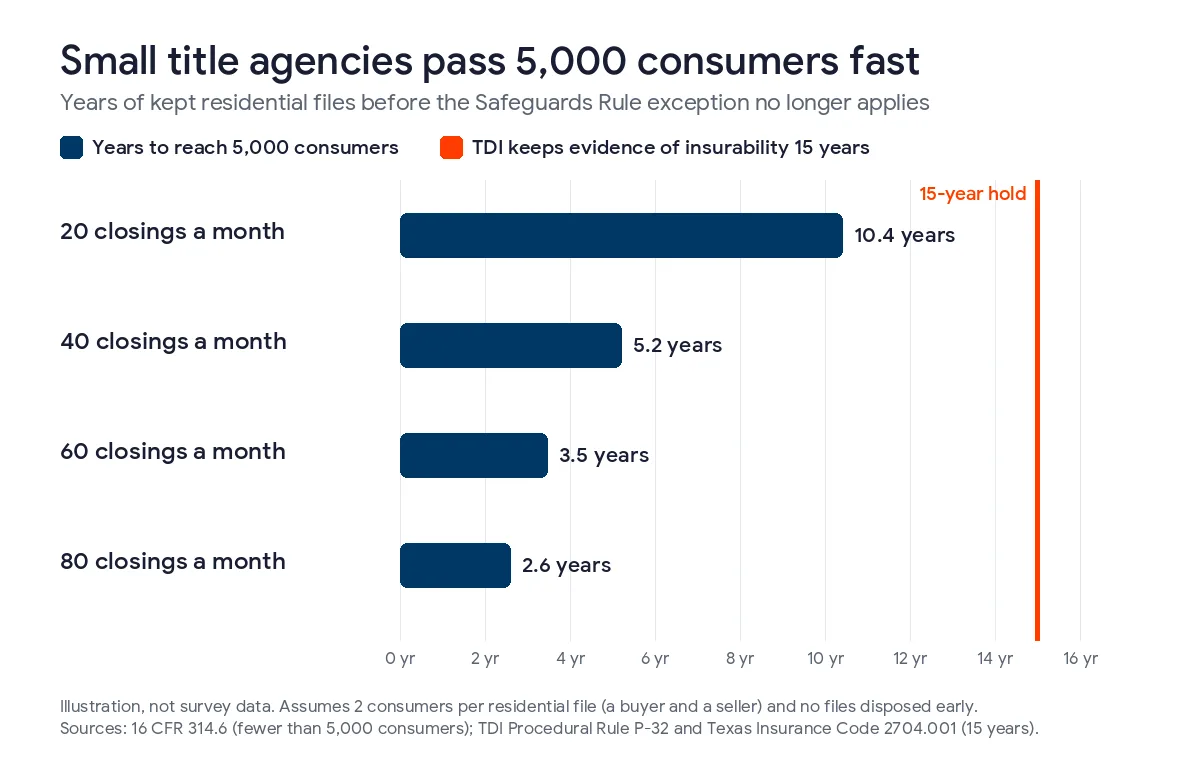
Our take? Document as if you’re over 5,000. Even if you might not be. Underwriter audits and lender questionnaires don’t care about the exemption, and a written incident plan is cheap insurance on its own.
Where TDI’s retention rule meets the 2-year disposal rule
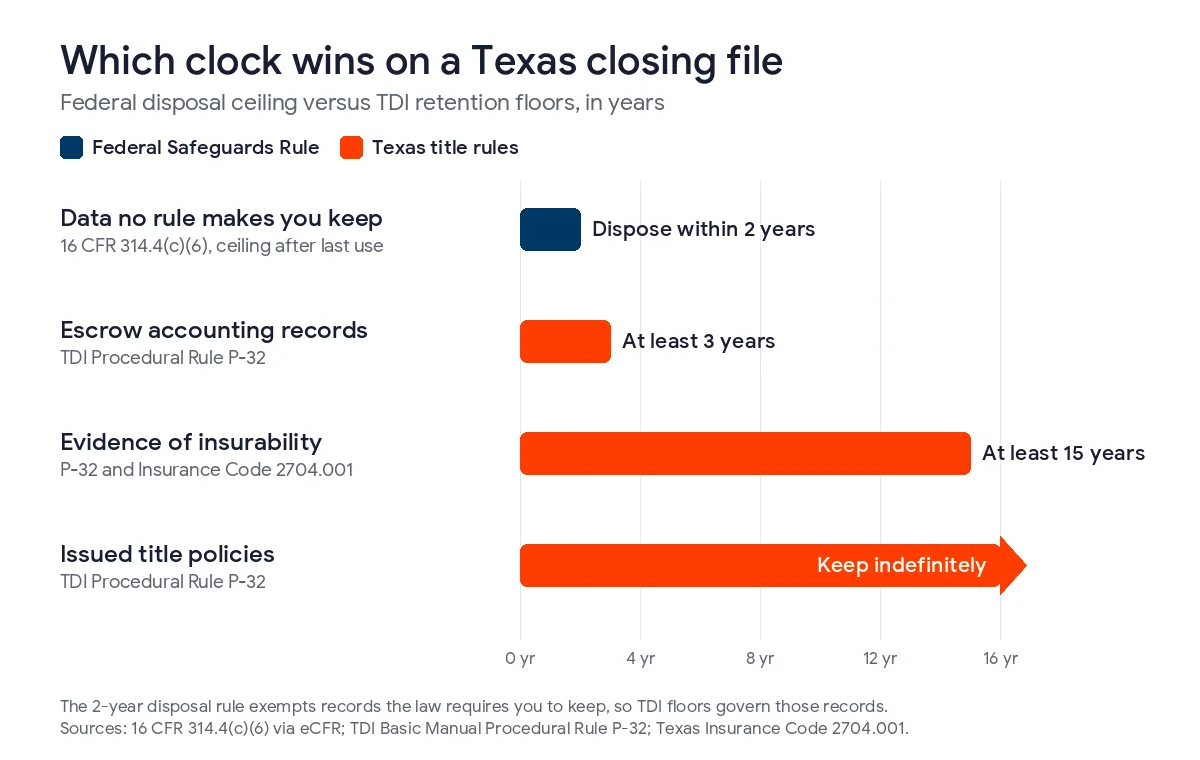
This is the conflict we rarely see written down. Section 314.4(c)(6) says to dispose of customer information no later than 2 years after you last used it for that customer, unless you need it for business operations, the law requires you to keep it, or targeted disposal isn’t reasonably feasible. Texas title law requires keeping quite a lot. So which wins?
TDI’s Procedural Rule P-32 sets the floors. Escrow accounting records, such as signed settlement statements, disbursement sheets, invoices, and check copies, stay at least 3 years. Evidence of insurability, meaning the commitment, title report, title opinion, or run sheet, stays at least 15 years, which tracks Insurance Code 2704.001. Issued policies stay forever.
| Record | Rule that sets the clock | Minimum hold | What the retention schedule should say |
|---|---|---|---|
| Signed settlement statements, disbursement sheets, invoices, check copies | TDI Procedural Rule P-32 | 3 years | Keep 3 years, then dispose unless another rule or a business need applies |
| Commitments, title reports, title opinions, run sheets | P-32 and Insurance Code 2704.001 | 15 years after the policy issues | Keep 15 years, encrypted, with access limited to examiners and closers |
| Issued title policies | P-32 | Indefinitely | Keep permanently and record where they live |
| Customer data no rule requires you to keep | 16 CFR 314.4(c)(6) | No floor, 2-year ceiling after last use | Dispose within 2 years, or write down the business reason for keeping it |
That last row is where the work is. It’s also the messy one. A closing file holds more than the P-32 categories. Copies of IDs, payoff statements with loan numbers, bank letters, and email threads full of personal details may not be evidence of insurability. Ask your underwriter which documents it counts. Then write the answer into the schedule. “We keep everything” isn’t a schedule.
Disposal needs its own record too. Shred logs cover paper. For drives and copiers, NIST’s SP 800-88 Rev. 2, published in September 2025, is the standard most IT providers follow for wiping media, and a certificate per device is easy to keep.
What evidence should be in the binder?
Policies say what you intend. Evidence shows it happened. Auditors want the second. For a title office running Microsoft 365 and a cloud closing platform, here’s the set we’d pull together, most of it exportable in an afternoon.
- The signed Qualified Individual designation, and the vendor contract if that person is outside the company.
- The written risk assessment, built on a method like NIST SP 800-30, with a date on every revision.
- An MFA registration report from Microsoft Entra and the closing platform’s own MFA setting, screenshotted with a date.
- A BitLocker or FileVault status report for every laptop and workstation.
- Quarterly access reviews for the closing software, email, shared drives, and the title plant.
- Vulnerability scan reports from the last 12 months and the most recent penetration test letter.
- Training completion records by employee and date.
- The vendor list with contract clauses, and the security questionnaire each critical vendor returned.
- The incident response plan and notes from the last tabletop exercise.
- Last year’s annual report, signed.
On MFA, CISA’s guidance on multifactor authentication pushes phishing-resistant methods over text codes, and we agree for anyone who can change wire instructions. If you’ve never had a structured review, a cybersecurity risk assessment in Dallas is the fastest way to produce items 2 and 5. Testing is its own job, and our penetration testing in Dallas page explains how an annual test is scoped. If you’re unsure which one the rule wants when, the difference between a penetration test and a vulnerability scan matters here, since the rule asks for both.
Who should hold all this? The rule lets the Qualified Individual work for a service provider, which is how most small title agencies handle it. A vCISO in Dallas can fill that seat, but the rule still makes you name a senior person inside the company to oversee them, and it holds you responsible for the outcome. Outsourcing the work doesn’t outsource the duty. Not even a little.
Which breach clocks does a Texas title company have to track?
There are 3, and they start on different triggers. Since May 13, 2024, the FTC rule’s paragraph (j) requires a report to the FTC within 30 days of discovering a notification event that involves 500 or more consumers. A notification event means someone got unencrypted customer information without permission, and encrypted data counts as unencrypted if someone without permission accessed the key. The amendment ran in the Federal Register on November 13, 2023.
Texas adds 2 more. Business and Commerce Code 521.053 requires notice to affected individuals within 60 days of determining a breach occurred, and a report to the Texas Attorney General within 30 days when 250 or more Texans are affected. If a vendor holds your data and gets breached, the same section says it has to tell you immediately, which is a clause worth copying into every vendor contract.
For a title office, the likeliest trigger isn’t ransomware. It’s email. Picture a closer’s mailbox taken over through a phishing link, with weeks of closing disclosures, IDs, and payoff letters sitting in the sent folder. That incident can start all 3 clocks at once, and it’s also how most wire fraud begins. Our sibling guide on wire fraud prevention for Dallas title companies covers the closing-day side. Your incident plan should name who decides whether the FTC clock has started, because the rule counts from discovery, not from the end of the investigation.
Where to start if the binder is thin
Don’t start with policies. Start with the data. Where does it live? In our experience, offices that write policies first end up describing systems they don’t actually run.
- Name the Qualified Individual, in writing, this week.
- List every system that holds customer data, including the title plant, closing software, e-recording, the remote notary platform, email, and any shared drive.
- Run the risk assessment against that list, and decide which risks you’ll fix and which you’ll accept.
- Close the MFA and encryption gaps first. They’re the cheapest rows to turn green.
- Write the retention schedule with your underwriter’s answer on P-32 records.
- Collect vendor contracts and questionnaires, starting with anyone who can see a closing file.
- Write the incident plan, then walk 1 scenario through it. A hijacked escrow mailbox is a good one.
- Book the pen test and the scanning schedule.
- Put the first annual report on the calendar for 12 months out.
Budget questions come up fast. They always do. Our breakdown of GLBA compliance IT cost in Texas covers what each piece tends to cost, and the post on what IT costs a Dallas title company puts it in the context of the whole IT budget. If you want to see what happens when an auditor asks for proof the paper can’t give, read our FTC Safeguards Rule remediation case study. Backups deserve a line in the binder too, and our data backup services page shows the restore testing we’d document. For firms that also hold lending or investment licenses, the wider rulebook is in cybersecurity requirements for Dallas financial services firms.
Our Dallas team answers support requests in 5 minutes on average, so when a closer can’t get into the closing platform on the last day of the month, someone picks up. That’s the operational side. The paperwork side is what this post is about, and it’s the part we see skipped most.
Questions Texas title agents ask about the Safeguards Rule
Is a title insurance agent a financial institution under the GLBA?
For its settlement work, it is. The FTC’s Safeguards Rule names entities that provide real estate settlement services as financial institutions, and Texas Insurance Code Chapter 601 separately applies GLBA duties to anyone holding a TDI license or other authorization, title agents included.
Who enforces the Safeguards Rule against a Texas title agent?
Both TDI and the FTC can have a hand in it. The GLBA gives state insurance regulators authority over insurance activity, and Texas assigned that to TDI in Insurance Code Chapter 601, which also lets the Attorney General seek up to $3,000 per violation. The FTC covers settlement services outside insurance.
Do we need a written risk assessment if we have fewer than 5,000 consumers?
Not under the federal rule, which waives it below 5,000 consumers. But the count includes every buyer and seller whose information you still keep, and TDI makes you keep evidence of insurability for 15 years, so few established agencies stay under the line.
Can our IT provider be the Qualified Individual?
It can, because the rule lets a service provider or affiliate fill the role. You still have to name a senior person in your company to oversee them, require them to keep a program that protects you, and you stay responsible for compliance.
How long can a title company keep closing files under the 2-year disposal rule?
As long as Texas law requires. The 2-year disposal deadline has an exception for records the law makes you keep, and TDI’s P-32 sets 3 years for escrow accounting records, 15 for evidence of insurability, and permanent retention for policies.
When does a title company have to report a breach to the FTC?
Within 30 days of discovery, if unencrypted customer information of 500 or more consumers was acquired without authorization. The report goes through an online form on the FTC’s website and has applied since May 13, 2024.
Send us whatever you have today, even if it’s 1 policy and a vendor list. We’ll map it against the 12 rows above, mark which ones have no owner or no evidence, and give you a written gap list. It’s free for Texas title and escrow offices.
Book a free Safeguards documentation review