
Title company IT security in Dallas comes down to protecting closing funds and borrower files at the same time. In practice that means phishing-resistant MFA, wire instructions verified by phone, encrypted document handling, backups ransomware can’t reach, and a written plan for the day something breaks.
I’m the CTO at Uprite, and title and mortgage offices don’t fit the usual small-business security advice very well. Even a small escrow office moves other people’s money by wire every working day, and it keeps Social Security numbers, bank statements and driver’s licenses for every buyer, seller and borrower who comes through. This guide is for owners, escrow managers and operations leads at title agencies, mortgage companies and loan offices around Dallas, Plano, Frisco, Irving and Fort Worth. It sits under our IT services for title companies in Dallas, and it maps the attacks you’re most likely to face, the Texas and federal rules that apply to your licenses, and the controls that close each gap.
Treat the mailbox and the wire as one system. Put phishing-resistant MFA on email, your title or loan software and every bank portal, verify wire and payoff instructions by phone at a number you already had, and keep borrower documents out of plain email. Then write it down. Title agents answer to TDI and the FTC’s Safeguards Rule, mortgage companies also report incidents to Texas SML within 30 days, and a breach touching 250 Texans goes to the attorney general within 30 days.
What does IT security mean for a title or mortgage company?
IT security for a title or mortgage company is the set of controls that protects two things, the money moving through escrow and the nonpublic personal information sitting in every loan and closing file. Federal law treats both kinds of firm as financial institutions, so those controls also have to be written down and owned by a named person.
That second part catches people off guard. The FTC’s Safeguards Rule lists an entity that provides real estate settlement services as a financial institution in its own definitions at 16 CFR 314.2, right next to mortgage brokers and lenders. So a Dallas title agency isn’t just a small office with a server closet. It’s a regulated holder of customer information, and sooner or later an examiner, an underwriter or a plaintiff’s lawyer will ask to see the program.
What are attackers after at a Dallas title or mortgage office?
The attacks we plan for at financial offices around DFW sort into 2 goals. One is to redirect a wire. The other is to take the files, either to sell the identities inside them or to lock up the office until the closings stop. The table lines up the 6 patterns we plan for with the control that usually stops each one and the part of the Safeguards Rule that expects it.
| Threat | Where it usually starts | Control that stops it | Where the Safeguards Rule expects it |
|---|---|---|---|
| Changed wire or payoff instructions | A taken-over agent, lender or escrow mailbox, or a look-alike domain one letter off | A callback to a number already on file and a second approver for any change | 314.4(c)(1) access controls and 314.4(e) staff training |
| Mailbox takeover | A phished password or an MFA push someone approved by habit | Phishing-resistant MFA plus alerts on new inbox rules and auto-forwarding | 314.4(c)(5) multi-factor authentication |
| Ransomware on the production system | An unpatched VPN or firewall, or a stolen remote login | Endpoint detection and response, scheduled patching, and offline backups of the production database and escrow ledger | 314.4(c) safeguards and 314.4(h) incident response plan |
| Stolen borrower files | Email attachments, shared drives open to everyone, unencrypted laptops | Encryption, a secure document portal and need-to-know file access | 314.4(c)(3) encryption and 314.4(c)(1)(ii) limited access |
| Vendor breach | Loan processing, closing, e-recording and notary platforms that hold your data | A vendor list, security terms in the contract and a yearly review | 314.4(f) service provider oversight |
| Former staff and stale accounts | Closers and processors who leave with logins still active | Same-day offboarding and a quarterly access review | 314.4(c)(1) and 314.4(c)(2) inventory of people and systems |
Wire fraud gets the headlines, and it deserves them. The step-by-step version of that first row, from the first spoofed email to the funding call, is in our closing-day checklist on wire fraud prevention for Dallas title companies. This post stays on the security program around it.
Who regulates title and mortgage company security in Texas?
Nobody hands a title agent a single rulebook. Which regulator you answer to depends on the licenses you hold, and plenty of DFW shops run a title agency and a mortgage operation under one roof. Here’s how the rules land.
| Type of firm | Who enforces privacy and security | What sets the security standard | Breach and incident clocks |
|---|---|---|---|
| Title insurance agent or escrow office | Texas Department of Insurance, which enforces federal financial privacy law for its license holders under Insurance Code 601.101 | Insurance Code 601.052 has TDI apply the federal safeguards standards, and the FTC rule names settlement services outright | People affected within 60 days, the Texas attorney general within 30 days at 250 or more Texans, and the FTC within 30 days at 500 or more consumers |
| Residential mortgage loan company | Texas Department of Savings and Mortgage Lending (SML) for the license, the FTC for the Safeguards Rule | FTC Safeguards Rule, 16 CFR 314 | SML report within 30 days of a reportable incident and a root cause report within 120 days under 7 TAC 56.210, plus the state and FTC notices |
| Mortgage banker | SML for the registration, the FTC for the Safeguards Rule | FTC Safeguards Rule, 16 CFR 314 | The same 30-day and 120-day SML clocks under 7 TAC 57.210, plus the state and FTC notices |
| Any business holding Texans’ sensitive personal information | Texas attorney general | Business and Commerce Code 521.052, which doesn’t apply to GLBA financial institutions | 60 days to people affected and 30 days to the attorney general at 250 or more Texans |
The primary text is worth reading yourself. The TDI enforcement language is in Insurance Code Chapter 601, the SML reporting rules are at 7 TAC 56.210 and 7 TAC 57.210, and the state breach clocks are in Business and Commerce Code Chapter 521.
Here’s my honest read. The overlap matters less than people fear, because the documents you’d show TDI, SML or the FTC are mostly the same documents. We build title and mortgage clients to the element list in 16 CFR 314.4, since it’s the most specific security text any of these regulators has published, and then add the Texas reporting clocks on top. One wrinkle is worth knowing. Texas’s own reasonable-security duty in Section 521.052 carves out GLBA financial institutions entirely, so the state is leaning on the federal standard for you, not handing you a lighter one. Your counsel and your underwriter should confirm how this applies to your specific licenses. The document-by-document version lives in our guide to the GLBA Safeguards Rule for Texas title companies, and we’ve written separately about what GLBA compliance costs a Texas firm.
What do Texas breach filings show about mortgage-side breaches?
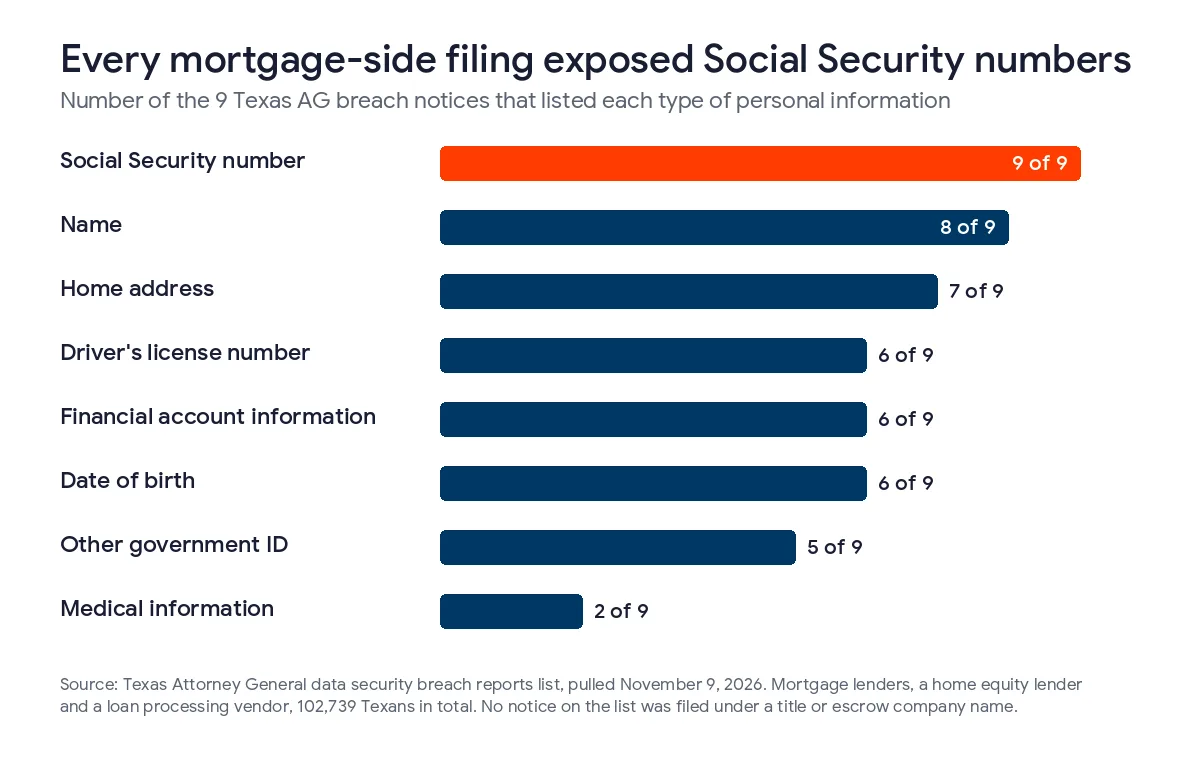
The Texas attorney general posts every breach notice that touches 250 or more Texans on its data security breach reports list. We pulled that list on November 9, 2026, when it held 692 notices posted from April 1, 2025 forward, and filtered it for mortgage, lending, title and escrow names. 9 notices came back, all from mortgage lenders, a home equity lender and a loan processing vendor, posted between December 2025 and October 2026. Together they covered 102,739 Texans and 1,136,569 people overall.
None of the 9 was filed under a title, escrow or abstract company name. That’s a fact about the list, not a clean bill of health for title offices, because a breach under 250 Texans never shows up on it at all, and most title agencies in Dallas are small enough that their breaches would sit under that line.
What was taken is the more useful part. All 9 filings listed Social Security numbers. 7 listed home addresses, and 6 each listed driver’s license numbers, financial account information and dates of birth. That’s close to a full identity kit, the same packet a fraudster needs to open credit in someone’s name or pose as a seller at your closing table.
The timing is the part I’d put in front of an owner. Measured from the date each company says it discovered the breach to the date the notice appeared on the list, the median was 63 days. 4 filings landed within about a month. One, a Tennessee loan office, appeared 506 days after a discovery date in March 2025. Texas’s 30-day clock to the attorney general runs from when a company determines a breach occurred, which can come well after first discovery, so these gaps aren’t proof anyone broke the rule. They do show how long forensic work takes when nobody planned for it.
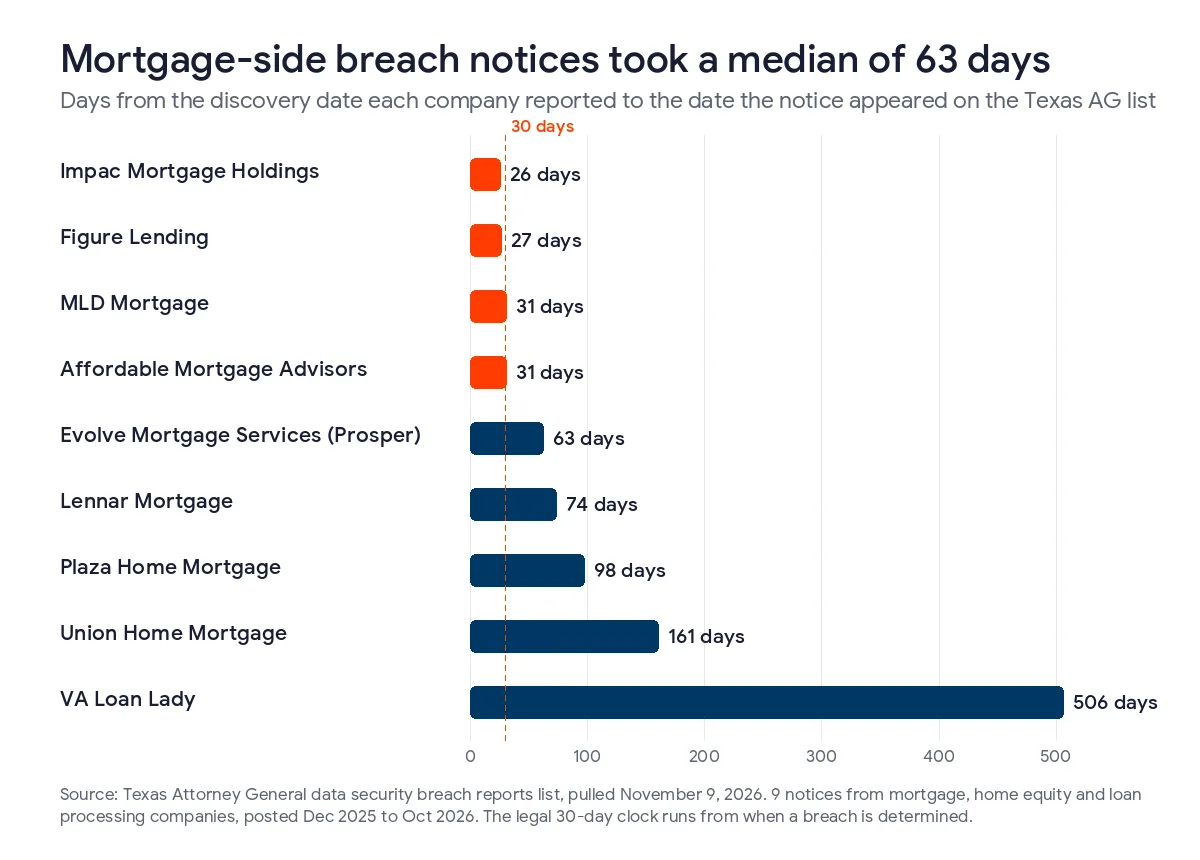
One filing stands out for DFW. Evolve Mortgage Services, a loan processing company in Prosper, filed on behalf of the financial institutions it serves, covering 13,501 people including 1,079 Texans. When you hand processing, closing or e-recording work to a vendor, their breach becomes your notice problem. That’s why the Safeguards Rule treats vendor oversight as its own element instead of a footnote.
Which security controls matter most for a small title or mortgage office?
If I could only fund 8 things at a 10 to 40 person title or mortgage office, it would be these, roughly in this order.
- Phishing-resistant MFA on Microsoft 365, the title production or loan origination system, and every bank and wire portal. CISA’s phishing-resistant MFA fact sheet calls it the most secure form of MFA, with number matching as the fallback where an app can’t support it.
- Wire and payoff changes verified by a call to a number you already had, with a second person approving any change to instructions.
- Alerts on new inbox rules, auto-forwarding and sign-ins from unusual places, read by someone who knows what normal looks like for your office.
- DMARC at enforcement on your own domain, so criminals can’t send mail that claims to come from you.
- A secure portal for borrower documents, so Social Security numbers and bank statements stop traveling as email attachments.
- Endpoint detection and response on every PC and server, with VPN and firewall patching on a set schedule.
- Backups of the production database, document storage and escrow ledger that ransomware can’t reach, restored as a test every quarter.
- Same-day offboarding and a quarterly review of who can see what, vendors included.
None of this is exotic. What fails in practice is coverage, like MFA on email but not on the bank portal, or backups that run every night and have never once been restored. I’d rather see 8 controls on every account than 20 controls on half of them.
What happens to closings when ransomware hits a title company?
Look at the largest example on the public record. Fidelity National Financial, the parent of Fidelity National Title and Chicago Title, told the SEC in a November 2023 filing that it had blocked access to some of its systems after a cybersecurity incident, and that its title insurance, escrow and other title-related services and its mortgage transaction services were affected. Its follow-up filing said the incident was contained on November 26, a week after the company became aware of it.
A national underwriter has incident responders on retainer and still lost a week. A 15-person Dallas title office on a Friday with 6 fundings on the calendar has far less room. So plan for that day before it arrives. Decide which closings move and who calls the lenders and the agents. Keep a printed contact sheet for your bank’s wire room. Know how you’d prove the escrow ledger balance from a backup taken before the attack. The Safeguards Rule calls this a written incident response plan at 314.4(h), and it’s one of the documents we most often find missing when we start with a new client.

What changed for title companies in 2026?
2 things are worth knowing. FinCEN’s Residential Real Estate Rule would have required title and settlement agents to report many all-cash home sales to entities and trusts. The U.S. District Court for the Eastern District of Texas vacated it on March 19, 2026, and FinCEN has appealed. According to FinCEN’s rule page, reporting persons aren’t required to file while the court’s order remains in force. If the rule comes back on appeal, you’d be collecting beneficial ownership details and IDs on a new group of buyers, so it’s worth deciding now where that data would live and who could open it.
The FTC’s breach notice requirement, meanwhile, has been in force since May 13, 2024. A covered firm has to notify the FTC within 30 days of discovering that unencrypted customer information on 500 or more consumers was acquired without authorization. The word unencrypted is doing real work in that sentence, and it’s one more reason the portal and laptop encryption items sit high on the list above.
Where should a Dallas title company start?
Start with a 30-day sprint, not a binder. In the first month we’d turn on phishing-resistant MFA for email and the bank portal, write the wire verification rule and have every closer sign it, run a restore test on the production system, and list every vendor that touches borrower data. Then name a Qualified Individual and write the program around what you’ve already done, which is far easier than writing it around what you plan to do. For the budget side, our breakdown of what IT costs a Dallas title company lays out the numbers by office size.
How does Uprite help Dallas title and mortgage companies?
Uprite runs managed IT and security for financial offices across Texas from our Dallas office on Alpha Road, with an average response time of 5 minutes. For title and mortgage clients the controls above run as a monthly service, with managed security services in Dallas watching mailboxes and endpoints and our team keeping the Safeguards paperwork current alongside your compliance lead. We’ve taken a client through a full Safeguards Rule remediation, and you can read how that FTC Safeguards Rule engagement ran. When you need the yearly test the rule asks for, we also run penetration testing in Dallas. For the wider picture, see our cybersecurity services in Dallas and our work in financial services IT in Dallas, or talk to our Dallas team.
Title and mortgage security questions from Dallas offices
Is a Texas title agent covered by the FTC Safeguards Rule?
Plan as if it is. The FTC’s own definitions name real estate settlement services as a financial activity, so a title agent running escrow and closings falls inside them, and TDI separately enforces federal privacy law for its license holders.
When does a Texas mortgage company have to tell SML about a cyber incident?
Within 30 days of becoming aware of a reportable incident, meaning one that poses a material risk to operations or customers. If the event also triggered notices to other agencies, a root cause analysis report follows within 120 days.
Do title companies report breaches to the Texas attorney general?
Yes, when at least 250 Texans are involved. The notice goes through the attorney general’s online form within 30 days of determining the breach occurred, and the people affected must hear from you within 60 days.
Is MFA actually required for title and mortgage companies?
Under the FTC Safeguards Rule it is. Section 314.4(c)(5) requires multi-factor authentication for anyone accessing an information system, unless your Qualified Individual approves an equivalent or stronger control in writing.
Do Texas title companies still file FinCEN real estate reports?
Not while the court order stands. The Eastern District of Texas vacated the rule on March 19, 2026, and FinCEN says reporting persons aren’t required to file while that order is in force, though it has appealed.
Can we email closing documents to buyers and sellers?
Plain email is the wrong channel for anything carrying Social Security numbers or account details. The Safeguards Rule requires customer information to be encrypted in transit over external networks, so most offices send these files through a secure portal instead.
Send us your headcount, the title or loan software you run, and how your office verifies wire instructions today. We’ll do a free security review of your Dallas title or mortgage office and show you which of these gaps are open right now.
Book a free security review