
Managed IT for a Houston nonprofit typically costs $125 to $175 per user each month in 2026, plus $0 to $5.50 per user for Microsoft 365 at nonprofit prices. Our Fully Managed plan starts at $138. Nonprofit status cuts the licensing, not the support.
I run operations at Uprite, which means I’m the person who sees what a support contract actually turns into once the tickets start coming in. Nonprofits ask me the same thing businesses ask. What will this cost us every month? Fair question. The answer is close to what a Houston business pays, with 2 big differences. Microsoft charges you far less for licenses. And your user count is harder to pin down. Much harder. Our page on IT services for nonprofits in Houston covers the work itself. This page puts prices on it.
The rates below come from our published managed IT pricing and the Houston numbers in our Texas MSP Pricing Index, both checked on October 27, 2026, while Microsoft’s nonprofit prices come straight from its own July 2026 price list. The local picture comes from the IRS file of every tax-exempt organization in Texas, which I matched to Harris, Fort Bend, Montgomery, Brazoria, and Galveston counties by ZIP code. Where a number isn’t published anywhere, I’ll tell you that instead of guessing.
What Does Nonprofit IT Support Cost in Houston?
Nonprofit IT support cost is the monthly amount a charity pays an outside provider to support its staff, devices, and data, usually priced per user with software licenses billed on top. For a nonprofit, the licensing line is where the discount lives. The support line rarely moves.
| What you pay for | Monthly cost per user | Source |
|---|---|---|
| IT Essentials, remote only, business hours capped at 8 hours per user a month, fewer than 12 staff | From $91 | Uprite published rate |
| Co-Managed IT, working beside an in-house IT employee | From $100 | Uprite published rate |
| Fully Managed IT, round-the-clock help desk plus onsite visits | From $138 | Uprite published rate |
| Typical fully managed range in Houston | $125 to $175 | Uprite pricing index, Houston businesses |
| Typical co-managed or remote-only range in Houston | $60 to $130 | Uprite pricing index, Houston businesses |
| Business Basic for an eligible nonprofit | $0 | Microsoft nonprofit price, July 2026 |
| Business Standard for an eligible nonprofit | $3.50 | Microsoft nonprofit price, July 2026 |
| Business Premium for an eligible nonprofit | $5.50 | Microsoft nonprofit price, July 2026 |
We publish 1 rate card. There isn’t a separate nonprofit column on it, and I’d be wary of any provider whose nonprofit discount shows up only after you’ve described your budget. What does change is the license underneath each seat. Same rate. Different license.
There’s also 1 Houston detail. It trips people up. We only offer the $110 remote IT Pro plan to organizations based outside greater Houston and San Antonio, so a Houston nonprofit with 12 or more staff usually lands on Fully Managed, or on Co-Managed if someone on payroll already does IT. Some clients mix plans across roles. Smaller teams can start on IT Essentials. It’s remote only.
Where the Nonprofit Discount Actually Shows Up
Microsoft repriced its business plans on July 1, 2026, and on the official price list a company now pays $22 a month for Business Premium and $7 for Business Basic, while an eligible nonprofit pays $5.50 for Premium and nothing at all for Basic. Microsoft describes its nonprofit discount on these products as 60% to 75%. That’s steep.
Here’s what that does to a seat. At our $138 starting rate, a Houston business on Fully Managed with Business Premium pays from about $160 per person. A nonprofit pays from about $143.50. Licensing drops from 13.8% of the seat to 3.8%. That’s real money. But notice what stays put. Labor is the bill.
For a made-up Houston agency with 25 staff, the license savings come to $412.50 a month, or $4,950 a year. At starting rates, the full monthly bill on Fully Managed is about $3,587.50 instead of $4,000. Nice, not transformative.
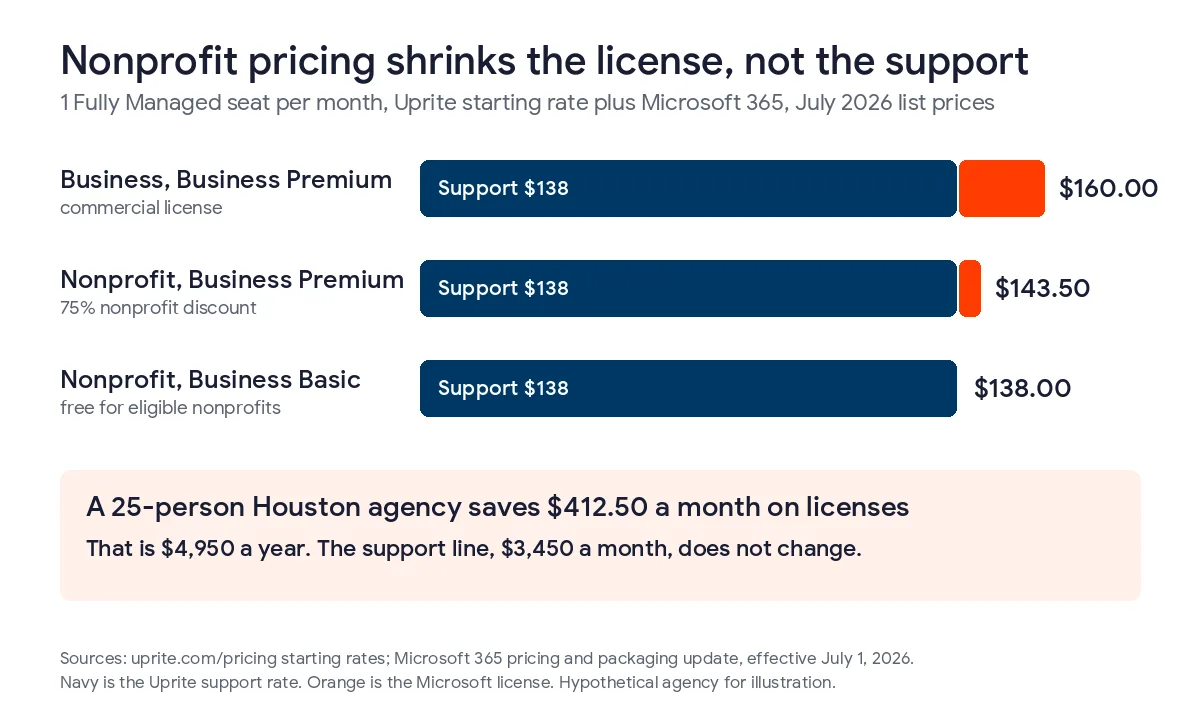
One thing has changed since many boards last looked. Microsoft’s nonprofit Microsoft 365 page now lists Business Premium as a 75% discount for eligible nonprofits, not a donation, so if your budget still assumes free Premium seats, check what your next renewal actually bills. Read the invoice. Prices quoted here are list prices, and Microsoft says they can vary by country and currency.
Who Counts as a User at a Houston Nonprofit?
This is where nonprofit quotes go sideways. A company’s user list is its payroll. A nonprofit has staff, part-time program workers, a board, and often a crowd of volunteers who answer phones, sort donations, or run an event once a year. Who gets a login? Who gets a seat?
Payrolls here are small. Private employers across the 5 counties averaged 16.4 people per workplace in 2025, as the Bureau of Labor Statistics counts them in its Quarterly Census of Employment and Wages. Individual and family services workplaces averaged 6.6. Social advocacy organizations averaged 12.0. Those industry counts include some for-profit employers, but the point holds. Small payrolls, big rosters.
Volunteers are the trap. Microsoft’s offer terms say volunteers, members, and program participants are not eligible for nonprofit licenses and subscriptions. Read that twice. There’s 1 exception. It’s narrow. Each licensed Microsoft 365 E3 or E5 seat can bring up to 5 Microsoft 365 F3 seats for volunteers. Most small Houston charities don’t buy E3 or E5. So a volunteer who needs an organization mailbox usually means a commercial license at full price. A shared staff login is not a fix. It leaves no record of who did what when something goes wrong, and it does not close the licensing gap either, because the person using it still is not eligible.
On the support side, we use position-based pricing, which means a front desk volunteer who checks a shared calendar isn’t billed like a development director who lives in the donor database all day. Our page on managed IT pricing in Texas explains how light-touch roles sit on a lower tier. We don’t publish a per-role price, because it depends on what each role touches, and I’m not going to invent one here.
My advice is simple. Bring a headcount broken out by role, staff first, then part-time workers, then volunteers who truly need access to donor or client records. Volunteers who only need a schedule rarely need a seat at all. A shared calendar works.
Most Houston Charities Are Too Small for Managed IT, and That’s Fine
I pulled the IRS Exempt Organizations Business Master File for Texas on October 27, 2026, and matched each ZIP code to a county using the Census Bureau’s 2020 ZIP code relationship files. After dropping private foundations, 26,427 public charities list an address in Harris, Fort Bend, Montgomery, Brazoria, or Galveston county. Harris alone has 17,053. About 5,425 of the total are churches. Churches bring their own IT questions, which our guide to IT support for Houston churches covers. That’s a big field.
| Revenue on the latest return in the IRS file | Public charities, 5 Houston-area counties | Share |
|---|---|---|
| Under $50,000 | 13,384 | 50.6% |
| $50,000 to $249,999 | 2,215 | 8.4% |
| $250,000 to $999,999 | 1,248 | 4.7% |
| $1 million to $4.99 million | 677 | 2.6% |
| $5 million or more | 393 | 1.5% |
| No revenue figure on file, common for churches, which need not file a return | 8,510 | 32.2% |
Only 2,318 of those charities, 8.8%, report revenue of $250,000 or more. Only about 1 in 25 reports $1 million or more. The rest are small. Many are run by volunteers, and plenty have no office at all. That’s the honest picture.
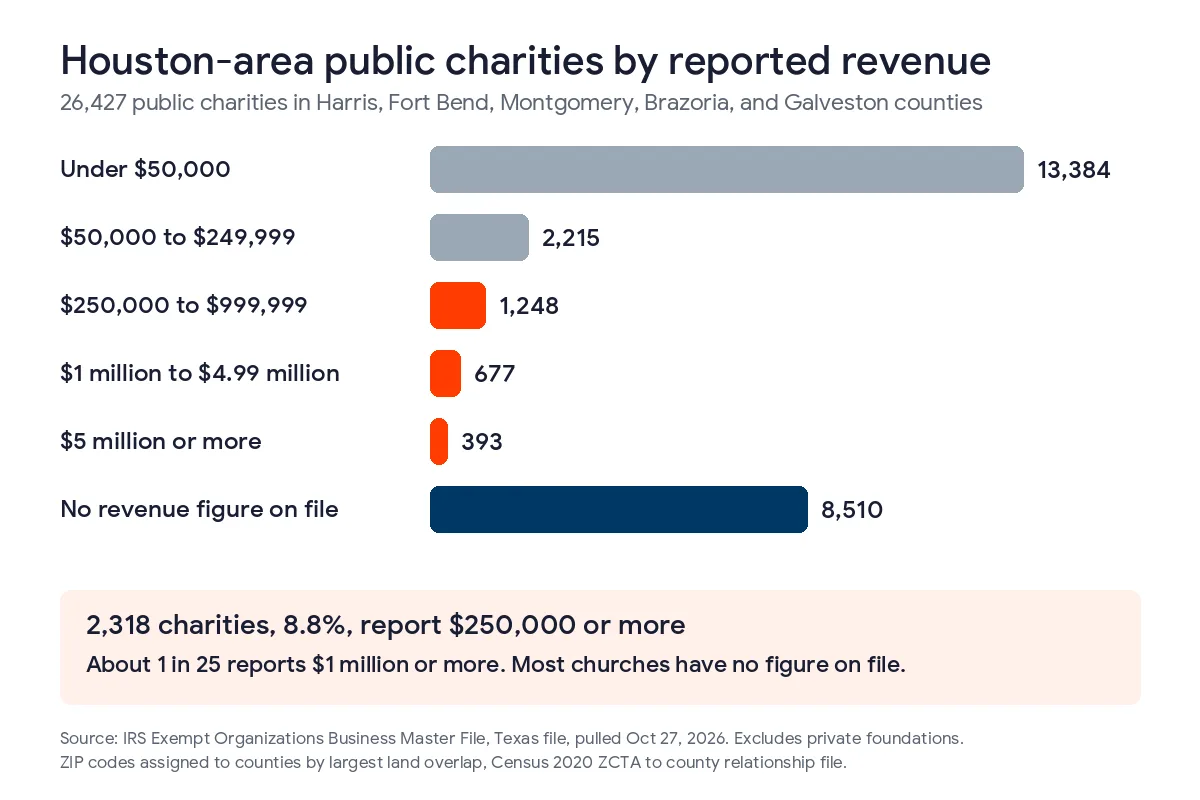
So what does managed IT look like as a share of a budget that’s big enough to need it? Take a made-up food bank partner agency with $500,000 in revenue and 8 staff. At our starting rates, Fully Managed with Business Premium comes to at least $1,148 a month, or $13,776 a year. That’s 2.8% of revenue. Manageable. On IT Essentials, which fits teams under 12 but has no after-hours help and caps support at 8 hours per user a month, the same 8 people start at about $772 a month. Now take a $3 million agency with 30 staff on Fully Managed. It pays from about $4,305 a month, or 1.7% of revenue. Scale helps. The percentage falls as the organization grows, because the number of people who need a seat rarely grows as fast as the budget does, especially when new money goes to programs, supplies, or grants passed through to partners rather than to new hires.
How Grants and Funders Can Cover the Cost
IT is usually overhead. Funders know that. Some pay anyway.
For federal money, the rule is 2 CFR 200.414(f). A recipient or subrecipient without a current federal negotiated indirect cost rate may elect to charge a de minimis rate of up to 15% of modified total direct costs, up from the old 10% cap, for awards made on or after October 1, 2024. On a hypothetical award with $400,000 in modified total direct costs, that’s up to $60,000 for indirect costs instead of $40,000. The $20,000 difference equals about 11 staff seats on Fully Managed for a year at our starting rate, if the award budget has room for it. Your costs must be charged consistently, as either direct or indirect. Never both. Check each award, because program rules can cap indirect costs lower, and talk to whoever prepares your grant budgets before you change how IT is charged on your books this year. For the planning side, see our guide to budgeting for IT at a Houston nonprofit.
The other place IT shows up is your Form 990. The IRS 2025 instructions put hardware, software, help desk and other technical support, information security, and IT contractor services on Part IX, line 14. Your contract lands there. Hardware you capitalize is depreciated on line 22 instead, and pay for your own IT staff goes on the compensation lines. Part IX applies only if you file the full Form 990, not the 990-EZ or 990-N. Your preparer or auditor makes the final call. Donors and grant reviewers can read that line. People do read it. I’d rather a board see a planned, steady number on line 14 every year than a sudden spike in the year a server died and the emergency invoices all landed at once.
What It Costs When Nonprofit IT Goes Wrong
The expensive month is rarely the contract. It’s the outage.
One nonprofit we worked with had about 40 staff depending on a single on-site server that failed without warning, with more than 3TB of data and decades of records on it. We stood up a temporary environment so people could work while the full recovery ran, and the systems were stable within days. The story is in our case study on rapid data recovery for a nonprofit organization. We don’t publish what that event cost the organization, so here’s a rough yardstick instead.
Workers at individual and family services employers in Harris County earned an average of $33,022 in 2025. Add benefits using the 1.43 multiplier implied by the BLS Employer Costs for Employee Compensation data and that’s about $22.68 an hour. If 40 people at that pay lose a full day, the organization burns about $7,258 in wages with nothing to show for it. A month of Fully Managed for 40 people with Business Premium starts at about $5,740. 1 bad day costs more than a month of prevention.
That’s also why I’d pay attention to a dull line on our pricing page. Fully Managed includes quarterly backup testing, meaning we actually restore files on a schedule. IT Essentials tests once a year. A backup that’s never been restored is a hope, not a plan. Test it.

Buildings add their own costs. When a Texas women’s shelter came to us, it was running consumer-grade network gear across several buildings, with outages and firewall gaps. We moved its servers to the cloud, upgraded the switching, and separated the staff network from the residents’ network, which you can read about in our IT transformation for a Texas women’s shelter. Hardware for each building is billed separately from the per-user rate, and internet service is its own contract. Budget for them separately.
And sometimes the cost is a provider who doesn’t answer. A national conservation nonprofit came to us after slow response times from its previous MSP, and our national nonprofit cybersecurity case study shows what changed once multifactor sign-in, a managed firewall, and quarterly reviews were in place. Security isn’t optional here. CISA and the FBI, with partner agencies in 5 other countries, published guidance for civil society groups in May 2024 because state-sponsored attackers go after them.
What a Houston Nonprofit IT Quote Should Show
Headline rates hide a lot. Before you compare totals, ask every provider to break these out.
- Which plan the per-user price comes from
- How staff, part-time workers, and volunteers are each counted
- Microsoft licenses as a separate charge, priced at the nonprofit rate where you qualify
- Equipment and internet service for every building or program site
- How many times a year a backup gets restored as a test
- Setup charges, and how the price changes after the first year
- Whether invoices can be split the way your grants and Form 990 need them
We’ll apply that yardstick when we compare the best IT providers for Houston nonprofits. Our service rate can’t go up during year 1, though Microsoft can still change license prices, and you can leave within 120 days if we haven’t satisfied you. Ask any provider for both.
When a Houston Nonprofit Doesn’t Need a Managed Provider
A lot of them don’t. An all-volunteer group with no staff, no office, and no sensitive records can get by with a few organization-owned accounts, multifactor sign-in turned on for everyone, and a written rule for who can approve payments. Remember the license terms above, since volunteers don’t qualify for nonprofit pricing. If that’s you, spend your time on those 3 things before you spend money on us.
The math flips once you have paid staff who sit idle whenever the network drops, client or donor records you’re responsible for, or more than 1 site to keep connected. A flat monthly fee beats paying for lost hours. If you already employ an IT person, co-managed support is usually the better fit. It runs $60 to $130 per user here, and the outside team covers nights and security tooling while your person keeps the daily requests.
You could hire instead. The May 2025 BLS wage survey puts the average Houston computer user support specialist at $62,700, roughly $89,600 once benefits are added. As our guide to how much managed IT costs in Houston works out, that salary would cover about 54 users on the $138 plan. Few charities here have 54 staff. And 1 hire can’t cover nights or their own vacation. Nobody can.
Reach us through the contact page with your staff count, roles, and sites. The button below works too.
List your staff, part-time workers, and volunteers who need access, plus the buildings you run. You’ll get a quote with each group priced separately, nonprofit licensing shown apart, and a plain note on who can skip a seat.
Get My Nonprofit QuoteHouston Nonprofit IT Pricing Questions
How much does managed IT cost a Houston nonprofit?
Most Houston nonprofits pay $125 to $175 per user each month for fully managed IT in 2026, plus up to $5.50 per user for Microsoft 365 at nonprofit prices. The Uprite Fully Managed plan begins at $138. Teams under 12 people can start on IT Essentials at $91 per user, with business hours support only.
Do nonprofits get a discount on Microsoft 365?
Yes, on licensing. As of July 2026, eligible nonprofits pay $5.50 per user for Business Premium instead of $22, and Business Basic is free. Microsoft lists Premium as a 75 percent discount now, not a donation, so budgets that assume free Premium seats need updating.
Can volunteers use nonprofit Microsoft licenses?
No, with 1 narrow exception. Microsoft says volunteers, members, and program participants are not eligible for nonprofit licenses. Each licensed Microsoft 365 E3 or E5 seat can bring up to 5 F3 seats for volunteers. Most small Houston charities use Business plans, so volunteers who need mailboxes usually need commercial licenses.
Can a federal grant pay for managed IT?
Often, through indirect costs. Under 2 CFR 200.414(f), an organization without a current federal negotiated rate may elect a de minimis indirect rate of up to 15 percent of modified total direct costs for awards made on or after October 1, 2024. IT must be charged consistently as direct or indirect, never both.
Where does IT spending go on Form 990?
On Part IX, line 14, Information technology. The 2025 IRS instructions place hardware, software, help desk support, information security, and IT contractor services there, so a managed IT contract belongs on that line. Pay for your own IT employees goes on the compensation lines instead. Groups that file Form 990-EZ or 990-N do not report this line.
Is a small Houston charity better off without a managed provider?
Sometimes, yes. Of 26,427 public charities in the 5 Houston-area counties, only 8.8 percent report revenue of $250,000 or more on their latest IRS return. An all-volunteer group with no office or staff can rely on a few organization accounts, turn on multifactor sign-in for every account, and write down who approves payments.
Would hiring our own IT person cost less?
Below about 54 users, usually not. The average Houston computer user support specialist earned $62,700 in the May 2025 BLS survey, about $89,600 with benefits, enough to pay for 54 users on the $138 plan. Few Houston charities employ that many people, and a single hire still leaves nights, vacations, and security work uncovered.