Most Fort Worth small businesses can skip a vCISO. You need one once security decisions keep landing on someone’s desk that nobody at the company is qualified to make, and that usually starts with HIPAA, the FTC Safeguards Rule, a defense contract, an insurer, or a breach.
I run Uprite, and we sell exactly this kind of part-time security leadership through our vCISO services in Fort Worth. Weigh what follows against the fact that I’d be glad to sell you one. I’d still rather tell a 9-person office in Burleson to keep its money than sign it to a retainer it won’t use.
Census counts 48,624 employer locations on the Fort Worth side of the metro with fewer than 20 people, and Texas asks very little of them in writing. What changes the answer is how often someone needs a security decision your staff can’t make. So I wouldn’t start with headcount. I’d start by counting those decisions from the last 12 months, because the count tells you more than the org chart does.
What does a vCISO actually do?
vCISO is short for virtual chief information security officer. It’s a senior security person you rent for a slice of each month. It’s a judgment job more than a keyboard job. A vCISO decides which risks the owners will accept, writes the program that says so, and backs the answers your company gives to an auditor, a carrier, or a prime contractor.
Your IT provider does different work. It patches machines, watches backups, resets passwords, and turns on multi-factor login. Picture a 40-person HVAC distributor in Haltom City whose IT company keeps every laptop current. Then a large general contractor sends a vendor security form, and question 18 asks who approved the company’s incident response plan. The IT company can’t answer that, and it shouldn’t try, because approving the plan is a business decision. That gap is the whole case for a vCISO. It either shows up in your company or it doesn’t. If you’re also weighing an outside compliance firm, our comparison of a vCISO vs compliance consultant in Fort Worth shows who does what.
How many Fort Worth businesses could go without one?
The large majority. In its 2023 County Business Patterns release, the Census Bureau counts 58,176 employer locations in the 6 counties of the Fort Worth-Arlington-Grapevine division, which are Tarrant, Johnson, Parker, Wise, Hood, and Somervell. Tarrant alone holds 47,656 of them. We lined each size band up against the tier Texas law assigns to it.
| Employees at the location | Fort Worth division locations | Share | What chapter 542 expects |
|---|---|---|---|
| Fewer than 20 | 48,624 | 83.6% | Password policies and staff cybersecurity training |
| 20 to 99 | 8,034 | 13.8% | Moderate measures built on CIS Implementation Group 1 |
| 100 to 249 | 1,071 | 1.8% | A program that follows a recognized framework |
| 250 or more | 447 | 0.8% | Over the size limit, so no safe harbor |
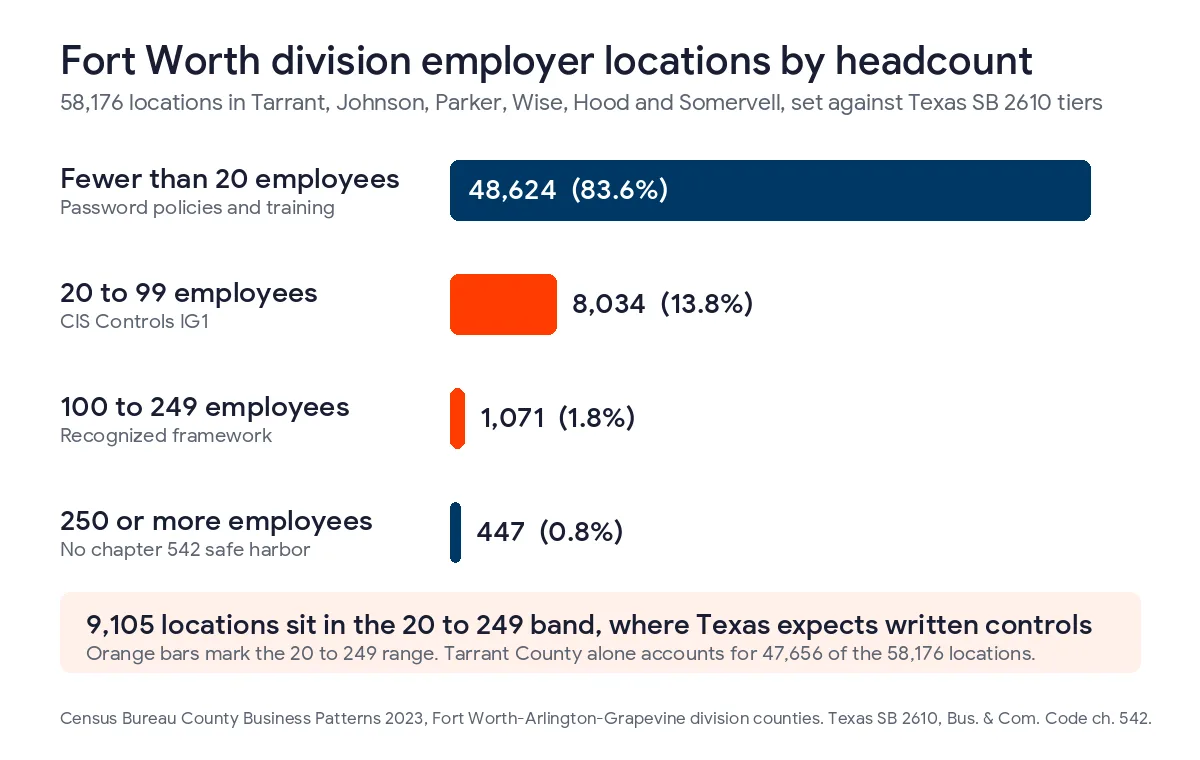
Those tiers come from Senate Bill 2610, in effect since September 1, 2025. The law shields a business under 250 employees from exemplary damages after a breach, but only if its program matched its tier when the breach happened. For the middle tier that means CIS Implementation Group 1, 56 safeguards a 60-person firm has to be able to prove with dates. Proving things with dates is squarely a vCISO job.
Read the counts with one caveat. Census counts locations, not companies, so a 6-person branch of a national lender sits in the top row beside a 6-person dental office in Weatherford. That branch has a security team in another state. That dental office has HIPAA duties and, most likely, nobody whose job it is to own them.
Count your security decisions from the last 12 months
Headcount gets you a rough answer. You’ll get a better one by looking back over the past year and counting the moments when someone had to make a security call that went past fixing a computer. I mean decisions that cost the business something if they were wrong.
These are the 7 we run into most often with Tarrant County companies. Go down the list and count honestly.
- An insurance renewal asked about controls, and an officer signed the answers.
- A customer or prime contractor sent a security questionnaire or a contract clause about protecting data.
- A regulation required a written risk analysis or a named security owner.
- You gave a new vendor access to client, patient, or employee records.
- Someone with admin rights left the company.
- A fake invoice, a payroll change request, or a strange login got far enough that people argued about what to do.
- You had to decide whether something was a reportable breach.
If you counted 0 or 1, your IT provider and a free framework will carry you. If you counted 2 or 3, buy help on those specific decisions as they come up. At 4 or more, you’re making security policy by accident every quarter, and that’s when a standing vCISO earns the fee, since the decisions start depending on each other.
That scale is ours. No regulator wrote it, and I’d bend it in one direction only. If a single item on your list involved patient data, defense information, or a signed insurance application, treat your count as one higher.
Which Fort Worth businesses need a security owner no matter their size?
Some industries don’t get to wait for the count. Federal rules name the role outright, and they don’t scale it down for small firms. The location counts below are Tarrant County figures from the same Census release.
Medical and dental offices
Under 45 CFR 164.308, each covered practice has to identify a security official and keep a current risk analysis. No headcount floor applies. Tarrant has 1,029 dental locations, and 988 of them employ fewer than 20 people. It also has 1,768 physicians’ offices, 1,556 of them under 20. In most of those offices the security official is the practice manager, who also handles scheduling and payroll.
That arrangement can work. What usually goes missing is a second set of eyes on the risk analysis, and a few hours a year of outside review fixes it. Our guide to a cybersecurity risk assessment in Fort Worth covers the scope, cost and timeline. HHS proposed a stricter version of the Security Rule in January 2025, and it still wasn’t final when we wrote this, so plan for the current text. Our page on healthcare IT services in Fort Worth covers the systems side.
Tax preparers, mortgage brokers, and car dealers
The FTC reads “financial institution” more broadly than most owners expect. Its definition in 16 CFR 314.2 pulls in tax preparers, mortgage brokers, and dealers who lease vehicles. All of them have to designate a Qualified Individual, a duty spelled out in 16 CFR 314.4. Firms holding data on fewer than 5,000 consumers get relief under 16 CFR 314.6, which drops the written risk assessment, the written incident response plan, the annual report, and the monitoring or penetration testing rule. The relief doesn’t touch the Qualified Individual, so somebody still holds that title.
The two ends of this group look nothing alike. Tarrant has 803 accounting and tax locations, and 757 have fewer than 20 people, so a partner acting as the Qualified Individual plus a written plan covers most of them. The county’s 105 new car dealer locations run the other way. 78 have 20 or more employees, and a dealership finance office on Interstate 20 that handles credit applications all day carries far more risk than a 4-person tax office on Camp Bowie.
Defense and aerospace suppliers
This group is what makes Fort Worth different from the rest of Texas. Tarrant has 37 aerospace product locations employing 22,343 people, which is mostly Lockheed Martin and Bell, plus 322 fabricated metal shops. When we went through federal subaward records for fiscal 2025, we found 122 Tarrant County companies holding DoD subcontracts. A 25-person machine shop in Haltom City can end up holding controlled unclassified information because a prime flowed it down.
DoD’s CMMC rollout is in an odd spot right now. The department suspended Phase 2, the third-party assessments, on July 13, 2026, and Lockheed Martin told its suppliers that Phase 1 self-assessments and the NIST SP 800-171 baseline still apply. DFARS 252.204-7012 hasn’t moved either. Under 32 CFR 170.22, a senior company official affirms compliance in SPRS, which means a named person tells the federal government the controls are in place. I wouldn’t let anyone make that statement on the strength of the IT vendor’s say-so. For the flow-down chain in detail, see our CMMC guide for Fort Worth aerospace suppliers.
Anyone who signs a cyber insurance application
No statute turns an insurance application into a security document. Your signature does. Carriers want to know about MFA on remote access, offline backups, and how email gets filtered, and an officer of your company puts a name to every reply. Should one of those replies prove false after a ransomware event, the carrier has grounds to fight the claim. The questions carriers are asking this year are in our cyber insurance renewal checklist for DFW.
What do Fort Worth breach notices show?
The Texas Attorney General publishes every breach notice that affects at least 250 Texans. Our pull of that public breach list on November 23, 2026 returned 699 notices posted since April 11, 2025, and 22 came from organizations based in Fort Worth-side cities such as Fort Worth, Grapevine, Bedford, Azle, Cleburne, and Mansfield.
They weren’t the big names you’d guess. 7 were retailers or merchants, 5 were medical or dental practices, 3 were school district filings, 2 were local governments, and 1 was an insurance agency. The other 4 were a law firm, an adoption agency, a steel products company, and a management services firm. The median notice covered about 2,140 Texans, and 5 covered fewer than 1,000.
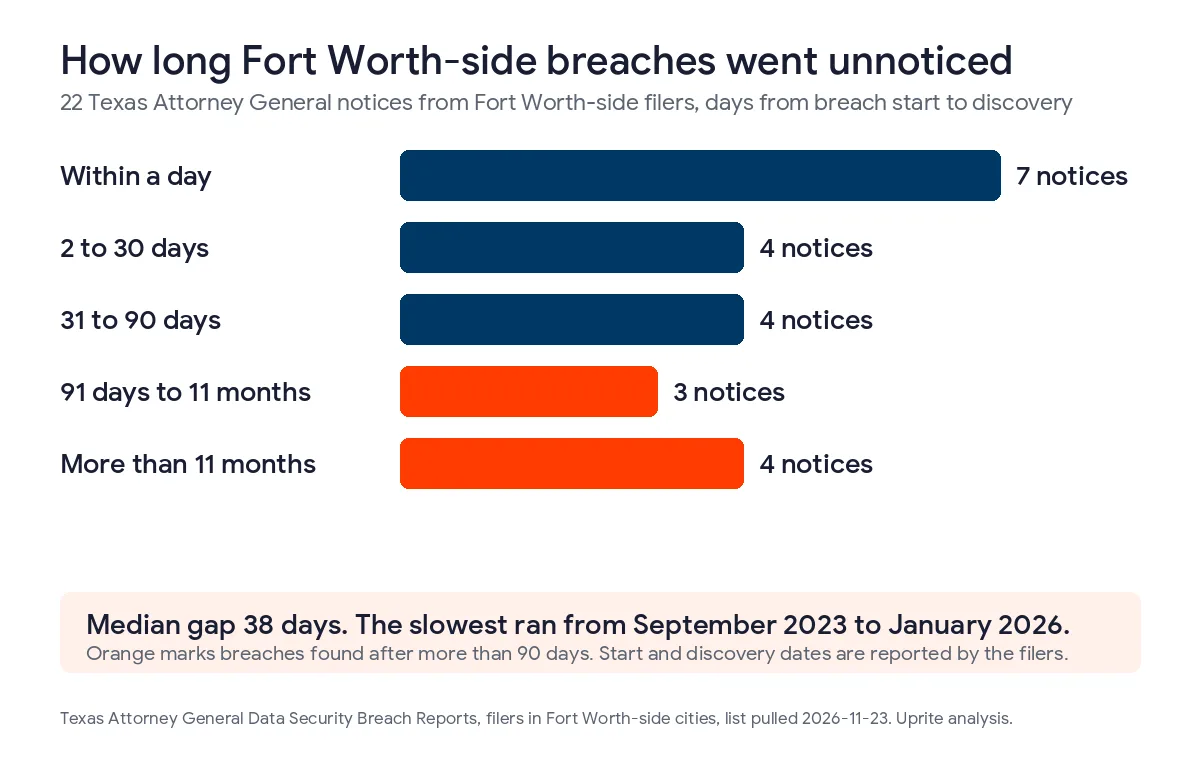
I’d look at the dates first. All 22 list when the breach started and when it was discovered. 7 organizations found theirs within a day. 7 others took more than 90 days, and 4 of those took longer than 11 months. The slowest, a retail services company in Crowley, reported a breach that began in September 2023 and wasn’t found until January 2026. Across all 22, the median gap was 38 days. Filers report these dates themselves, so treat them as approximate.
That split matters here. Catching a quiet breach sooner is mostly monitoring work, which is what managed security services in Fort Worth are for. Knowing what to do on day 1 is a leadership job. Texas gives you 30 days from the date you determine a breach occurred to tell the Attorney General, if it touches 250 or more residents. That clock sits in Business and Commerce Code 521.053. On the AG’s site, 11 of the 22 notices went up more than 30 days after the discovery date the filer gave. The posting date isn’t the filing date, so that doesn’t prove anyone filed late. It does show how much happens between “we found something” and a public notice, and somebody at your company should own that stretch before it starts.
When is it fine for a Fort Worth company to wait?
Waiting is reasonable if every one of these is true.
- Headcount is under 20.
- No medical charts, tax returns, loan files, or defense drawings live on your systems.
- Your 12-month count was 0 or 1.
- Your IT provider can show dated evidence that MFA is on, restores have been tested, and patches go out.
In that case the free material is good enough for now. The Small Business Quick-Start Guide from NIST runs a handful of pages and reads in one sitting. CISA’s Cyber Hygiene services include free scanning of internet-facing systems for critical infrastructure organizations, and health care practices and utilities count. Our small business cybersecurity checklist for Fort Worth turns the basics into a single page.
Which kind of help fits your count?
Match your result to a row. When two rows fit, take the more cautious one.
| Where you landed | What we’d start with |
|---|---|
| Count of 0 or 1, no regulated data | Keep your IT provider and work through the NIST guide |
| Count of 0 or 1, with patient, tax, or loan data | Make one employee the owner and get a yearly outside review |
| Count of 2 or 3 | A short vCISO project for each decision, such as one renewal form or one questionnaire |
| Count of 4 or more, under 100 people | Monthly vCISO hours aimed at the 56 IG1 safeguards |
| Defense supplier holding CUI, or 100 to 249 people | Standing vCISO coverage and 24/7 monitoring |
| 250 or more staff, with audits every month | Compare a full-time hire with fractional coverage |
For what each of these runs locally, see our breakdown of what cybersecurity costs in Fort Worth, or our guide to vCISO cost in Fort Worth for retainer ranges.

Where to go from here
If you landed in the bottom 3 rows, get a written program in place before the next renewal or questionnaire shows up, because those forms arrive on someone else’s schedule. If you landed in the top row, bookmark this and recount when you hire employee number 20 or a customer sends you its first security form. If you want to compare firms before calling anyone, start with our list of the best vCISO providers in Fort Worth.
Questions Fort Worth owners ask before hiring a vCISO
Is a vCISO the same thing as a vCIO?
No. A vCIO plans technology spending and projects, and a vCISO owns security risk and the program behind it. Some small firms buy both from one provider. That works as long as the security person is free to disagree with the technology plan.
Can my managed IT provider act as my vCISO?
It can, if the security person there isn’t also working your help desk queue. Ask who would sign your written program. Then ask what happens when their own team’s work is the thing that failed, since a vCISO has to be able to say so.
We’re a 25-person machine shop in Arlington with one defense customer. Where do we start?
Ask your customer whether you hold controlled unclassified information. If you do, DFARS 7012 and a NIST SP 800-171 self-assessment apply today, Phase 2 suspension or not, and a vCISO usually pays for itself. If you only handle federal contract information, CMMC Level 1 is a much lighter lift.
Our insurance renewal is due next month. Is that too soon to bring in a vCISO?
Not usually. One application is a small project measured in hours. The vCISO checks each answer against evidence, flags the ones you can’t support, and helps you fix or correct them before an officer signs.
What does a vCISO hand over in the first 90 days?
Expect 4 things. A finished risk assessment, fixes ranked by cost and risk, a written program the owners signed, and an incident plan naming who makes which call in the first hour. If you get a generic template with your logo on the cover, push back.
Could we hire a security analyst instead?
You could, but an analyst usually isn’t the person who signs. BLS wage data for May 2025 shows 7,080 information security analysts employed across the whole Dallas-Fort Worth metro, earning a mean $133,790. Computer and information systems managers, who sit closer to the signing level, averaged $185,720. Few firms under 100 people have a full week of that work.
Tell us your count from the 12-month list. We’ll give you a straight answer on whether a vCISO makes sense for your Fort Worth company, and if the answer is no, you’ll hear that from us too.
Speak to a vCISO