
A compliance consultant gets a Fort Worth company ready for one audit, assessment, or questionnaire and then hands back the file. A vCISO owns the security program after that, including the risk reviews, scans, and written reports that federal rules make you repeat.
I run Uprite, and this post is a companion to our page on vCISO services in Fort Worth. The question usually reaches me after a compliance project has ended. A dealership, a dental practice, or a parts supplier paid someone to write policies and score its controls, and the binder came back looking good. Then the next year arrives with a board report to write, scans to run, and a risk assessment that no longer matches the business, and nobody’s name is on any of it. Below I cover what each role delivers, how many Tarrant County businesses fall under a rule that asks for a named security owner, which duties come back every year, what each option costs, and when a consultant alone is the right call.
Hire a compliance consultant when the job has an end date, like a first HIPAA risk analysis, a CMMC gap assessment, or a written Safeguards Rule program. Hire a vCISO when someone has to keep that program running. The FTC Safeguards Rule asks for a named Qualified Individual, a yearly written report, a yearly penetration test unless you monitor continuously, and vulnerability scans every 6 months. Firms with fewer than 5,000 customers are exempt from several of those duties.
What’s the difference between a vCISO and a compliance consultant?
A compliance consultant measures your company against one framework, such as HIPAA, the FTC Safeguards Rule, or CMMC, and delivers a gap list, policies, and evidence for a review. A vCISO, or virtual chief information security officer, is a part-time security executive who owns the whole program and decides what happens next.
| Point of comparison | Compliance consultant | vCISO |
|---|---|---|
| What you’re buying | A defined deliverable for one framework | A named owner for the security program |
| When it ends | When the report or the audit is done | Not while the contract runs |
| Scope | The controls that framework lists | Every security risk, including ones no rule mentions |
| Who gets the results | The person who hired them | Ownership or the board, in writing |
| Typical billing | Fixed fee or hourly | A monthly block of hours |
| Can serve as the named security person | Rarely, since the engagement ends | Yes under the FTC rule, with conditions |
The two overlap more than the job titles suggest. A good consultant often knows a single framework in more depth than a vCISO does, and a vCISO spends a large share of the year on compliance evidence. The real split is ownership after the deliverable. Ask who will update the risk assessment when you open a second location or switch to new software. If no one is assigned, the documents start drifting the first time the business changes.
How many Fort Worth businesses fall under a rule that names a security owner?
About 4,100 private workplaces in Tarrant County are in industries covered by the FTC Safeguards Rule, HIPAA, or CMMC, based on the 2025 BLS Quarterly Census of Employment and Wages. That’s roughly 1 in 12 of the county’s 49,561 private establishments. I pulled the counts by industry code to see who actually sits in each group.
| Industry (NAICS code) | Tarrant establishments, 2025 | Employees | Rule that usually applies |
|---|---|---|---|
| New car dealers (441110) | 101 | 9,098 | FTC Safeguards Rule when they arrange financing or leases |
| Used car dealers (441120) | 186 | 1,594 | FTC Safeguards Rule when they arrange financing |
| Nondepository lenders, including mortgage lenders (5222) | 347 | 9,665 | FTC Safeguards Rule |
| CPA offices (541211) | 284 | 2,074 | FTC Safeguards Rule when they prepare returns |
| Tax preparation offices (541213) | 261 | 591 | FTC Safeguards Rule |
| Physician offices (6211) | 1,908 | 21,565 | HIPAA Security Rule |
| Dental offices (6212) | 943 | 6,889 | HIPAA Security Rule |
| Aerospace product and parts makers (3364) | 56 | 22,742 | CMMC and DFARS contract clauses |
The average size is what caught my eye. A Tarrant tax preparation office has about 2 employees, a dental office about 7, and a new car dealer about 90, while the 56 aerospace sites average around 406. A 2-person tax office and a 90-person dealership answer to the same FTC rule, but they shouldn’t buy the same kind of help.
Keep in mind that the BLS counts locations, not companies, and the rules turn on what a business does. A used car lot that never arranges financing may not be a financial institution under the rule at all, and a medical office that never bills insurance electronically may sit outside HIPAA. Your attorney should confirm which rules reach you before you buy anything.
Which compliance duties come back every year?
Each of these rules sets duties that repeat. A consultant can handle the first round of every one of them, and the question worth asking is who handles the second round.
| Duty | Where it comes from | How often | Usual owner |
|---|---|---|---|
| Name a person to oversee, run, and enforce the program | 16 CFR 314.4(a) | Ongoing | vCISO or a qualified employee |
| Written risk assessment, then reassessments | 16 CFR 314.4(b) | Once, then periodically | Consultant first, vCISO after |
| Penetration test | 16 CFR 314.4(d)(2)(i) | Yearly, unless monitoring is continuous | Outside tester, scoped by the vCISO |
| Vulnerability assessment | 16 CFR 314.4(d)(2)(ii) | At least every 6 months and after material changes | vCISO with your IT provider |
| Written report to the board or a senior officer | 16 CFR 314.4(i) | At least yearly | vCISO |
| Notice to the FTC for an event involving 500 or more consumers | 16 CFR 314.4(j) | Within 30 days of discovery | vCISO coordinates, the company files |
| Identify a HIPAA security official | 45 CFR 164.308(a)(2) | Ongoing | An employee, often with vCISO support |
| Review audit logs and access reports | 45 CFR 164.308(a)(1)(ii)(D) | Regularly | vCISO with your IT provider |
| Keep and review security documentation | 45 CFR 164.316(b)(2) | Keep 6 years, review periodically | vCISO |
| CMMC Level 1 self-assessment and affirmation | 32 CFR 170.15 and 170.22 | Yearly | vCISO prepares, a senior employee signs |
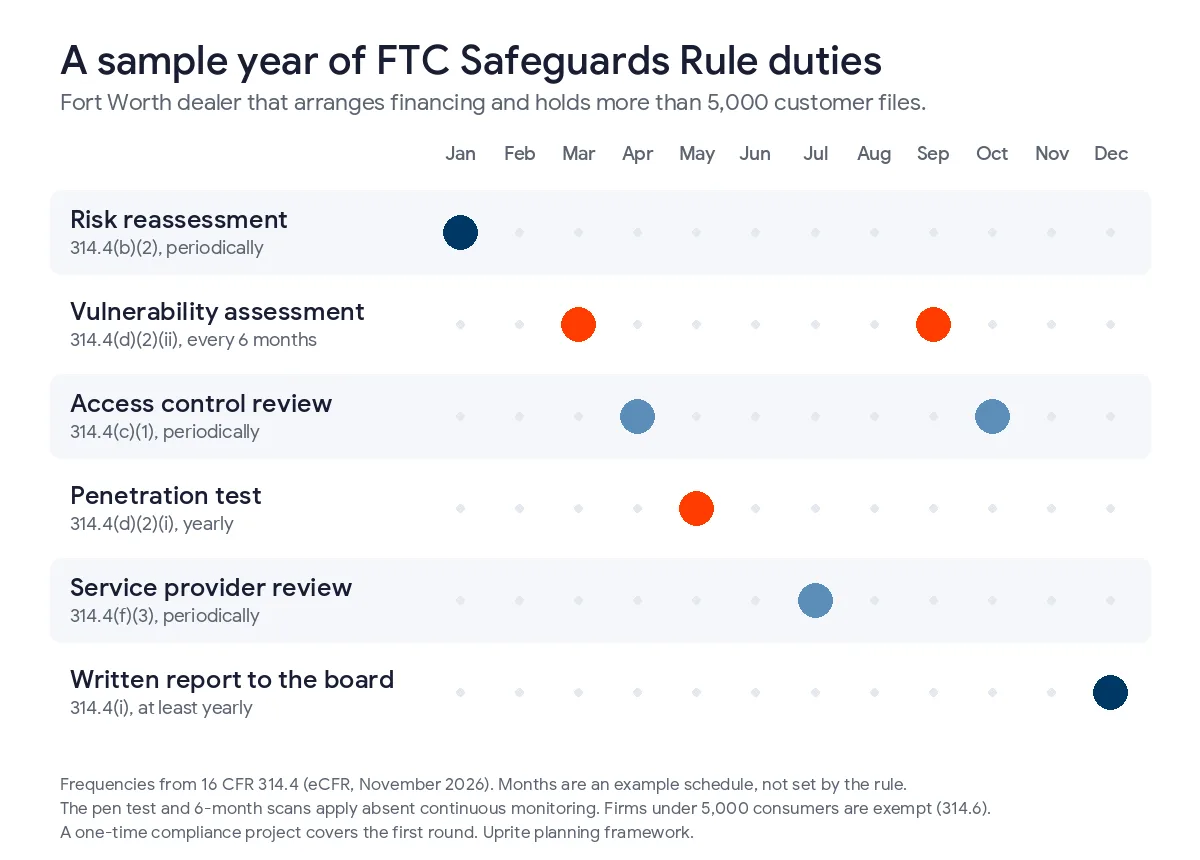
The FTC rule answers the outsider question directly. Section 314.4(a) says the Qualified Individual can be employed by you, an affiliate, or a service provider. If you use an outsider, you keep responsibility for compliance, you designate a senior employee to direct and oversee that person, and you require the provider to maintain its own security program. That describes a vCISO arrangement well. It describes a finished consulting project poorly, because the rule’s job description is overseeing, implementing, and enforcing the program, and a consultant who wrapped up in March isn’t doing any of those things in October.
HIPAA reads a little differently. Section 164.308(a)(2) tells a practice to identify the security official responsible for its security policies, and it doesn’t say that person has to be an employee. In small practices I usually see the office manager named, with an outside adviser doing the technical work. NIST’s SP 800-66 Revision 2, published in February 2024, lays out what that official is expected to oversee, and it’s a better reading list than most vendor checklists. Under section 164.316(b)(2), the documentation has to be kept for 6 years and reviewed periodically, which is another job that outlasts a project.
Defense suppliers have their own repeat cycle. 32 CFR 170.22 requires an affirmation of continuing compliance every year, signed by a senior person inside the company. Our post on CMMC for Fort Worth aerospace suppliers covers that cycle for shops working under a prime.
Does the 5,000-customer exemption change the answer?
It can. Section 314.6 exempts financial institutions that hold information on fewer than 5,000 consumers from 4 parts of the FTC rule. Those are the written risk assessment, the penetration testing and vulnerability assessments, the written incident response plan, and the yearly report to the board.
The Qualified Individual requirement still applies, along with access controls, encryption, multi-factor authentication, training, and oversight of service providers. Take a hypothetical 2-person tax office in Benbrook with 900 clients. Its list is short. A consultant can set up the controls and policies in a few days of work, and the owner can act as the Qualified Individual. A monthly vCISO fee wouldn’t make sense to me there.
Dealers sit on the other side of the line more often. A dealership that has arranged financing for several years may well hold more than 5,000 customer files, and once it does, every recurring duty in the table above applies to it.
What does each option cost a Fort Worth company?
For hourly rates I used the GSA CALC labor rate tool, which lists the ceiling prices vendors hold on federal contracts. On November 23, 2026, it held 139 rates for security and IT compliance job titles without a clearance requirement, from 68 vendors. The median was $150.88 an hour, and the middle half ran from $114.74 to $182.62. Titles for chief information security officer showed 100 rates from 66 vendors, with a median of $204.71 and a middle half of $174.39 to $243.63.
A vCISO hour therefore costs about 36% more than a compliance hour at the median. The compliance titles include junior analysts, which pulls that median down, and every figure here is a ceiling, so commercial quotes often come in lower.
| Option | Hours | Year 1 | Year 2 |
|---|---|---|---|
| Compliance consultant, one project | 60 to 120 | About $9,050 to $18,110 | Nothing, and no owner |
| Consultant called back for the report and reassessment | 40 more in year 2 | About $9,050 to $18,110 | About $6,040 |
| vCISO at 8 hours a month | 96 a year | About $19,650 | About $19,650 |
| vCISO at 16 hours a month | 192 a year | About $39,300 | About $39,300 |
The hour counts are my own planning figures for a company of 40 to 100 people under one framework. They aren’t survey data. The penetration test and the scans are billed separately in every row. A full-time security executive in the metro costs about $265,600 a year with benefits, and our comparison of a vCISO vs a full-time CISO shows where that line crosses.
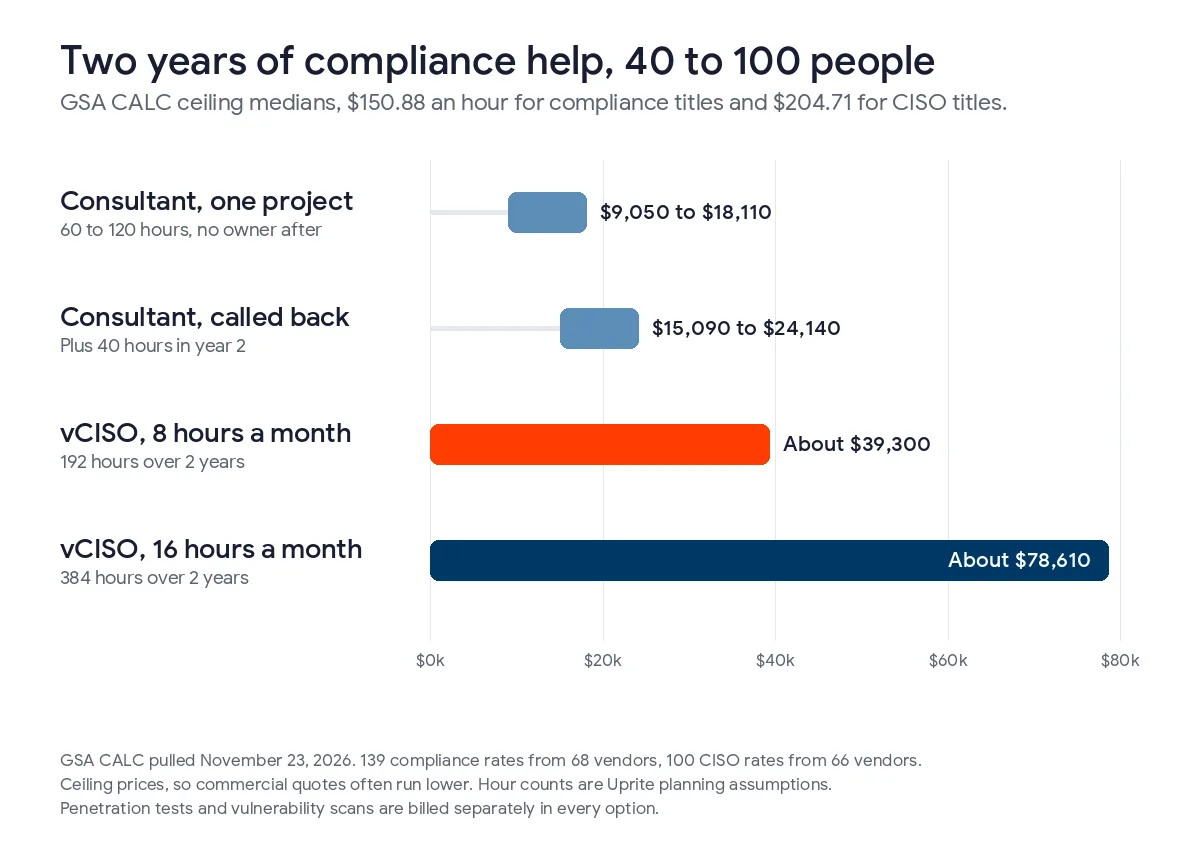
On price alone, the consultant wins for a company with a short duty list. The vCISO starts paying for itself when a second framework, a second location, or a large customer’s security questionnaire shows up, since each of those adds work that nobody scoped in the original project.
Which one fits your business?
I’d sort it by the duty list, not by headcount alone. These 5 examples come up often around Tarrant County.
| Your situation | What I’d suggest | Why |
|---|---|---|
| 2-person tax office with fewer than 5,000 clients | A consultant for setup, with the owner as Qualified Individual | Section 314.6 removes most of the recurring work |
| 12-person dental office in Keller | A consultant for the first risk analysis, the office manager as security official, and a yearly check-in | HIPAA needs a named official and current records, not weekly oversight |
| Dealership on the west side that arranges financing | A vCISO | The board report, pen test, and scans come back every year |
| 60-person machine shop near AllianceTexas supplying a prime | A consultant for the gap assessment, then a vCISO for the yearly cycle | The first assessment ends, but the affirmation repeats |
| 120-person mortgage lender with 2 offices | A vCISO working with a managed security team | Several duties, 2 sites, and customer audits add up to steady monthly work |
We sell vCISO hours, so weigh my view with that in mind. I’d still send an owner to an independent consultant in 3 cases. The first is when you want a second opinion on a provider’s controls, ours included. The second is when you want the person scoring your controls to be someone who didn’t set them up. The third is when your duty list is short enough that one visit a year covers it.
What happened when one of our clients had the policies but no owner?
One of our clients under the FTC Safeguards Rule had already done most of the work. Policies existed and controls were running. What it lacked was an owner and a schedule. Documents had drifted away from what the rule requires, and some controls that were in place couldn’t be shown on paper when someone asked.
We started by reviewing every policy against the rule and turned the gaps into checklists, each with an owner and the evidence that proves it. Then we set a recurring review schedule, so the program stays current between review cycles instead of getting rebuilt under pressure. The full write-up is in our FTC Safeguards Rule remediation case study.

The first half of that engagement is the part a compliance consultant does well. The second half, keeping it current with a name attached, is the vCISO job, and it’s the half that tends to go missing.
How does Uprite handle this for Fort Worth companies?
We do both kinds of work. Our compliance and regulatory assessment is a project that ends with a gap list and a plan. Our vCISO service puts a named person in charge of the program after that, priced by scope once we’ve reviewed your duties. The vCISO works on top of our managed security services in Fort Worth, where the monitoring and endpoint protection run. We aren’t a law firm and we don’t certify anyone. Your attorney reads the rules, and any certificate comes from an outside assessor.
Fort Worth clients are served from our Dallas office at 5757 Alpha Rd, roughly 30 miles east of downtown, and our average response time is 5 minutes. If you’re still sizing the budget, our Fort Worth cybersecurity cost guide and the Texas SB 2610 safe harbor checklist are good places to start. Clinics can see how this fits on our healthcare IT services in Fort Worth page, and lenders and CPA firms on our financial services IT in Fort Worth page. If the open question is technology planning rather than security, our post on a vCIO vs an IT consultant in Fort Worth covers that choice, and the rest of our security work is on our cybersecurity services in Fort Worth page.
What Fort Worth owners ask before choosing
Can an outside vCISO serve as our FTC Qualified Individual?
Section 314.4(a) allows it, with conditions. You keep responsibility for compliance, you name a senior employee to direct and oversee the vCISO, and you require the provider to maintain its own security program.
Will a compliance consultant certify that we’re HIPAA compliant?
No government agency issues a HIPAA certification, so any certificate a consultant hands you is their own document. What they can give you is a written risk analysis and a gap list, and those records matter far more if a patient complaint or a breach ever leads to questions.
We have fewer than 5,000 customers. What does the Safeguards Rule still require?
The Qualified Individual, access controls, encryption, multi-factor authentication, training, and service provider oversight all still apply. Section 314.6 only removes the written risk assessment, the testing requirements, the written incident response plan, and the board report.
How many hours a month does a vCISO spend on a 50-person company?
About 8 to 16 hours in a normal month for one framework, based on our planning figures. The first quarter runs heavier while the risk assessment and policies get built, and months with a board report or a pen test take longer than quiet ones.
Should the same firm write our policies and test them?
It’s allowed, and it saves time, but nobody checks the author’s work. Some owners split it, with one firm building the program and another running the yearly penetration test.
What happens to the compliance binder after the consultant leaves?
It stays accurate until something changes, like a new system, a new vendor, or a key person leaving. HIPAA asks you to keep security documentation for 6 years and review it periodically, so somebody has to be assigned to that review.
Have a Safeguards, HIPAA, or CMMC duty on your list with no name next to it? Send us the list. We’ll tell you which items a one-time project can close and which ones need an owner. Our average response time is 5 minutes.
Talk to a vCISO