
A cybersecurity risk assessment for a Fort Worth company of 25 to 99 people usually takes 2 to 4 weeks and costs about $5,600 to $12,700 at published federal rate-card prices. Smaller offices pay less, and it’s often the first project in our vCISO services in Fort Worth.
Few Fort Worth companies go looking for one. A request shows up instead. It might be a cyber insurance renewal form, a supplier portal from a defense prime, or a hospital system that wants proof before it shares patient data with your clinic. Each of those people wants something a little different, and the scope you agree to decides both the invoice and the calendar. We wrote this for owners, controllers, plant managers, and practice managers who’ve been handed that request. Our cybersecurity services in Fort Worth start with a free security assessment, and further down we’re clear about where the free part ends.
Plan on getting back a list of every system, data set, and vendor you rely on, a likelihood and impact rating for each risk, and a fix list with names and dates on it. Budget 20 to 30 assessor hours under 25 employees, 40 to 60 hours up to 99, and 80 to 120 hours above that. Who asked for the assessment matters more than headcount, because a defense prime, an insurer, and HIPAA each expect a different document.
What is a cybersecurity risk assessment?
A risk assessment, in cybersecurity terms, is a structured review of what your company depends on, from laptops and Microsoft 365 to payroll vendors and shop-floor PCs, and what could realistically go wrong with each. Every risk is rated for likelihood and business impact, given an owner, and paired with a fix. The output is called a risk register.
Assessors usually follow NIST Special Publication 800-30, which splits the work into 4 phases. You prepare, you conduct the review, you communicate the results, and you keep the register current as things change. Version 2.0 of the NIST Cybersecurity Framework puts this work in its Risk Assessment category, and its last outcome, ID.RA-10, asks you to assess critical suppliers before you buy from them. For a Fort Worth subcontractor that cuts both ways. You’re assessing your vendors while your own customers are assessing you.
Who asked for it, and what will they accept?
Start here, before you call anyone for a quote. Whoever is asking sets the framework, the boundary, and the format, and those 3 things drive most of the cost. We see 5 kinds of requests in Fort Worth.
| Who’s asking | What’s behind the request | What they expect to see | Where the scope lands |
|---|---|---|---|
| Your cyber insurer at renewal | The carrier’s application and underwriting questions | Honest answers on MFA, endpoint detection, backups, and admin accounts, sometimes with screenshots | Controls and evidence, often without a formal register |
| A defense prime’s supplier portal | DFARS 252.204-7012 and NIST SP 800-171 requirement 3.11.1 | A periodic risk assessment plus a current score posted in SPRS | Only the systems that touch controlled unclassified information |
| Your own medical or dental practice | HIPAA, under 45 CFR 164.308 | A written risk analysis covering all electronic patient data | Every system and vendor that stores or sees patient records |
| A lender, CPA firm, or tax preparer | 16 CFR 314.4, the FTC Safeguards Rule | A written assessment that states how you rated each risk | Customer financial records, wherever they ended up |
| You, for legal protection | Texas Business and Commerce Code Chapter 542 | A dated program that fits your headcount tier | Sized by employee count, for companies under 250 |
Each row has its own source text. HIPAA’s requirement is in 45 CFR 164.308, and HHS explains what an acceptable analysis includes in its risk analysis guidance. The FTC version is 16 CFR 314.4, and Section 314.6 drops the written requirement for firms with records on under 5,000 consumers, though the assessment itself still has to happen. Chapter 542 came from Senate Bill 2610, which took effect September 1, 2025. It expects password policies and training under 20 employees, CIS Controls Implementation Group 1 from 20 to 99, and a recognized framework such as NIST CSF from 100 to 249. Each tier gets its own section in our Texas SB 2610 compliance guide.
Here’s the part that saves money. A company answering to 2 of these doesn’t need 2 assessments. We map the work once to the strictest framework you face, usually NIST SP 800-171 for defense suppliers or the HIPAA risk analysis for clinics, then answer the insurer’s questions from the same evidence. What we’d steer you away from is buying the cheapest version for the insurer and hoping it satisfies a prime later. It usually won’t, because the prime wants the boundary drawn around its own data. If renewal is the only thing on your desk right now, our cyber insurance renewal checklist for DFW is the faster starting point.
How does Tarrant County’s business mix change the scope?
Fort Worth leans on industries that come with their own security rules. We pulled 2025 annual averages from the BLS Quarterly Census of Employment and Wages for Tarrant County’s private employers, 49,561 establishments in all, and sorted the sectors by the rule most likely to ask for an assessment.
| Tarrant County sector, 2025 | Establishments | Jobs | Rule that usually drives the assessment |
|---|---|---|---|
| Health care and social assistance | 6,818 | 121,354 | HIPAA risk analysis |
| Physician offices (within health care) | 1,908 | 21,565 | HIPAA risk analysis |
| Dental offices (within health care) | 943 | 6,889 | HIPAA risk analysis |
| Finance and insurance | 3,050 | 49,199 | FTC Safeguards Rule for non-bank firms |
| Accounting and tax preparation | 979 | 5,927 | FTC Safeguards Rule |
| Manufacturing | 1,951 | 93,180 | DFARS and NIST SP 800-171 on defense work |
| Aerospace products and parts (within manufacturing) | 56 | 22,742 | DFARS and NIST SP 800-171 |
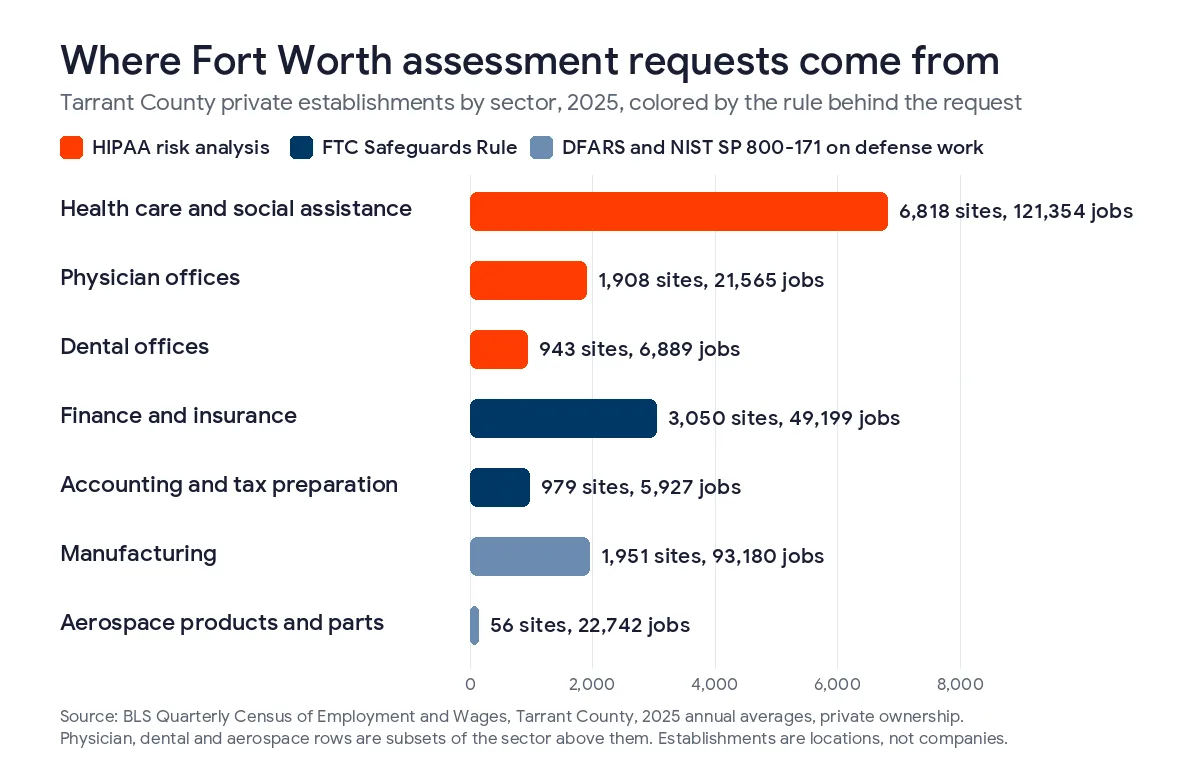
Two things jump out. Health care is the biggest regulated group by a wide margin, and its offices are small. Tarrant’s 4,823 outpatient locations average about 12 employees each, yet a 6-person dental practice in Hulen carries the same HIPAA duty as a hospital, just with far fewer systems to look at. The aerospace line looks tiny until you read the jobs column. Those 56 locations employ 22,742 people, and the supplier base behind them generates most of the defense questions we get in Fort Worth.
An establishment is a single location, not a company, so a practice group with 4 clinics counts 4 times. Not every office in these sectors falls under the rule shown, either. We’d read the table as a map of where requests come from, not a legal finding. Clinics can see how we handle the day-to-day side on our healthcare IT services in Fort Worth page, and lenders and CPA firms can start with financial services IT in Fort Worth.
Defense suppliers usually answer more than one prime
Federal spending records add a Fort Worth detail you won’t find in statewide numbers. In USAspending.gov subaward data for fiscal 2025, 122 Tarrant County companies took Defense Department subawards across 1,510 records. Forty-seven of them sold to 2 or more prime contractors, and 25 sold to 3 or more. Lockheed Martin, Sikorsky, Boeing, Raytheon, and Bell were the primes that showed up most.
Each prime runs its own supplier review, and they don’t pool answers. A machine shop in Haltom City on 3 primes’ supplier lists can face 3 versions of the same questions in one year. That’s where a single assessment built on NIST SP 800-171 and kept current pays for itself, since you answer every portal from the same register instead of starting over.
Watch the vocabulary, though. Requirement 3.11.1 asks you to assess risk periodically. Your SPRS score is something different, a self-scored NIST SP 800-171 DoD Assessment against all 110 requirements, and DFARS 252.204-7019 requires it to be 3 years old or newer before you can be considered for an award. A CMMC certificate is a third thing again. On July 13, 2026 the Defense Department suspended Phase II of CMMC, the third-party certification step. The 7012 and 7019 clauses are still in the November 19, 2026 edition of the eCFR. Our guide to CMMC for Fort Worth aerospace suppliers covers the scoring side in more depth.
What’s a realistic risk assessment timeline in Fort Worth?
For a company of about 50 people, budget 2 to 4 weeks between kickoff and readout, with 40 to 60 hours of assessor time inside that window. Those are our planning numbers, not an industry standard. A 4-week job usually runs like this.
- Week 1. Kickoff and a written scope letter naming the requester, the framework, and the systems inside the boundary. You grant read-only admin access.
- Week 2. Interviews with the owner, whoever handles IT, and the people who run payroll, billing, or production scheduling. The assessor pulls configuration exports from Microsoft 365, the firewall, and the backup system.
- Week 3. Each risk gets a likelihood and impact rating, and the assessor chases vendor answers that are still missing.
- Week 4. A readout of the draft register and a ranked fix list, then a final version with owners and target dates.
A company under 25 people in one office is often done in 1 or 2 weeks. Once you pass 100 employees, or with patient records or controlled defense data inside the boundary, 4 to 6 weeks is more honest. When a job runs late, it’s rarely the assessor holding it up. It’s an outside IT provider that takes a week or more to grant access, or a software vendor that can’t say where your backups sit.
What to have ready before kickoff
- A list of computers, servers, and network gear, even a spreadsheet that’s a year old
- Admin contacts for Microsoft 365 or Google Workspace and for your firewall
- Every vendor that holds your data or logs in to your systems, with the contract owner’s name
- Your last cyber insurance application and any supplier questionnaires from customers
- Where HR keeps injury reports, benefits forms, and scanned IDs
- Any earlier assessment, audit letter, or SPRS submission
In our experience, having that list on day 1 takes about a week off the calendar. The HR item gets skipped most, and it’s the one that surprises owners, because benefits and injury paperwork often hold medical details nobody thinks of as patient data.
What does a cybersecurity risk assessment cost in Fort Worth?
Price follows hours, and hours follow scope. We estimated hours for 3 company sizes and priced them with GSA’s CALC labor rate data, pulled November 23, 2026. A search of risk assessment labor categories that don’t need a security clearance returned 59 ceiling rates from 21 contractors. The middle half ran from $140.38 to $212.07 an hour, and the median was $174.30.
| Company size | Assessor hours (our estimate) | Typical range | At the $174.30 median |
|---|---|---|---|
| Fewer than 25 employees | 20 to 30 | $2,810 to $6,360 | $3,490 to $5,230 |
| 25 to 99 employees | 40 to 60 | $5,620 to $12,720 | $6,970 to $10,460 |
| 100 to 249 employees | 80 to 120 | $11,230 to $25,450 | $13,940 to $20,920 |
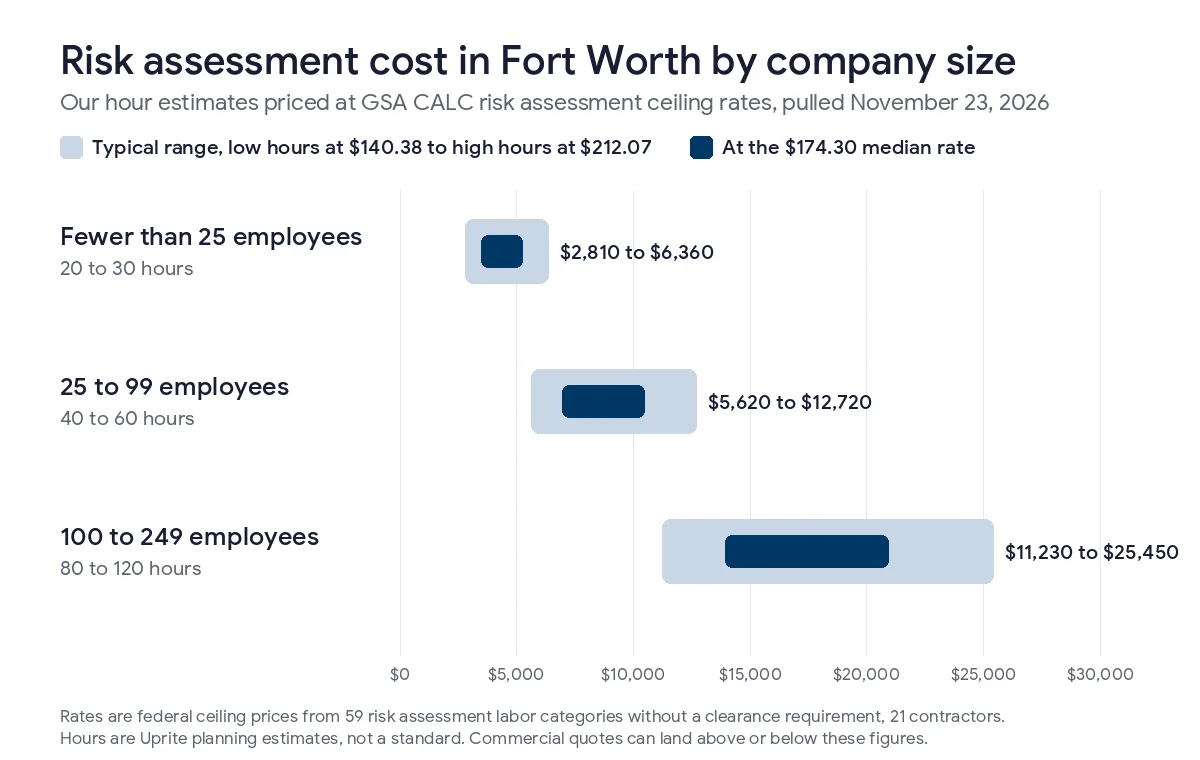
These are federal ceiling prices, so a commercial quote in Fort Worth can land on either side of them. The bigger swing we see is who actually does the work. In the same data, assessors with 8 or more years of required experience carry a median ceiling rate of $206.68 an hour. At 5 years or less it’s $139.79. On a 50-hour job that’s roughly $10,330 against $6,990. Ask each bidder who’ll run the interviews and who’ll write the ratings, since a senior name on the proposal and a junior one on the calendar is worth checking for.
Your second year should cost less. The inventory and vendor list carry over, so the job becomes an update rather than a rebuild. What you’ll spend fixing the findings is a separate budget, and our Fort Worth cybersecurity cost guide breaks it down by headcount. Some companies would rather have one person own the program all year, and what a vCISO costs in Fort Worth depends mostly on how many hours a month you need.
What won’t a risk assessment give you?
It isn’t a penetration test, a vulnerability scan, or a certificate. A scan lists known weaknesses and a penetration test tries to use them. The assessment is where someone decides which of those findings could really cost you money. For the difference between the 2 tests, read penetration testing vs vulnerability scanning, and testing is usually priced as its own line. It isn’t a CPA firm’s attestation report or a CMMC certificate either, and no honest assessor will call it one. If a customer asked for either by name, tell every bidder up front.
Some free help is worth using. Organizations that count as critical infrastructure can sign up for CISA’s Cyber Hygiene services, which include free scanning of whatever you expose to the internet. Small medical offices can use the Security Risk Assessment Tool that HHS gives away. A business with under 20 people and no regulated records can produce a decent first pass on its own using our guide on how to conduct a cybersecurity risk assessment, and our cybersecurity checklist for Fort Worth small businesses covers the controls side. We’d still have someone outside the company read your draft, because people tend to grade their own systems kindly.
How does Uprite handle risk assessments in Fort Worth?
Our first step costs nothing. We look at endpoint protection, patch gaps, and the firmware on your firewall and VPN, then hand you the findings in priority order. You don’t owe us anything after that.
That free review won’t satisfy a prime, an insurer’s auditor, or HHS. The formal assessment, with every risk rated, owned, and dated against the framework your requester named, belongs to our vCISO work. The price comes straight from the scope letter, so you see the hours before anything starts. If you’re still weighing whether a small business needs a vCISO at all, the free review is a sensible first step. After the readout, our managed security services in Fort Worth can work the fix list with you, and when something breaks, our average response time is about 5 minutes.
Fort Worth risk assessment questions we hear most
Can one assessment satisfy both our insurer and a defense prime?
Yes, if it’s mapped to NIST SP 800-171 and the boundary includes the prime’s data. The insurer’s questions about MFA, backups, and endpoint protection can then be answered from the same evidence. Going the other direction rarely works.
How long does it take a 40-person Fort Worth company?
Usually 2 to 4 weeks on the calendar and 40 to 60 hours of the assessor’s time. The schedule depends more on how fast your IT provider and vendors respond than on the assessor.
What should a Fort Worth company budget for one?
About $5,600 to $12,700 for 25 to 99 employees at federal rate-card prices, and roughly $2,800 to $6,400 under 25. Uprite’s first security assessment is free.
Does Texas law require a cybersecurity risk assessment?
Not for most private companies on its own. Chapter 542 limits the damages a business under 250 employees can face after a breach when it can show a qualifying program, and DFARS, HIPAA, and the FTC Safeguards Rule each require assessments in their own sectors.
Is our SPRS score the same thing as a risk assessment?
No. The SPRS score is a weighted score, out of 110, for how fully you’ve put the NIST SP 800-171 requirements in place, while a risk assessment rates what could go wrong and how badly. A defense supplier needs both, and the score can’t be more than 3 years old.
How often does it need repeating?
Annually suits most Fort Worth companies. Repeat it sooner after a breach, a new prime contract, an acquisition, an office move, or the departure of whoever ran IT.
Forward us the request you got, from an insurer, a prime, or a regulator, along with how many people you employ and where. We’ll do the free review for your Fort Worth office and explain what a formal assessment would need to cover. Whether you hire us after that is your call.
Book your free Fort Worth assessment