
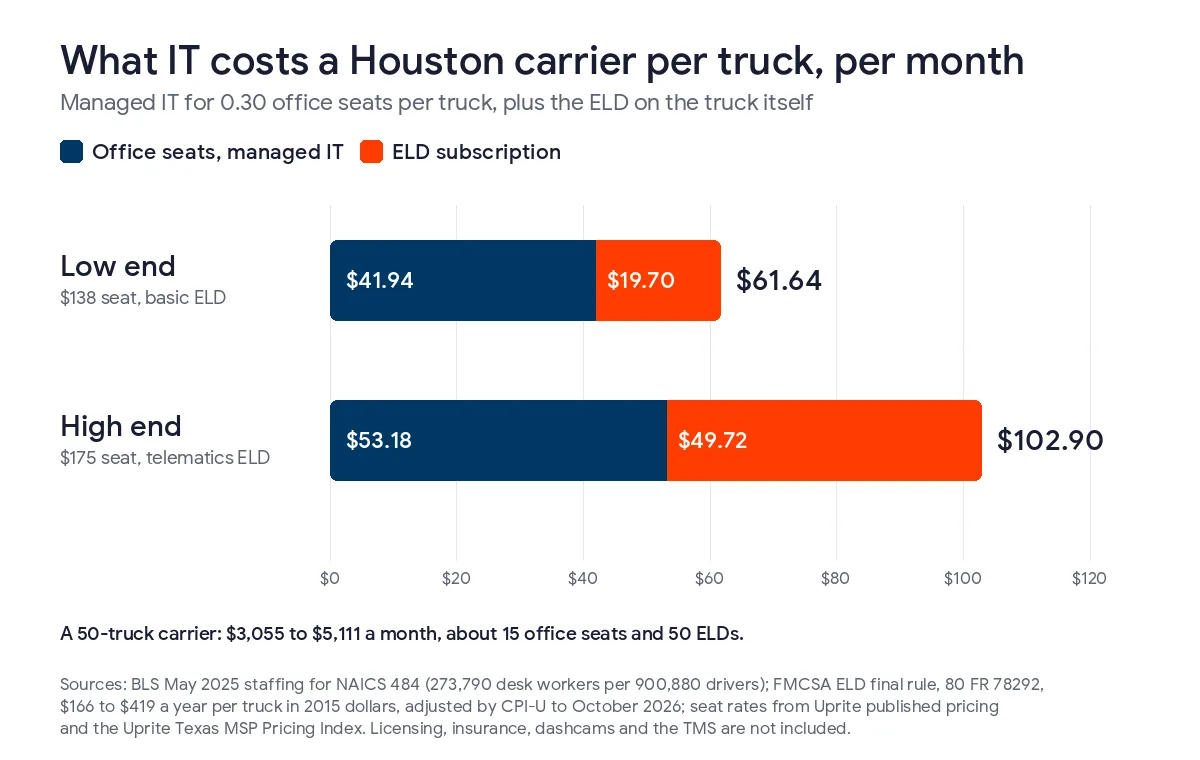
A Houston trucking company should budget about $62 to $103 a month per truck for IT in 2026, which covers managed support for roughly 3 office seats per 10 trucks plus an ELD subscription priced at federal estimates.
That works out to about $3,060 to $5,110 a month for a 50-truck carrier, before Microsoft licensing and insurance. I run operations at Uprite, and we price our IT services for trucking companies in Houston after we’ve walked the office, the shop, and the yard, so this page shows the math we use instead of a rate card. It’s built on federal staffing data for the trucking industry, the FMCSA’s own cost estimate for an ELD, and the records rules that decide how much a carrier has to back up. Freight brokers are a different case, because nearly everyone at a brokerage sits at a desk, and our freight brokerage and 3PL cost guide covers that model.
Trucking IT runs on 2 meters, office seats and trucks. Federal data puts about 3 desk workers behind every 10 drivers, so a carrier pays for far fewer supported seats than its headcount suggests. The truck meter is mostly the ELD, which the FMCSA priced at $166 to $419 a year per truck in 2015, or about $236 to $597 in today’s dollars. Retention rules and cargo-theft fraud set the rest of the budget.
How much does IT cost a Houston trucking company per month?
IT cost for a trucking company is the monthly price of supporting the people who dispatch, bill, and manage the fleet, plus the in-cab technology that every truck carries. Managed IT covers the first part. The ELD vendor bills the second part, and most carriers forget to add the 2 together when they compare quotes.
The table counts office seats at 0.30 per truck and prices them between our published $138 per user and the $175 top of the typical small business band in our Texas MSP pricing index. The truck column runs from a basic ELD to one with telematics, using the FMCSA estimate adjusted for inflation.
| Trucks | Office seats | Managed IT a month | ELD a month | Total a month | Total a year |
|---|---|---|---|---|---|
| 10 | 3 | $414 to $525 | $197 to $497 | $611 to $1,022 | $7,330 to $12,270 |
| 25 | 8 | $1,104 to $1,400 | $492 to $1,243 | $1,596 to $2,643 | $19,160 to $31,720 |
| 50 | 15 | $2,070 to $2,625 | $985 to $2,486 | $3,055 to $5,111 | $36,660 to $61,330 |
| 100 | 30 | $4,140 to $5,250 | $1,970 to $4,972 | $6,110 to $10,222 | $73,320 to $122,670 |
| 200 | 61 | $8,418 to $10,675 | $3,940 to $9,944 | $12,358 to $20,619 | $148,290 to $247,430 |
Licensing, cyber insurance, dashcams, and the TMS subscription sit outside these totals. So do one-time projects such as a new yard network. Per-seat rates also tend to drift down once you’re past about 100 supported users, so the 200-truck row is a ceiling more than a forecast.
Why does a trucking company pay per seat and per truck?
Because most of the payroll is on the road. In May 2025, BLS counted 1,499,660 people working in truck transportation, and 900,880 of them were heavy and tractor-trailer drivers, according to the BLS industry staffing estimates for NAICS 484. Office, management, finance, sales, and computer jobs added up to 273,790. That’s 0.30 desk workers for every driver.
A driver doesn’t need a workstation. They need a login, a phone or tablet that’s locked down, and an ELD that works. A dispatcher, a safety manager, and the person running billing each need a full seat, with a mailbox, backup, endpoint protection, and somebody to call when the TMS won’t open. If a provider multiplies its seat rate by your total headcount, it’s quoting about 3 times the support you actually use.
Shop technicians are the in-between case. BLS counted 56,870 bus and truck mechanics in the industry, about 6 for every 100 drivers. In most shops we see, they share a diagnostic laptop and a parts terminal rather than each having a PC, so we count shared devices there, not people.
What does the Houston trucking market actually look like?
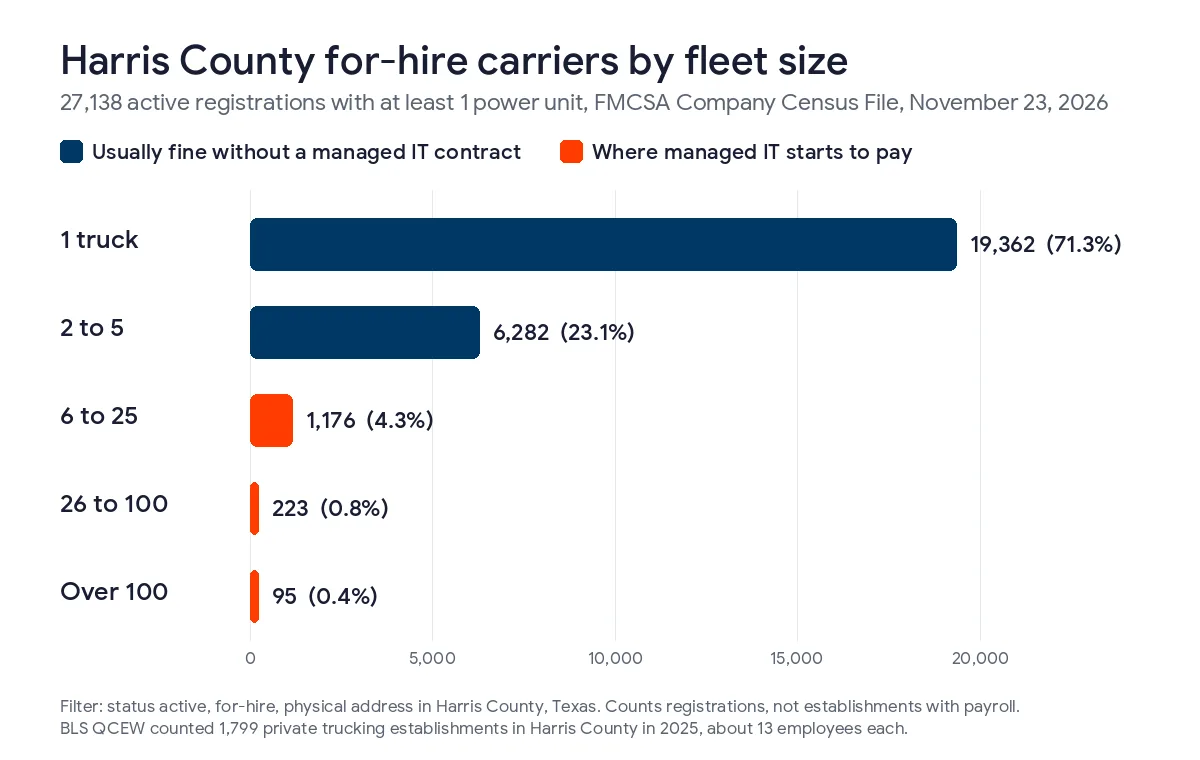
Small, and mostly 1 truck. We filtered the FMCSA Company Census File on November 23, 2026 for active for-hire carriers with a Harris County address and at least 1 power unit. It returned 27,138 registrations.
| Power units | Harris County carriers | Share | What IT usually looks like |
|---|---|---|---|
| 1 | 19,362 | 71.3% | A phone, an ELD, and a bookkeeping app |
| 2 to 5 | 6,282 | 23.1% | An owner who also dispatches, plus a shared laptop |
| 6 to 25 | 1,176 | 4.3% | A small office, a TMS, and the first real backup problem |
| 26 to 100 | 223 | 0.8% | A dispatch floor, a shop, and a safety department |
| More than 100 | 95 | 0.4% | Multiple yards, EDI with shippers, and a security questionnaire every quarter |
Payroll data tells the same story from the other side. The BLS Quarterly Census of Employment and Wages counted 1,799 private trucking establishments in Harris County in 2025 with 24,103 employees, about 13 per firm. That’s roughly 8 drivers and 4 people inside. Average pay was $103,785, which is 36% above the Texas trucking average of $76,084.
The gap comes from specialized freight. Harris County’s 449 specialized carriers, the heavy-haul, tank, and oilfield outfits, paid an average of $149,408 across 9,208 jobs. Those are also the carriers most likely to haul hazmat, and 1,539 of the Harris registrations in the census file carry a hazmat flag. Expensive drivers and regulated loads raise the price of an hour when dispatch goes down, and that’s the honest reason a Houston specialized carrier spends more on IT than a dry van fleet the same size.
Here’s the other honest part. If you run 1 truck, you probably don’t need a managed IT contract, and we’ll tell you so. The model starts paying for itself somewhere around 6 to 10 trucks, when you’ve got a TMS, an office of 3 or more, and files you can’t afford to lose.
Which federal records rules set a carrier’s backup bill?
FMCSA retention periods decide how much data you keep and for how long, and that’s what drives backup and archive cost. One of them goes further than most owners realize. Under 49 CFR 395.22(i), a carrier must keep a back-up copy of its ELD records for 6 months on a device separate from the one holding the originals.
| Record | How long to keep it | Rule |
|---|---|---|
| Records of duty status and supporting documents | At least 6 months | 49 CFR 395.8(k) |
| Back-up copy of ELD records, on a separate device | 6 months | 49 CFR 395.22(i) |
| Driver qualification file | Employment plus 3 years | 49 CFR 391.51 |
| Vehicle inspection, repair, and maintenance records | 1 year, and 6 months after the truck leaves your control | 49 CFR 396.3(c) |
| Positive drug and alcohol results, refusals, program records | 5 years | 49 CFR 382.401 |
| Negative and canceled test results | 1 year | 49 CFR 382.401 |
Most ELD platforms keep your logs in their own cloud, which is fine, but we’d ask the vendor in writing where the separate copy lives and how you’d export it if you switched providers. The driver files are the bigger risk. Every driver who left in the last 3 years still has a qualification file somewhere, with a license number, a medical certificate, and employment history in it. If those files sit on a shared drive in the dispatch office, you’re paying to protect them whether you budget for it or not.
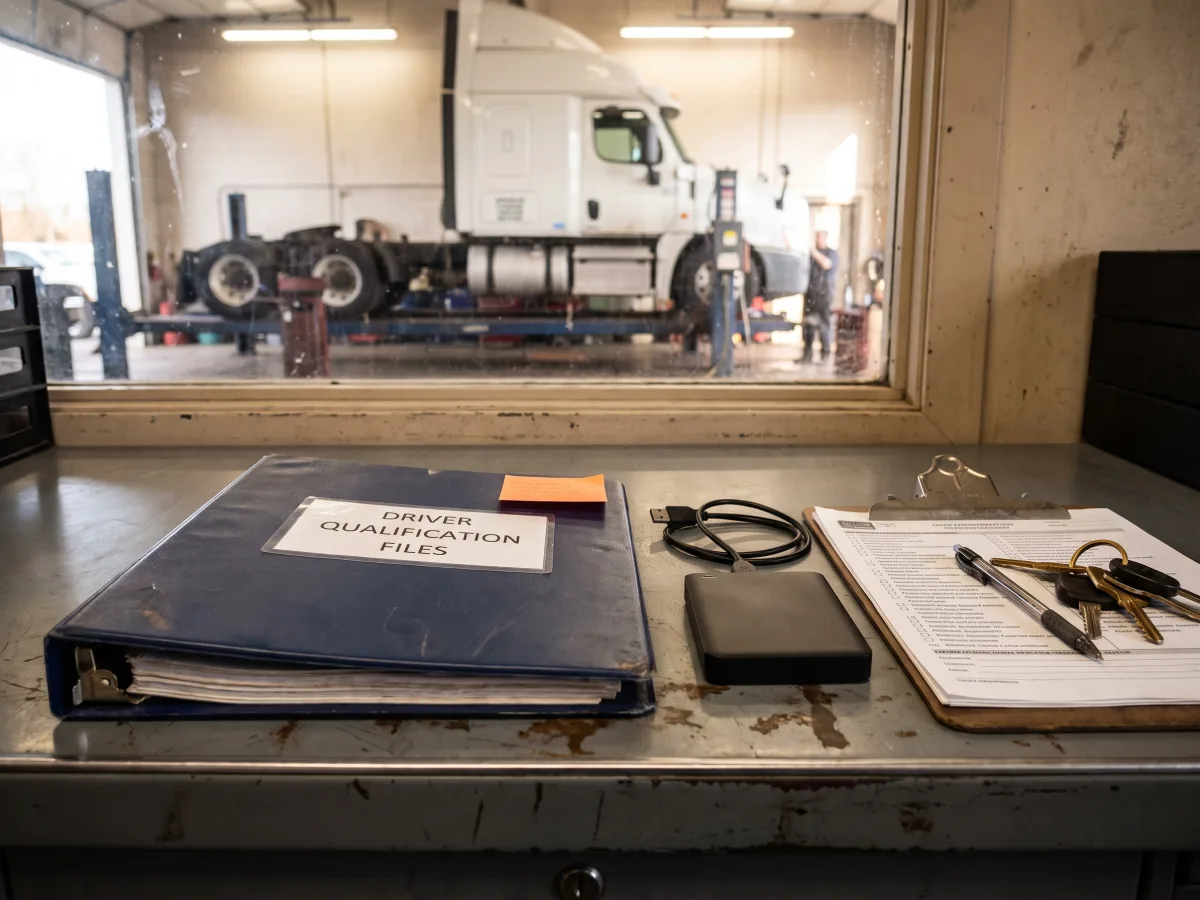
That ties straight into Texas law. Under the 2023 amendment to Business and Commerce Code 521.053 in Senate Bill 768, a business that has a breach involving 250 or more Texans has to notify the Attorney General within 30 days, through the Attorney General’s data breach reporting form. Because the qualification files outlive the job by 3 years, a carrier with steady driver turnover can hold records on 250 people long before it runs anything close to 250 trucks. We compare where those archives should live in our guide to cloud backup versus on-prem backup in Houston.
What do cargo theft and carrier fraud add to the budget?
On April 30, 2026, the FBI warned in public service announcement I-043026-PSA that cyber-enabled cargo theft is surging. Estimated cargo theft losses in the United States and Canada reached nearly $725 million in 2025, up 60% from 2024. The average theft was worth $273,990.
The pattern the FBI describes starts in someone’s inbox. A spoofed broker email asks a carrier to sign an agreement or answer a bad service rating, the link installs remote management software, and the attacker then posts fake loads or changes the carrier’s registration details. The FMCSA keeps a running list of impersonation sites and scams on its registration fraud alerts page.
So the security lines that matter most for a carrier are ordinary ones. Multi-factor login on email, the TMS, the load boards, and the FMCSA portal. Email filtering that catches lookalike domains. Endpoint monitoring that flags a remote access tool nobody approved. We’d add a phone call to a known number before any change to payment or pickup details, which costs nothing. Our Fully Managed plan at $138 per user includes a security stack, 24/7 support, and backups with quarterly restore tests, and carriers with their own IT staff can add our managed security services in Houston at $40 per user a month. The CISA Cross-Sector Cybersecurity Performance Goals are a fair checklist for scoping it, and NIST’s small business cybersecurity corner has plain-language versions. How brokers get targeted on the load board side is a separate post in this series on cybersecurity for freight brokers.
Should a Houston carrier hire its own IT person instead?
For almost every carrier under 200 trucks, yes. In May 2025, a computer user support specialist in the Houston metro averaged $30.14 an hour and a network administrator averaged $52.02, per the BLS Houston metro wage estimates. Add benefits at the ratio from the June 2026 employer compensation survey, where private employers paid $46.89 an hour in total for every $32.82 in wages, and that help desk hire costs about $89,570 a year. A network administrator is closer to $154,590.
Trucking companies rarely hire either. BLS counted only 4,200 computer and math workers across the entire industry, 1 for every 357 employees. A 50-truck carrier has about 83 people, which justifies less than a quarter of an IT role, and its managed IT line from the first table comes to $24,840 to $31,500 a year. That’s 28% to 35% of one loaded help desk hire, and it comes with after-hours coverage the single hire can’t give you.
The exception is a carrier that already has a capable IT person and needs depth behind them. That’s what co-managed IT in Houston is for, at $100 per user a month on our published plan. We’d only steer a fleet toward hiring in-house past about 150 to 200 trucks, or where the yards and EDI links are complicated enough to keep 1 person busy every day.
How do you check a trucking IT quote?
Start by asking what the provider counted, because the unit changes the number more than the rate does.
- Ask how many seats the quote assumes, and compare it with your real count of dispatch, safety, billing, and management staff.
- Ask how drivers are handled. A login and a managed phone shouldn’t cost the same as a full office seat.
- Get the ELD subscription, dashcams, and TMS on their own lines, with the vendor named, so nothing gets counted twice.
- Ask where the separate ELD back-up copy lives and who can export it.
- Ask where driver qualification files are stored, who can open them, and how long they’re kept after a driver leaves.
- Ask what happens at 5 in the morning when dispatch can’t log in, and who answers. Our own average first response is 5 minutes.
- Ask which licensing, projects, and on-site visits are billed outside the monthly fee.
If the quote can’t answer those, it’s a guess. Our guide to managed IT cost in Houston covers the general benchmarks, and our post on managed IT for Texas logistics companies walks through the systems a carrier depends on. What an outage costs once dispatch and ELD systems go down is the subject of the next post in this series, on ELD and fleet system downtime. Our own rates are on our published pricing page, so you can check any number on this page against them.
What Houston carriers ask about IT costs
How much should a 25-truck Houston carrier spend on IT each month?
Plan on about $1,600 to $2,650 a month, which covers managed IT for roughly 8 office seats and an ELD on every truck. Licensing, insurance, and the TMS subscription come on top of that, and a specialized or hazmat fleet should plan toward the high end.
Do truck drivers count as IT seats?
Usually not as full seats. A driver needs a secure login, a managed phone or tablet, and a working ELD, while a dispatcher needs a full workstation with backup and support, so we price the 2 differently and you should ask any provider to do the same.
Is the ELD subscription part of managed IT?
No, the ELD vendor bills it separately, and the FMCSA estimated $166 to $419 a year per truck in 2015 dollars. Adjusted with the BLS consumer price index through October 2026, that’s about $236 to $597, and units with cameras or extra telematics cost more.
What federal rule affects a trucking company’s backups?
49 CFR 395.22(i) requires a 6-month back-up copy of ELD records on a separate device. Driver qualification files must be kept for 3 years after a driver leaves, and positive drug and alcohol results for 5 years, so the archive keeps growing even when the fleet doesn’t.
Why do Houston trucking companies seem to pay more for IT than carriers elsewhere in Texas?
Houston has more specialized and hazmat freight, where pay runs much higher. Harris County specialized carriers averaged $149,408 in 2025, against $76,084 for Texas trucking overall, so every hour of dispatch downtime costs more in wages.
When does a small carrier actually need managed IT?
Usually somewhere between 6 and 10 trucks. That’s when there’s a TMS, an office of 3 or more, and driver files that have to be kept for years, and a single truck with 1 phone rarely needs a contract at all.
Send us your truck count, your office headcount, and the systems you run, and we’ll send back a written monthly number with every line item named, including what we won’t cover.
Get a Trucking IT Quote