IT Services for Trucking and Logistics Companies in Houston
IT services for trucking companies in Houston cover dispatch and TMS servers, ELD account and backup duties, driver tablets, yard networks, and email security, with fully managed IT published at $138 per user per month. Uprite runs it from 2 Houston offices as part of our managed IT services in Houston.
Managed IT for Houston carriers, heavy-haul and oilfield fleets, and drayage operators, from the Port Houston terminals to the Beltway 8 yards. Run around hours of service, not office hours.
Get Your Free Fleet IT AssessmentNo obligation. We map your dispatch systems, ELD accounts, and driver devices before anything changes.In Texas Since 1999 | MSP 501 Winner 7 Years Running | SOC 2 Type 1 (2023) | 120-Day Satisfaction Guarantee
Talk to a Trucking IT Expert
Recognized Across Texas for Trucking and Logistics IT












The Harris County Carrier
Houston Has 1,799 Trucking Companies. Most Run on 13 People.
Start with the count.
The BLS Quarterly Census of Employment and Wages found 1,799 private trucking establishments in Harris County in 2025, employing 24,103 people. That’s 13.4 people per location. Dallas County has 1,004 trucking establishments and 23,294 jobs, so Houston moves almost the same workforce through 79% more companies.
Pay tells the other half. Harris County trucking averaged $103,785 a year in 2025, 36% above the Texas trucking average of $76,084. Specialized freight (tank, heavy haul, oilfield, and other loads that need special equipment) explains most of the gap, because its 449 Harris establishments paid $149,408 on average, 67% above the same trade statewide, and the county holds 2.4 times the national share of those jobs.
That’s the expensive end.
The rest is general freight. 1,350 Harris County establishments haul it, averaging 11 people each, and 989 of them run long-distance truckload. In 2020 the county had 1,644 trucking establishments in total. The count grew 9.4% in five years. Average pay rose 29%.
So the typical Houston carrier is small, well paid per head, and hauling freight a customer watches closely. It also has almost nobody at a desk. The BLS occupational survey for truck transportation puts 18.3% of the workforce in management, business, sales, and office roles, and 0.3% in computer jobs. A 13-person carrier has 2 people inside. Neither was hired to run IT.
Port operators have their own page on maritime IT support in Houston, Coast Guard rule included. This one is about the carriers. They need the basics every office needs plus three things nobody else asks about. Logs. Tablets. A dispatch server that can’t go down on a Monday.
Inside the Terminal
IT Services for Trucking Companies in Houston Start With Dispatch, Logs, and Tablets
Most Houston carriers have a decent ELD and a fragile everything else.
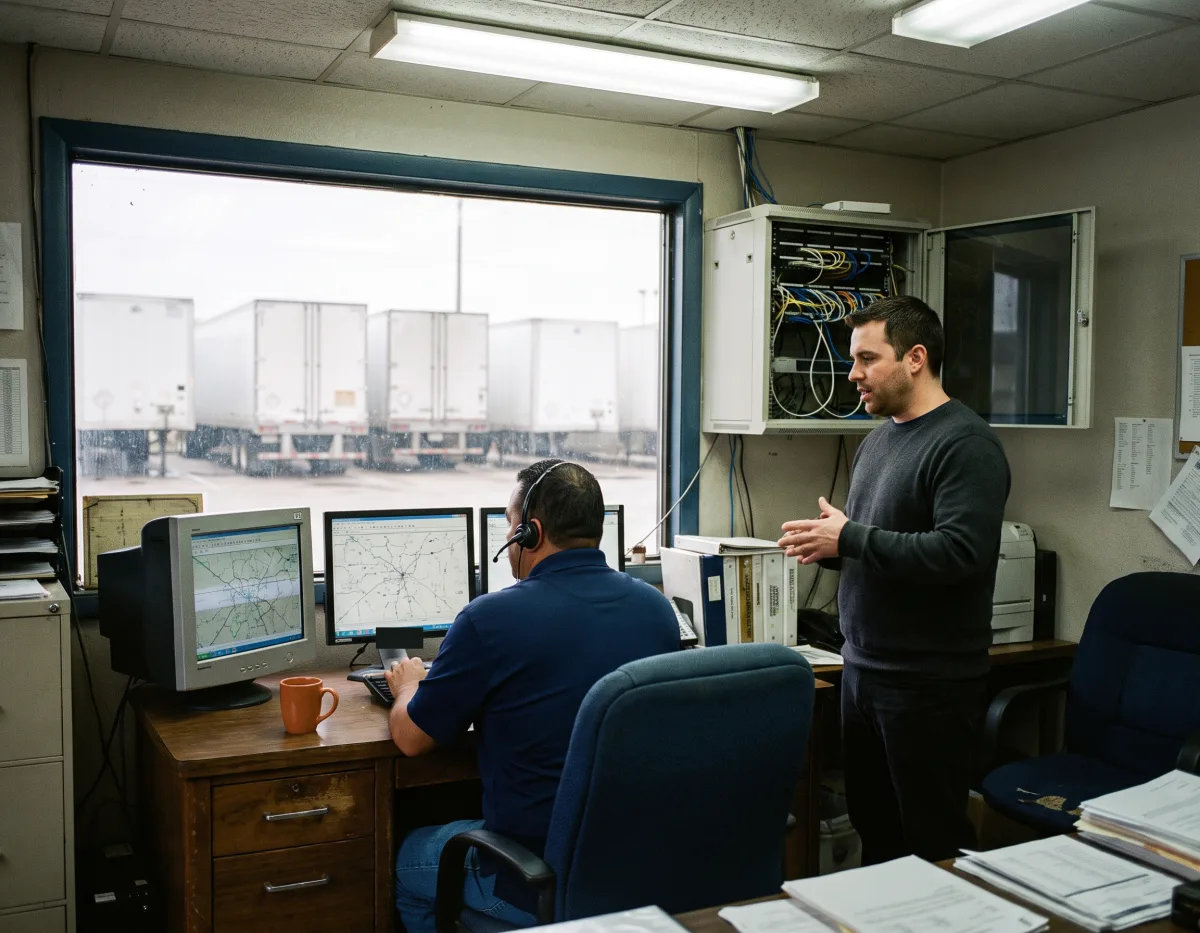
Take the TMS (loads, rates, settlements, invoices). When its server or its internet line stalls, dispatch falls back to cell phones and a whiteboard for an hour, right up until billing can’t release a single invoice. A 13-person carrier has no second dispatcher to soak that up.
The ELD is next. The device belongs to a vendor. The accounts don’t. Under 49 CFR 395.22 the carrier creates, updates, and deactivates every driver and support account, and a driver’s license number can’t be part of the username. A driver quits on a Friday and somebody has to close that login. Usually nobody does.
Then the tablets. Drivers carry phones or rugged tablets for logs, bill-of-lading photos, fuel cards, and the shipper’s app. Leave one at a truck stop on I-10 in Baytown and it walks off holding email, a document scanner, and a saved password to the factoring portal.
Driver files are the quiet liability. A qualification file holds a license copy, a medical certificate, a motor vehicle record, and often a Social Security number, and 49 CFR 391.51 keeps it for as long as the driver works for you plus 3 years. Turnover in this trade is high. That archive only grows.
Accounts churn faster than anyone budgets for. Owner-operators, a weekend dispatcher, a broker agent working from home in Katy, a mechanic who needs the parts system, and the shop’s diagnostic laptop all get access, and almost none of it gets taken back.
The split is simple. Your safety manager owns hours of service and driver qualification. We own the network, servers, backups, accounts, devices, and security, and we keep running the systems your safety manager depends on.
What That Looks Like Across Houston Fleets
Heavy Haul and Oilfield Carriers
Permits, route surveys, and rig-move schedules on backed-up storage, with field crews signing in from tablets we can wipe remotely.
Tank and Hazmat Fleets
Shipping papers, training records, and emergency contacts a dispatcher can reach at 3 AM, even with the office server down.
Port Drayage Operators
Terminal appointment portals, gate photos, and container tracking on a yard network that holds up next to stacked steel boxes.
Regional Truckload Carriers
TMS, fuel card, and settlement systems kept current through month-end, with driver pay data locked to the two people who process it.
Freight Brokers and Agents
Load board logins, carrier onboarding records, and email guarded against the impersonation tricks that end in a stolen load.
Fleet Maintenance Shops
Diagnostic laptops, parts inventory, and work-order PCs kept off the dispatch network, so an infected shop machine stays in the shop.
The mistake we see most is treating the ELD as a compliance gadget and the office as an IT problem. A driver who left in March still has a working ELD login, two dispatchers share one admin password, and the only backup of the logs sits on the same laptop as the originals. That’s three findings from one walk-through.
The Rules
Which Trucking Rules Turn Into IT Work in Houston?
Ransomware gets the headlines (our cybersecurity services in Houston cover that side), but most of the IT work at a carrier comes from hours-of-service and records rules that read like safety regulation.
Start with 49 CFR 395.34. When an ELD malfunctions, the driver owes you written notice within 24 hours and rebuilds the current day plus the previous 7 days on paper graph-grids. You then have 8 days to repair or replace the unit. Need longer? You ask the FMCSA Division Administrator within 5 days of the driver’s notice, listing the make, model, and serial number of every affected device.
The backup rule is stricter than most carriers realize. 49 CFR 395.22(i) makes a carrier keep a backup copy of its ELD records for 6 months on a device separate from the one holding the originals. A vendor cloud plus an export nobody has opened since spring is not that.
Then comes Texas law.
Section 521.052 of the Texas Business and Commerce Code requires reasonable procedures to protect sensitive personal information, and driver files are full of it. If a breach exposes that data, 521.053 gives you 60 days to notify the people affected and 30 days to tell the Texas Attorney General once 250 or more Texans are involved. Our write-up on ELD and fleet system downtime in Houston takes the outage side further.
Logs Backed Up Somewhere Else
An export of every ELD record on storage separate from the vendor’s system, kept 6 months and checked on a schedule.
The 8-Day Clock Written Down
Who takes the driver’s notice, who calls the ELD vendor, and when the extension request goes out, all decided before the first dead unit.
Driver Files Locked Down
Qualification files and medical certificates in access-controlled storage, held 3 years after a driver leaves, then destroyed on schedule.
Logins Closed the Day a Driver Leaves
ELD, email, fuel card portal, and dispatch accounts removed together, with multi-factor sign-in on the rest, as CISA recommends.
Hours and Service
Houston Fleets Run Around the Clock. Office-Hours IT Doesn’t.
A dispatch outage is a different kind of outage. Nobody stares at a dead screen for long. Trucks sit.
Run a dispatch desk from 4 AM to 10 PM, 7 days a week, and you’re covering 6,552 hours a year. One in-house IT hire on a standard 2,080-hour year is there for about 32% of them, before vacation, sick days, or the week that person loses rebuilding a server.
So we plan around your freight. Peak weeks, compliance reviews, and quarterly IFTA filing go on the calendar first, and patches and changes wait for quiet hours. Our notes on dispatch software IT support in Houston cover the TMS side in more detail.

What We Support in Houston Fleets
Dispatch and TMS
Servers, databases, and internet failover for the TMS you already run, in the office or in a vendor cloud, with restores tested before month-end settlements.
ELD Accounts and Exports
Driver and support accounts opened and closed on schedule, plus the separate 6-month backup 49 CFR 395.22 asks for. We don’t sell ELDs.
Driver Phones and Tablets
Mobile device management for the phones and tablets in the cab, so a lost device gets locked and wiped remotely the day it goes missing.
Yard and Terminal Networks
Firewalls, switching, and Wi-Fi that reach the dock, the shop, and the guard shack, with cameras and gate systems kept off the office network.
Microsoft 365 for Drivers and Dispatch
Shared dispatch mailboxes, multi-factor sign-in, and accounts for drivers who check email twice a week, set up so a departing driver’s access ends that day.
Backup and Recovery
Off-site copies, tested restores, and a restart order that puts dispatch and billing first, backed by our disaster recovery services in Houston.
Has Uprite done this for a trucking company before?
Not in a published case study, and we won’t dress one up. What we can show is how we work. Our average first response is 5 minutes across every ticket, our controls were reviewed in a 2023 SOC 2 Type 1 report, and we’ve supported Texas businesses since 1999 from offices near the Galleria and in Clear Lake. If that isn’t enough, the 120-day satisfaction guarantee is there for exactly this reason.
The truck can wait an hour. The load can’t.
What We Run
Dispatch, Logs, Driver Files, Devices, and Vendor Access
Most managed IT agreements list the help desk, patching, backup, and antivirus, and stop there.
None of them says who can still sign in to your ELD portal, or whether last quarter’s logs exist anywhere outside the vendor’s cloud. Those are the first two questions an auditor asks. A plaintiff’s lawyer asks them too.
At a small carrier, 5 things carry most of the risk. Dispatch decides whether trucks move, logs decide whether you pass a compliance review, and driver files decide how bad a breach gets. Devices and vendor logins are where most trouble gets in.
What Each Line Covers
| Service line | What Uprite runs | Rule or requirement behind it |
|---|---|---|
| Dispatch and billing systems | TMS servers or cloud tenants, internet failover, and restore-tested backups ahead of month-end settlements | Shipper service commitments and your factoring company’s terms |
| ELD records and accounts | Driver and support accounts opened and closed on schedule, plus a separate backup copy held 6 months | 49 CFR 395.22(b) and (i), and 395.8(k) |
| Driver qualification files | Access-controlled storage, logged access, and destruction on schedule | 49 CFR 391.51 retention and Tex. Bus. & Com. Code 521.052 |
| Driver phones and tablets | Device management, remote lock and wipe, and control over which apps reach company data | Breach-notice duties under Tex. Bus. & Com. Code 521.053 |
| Vendor and contractor access | Logged, expiring sessions for ELD, TMS, and camera vendors | Cyber insurance terms and shipper security questionnaires |
Dispatch comes first, because that’s where revenue stops. We map where the TMS actually runs, what it connects to (fuel cards, factoring, shipper portals, load boards), and what happens to billing if its server dies at 2 AM.
Compliance reviews lean hardest on logs. Under 49 CFR 395.8(k) a carrier keeps 6 months of duty-status records and the documents behind them, so we hold a separate copy and prove it restores.
Network problems hide better. Put the yard cameras, a shop laptop, and the dispatch PCs on one flat network, and one bad click travels a long way. We split them.
Vendor logins are the risk nobody owns. ELD providers, TMS resellers, camera installers, and the fuel card company each got a login once, and few were ever removed. We find them, and the ones you keep go behind logged sessions that expire.
Backups come last. They’re the least tested. A backup nobody has restored is a guess.
That’s a lot for a safety manager to track on top of hours of service and driver hiring, which is why handing it off is the point.
By the Numbers
The Numbers Behind Trucking IT in Houston
Every figure here has a source you can pull yourself. The labor data is BLS, the deadlines are federal rule text, and two numbers are Uprite’s own.
1,799
Private trucking establishments in Harris County in 2025, averaging 13.4 employees, per the BLS Quarterly Census of Employment and Wages.
$149,408
Average 2025 pay in Harris County specialized freight trucking, 67% above the Texas average for the same trade.
8 days
Time a carrier has to repair or replace a malfunctioning ELD under 49 CFR 395.34, unless FMCSA allows more.
6 months
How long a carrier must keep a backup of its ELD records on a separate device, under 49 CFR 395.22(i).
$138
Uprite’s published starting rate per user per month for Fully Managed IT, with on-site visits in Houston included.
| Metric | Data Point | Source |
|---|---|---|
| Private trucking establishments, Harris County | 1,799, employing 24,103 | BLS QCEW, NAICS 484, 2025 |
| Average annual pay, trucking | $103,785 (Texas $76,084) | BLS QCEW, NAICS 484, 2025 |
| Specialized freight trucking (NAICS 4842) | 449 establishments, 9,208 jobs, $149,408 average pay | BLS QCEW, 2025 |
| Specialized freight concentration | 2.40 times the national share of employment | BLS QCEW location quotient, 2025 |
| General freight trucking (NAICS 4841) | 1,350 establishments, 14,894 jobs, 11 per establishment | BLS QCEW, 2025 |
| Trucking establishments, Dallas County | 1,004, employing 23,294 | BLS QCEW, NAICS 484, 2025 |
| Harris trucking establishments, 2020 to 2025 | 1,644 to 1,799, up 9.4% | BLS QCEW, 2020 and 2025 |
| Management, business, sales, and office share of trucking jobs | 18.3% nationally | BLS OEWS, NAICS 484, May 2025 |
| Computer occupations share of trucking jobs | 0.3% nationally | BLS OEWS, NAICS 484, May 2025 |
| ELD repair deadline | 8 days, with any extension requested within 5 | 49 CFR 395.34(d) |
| ELD backup retention | 6 months on a separate device | 49 CFR 395.22(i) |
| Driver qualification file retention | Length of employment plus 3 years | 49 CFR 391.51(c) |
| Texas breach notice | 60 days to individuals, 30 days to the AG at 250+ Texans | Tex. Bus. & Com. Code 521.053 |
| Uprite rates, per user per month | Fully managed $138, co-managed $100, MSSP security $40 | uprite.com/pricing |
| Uprite average first response | 5 minutes | Measured across all tickets and priorities |
Pricing
What Do IT Services Cost a Houston Trucking Company?
Fully managed IT for a Houston carrier starts at $138 per user per month with on-site help included, co-managed IT runs $100, and security-only coverage starts at $40.
Every rate sits on our public pricing page, so your controller can check it before anyone books a call.
| Plan | Per user, per month | Built for | What it includes |
|---|---|---|---|
| Fully Managed IT | From $138 | Carriers with no IT person on staff | On-site and remote help for dispatch, office, and shop staff, around-the-clock availability, network and cloud management, the full security stack, vCIO planning, and quarterly backup tests |
| Co-Managed IT | From $100 | Fleets with an IT manager or a one-person IT department | Shared support, compliance consulting, a technology roadmap, and clean handoffs with your own person |
| MSSP Security Focus | From $40 | Carriers that need protection first | Firewall management, SIEM and SOC monitoring, vulnerability scanning, incident response, and a quarterly security review |
Here’s the part that surprises carriers. We price per user who needs IT support, and at a trucking company that’s mostly dispatch, the office, and the shop. On the BLS mix, a 50-person carrier has about 9 people in those seats, so Fully Managed for them runs $1,242 a month. Drivers who only touch the ELD and a phone get counted with you on the first call, not assumed.
A smaller fleet can start with security-only coverage at $40 a user plus tested backup and move up as it grows. The line-by-line version, devices and software included, is in our guide to trucking company IT cost in Houston.
Software is the second invoice. TMS subscriptions, ELD service plans, and the Microsoft 365 licenses billed through us are separate lines. Brokerages run the other way, with nearly everyone at a desk, which is why IT costs for a Texas freight brokerage or 3PL look so different.
If you need hands on equipment, price the on-site plans, because a remote-only plan can’t replace a dead switch in the dispatch room at 4 AM. Our Houston technicians drive to the yard.
Contract terms stay plain. The rate holds through year one, there are no hidden fees, and the 120-day satisfaction guarantee lets you walk if we fall short.
Send us your truck count, your TMS, and the name of your ELD provider.
You get back a written list of what’s exposed and what’s missing before you sign anything. No sales deck first.
Talk to a Trucking IT ExpertGetting Started
How Does Uprite Onboard a Houston Carrier?
We schedule around your freight, and nothing changes during a peak week or the days before a compliance review.
Step 1. Inventory Every System, Device, and Login
We start in the dispatch room and the yard. We list the TMS, the ELD portal, every tablet and phone, the shop PCs, the cameras, and every account that still works, including the ones that belong to people who left.
Step 2. Rank the Risks Against Your Freight and Your Rules
The inventory becomes a plan ranked by what could stop dispatch, fail a compliance review, or expose driver records. Logs with no separate backup and logins with no owner usually land at the top.
Step 3. Lock Down Accounts, Driver Files, and Vendor Access
Accounts become company-owned, sign-in gets multi-factor, driver files move into access-controlled storage, and vendor sessions go through a broker that logs and expires them.
Step 4. Split the Network and Prove the Backups
Cameras, gate systems, and shop machines move off the dispatch network, and we prove disaster recovery for your Houston office works with a real restore of the TMS and the ELD exports.
Step 5. Run It Through Peak Weeks, Audits, and Hurricane Season
From there it’s 24/7 monitoring and patching, a help desk a dispatcher can call at 4 AM, scheduled restore tests, and current answers ready for your insurer and your shippers’ security questionnaires.
How long it takes depends on how scattered things are. A 15-truck carrier on Microsoft 365 with a cloud TMS moves fast. A 150-truck fleet with an office server, a shop, and two yards takes longer, and we’ll tell you which one you are after the walk-through.
Who It Fits
Which Houston Trucking Companies Is Uprite Built For?
| Right fit |
|---|
| Harris County and Gulf Coast carriers with roughly 10 to 250 users across dispatch, the office, and the shop |
| Heavy-haul, oilfield, tank, and hazmat fleets where a lost permit file or a down dispatch desk strands an expensive load |
| Port drayage and regional truckload carriers juggling terminal portals, shipper apps, and a TMS at the same time |
| Fleets with no IT person, where the safety manager or the controller has been handling the ELD portal and the router |
| Carriers dispatching nights and weekends who need help after the office closes |
| Fleets with yards in Pasadena, Baytown, La Porte, Channelview, or along Beltway 8 that depend on one main office’s servers |
Sound like your operation? A short call gets it started. Bring a rough count of office and shop users and the name of your TMS.
Before You Switch
What Keeps Houston Carriers From Outsourcing IT?
4 objections come up on almost every first call with a fleet.
“Our ELD vendor handles the tech.”
For the device, mostly. The vendor fixes the unit and hosts the data, but 49 CFR 395.22 still leaves you responsible for the accounts, the separate backup, and the 8-day repair clock. Everything around the ELD, from the dispatch PCs to the tablets, is yours.
“We can’t stop dispatch to switch.”
You won’t have to. We move one system at a time, schedule changes for overnight or Sunday, and keep the old access working until the new setup is proven.
“Nobody hacks a 20-truck carrier.”
Criminals don’t care about your size. They care about your email, your factoring account, and the load on your trailer. A spoofed dispatcher email or a hijacked broker login can redirect a payment or a whole shipment, and a small carrier rarely has a second person checking.
“Outsourced IT is for bigger fleets.”
The math says otherwise. A 13-person carrier can’t justify a full-time IT salary, and per-user pricing means you pay for the few people at desks, not the whole driver roster. Our page on cybersecurity for Houston freight brokers covers the broker side of the same problem.
Definition
What Are IT Services for Trucking Companies?
3 Things That Set Uprite Apart for Houston Fleets
Plans Sized to Who You Employ
Fully Managed covers everything for carriers with no IT staff. Co-Managed works beside an IT person you already have. MSSP Security Focus adds firewall management, SOC monitoring, and incident response when protection has to come first.
Rates Your Controller Can Check
Fully managed is $138 per user per month, co-managed is $100, and MSSP security augmentation is $40, all locked for the first year. Nobody has to ask for a quote to see them.
Technicians Who Know Where the Yards Are
Our offices at 5718 Westheimer Road near the Galleria and 16441 Space Center Boulevard in Clear Lake put an engineer within a drive of the Port Houston terminals, the Beltway 8 yards, and the refinery corridor. When the dispatch room’s network drops, someone drives out.
What Clients Say
What Houston Businesses Say About Working With Uprite
Hector and Kareem are super helpful! They are always willing to take on my computer problems even if its small. I had my mouse disappear off my screen, it was an user issue but Hector didn't make me feel small or "dumb" for this error. We love uprite!
Barnes Network Solutions came recommended highly by a trusted contractor and let me tell you, they did not disappoint. Five stars.
I had been having trouble with an IT matter that I didn't think would be fixed but Arvin Ebueng from Upright took his time with me and worked with me until we were able to resolve the issue. The issue was an internal issue with the way the program was written, but Arvin came up with a great work around so that I am now able to do what I need to do at my job. Long story short, he got me access to both things that I need access to simultaneously and daily. Thanks 😊 Arvin, you are much appreciated 👏 💐 🥳.
Uprite has been one of the best services the company I work with has provided for us they help us with any issues we run into and are always easy to work with, and very patient with us and friendly.
I'm am not a "tech" person, however the team at Uprite gets me through the technological side of computers and software so that I can function on a daily basis... but the most enduring quality is that they care. Special shoot out to Mary, Sergio, Eufemio, Hector, and Jeff just to name a few... I appreciate each of you and the help you give me.
FAQ
What Houston Carriers Ask Before They Switch
Help desk support for dispatch, office, and shop staff, TMS and billing system upkeep, ELD account management with separate log backups, driver device management, yard networks, and email security. Uprite covers all of it under one monthly rate per user, with on-site visits from our two Houston offices.
It starts at $138 per user per month for Fully Managed, $100 for co-managed, and $40 for security-only coverage. Because billing follows the users who need IT support, a 50-person carrier with about 9 office and shop users would pay roughly $1,242 a month on Fully Managed. TMS and ELD subscriptions are billed separately.
No, and you wouldn’t want us replacing your provider. The ELD vendor keeps the device and its data service. We handle the carrier-side duties around it, which means opening and closing driver accounts, keeping the separate 6-month backup 49 CFR 395.22 requires, and managing the phones and tablets the app runs on.
The driver gives written notice within 24 hours and keeps paper logs, and the carrier has 8 days to repair or replace the unit. Those deadlines come from 49 CFR 395.34. If 8 days won’t be enough, the carrier must ask the FMCSA Division Administrator for an extension within 5 days of the driver’s notice.
We keep them in access-controlled storage with logged access and multi-factor sign-in, back them up off-site, and destroy them on schedule. Federal rules keep each file for the length of employment plus 3 years, and the license and Social Security numbers inside fall under Texas breach-notice law.
Dispatch moves with your people. We set up remote access to the TMS, phone lines that forward to cell numbers, and tested backups held outside the Gulf Coast, so dispatchers can work from home or a sister yard. We can walk through that restart order with you before each hurricane season.
Yes. Owner-operators get their own accounts limited to what they need, usually the ELD, load paperwork, and settlement statements, with nothing on the dispatch network. When the lease ends, every login ends with it.
Yes, through brokered sessions that are logged and expire. A vendor reaches the one system it supports, for as long as the job needs, with multi-factor sign-in. A remote tool left running permanently on the dispatch server is one of the first things we remove.
Yes. We document the controls you already have, close the gaps the questionnaire asks about, and keep the answers current with their evidence. Uprite’s 2023 SOC 2 Type 1 report covers our own controls, which helps when a shipper asks about your IT provider.
Our average first response is 5 minutes across every priority, measured rather than promised. Fully Managed plans answer around the clock, and a down TMS or a dead dispatch network gets worked as urgent until trucks are moving again.
Start Here
Find Out What Your Fleet Is Running On
Who can still sign in to your ELD portal? Where is the second copy of last month’s logs? If the dispatch server failed tonight, could trucks roll at 4 AM? Most Houston carriers can’t answer all three.
Our assessment does. You get a written map of systems, devices, accounts, vendor access, driver files, and backups, ranked by what would stop freight first. It’s yours to keep, whoever you hire.
Your next compliance review won’t wait for a good week.
Your logs should already exist somewhere a dead server can’t reach.
Rather talk first? Dial (281) 956-2280 and ask for the trucking assessment.