
In Dallas, a vCISO retainer covering 8 to 40 hours a month comes to about $1,000 to $7,700 in local labor for a senior security manager, benefits included. Published DFW provider retainers run higher, at $3,000 to $15,000 a month.
The space between those 2 ranges is what this guide explains. Uprite prices its own vCISO services in Dallas by scope after a review, so instead of a rate card you get the inputs. We use May 2025 BLS pay for the Dallas-Fort Worth-Arlington metro, a federal benefits ratio, and the Texas and federal rules that set how many hours a company needs. Run any proposal through it, ours too. Our Dallas cybersecurity cost guide introduced the $128 hourly yardstick, and this page breaks it out by seniority and retainer size.
Senior security time costs a Dallas employer about $128 an hour at the mean and $192 at the 90th percentile once benefits are counted. That puts 8 hours a month at $1,020 to $1,540 and 40 hours at $5,110 to $7,680 in labor. A full-time hire runs $22,130 to $33,280 a month. Company size under Texas SB 2610 gives a sensible starting point for hours, and CMMC, HIPAA, or the FTC Safeguards Rule adds to it. Our vCISO vs CISO guide for Dallas uses the same size tiers to show when a full-time hire makes more sense.
What does a vCISO cost per month in Dallas?
A vCISO is a virtual chief information security officer. You buy a fixed block of a senior security leader’s hours each month instead of paying a salary. Those hours go to the risk assessment, the written policies, vendor reviews, insurer questionnaires, and the report to ownership. Security software, 24/7 monitoring, and penetration tests are billed on their own lines.
The table converts hours into Dallas labor dollars. Each figure is the monthly hours multiplied by the loaded wage for a DFW computer and information systems manager, the BLS category that covers IT directors and heads of security.
| Hours a month | Labor at the DFW mean, $128 an hour | Labor at the 90th percentile, $192 an hour | Typical Dallas buyer |
|---|---|---|---|
| 4 to 8 | $510 to $1,020 | $770 to $1,540 | Fewer than 20 staff and no federal rule in play |
| 12 to 20 | $1,530 to $2,550 | $2,300 to $3,840 | 20 to 99 staff working through CIS IG1 |
| 24 to 40 | $3,060 to $5,110 | $4,610 to $7,680 | 100 to 249 staff, or a CMMC, HIPAA, or FTC duty |
| 60 to 80 | $7,660 to $10,220 | $11,520 to $15,360 | Several sites, a Level 2 assessment, or an audit year |
| About 173, full time | $22,130 | $33,280 | Security needs a dedicated owner |
Treat those numbers as a floor, not a quote. A provider also carries a backup person, its own tools, insurance, recruiting, and a margin. A proposal priced well above the floor is normal. A proposal priced below it deserves a question about who is actually doing the work.
What do Dallas providers publish for vCISO pricing?
Few Dallas firms post a number. The most detailed public figures we found are in a DFW managed services provider’s July 2026 cost guide. It lists retainers of $3,000 to $15,000 a month, engagements of 10 to 30 hours, and $200 to $400 an hour for ad hoc advice. Houston firms that publish prices list $1,500 to $15,000 a month, as our Houston vCISO pricing guide shows.
Put those prices next to the labor floor. A $200 to $400 hourly rate is 1 to 3 times the $128 to $192 that the same hour costs a Dallas employer in pay and benefits. A $3,000 retainer covers 16 to 23 hours of local senior labor. If a $3,000 proposal promises 10 hours, the provider is charging for something beyond the person’s time, such as tools, backup coverage, or margin. That can be fair. It should still be written down.
Is senior security time pricier in Dallas than in Houston or San Antonio?
It’s slightly pricier than Houston and a lot pricier than San Antonio. BLS’s May 2025 wage survey for Dallas-Fort Worth-Arlington counts 30,690 computer and information systems managers, more than the Houston and San Antonio metros combined. Their location quotient is 1.76, so the job is 76% more concentrated here than in the US as a whole. Mean pay is $89.29 an hour, or $185,720 a year. The median is $173,810, the 75th percentile is $215,260, and the 90th percentile is $279,270.
An employer pays more than the wage. BLS’s Employer Costs for Employee Compensation release put private-industry compensation at $46.89 an hour in June 2026, with $32.82 of it in wages. That ratio is 1.43. Multiplied through, a DFW manager hour costs $128 at the mean, $148 at the 75th percentile, and $192 at the 90th.
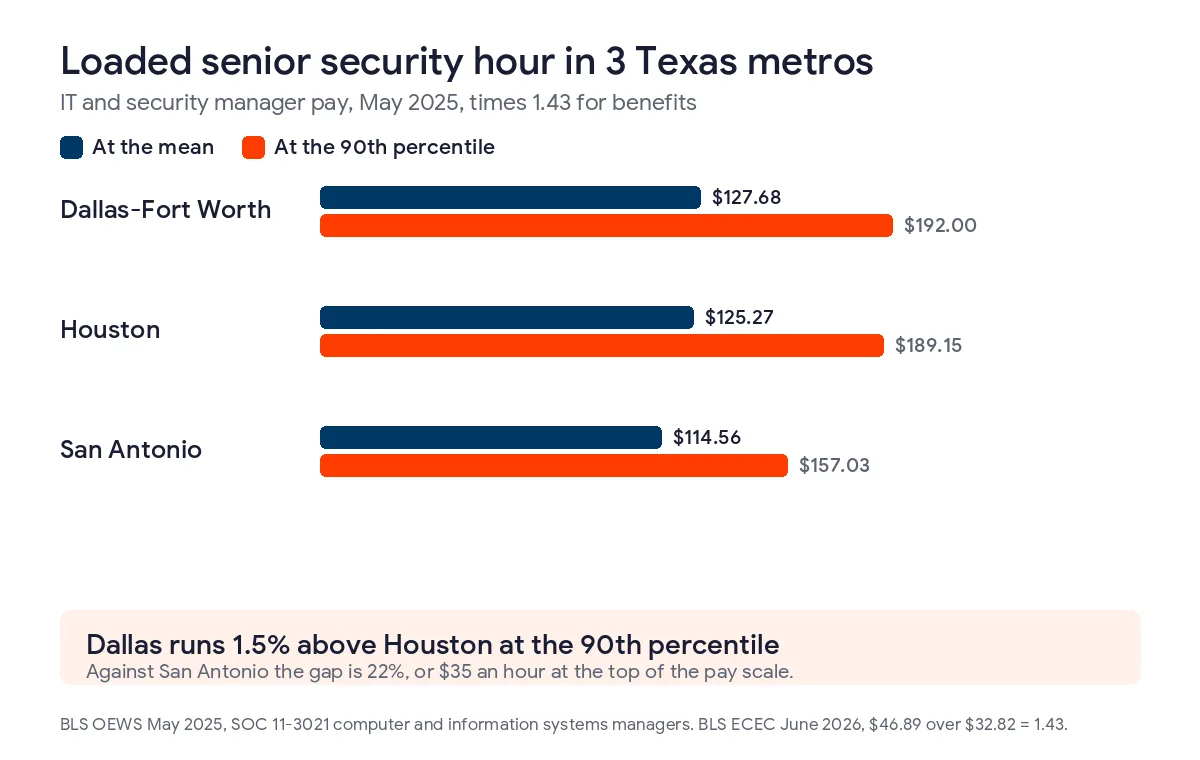
| BLS May 2025 measure | Dallas-Fort Worth | Houston | San Antonio |
|---|---|---|---|
| IT and security managers employed | 30,690 | 13,090 | 4,090 |
| Manager mean hourly wage | $89.29 | $87.60 | $80.11 |
| Manager pay at the 90th percentile | $279,270 | $275,130 | $228,410 |
| Employer cost per hour at the 90th percentile | $192 | $189 | $157 |
| Information security analyst mean pay | $133,790 | $126,880 | $125,830 |
The Houston gap is small at the senior level. Dallas manager pay runs 1.9% above Houston at the mean and 1.5% above it at the 90th percentile. On a 20-hour retainer that’s $48 to $57 a month, which is too little to show up in a quote. Analyst pay shows a bigger Dallas premium. DFW security analysts earn 5.4% more than Houston’s and 6.3% more than San Antonio’s, so a monitoring contract staffed by analysts carries more of the local premium than a vCISO retainer does.
San Antonio is where the gap opens up. A Dallas manager at the 90th percentile earns 22.3% more than one in San Antonio, and a 20-hour retainer costs $263 to $699 more a month in labor. Our San Antonio vCISO cost guide runs the same math for that metro.
Which percentile should you use? We price a vCISO from the 75th to the 90th percentile because the role signs off on risk decisions and briefs the owners. BLS doesn’t measure seniority inside the category, so that part is our judgment. If the person a provider assigns is a mid-career manager, the median of about $119 an hour is a fairer comparison.
How do you turn a Dallas vCISO quote into hours?
Divide the price by the local cost of an hour. It shows what a proposal from a Dallas, Houston, or national firm would buy in senior time here.
- Write down the monthly retainer from the proposal.
- Divide it by $192, the loaded 90th-percentile Dallas hour, to get the low hour count.
- Divide it by $128, the loaded mean, to get the high hour count.
- Compare both counts with the hours the proposal commits to in writing.
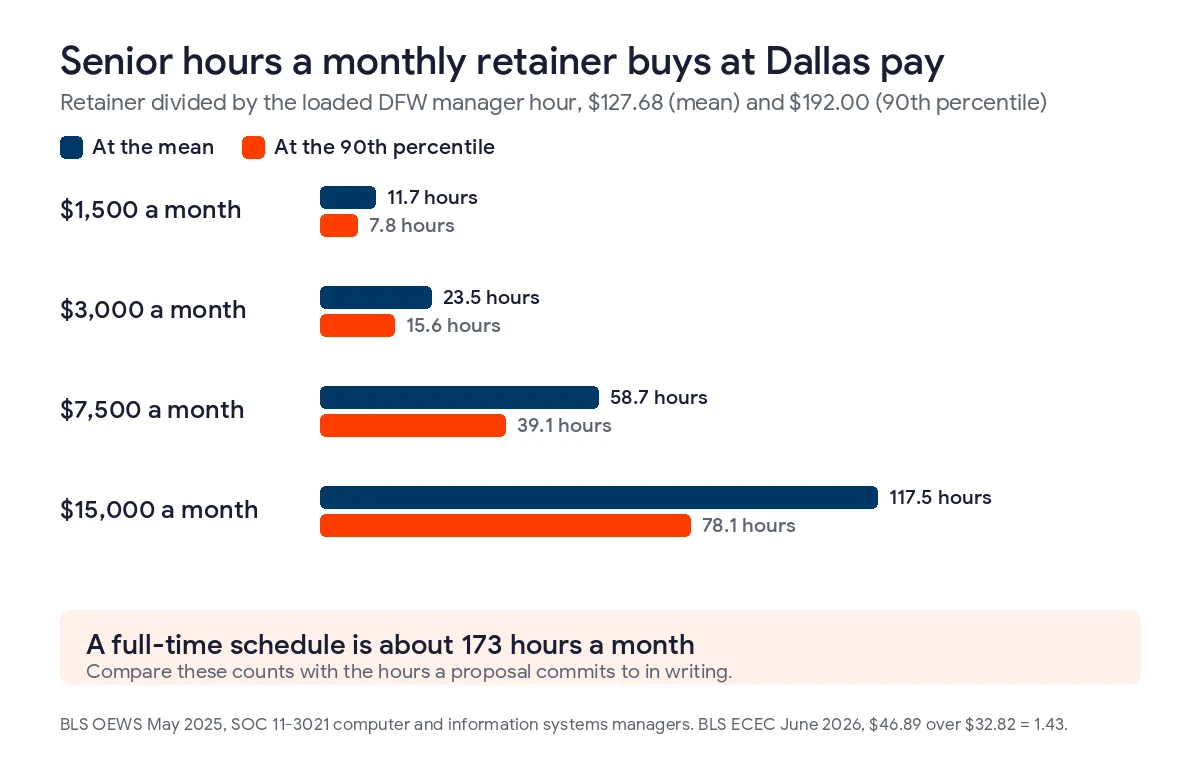
Here’s how 3 common prices work out. $3,000 a month buys 16 to 23 senior hours at Dallas pay. $7,500 buys 39 to 59 hours. $15,000 buys 78 to 118 hours, or about 68% of a full-time schedule at the top of that range. When a $7,500 proposal commits to 16 hours, ask what pays for the other 23 or more. It may be a GRC platform license or a monitoring service, and that’s fine when the proposal itemizes it.
How many vCISO hours does Texas law point a Dallas company toward?
Texas linked a breach defense to company size in 2025. SB 2610 added chapter 542 to the Business and Commerce Code, in effect since September 1, 2025. It applies to businesses with fewer than 250 employees that own or license sensitive personal information. When one of them has a qualifying cybersecurity program in place at the time of a breach, a court can’t award exemplary damages against it over that breach. The program it needs scales with headcount.
| Headcount | Chapter 542 program | Monthly hours we’d start with |
|---|---|---|
| Under 20 | Simplified requirements, such as password policies and employee cybersecurity training | 4 to 8, or the free state program |
| 20 to 99 | Moderate requirements, including CIS Implementation Group 1 | 12 to 20 |
| 100 to 249 | A recognized framework, such as the NIST Cybersecurity Framework or the ISO/IEC 27000 series | 24 to 40 |
| 250 and up | Not covered by chapter 542 | Set by customers, insurers, and regulators |
The safe harbor is narrow. Actual damages and regulators are still on the table, and the defense only works if you can prove the program existed on the breach date. For a company with 20 to 99 people, building that proof is most of the vCISO’s job. CIS Implementation Group 1 lists 56 safeguards. Someone has to put each one in place, record the date, and keep the evidence current. At a 60-person engineering firm in Las Colinas, that work usually falls to whoever runs IT on the side.
What does CMMC add for suppliers to Fort Worth defense plants?
Machine shops, electronics makers, and software firms across DFW supply Lockheed Martin’s Fort Worth plant, Bell, and other primes. If they handle federal contract information or controlled unclassified information, the CMMC program in 32 CFR Part 170 applies to them. It changes a vCISO budget in 2 ways.
The first is the calendar. Level 1 means a self-assessment every year against 15 basic requirements. Level 2 covers the 110 requirements of NIST SP 800-171, and a Level 2 self-assessment repeats every 3 years with an annual affirmation in between. On July 13, 2026, the Department of War suspended Phase 2, the rollout of third-party Level 2 certification, and the SBA praised the suspension on behalf of small suppliers. Any contract with the DFARS 252.204-7012 clause still obligates the supplier to the NIST SP 800-171 controls.
The second is the signature. 32 CFR 170.22 requires an Affirming Official to confirm continuing compliance in SPRS after each assessment and once a year after that. Section 170.4 defines that official as a senior person from within the contractor. A vCISO can run the assessment, maintain the evidence, and brief that person. The name entered in SPRS still has to belong to someone on your payroll, so budget retainer time for the briefing.

We’d put a Level 1 supplier in the 4- to 8-hour range. A Level 2 supplier with a system security plan and open POA&M items fits 24 to 40 hours, with more in an assessment year. Our CMMC compliance cost guide for DFW prices the rest of the program.
Which federal rules name a security role, and can a vCISO hold it?
Dallas has large accounting, lending, and healthcare sectors, and 3 federal rules name a responsible person for security. They don’t agree on whether that person can work for an outside firm.
| Rule | Dallas businesses it reaches | Named role | Can an outside vCISO fill it? |
|---|---|---|---|
| CMMC, 32 CFR 170.22 | Defense suppliers and their subcontractors | Affirming Official | No, it must be a senior person inside the company |
| FTC Safeguards Rule, 16 CFR 314.4 | CPA and tax firms, mortgage brokers, and car dealers | Qualified Individual | Yes, if the company keeps responsibility and names a senior employee to oversee the provider |
| HIPAA Security Rule, 45 CFR 164.308 | Medical and dental practices, plus their business associates | Security official | The rule is silent, so ask counsel first |
The Safeguards Rule also requires a written report to the board or a senior officer at least once a year. 16 CFR 314.6 gives smaller firms relief. If you hold customer information on fewer than 5,000 consumers, 4 requirements drop away, which are the written risk assessment, continuous monitoring or annual penetration testing, the written incident response plan, and the annual report. A 14-person CPA office in Uptown with 3,200 clients may need a few hours a quarter rather than a monthly retainer. Our guide to a WISP for Dallas CPA firms walks through the written plan itself.
For practices around the Southwestern Medical District, 45 CFR 164.308 requires an accurate and thorough risk analysis and an assigned security official. The analysis takes most of the billable hours. A common split puts the practice administrator in the security official role while the vCISO handles the analysis and the policies. Our healthcare IT services in Dallas page covers the systems side.
Should you pay by retainer, by the hour, or by project?
Start with what you’re buying. A retainer buys an owner who runs reviews, tracks evidence, and reports through the year. Hourly billing suits a one-time task, such as a customer security questionnaire or a single board briefing, but nobody owns the program in between. A fixed-fee project suits a first risk assessment or a starter policy set, and it stops when the document is delivered.
The first quarter costs more than the rest. Asset and account inventories, the first risk assessment, and first drafts of policies all land in months 1 to 3. Many providers charge a one-time onboarding fee for that work and then step down to a smaller retainer. If a quote shows the same amount every month from the start, ask where the setup work went.
Check that the proposal answers these questions before you sign.
- Who your assigned vCISO is, and who covers when that person is on vacation
- Whether unused hours roll over or expire
- Which records you keep when the contract ends, including the policies, the risk register, and the assessment evidence
- How incident time outside business hours is billed
Records matter because the chapter 542 defense and a CMMC affirmation both depend on dated evidence. Evidence that lives only in a provider’s portal can be hard to get back once the contract ends.
When does a full-time CISO make more sense for a Dallas company?
A full-time security manager at the Dallas mean costs about $265,600 a year with benefits, or $22,130 a month. At the 90th percentile the figure is $399,400 a year, about $33,280 a month. Recruiter fees and the months the seat sits open are extra.
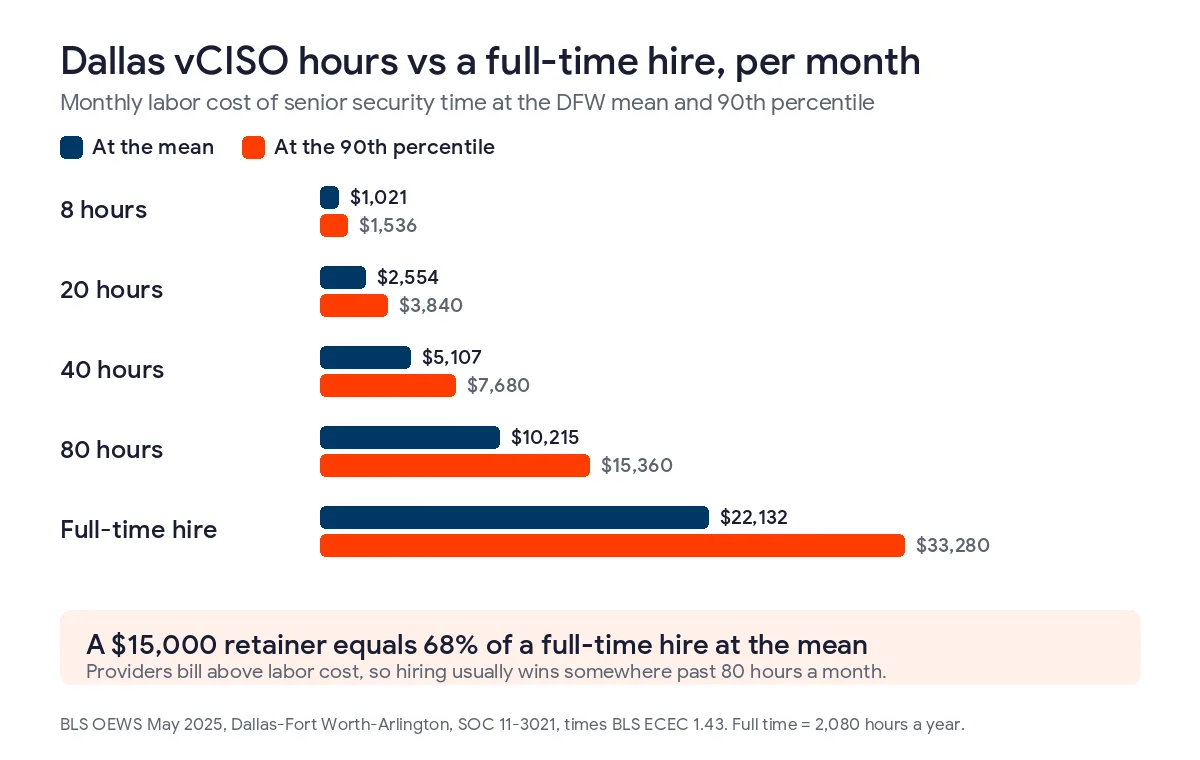
Because providers charge above labor cost, the break-even comes before a full schedule. A $15,000 retainer already equals 68% of a full-time manager at the Dallas mean. Somewhere past 80 hours a month, hiring usually costs less. A common handoff keeps the vCISO on for one quarter while the new hire settles in.
An analyst is a different hire. DFW’s 7,080 information security analysts average $133,790 a year, about $191,300 with benefits. They work in the tools and the alert queue. Setting risk priorities and briefing owners usually takes someone more senior, and pairing a vCISO with a managed security team covers both jobs.
A vCISO also isn’t a vCIO. Our vCIO services in Dallas cover technology budgets and roadmaps. The vCISO covers security risk and the rules above. Small companies sometimes buy both from 1 provider, though the scopes and the hours stay separate.
Is there a free place for a Dallas small business to start?
Yes. The Texas Small Business Cybersecurity Assistance Center was announced in November 2024 with a 2-year, $1 million SBA grant. UTSA’s Small Business Development Center leads it, and the SBDC at Dallas College is one of its named partners. Texas small businesses can get up to 40 hours of free vCISO help, along with assessments and training. The grant period began in late 2024, so call the Dallas College SBDC to confirm the program is still enrolling.
The free hours run out well before a full year of program work. For a company under 20 people they cover starter policies and a staff training schedule, which is close to what chapter 542 expects at that size.
How does Uprite price vCISO work in Dallas?
We quote vCISO work after a scoping review. We count your employees, identify which of the rules above apply, list your sites, and read what your customers and your cyber insurer already require. Your vCISO then works alongside our Dallas managed security team. That service, MSSP Security Focus, starts at $40 per user per month, and our first response averages 5 minutes across every ticket priority. Policies, alerts, and evidence sit in one shared record.
Your insurer’s questionnaire is often the fastest way to size the hours, and our guide to cyber insurance requirements in Dallas lists what carriers ask for. Managed IT plans are on our pricing page. Uprite isn’t a law firm, so ask your attorney how these rules apply to your business.
Questions Dallas owners ask about vCISO pricing
What does 1 hour of vCISO time cost in Dallas?
About $128 to $192 is what a Dallas employer pays in wages and benefits for an hour of a senior security manager’s time, based on May 2025 BLS pay for the metro’s 30,690 IT and security managers. Provider rates run higher, and one DFW firm publishes $200 to $400 an hour.
Is a Dallas vCISO more expensive than one in Houston?
Only by a little at the senior level. Dallas manager pay is 1.9% above Houston at the mean and 1.5% above it at the 90th percentile, which adds about $50 a month to a 20-hour retainer. Differences between firms come from scope and markup far more than from the city.
Can a vCISO sign our CMMC affirmation in SPRS?
No. The person who affirms in SPRS has to be a senior official inside the contractor, under 32 CFR 170.22 and the definition in 170.4. Your vCISO can build the assessment and the evidence file, and should brief the official before the affirmation goes in.
We have 15 employees in Plano. Do we need a monthly retainer?
Probably not yet. Chapter 542 asks a business under 20 employees for simplified steps, and the free state center or a few advisory hours each quarter can cover those. The math changes once you pass 20 employees, or when a contract brings in CMMC or the FTC Safeguards Rule.
Does the CMMC Phase 2 pause let us skip a vCISO this year?
Not if you hold contracts with DFARS 252.204-7012. The July 2026 suspension paused third-party Level 2 certification only. You still owe the NIST SP 800-171 controls, plus a yearly affirmation for any score already entered in SPRS.
Send us your headcount, the contracts and rules you work under, and your insurer’s latest questionnaire. We’ll return a written Dallas vCISO scope with the monthly hours spelled out, and it’s yours to keep whether or not you hire us.
Speak to a vCISO