
A Dallas company needs an IT consultant when it can describe the finished deliverable before work starts, and a vCIO when the same decisions keep coming back, such as budgets, renewals, server retirements, and Chapter 542 updates.
I’m the Lead vCIO at Uprite, and this post sits under our main page on IT consulting in Dallas. Owners in Plano, Las Colinas, and Uptown ask me some version of this question every month. They usually frame it as a choice between 2 kinds of hire. I find it more useful to ask what happens to the work after the first invoice is paid. Below I cover how the 2 roles differ, which Dallas decisions fit each one, what the public BLS, GSA, and Census numbers say about cost, how the Texas safe harbor law changes the math, and the cases where I’d tell you to hire an independent consultant instead of us.
Use an IT consultant for a project you can scope in writing and finish, like an office move, a software selection, or a review before an acquisition. Use a vCIO for work that returns on a schedule, like the annual IT budget, vendor renewals, the cyber insurance questionnaire, and keeping a Chapter 542 security program current. Windows Server 2016 loses security updates on January 12, 2027, which is a good test of which kind of help your company has.
How is a vCIO different from an IT consultant?
An IT consultant is an outside expert hired to solve a defined problem for a set fee or hourly rate, and the engagement ends when the deliverable is accepted. A vCIO, or virtual chief information officer, is a part-time technology executive who owns a company’s IT roadmap, budget, and vendor decisions on a continuing basis.
Neither title is its own occupation in federal data. The BLS groups senior technology leaders under computer and information systems managers, and its occupational profile lists chief information officer as one of the job titles in that group. A vCIO does that job for several companies at once on a fractional schedule. A consultant on a project is usually doing something narrower, closer to a specialist than an executive.
| Question | IT consultant | vCIO |
|---|---|---|
| What are you buying? | A finished deliverable | Ongoing ownership of the IT plan |
| How long does it last? | Weeks to a few months | Years, reviewed every quarter |
| How is success judged? | The deliverable is accepted | Roadmap items get done on budget |
| Who keeps the history? | Your files, if someone saved them | The vCIO, from one review to the next |
| Who talks to vendors? | Only during the project | Every renewal and every quote |
| How is it billed? | Hourly or a fixed project fee | Monthly, or included in managed IT |
The history row is the one owners underestimate. A consultant who comes back after a year starts by learning the environment again, and you pay for those hours twice. A vCIO who handled last year’s insurance renewal already knows what the company told the carrier about backups and multifactor login, and which fixes were promised by a certain date.
Why does the Dallas market make this choice harder?
Dallas has a deep pool of senior IT talent, and it’s also expensive. The BLS counted 30,690 computer and information systems managers in the Dallas-Fort Worth-Arlington metro in May 2025, with an annual mean wage of $185,720. Houston had 13,090 people in the same occupation. The DFW count includes IT leaders at the large corporate headquarters in Irving, Plano, and Richardson, and a smaller company hiring a CIO competes with those employers for the same people.
Private employers pay about 43% on top of wages for benefits and payroll taxes, based on the June 2026 Employer Costs for Employee Compensation release. That puts a full-time Dallas CIO at roughly $265,600 a year before a recruiter’s fee or a bonus.
Very few DFW businesses are big enough to justify that hire. The Census Bureau’s County Business Patterns data for 2023 counts 189,739 employer establishments in the metro. Of those, 158,493 had fewer than 20 people on payroll, and 29,416 had between 20 and 249. That middle group is where I hear the vCIO versus consultant question most. These companies have real IT spending and real compliance exposure, but not enough work to keep a $265,000 executive busy. Establishments are locations, not companies, so a firm with 3 offices counts 3 times. The size pattern still holds.
The same market also has plenty of consultants. The BLS counted 18,010 management analysts and 20,000 computer systems analysts in the metro in May 2025. Finding someone to run a project in Dallas is easy. Keeping one person accountable for the plan after the project ends is the harder part.
Which Dallas decisions fit each role?
It helps to sort by the decision instead of the job title. These are 9 situations we see in Dallas, split by whether the work ends or repeats.
| Situation | Better fit | Reason |
|---|---|---|
| Moving an office from Uptown to Frisco or Las Colinas | IT consultant | The move date is fixed and the work ends at move-in |
| Choosing an ERP, practice management, or accounting system | IT consultant | It’s a selection project with a decision date |
| IT due diligence before buying a competitor | IT consultant | It has to be independent and done before closing |
| A second opinion on a managed IT proposal | IT consultant | The reviewer shouldn’t be bidding on the work |
| Building the annual IT budget | vCIO | Each year builds on last year’s spending and plans |
| Microsoft 365, phone, and copier renewals | vCIO | Renewal dates are spread across the year |
| Tracking end-of-support dates for servers and firewalls | vCIO | Some product is always 12 to 18 months from retirement |
| The yearly cyber insurance questionnaire | vCIO | Answers need to match last year’s and the real controls |
| Keeping a Chapter 542 security program current | vCIO | The law protects a program that is maintained over time |
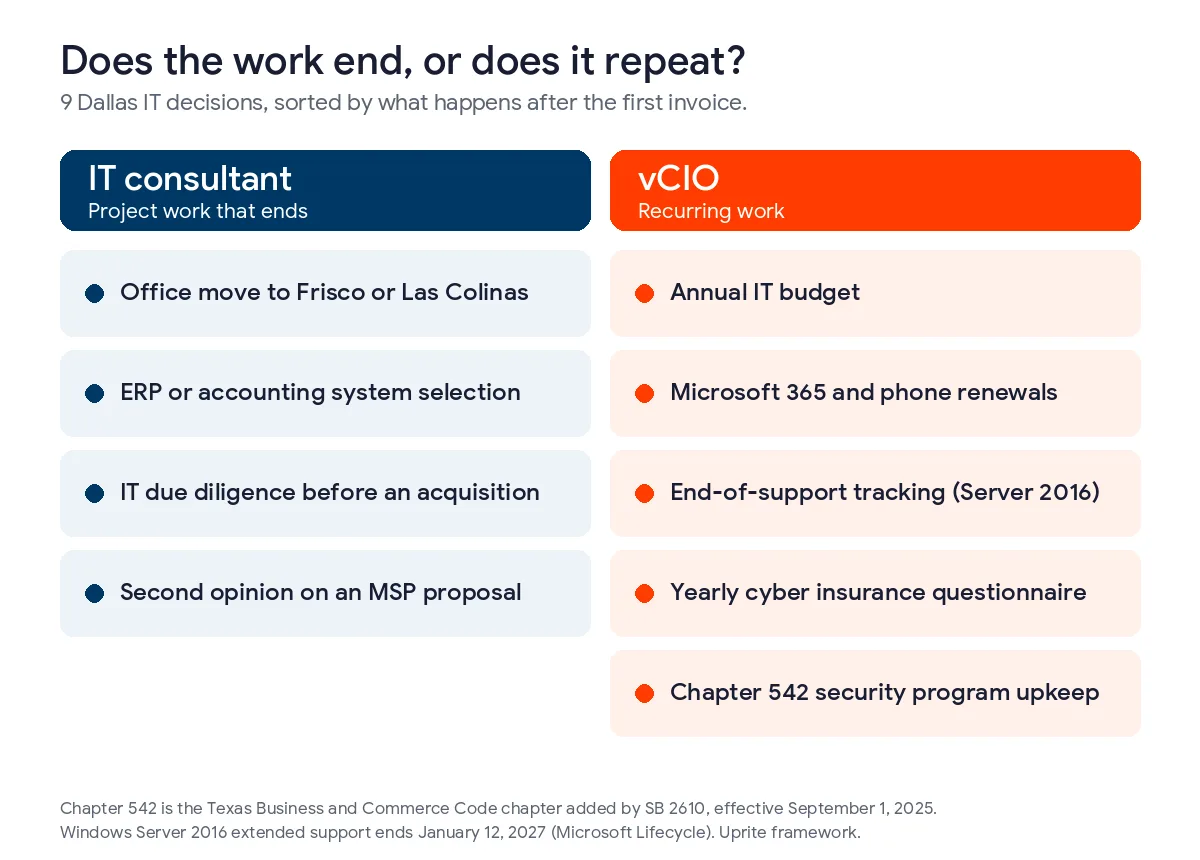
Some work starts as a project and turns into a recurring job. An office move to Frisco is a project with a fixed date. After move-in, though, the new building has its own internet circuit contract, a firewall subscription that renews, and a landlord who controls the network closet. Those items show up again every year, and they’re usually the ones nobody owns.
What does Windows Server 2016 show about the difference?
Microsoft’s lifecycle page for Windows Server 2016 shows extended support ending on January 12, 2027. After that date Microsoft stops releasing security updates for it. That’s 60 days from the date of this post, and plenty of Dallas offices still run a file server or a line-of-business application on that version.
Consider a hypothetical 70-person firm in Richardson with 2 servers on Windows Server 2016. A consultant can scope the replacement well. They can compare new hardware, a move to Azure, or a switch to a cloud version of the application, and then write a plan with a price. That’s a good use of a consultant.
The harder question is why the firm is finding out in November. The end date for Windows Server 2016 has been public for years. A vCIO keeps a lifecycle list of every server, firewall, switch, and major application with its support end date, and puts each replacement into the budget a year or more ahead. With that list, the replacement is a planned line in the 2026 budget. Without it, the same replacement turns into an unplanned expense in the last weeks of the year.
How does Texas Chapter 542 affect the choice?
Senate Bill 2610 took effect on September 1, 2025, and added Chapter 542 to the Texas Business and Commerce Code. It covers businesses with fewer than 250 employees that hold sensitive personal information. If one of them is sued after a breach, the court can’t award exemplary damages against it when it shows that it “implemented and maintained” a qualifying cybersecurity program at the time of the breach.
The requirements scale with headcount. Under 20 employees, the law asks for simplified measures such as password policies and staff training. From 20 to 99 employees, it names CIS Controls Implementation Group 1, which has 56 safeguards. From 100 to 249, the program has to conform to a recognized framework such as the NIST Cybersecurity Framework. In the 2023 Census data, about 25,600 DFW establishments sat in the 20 to 99 band and about 3,800 in the 100 to 249 band.
Section 542.004(c) is the important part for this comparison. When a framework is updated, the business has until the later of the framework’s implementation date or the first anniversary of its publication to update its own program. A consultant can write a good program in a few weeks. Under a project contract, though, nobody at the consulting firm is assigned to watch for the next CIS or NIST version after the final invoice. The word “maintained” in the statute points to an owner, and that is usually a vCIO or an internal IT leader.
What does each option cost in Dallas?
Quotes vary a lot between firms, so I started from public data instead.
For outside help, the GSA’s CALC labor rate tool is one of the few public sources of negotiated hourly rates. When I pulled it on November 13, 2026, it had 1,013 ceiling rates for IT consultant job titles without a security clearance, from 337 vendors. The median was $149.62 an hour, and the middle half ran from $123.53 to $182.89. CIO-level titles were rare. There were 11 rates from 10 vendors, including some labeled virtual CIO, with a median of $245.19.
These are federal contract ceilings, so they’re a reference point and not a Dallas price list. As a floor, DFW management analysts earned a mean of $53.96 an hour and computer systems analysts $58.61 an hour in May 2025. A consulting firm has to bill well above wages to cover benefits, overhead, and time it can’t bill.
| Option | Basis | Rough cost |
|---|---|---|
| Full-time Dallas CIO | $185,720 mean wage plus about 43% for benefits and taxes | About $265,600 a year |
| Small consultant assessment | 40 hours at the $149.62 CALC median | About $6,000 once |
| Mid-size consultant assessment | 80 hours at the same rate | About $12,000 once |
| Complex consultant assessment | 120 hours, often several sites or compliance mapping | About $18,000 once |
| Standalone vCIO | $3,000 to $10,000 a month | $36,000 to $120,000 a year |
| vCIO included in managed IT | Part of the per-user rate | No separate line item |
The 40, 80, and 120 hour sizes are my own planning assumptions, not survey results. The $3,000 to $10,000 range is what other providers typically charge for a standalone vCIO. Divided by the $245.19 CIO-level median, it works out to about 12 hours a month at the low end and about 41 hours at the high end. In my experience that’s roughly what a quarterly review, the next year’s budget, and the renewals in between take for a company in the 20 to 249 range.
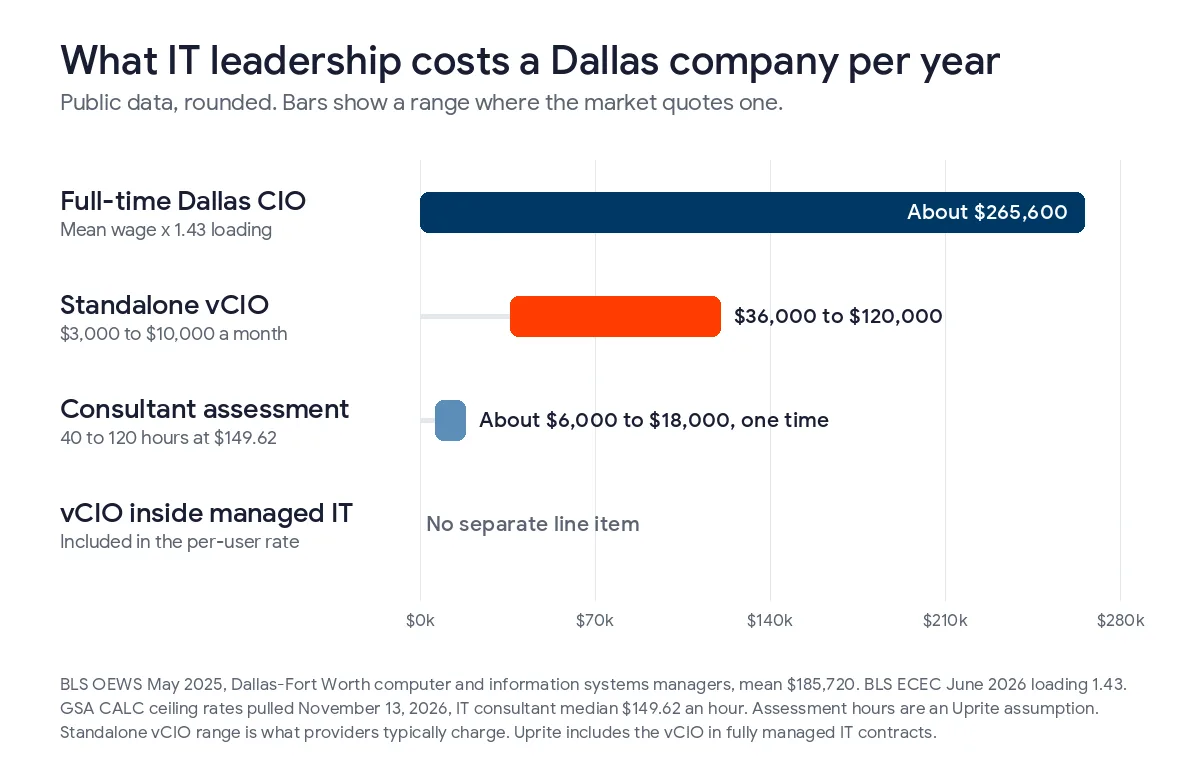
On paper the consultant is cheaper per year. The comparison changes when a company calls the consultant back 3 or 4 times a year. Each visit pays for some discovery again, and the total can land inside the vCIO range while nobody carries the plan between visits.
When should you hire an independent consultant instead?
I run the vCIO practice for a managed IT provider, so I have an obvious interest here. Even so, there are 4 situations where I’d tell a Dallas owner to hire an independent consultant.
- Your current provider, including us, has sent a proposal for new hardware or a new contract, and you want it reviewed by someone who isn’t selling it.
- You already have a strong IT director, and you need one specialty for a short time, such as a network redesign for a second building.
- You’re buying or selling a company and need the IT reviewed independently before closing.
- You’re about to sign a multi-year agreement and want the roadmap checked by someone who won’t be paid to carry it out.
A vCIO who works for a managed provider has a stake in which firewall, backup system, or support plan you buy. Good vCIOs say that openly and show you the alternatives. An outside consultant with no implementation work to win doesn’t have that conflict in the first place.
That advantage has limits. If you’ve hired the same consultant 3 times in 18 months for related problems, the pattern usually means nobody owned the plan between projects. Owning the plan is the vCIO’s job.
How do Dallas companies move from one to the other?
Many start with a consultant. They buy a scoped assessment, get a written roadmap, and then find that nobody on staff has time to carry it out. Our IT consulting services are built for that path. The project assessment is a fixed fee, it typically takes 4 to 6 weeks, and the client keeps the assessment and roadmap whether or not they hire Uprite afterward.
These signs usually mean a company has outgrown project-only help.
- The last IT roadmap is more than 9 months old and nobody has updated it.
- Software subscriptions and copier leases renew automatically before anyone reviews them.
- Nobody knows who answered last year’s cyber insurance questionnaire or what they said.
- Leadership has never seen an IT budget broken out by month and by project.
- Nobody can say which security framework the company follows or which version.

If 2 or more of those are true, the real decision is who owns the plan. Our guide to what a vCIO does in Texas lists the deliverables and a sample yearly calendar. Our explainer on whether your business needs a vCIO compares the role with a full-time CIO, and the vCIO and CTO comparison covers engineering leadership. If the gap is security leadership specifically, read our vCISO and CISO comparison for Dallas.
How does Uprite handle vCIO work in Dallas?
Every fully managed IT client gets a named vCIO, and I lead that team. The vCIO is included in the monthly per-user fee, so it doesn’t appear as a separate charge. Each quarter ends with a business review where we go through roadmap progress, budget, security status, and changes in the business since the last meeting. The details for this metro are on our vCIO services in Dallas page, and our Dallas office is at 5757 Alpha Road.
If a managed agreement isn’t the right step yet, a company can start with the fixed-fee assessment instead. Companies with an internal IT team can also use co-managed IT in Dallas, which adds vCIO planning on top of the staff they already have. The full service is described on our managed IT services in Dallas page, and you can reach us through the contact page.
Questions Dallas owners ask about vCIOs and IT consultants
Does a vCIO replace the need for IT consultants?
No. A vCIO often brings in a specialist for a project, such as a network redesign or an ERP selection, and then makes sure the results are carried out. The difference is that the vCIO decides when a specialist is needed and owns what happens after they leave.
How long does an IT consulting assessment take?
A scoped assessment for a company with 20 to 249 employees usually takes 4 to 6 weeks. That covers interviews, an inventory of hardware and software, a security review, and a written roadmap with a budget. Several sites or compliance mapping can make it longer.
What should a vCIO deliver in the first 90 days?
Expect an inventory of systems and contracts, a list of products nearing end of support, a first-year budget, and a short list of the highest-risk gaps. You should also get a date for the first quarterly business review. If those items aren’t on paper after 90 days, ask why.
Is a vCIO worth it for a company with fewer than 20 employees?
Often it isn’t, at least not as a standalone purchase. Chapter 542 asks firms under 20 employees for simplified measures such as password policies and training, and a short consulting project plus good managed support may cover that. A vCIO makes more sense once renewals, budgets, and compliance questions start stacking up.
Can a vCIO work with our in-house IT person?
Yes, and it’s a common setup. The in-house person keeps running daily operations. The vCIO adds the budget, the multi-year roadmap, vendor negotiations, and framework mapping that a one-person department rarely has time for.
What should an IT consultant hand over when the project ends?
Ask for the full assessment, network diagrams, the hardware and software inventory, admin credentials stored in your own password vault, and the roadmap in a format you can edit. Those documents let a vCIO or a new provider pick up the work without paying for discovery again.
Not sure if your next IT decision is a one-time project or an ongoing job? Send us the list of what’s coming up this year and we’ll help you sort it, consultant work on one side and vCIO work on the other. Our average response time is 5 minutes.
Talk to a vCIO