A Houston nonprofit should budget IT as a per-person operating cost, about $91 to $138 per staff member a month for managed support before licensing, and fund it from direct grant lines, its indirect rate, and unrestricted money. Grants can often pay for more of that than the budget shows. Not all of it, though.
My job at Uprite is operations, so I’m usually in the room after a nonprofit signs, when we find out what the last budget left out. It’s rarely the hardware. On day 1, the technology is usually fine. The budget behind it isn’t. A program grant buys 6 laptops, nobody funds the support, and 3 years later the shelter or food pantry is running on a server nobody has patched. For the service side, start with our page on IT services for nonprofits in Houston. Here I only deal with the money.
Everything below comes from documents you can check yourself. The grant rules come from the federal Uniform Guidance and the Texas Health and Human Services indirect cost rules, the tax reporting rules from the IRS instructions for Form 990, and the Houston numbers from the IRS master file of exempt organizations, which I pulled on October 27, 2026. Prices come from our own published managed IT pricing. Where a funder’s rules decide the answer, I’ll say so. Read your award letter.
What Does a Nonprofit IT Budget Actually Include?
A nonprofit IT budget is the yearly plan for every technology cost an organization carries, from support and security to devices, software, internet, and backup, with each line tagged by where the money comes from. That last part is what separates it from a business IT budget. A company has one wallet. You have several. Each one has rules.
| Budget line | Typical Houston cost basis | Who usually pays |
|---|---|---|
| Managed support and help desk | $91 to $138 per staff member per month at Uprite | Indirect rate or unrestricted funds, partly direct where staff work on one program |
| Laptops and other computing devices | Your model price times the number of staff | Direct grant line when the device serves the program |
| Software and cloud subscriptions | Per user, often discounted or donated | Split by program use, the rest unrestricted |
| Security, backup, and restore testing | Included in Fully Managed, or $40 per user on our security-only plan | Indirect or unrestricted, almost never a program line |
| Servers, firewalls, and network gear at $10,000 or more per unit, or less if your capitalization policy is lower | Quoted per project | Capital campaign, reserve, or a grant with written prior approval |
| Internet circuits and phones | Per site | Occupancy or indirect costs |
Look at the third column. Grants show up, but only in certain rows, and the rows they skip are the ones that keep the lights on. Support. Security. Backup. Grant budgets usually file all 3 under indirect costs.
Why Don’t Grants Cover IT?
Because IT usually gets classified as overhead. And overhead is what funders try hardest to keep small.
The Texas Health and Human Services indirect cost rate page uses the IT department as one of its 3 textbook examples of an indirect cost, right next to accounting and executive staff. If the state’s own health and human services agency files IT that way, your program officer probably does too. The same page says HHSC and DSHS grantees need an approved rate in place before they recover any indirect cost, and that charging one without it can get the cost disallowed. That’s a real risk.
None of this is new. In 2009 Ann Goggins Gregory and Don Howard described the nonprofit starvation cycle in the Stanford Social Innovation Review, the loop where funders expect low overhead, nonprofits underspend to meet the expectation, and the underspending becomes the new normal. One line from that piece has stuck with me. “Nonfunctioning computers cannot track program outcomes and show what is working and what is not.” Think about that. The funder who won’t pay for the computer often wants the outcome report.
Benchmarks don’t help much either. The figure people still quote, that the average nonprofit spends 3.2% of its budget on technology, comes from the 2014 NTEN staffing and investments report. It’s 12 years old. I wouldn’t build a 2027 budget on it. I’d also be wary of anyone who hands you a percentage without asking how many people you employ.
Where Can IT Money Come From Inside a Grant Budget?
There are 3 places. Direct costs, the indirect rate, and unrestricted money. A workable budget uses all of them, and the trick is knowing which IT cost belongs in which bucket before you write the proposal, not after the award letter arrives.
Direct costs, for devices and time the program actually uses
Federal money, including the federal dollars that reach Houston nonprofits through the City, Harris County, or a Texas state agency, follows 2 CFR 200.453. Its paragraph (c) allows computing devices to be charged as direct costs when they’re “essential and allocable, but not solely dedicated” to the award. Read that phrase twice. A laptop doesn’t have to sit idle outside program hours to qualify. It has to be needed for the program and charged in proportion to its use.
The definitions in 2 CFR 200.1 matter just as much. A computing device is a supply, not equipment, when it costs less than $10,000 or your own capitalization threshold, whichever is lower, no matter how long it lasts. Supplies are easy. Equipment isn’t. 2 CFR 200.439 requires prior written approval before general purpose equipment goes into a grant as a direct cost, and it bars equipment from indirect costs altogether. So a $12,000 server, or a $6,000 one if your capitalization policy starts at $5,000, needs an early conversation with the program officer. Ask early. A case manager’s laptop usually just needs a budget line.
Support time can be direct too, when it’s specific. Setting up a client intake database for one program, training that program’s staff on it, and fixing it when it breaks is program work that can sit on that program’s grant. Password resets for the whole office aren’t. Keep the 2 apart in your time records.
The indirect rate, which is where support and security live
Under 2 CFR 200.414(f), any organization that hasn’t negotiated its own rate can claim up to 15% of its modified total direct costs as indirect recovery. That’s the de minimis rate. It used to be 10%. The 15% cap applies to federal awards made on or after October 1, 2024, so an older award keeps its original terms unless the agency amends it. Check your award date. Texas HHS applies the same 15% to state awards made on or after that date under the Texas Grant Management Standards, and its page says the acknowledgment letter normally comes back within a week.
A 5-point change sounds small. Run it on a real award.
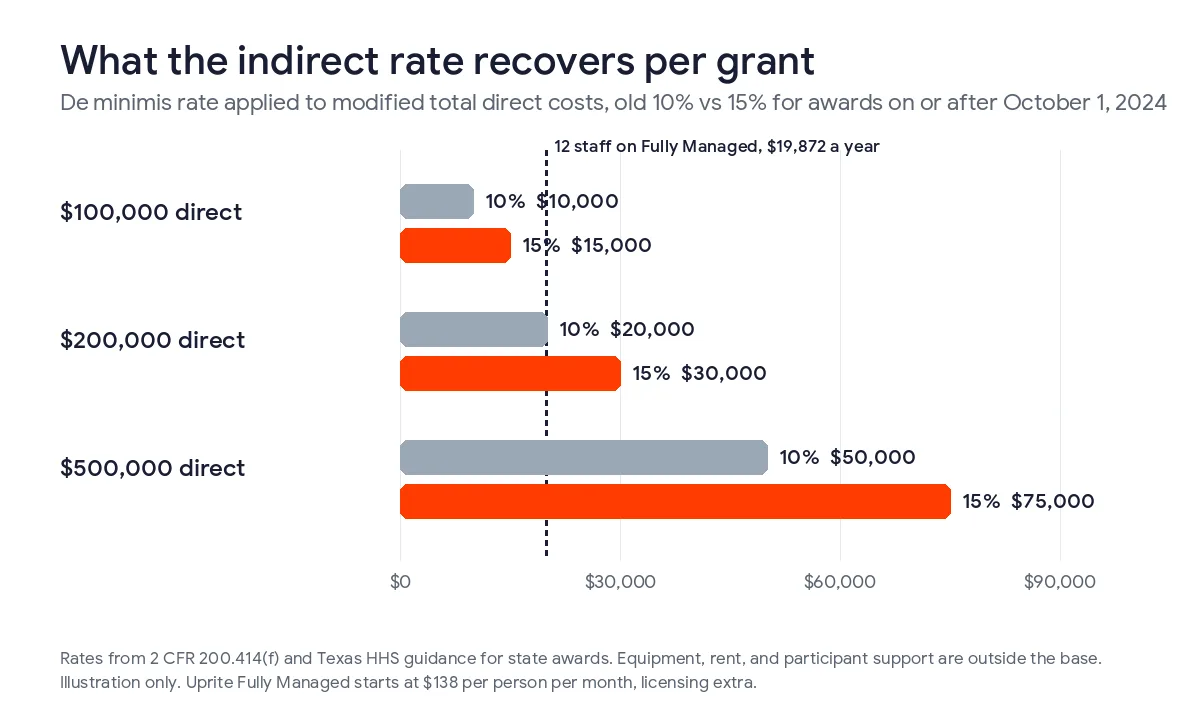
On a grant with $200,000 in modified total direct costs, 10% recovers $20,000 and 15% recovers $30,000. A 12-person team on our Fully Managed plan at $138 a person costs $19,872 a year before licensing. That indirect money also has to cover accounting, rent, and executive time, so IT only gets a share of it. The extra $10,000 the new rate brings in makes that share much easier to defend. There’s a catch. You have to elect the rate, charge each cost consistently as direct or indirect, and use it on all your federal awards until you negotiate a rate of your own. No election, no recovery.
One limit worth knowing. Equipment and rent are excluded from the base, so a grant that’s mostly a building lease won’t generate much indirect money no matter what rate you elect.
Unrestricted money and the funders who give it
Whatever the grants don’t reach comes from unrestricted gifts, events, earned revenue, or general operating support. Some private foundations make general operating grants specifically so the organization can decide what overhead to fund. Have one of those relationships? Then name IT in the ask. Funders who give unrestricted money generally want to hear what it protects. Tell them.
How Much Should a Houston Nonprofit Spend on IT?
Price it per person, not as a share of revenue. A percentage hides the 2 numbers that actually drive the bill, how many people need support and how many sites they work from. To see how 9 Houston firms price and prove that support, read our ranking of the best IT providers for Houston nonprofits.
Some local context helps. The IRS exempt organization master file lists 14,541 501(c)(3) records with a Houston mailing address. Of the 13,164 public charities among them, 3,151 report a revenue figure above zero, and 1,668 of those report $200,000 or more. That’s roughly the line where an organization can no longer file the short Form 990-EZ. Their median revenue? About $899,000.
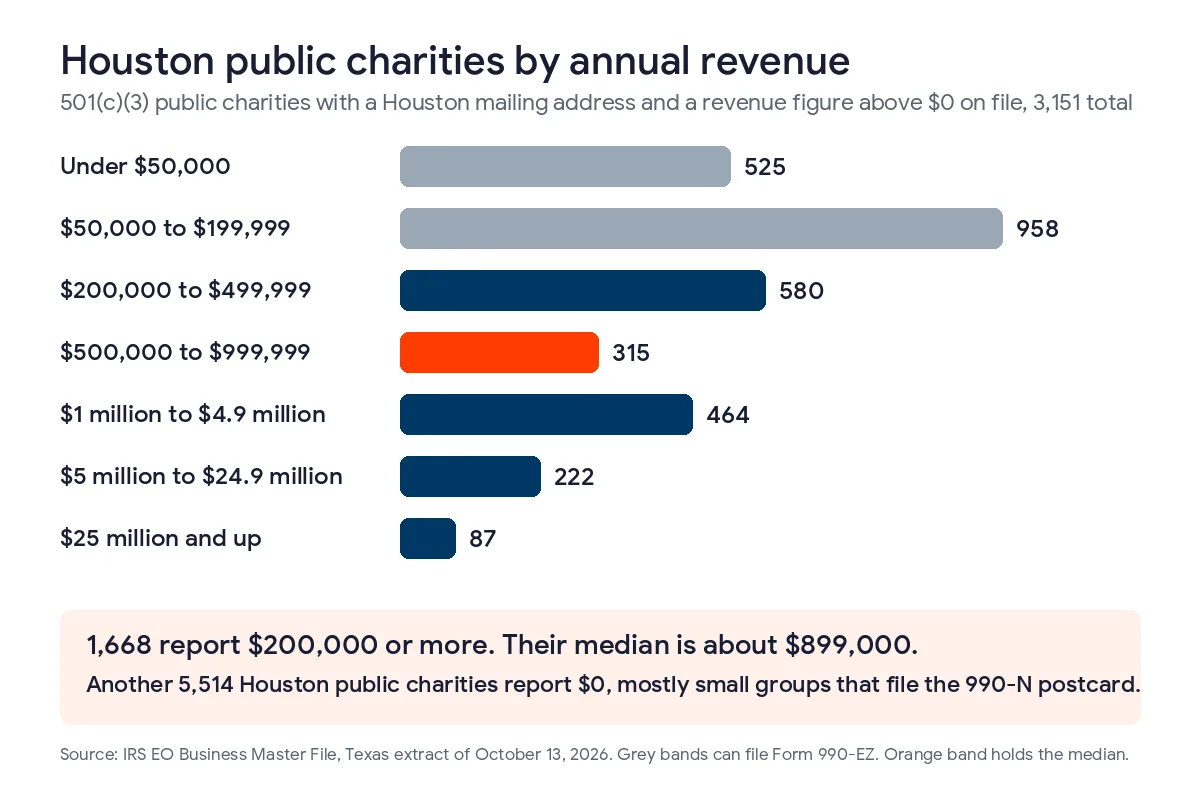
So picture a $900,000 Houston nonprofit with 12 staff. On our Fully Managed plan at $138 a person, IT support runs $1,656 a month, or $19,872 a year. That’s 2.2% of revenue. Licensing and devices come on top. An 8-person team can use our remote IT Essentials plan at $91 instead, since it’s built for teams under 12 people, which comes to $728 a month, about 1% of the same budget. That plan covers business hours only, up to 8 support hours per person a month. These are our published starting prices. The examples are illustrations, not quotes.
| Staff who need support | Uprite plan | Per month | Per year |
|---|---|---|---|
| 5 | IT Essentials, remote, at $91 | $455 | $5,460 |
| 8 | IT Essentials, remote, at $91 | $728 | $8,736 |
| 12 | Fully Managed at $138 | $1,656 | $19,872 |
| 20 | Fully Managed at $138 | $2,760 | $33,120 |
| 40 | Fully Managed at $138 | $5,520 | $66,240 |
A Houston-specific note on that table. Our $110 remote IT Pro plan isn’t offered in the Houston or San Antonio areas, which leaves a Houston team of 12 or more with 2 choices from us, Fully Managed, or Co-Managed at $100 when there’s already an IT person on staff. I’d rather say that up front than have it surprise a finance committee. Volunteers are the other judgment call. A volunteer who checks email once a month rarely needs a paid seat, while one who runs intake 3 days a week from your front desk probably does, and that one distinction can move the monthly bill more than any rate negotiation.
Add 2 lines the support price doesn’t include. One is licensing, which has its own nonprofit rules and deserves its own article. Then there’s device replacement. Divide your laptop count by 4, multiply by the price of the model you actually buy, and put that in the budget every year. No more emergency laptop purchases. For a detailed breakdown by organization size, see what IT costs a Houston nonprofit. For the general mechanics of building any IT budget, our guide to creating an IT budget still holds up.
How Should IT Show Up on Your Form 990?
Not all in management and general. That’s the mistake I see most often. It makes the organization look more overhead-heavy than it is.
The IRS instructions for Form 990 put information technology on line 14 of Part IX, and they define it broadly, covering hardware, software, help desk and other technical support, website operations, and information security services. Section 501(c)(3) organizations must split every Part IX line across 3 columns, program services, management and general, and fundraising. If your books don’t already allocate expenses, the instructions let you use “any reasonable method of allocation” as long as you document it. IT staff salaries go on lines 5 through 10 instead, and depreciation on IT equipment goes on line 22.
Headcount is the simplest reasonable method. Say 9 of your 12 staff work in programs, 2 in administration, and 1 in development. Split the $19,872 support bill the same way and $14,904 goes to program services, $3,312 to management and general, and $1,656 to fundraising. Your auditor may prefer time records or a usage measure instead. That’s fine. Pushing everything into programs to flatter the ratio isn’t. Pick a method you could defend line by line, write it down, and use it every year. Consistency matters more.
Churches are the exception. The same IRS file codes 3,179 Houston 501(c)(3) records as churches, and churches aren’t required to file a 990 at all, so their budgeting looks different. Our post on IT support for Houston churches covers that side.
The Houston Line Item No Funder Wants to Pay For
Recovery. Specifically, a backup you’ve actually restored, and a plan for working when the building has no power.
Hurricane Beryl knocked out power to about 2.7 million customers in July 2024, 2.2 million of them on CenterPoint, and the Public Utility Commission of Texas final report on Beryl says telecom disruptions ran from July 8 through July 16 for most providers. Picture a food pantry that week. Demand goes up. The phones don’t work.

I think about a nonprofit we worked with at the end of 2025. Its main on-site host server failed without warning, with decades of records and about 40 staff depending on it. Our team stood up a temporary “lifeboat” environment so people could keep working while we recovered more than 3TB of data over the following days. The nonprofit data recovery case study tells the full story. The case study credits reliable backup systems, and that’s the point. Backup is a budget line. It’s also the line that gets cut first when a grant ends. Protect it.
So budget restore testing as its own named item. Funders understand “we tested recovery of our client records 4 times this year” far better than they understand “managed backup.”
Cut Before You Ask
A finance committee will take a larger IT budget more seriously when it can see what you already cut. There’s usually something.
A Texas women’s shelter we supported had consumer-grade network equipment spread over several buildings. Moving its servers to the cloud and separating the staff and resident networks took on-site server hardware off its replacement list. No server, no server refresh. You can read the women’s shelter IT case study for the details. A national conservation nonprofit with multiple chapters had a different problem, an outside provider that answered slowly and separate setups in every chapter. Consolidating support and adding multifactor sign-in strengthened security and simplified support at the same time, as the multi-chapter nonprofit case study shows.
There are 2 other checks that cost nothing. First, donated software isn’t always free. TechSoup, for example, charges administrative fees on many donated products, so put those fees in the budget. Second, the federal Cybersecurity and Infrastructure Security Agency keeps a list of no-cost cybersecurity services and tools, including vulnerability scanning of your internet-facing systems. Free is a good price.
How Do You Present the IT Budget to Your Board and Funders?
Bring one page. Build it in this order.
- Head count first. List every person who needs support, by program, with volunteers who need accounts shown separately.
- Then the math. Rate times head count, never a lump sum.
- A tag on every line saying direct, indirect, or unrestricted. Direct lines name the grant.
- Which indirect rate you elected (10% or 15% de minimis, or a negotiated rate) and the awards that use it.
- The Form 990 allocation method you’ll use for line 14, written in one sentence.
- Device replacement on a 4-year cycle. Recovery testing gets its own line.
- What you cut this year, in dollars.
Boards approve numbers they can follow. And when IT is tied to a program outcome, like faster intake or cleaner reporting, it’s easier to ask for it in the program budget next cycle.
Do You Even Need a Managed Provider?
Maybe not yet. A 4-person nonprofit with no server, one office, and a board treasurer who’s comfortable with Microsoft 365 can do well on donated software, multifactor sign-in for every account, and a backup it restores twice a year. I’d tell that organization to spend its money on the mission. Call us when you hire the 8th person or open a second site.
The math changes when staff lose hours every week to IT problems, when you hold client or donor records you’d hate to see on the news, or when a funder sends a security questionnaire you can’t answer. At that point, a flat monthly rate is usually cheaper than the hours you’re already losing. Hiring your own person makes sense much later. Houston computer user support specialists earned a mean of $62,700 a year in the May 2025 BLS wage survey, or roughly $89,600 with benefits, which pays for about 54 people on our $138 plan. Want real numbers? Send your staff count and sites through our contact page. The button below works too.
Tell us how many people you support, how many sites you run, and which grants you’re working under. We’ll price support per person, show what’s likely direct and what’s indirect, and flag anything your finance lead should confirm with the funder.
Build My Nonprofit IT BudgetNonprofit IT Budget Questions From Houston Directors
How much should a Houston nonprofit spend on IT each year?
Plan on about $91 to $138 per staff member per month for managed support, plus licensing and devices. A 12-person Houston nonprofit on Uprite Fully Managed IT pays $19,872 a year for support, which is about 2.2% of an $899,000 budget, the median for larger Houston charities.
Can grant money pay for laptops and IT support?
Often, yes, for devices and program-specific work. Federal rule 2 CFR 200.453 lets a grant pay directly for computing devices that are essential and allocable to the program. Office-wide support and security usually go through the indirect rate or unrestricted funds instead.
What is the de minimis rate, and does it apply to Texas state grants?
It is a flat indirect rate of up to 15% of modified total direct costs for organizations without a negotiated rate. Texas HHS applies 15% to state awards made on or after October 1, 2024, and 10% to older awards, so check the award date first.
Does IT count as overhead on Form 990?
Only the share that supports administration and fundraising. IT goes on Part IX line 14, and 501(c)(3) organizations must split it across program services, management and general, and fundraising. The IRS accepts any reasonable allocation method, such as headcount by program, as long as it is documented.
Do Houston churches budget for IT the same way?
Not quite. Churches are not required to file Form 990, so the Part IX allocation does not apply, and church budgets rarely depend on federal grants. The per-person support math is the same, but the money usually comes from the general fund or a capital campaign.
Is donated software actually free?
Rarely all the way. Programs such as TechSoup charge administrative fees on many donated products, and donated licenses still need someone to set them up, secure them, and remove access when staff leave. Budget for the fees and for the support time.
When does hiring an IT person cost less than managed IT?
On salary alone, at around 54 staff. A Houston computer user support specialist averaged $62,700 in May 2025 BLS data, or about $89,600 a year with benefits, which equals 54 people at $138 a month. One hire still cannot cover security, vacations, or after-hours calls alone.