Short version. Construction IT pricing in Texas runs $135 to $210 per supported seat per month in 2026, and most contractors land between $155 and $185. The trap isn’t the rate. It’s the unit. Only 23% to 42% of a construction payroll ever touches a supported computer, so a headcount-based quote can be 4 times too high. Jobsite connectivity is billed per site, never per user. And one idle crew hour costs more than 2 seats at $170 for a month.
Construction IT services in Texas cost $135 to $210 per supported seat per month in 2026, with most contractors paying $155 to $185. Jobsite connectivity is billed per site and adds $100 to $500 a month for each active trailer.
Those bands sit on top of our managed IT cost guide for Texas, which puts the general market at $125 to $225 per user. This page answers a narrower question. What does a Texas contractor actually pay, and why do 2 proposals for the same company come back 4 times apart? It happens constantly.
I sit in a lot of these meetings. A controller slides 3 proposals across the table, and the monthly numbers are $4,800, $11,200, and $19,900 for what everybody in the room believes is identical scope. Nobody can explain the spread. Not the vendors either. So the firm picks the middle one and hopes. That’s the most expensive way I know to buy technology.
The spread is explainable. It comes down to one word that construction buyers and IT providers define completely differently. That word is user.
What Does Construction IT Cost Per Seat in Texas?
Construction managed IT is a flat monthly fee per supported seat covering help desk, patching, endpoint security, backup, identity management, mobile device management, and support for the project and accounting platforms your teams actually run. A supported seat is a person with an assigned, managed computer. Not a person on payroll.
Here’s where Texas contractors land by profile. These come from real quotes across Houston, Dallas-Fort Worth, and San Antonio.
| Contractor profile | Per supported seat per month | What that rate usually carries |
|---|---|---|
| Small trade contractor, 1 office, under 15 seats | $150 to $190 | Help desk, Microsoft 365 management, EDR, backup, one office network |
| Growing GC or sub, 15 to 50 seats, 2 to 6 active sites | $155 to $185 | Above, plus jobsite connectivity, mobile device management, and Procore and Bluebeam support |
| Established contractor, 50 to 150 seats, multi-region | $145 to $175 | Above, plus a vCIO, 24/7 monitoring, ERP coordination, capacity planning by project load |
| Federal or defense-adjacent contractor, any size | $190 to $260 | Above, plus NIST 800-171 control work, evidence collection, and a segmented enclave |
Notice the rate falls as the firm grows. That’s normal. It’s the same curve our Texas MSP Pricing Index shows across every industry. A falling rate doesn’t mean a falling bill. Volume moves the rate, not the total.

Why Does Headcount Billing Break Construction IT Quotes?
This is the whole article, so I’ll be blunt about it. In most industries, headcount and supported seats are close enough that nobody bothers separating them. A law firm with 60 people has roughly 60 computers. Construction is different. The gap is enormous, and it’s the single reason 2 honest providers can quote the same contractor numbers that look like they came from different planets, with neither of them doing anything wrong.
Federal data measures that gap. The Bureau of Labor Statistics Occupational Employment and Wage Statistics program publishes the occupational mix inside each construction subsector. Add up management, business and financial, computer, engineering, sales, and office administrative roles in the May 2025 data, and you get the share of a construction payroll that plausibly needs an assigned, managed computer.
| Construction subsector | Office and supervisory share of payroll | Supported seats at 100 employees |
|---|---|---|
| Building construction, general contractors and homebuilders | 41.9% | About 42 |
| Specialty trade contractors, electrical, mechanical, concrete | 23.7% | About 24 |
| Heavy and civil engineering, highway, utility, industrial | 22.7% | About 23 |
Run the arithmetic. A Texas electrical contractor with 120 employees has roughly 28 supported seats. At $170 a seat that’s about $4,760 a month. Now price the same firm at $170 across all 120 people. You get $20,400. That’s the exact shape of the outrageous third proposal in almost every stack I’ve reviewed.
Same rate. Same company. A 4-fold difference in the monthly bill, driven entirely by which number the provider multiplied.
The reverse error costs you too. A general contractor with 120 employees has closer to 50 supported seats, so its bill lands near $8,500. That’s almost 80% above the electrical contractor at identical headcount. A provider who assumes every construction firm is field-heavy will underscope the GC, discover it 6 weeks into onboarding, and come back for more money on a contract you both thought was settled. Nobody enjoys that meeting.
Ask one question before you compare anything else. How many seats did you count, and which roles did you include? If the answer is your employee count, the proposal is worthless. Start over.
Why Do Texas Contractors Cost More to Support Than the Average SMB?
Construction costs more per seat. It comes down to 4 things, and none of them are mysterious once somebody itemizes them, which almost no proposal does.
The first is connectivity that keeps moving. An accounting firm has one network for 5 years. A contractor stands up a trailer network in March, runs it through a wet spring, moves it in September, and repeats that on 4 jobs at once while the office network sits exactly where it was. Every mobilization is a small deployment project. Survey, circuit, hardware, teardown. That work is real labor and it recurs.
Second, the software is unusual. Procore, Autodesk Construction Cloud and Revit, Bluebeam Revu, Sage 300 CRE, Viewpoint Vista and Spectrum, HCSS, and Buildertrend. A general MSP has probably supported none of them. Learning them runs on your dime. Slowly. Your project engineers wait while it happens. Supporting these platforms well is a specialty, and specialties price accordingly.
Third, construction is now a top target. GuidePoint Security’s Q1 2026 ransomware report counted 131 construction victims in the first quarter, up 44% year over year and up 12% from the previous quarter, which made construction the fourth most-attacked industry behind manufacturing, technology, and healthcare. In all, 22 distinct groups claimed construction victims that quarter. Attackers noticed something here before the industry did. Schedules don’t pause.
What they noticed is the fourth driver. Construction has almost no internal IT. Across the 3 construction subsectors, computer and mathematical occupations account for roughly 0.36% of employment, which works out to about 1 IT person for every 279 construction workers in the BLS May 2025 national industry data. One. Now compare that to the payment volume flowing through a contractor’s email every week, where a single mistimed change order can move more money than the entire annual IT budget of the firm receiving it. The mismatch is obvious.
Wire fraud is where that mismatch gets expensive. The FBI’s 2025 Internet Crime Report logged $3.05 billion in business email compromise losses across 24,768 complaints, and wire transfer or ACH was the payment method in 86% of them. Change-order emails and lien waivers are perfect cover. I’ve watched a subcontractor lose a progress payment to a spoofed thread that read exactly like the 40 legitimate ones above it. It read fine. That was the problem.
Which Construction IT Costs Aren’t Priced Per User?
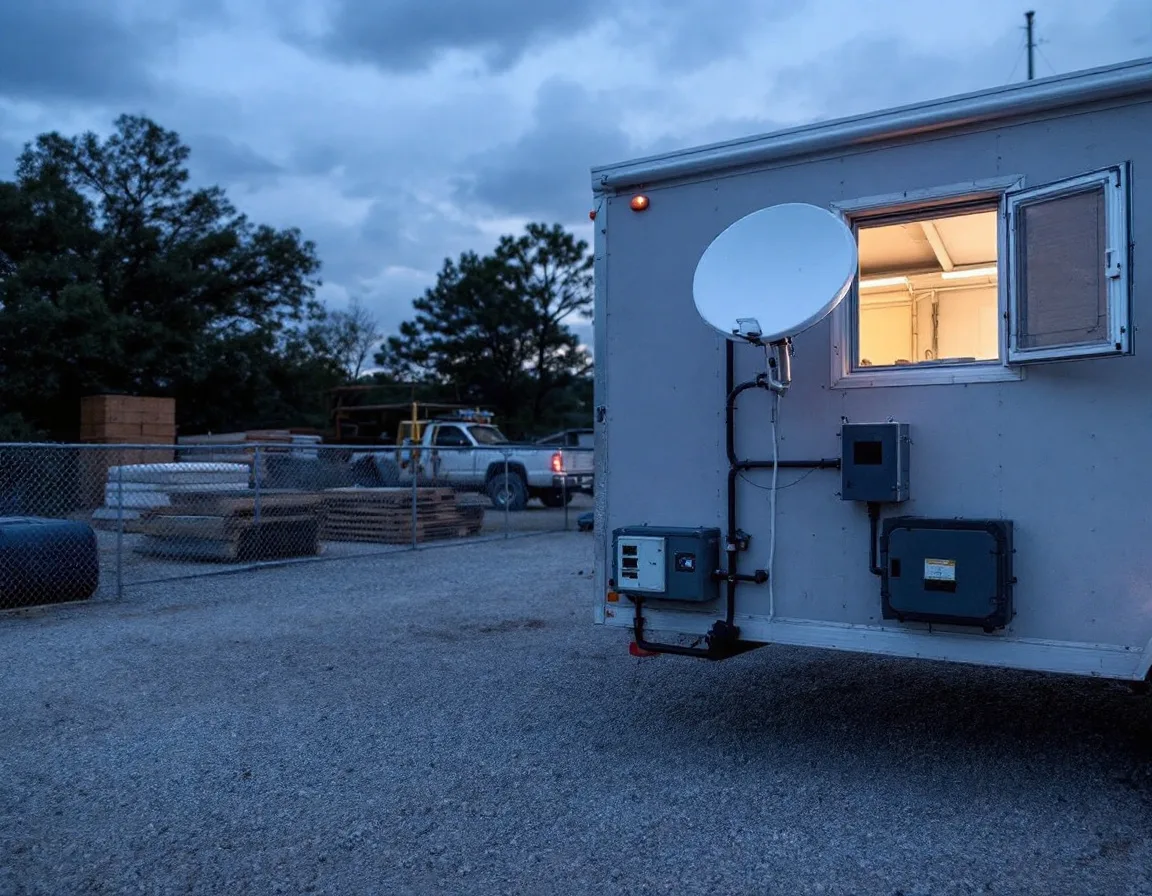
Here’s the part that surprises contractors most. A meaningful share of your IT spend has nothing to do with how many people you employ. It scales with active jobsites. Different unit, different line.
| Jobsite line item | Typical Texas cost | How it’s billed |
|---|---|---|
| Trailer network build, router, switch, access points, cabling | $1,800 to $4,500 | One time per mobilization |
| Bonded LTE or fixed wireless circuit | $100 to $300 per month | Per active site |
| Satellite service for sites with no terrestrial option | $155 to $280 per month on the 500 GB and 1 TB business tiers, plus $349 to $1,999 hardware | Per active site |
| Site survey and coverage design | $600 to $1,800 | One time per site |
| Demobilization, teardown, and gear return | $400 to $900 | One time per site |
| Ruggedized tablet or laptop, procured and managed | $1,200 to $2,600 per device | Capital, plus $12 to $25 per month to manage |
Satellite deserves a note, because it changed the math for rural Texas work. Starlink now covers pipeline, wind, solar, and highway jobs that used to need a bonded cellular kit and a lot of hope. It isn’t free. It’s predictable, which on a remote job is worth more.
Most sites need one circuit. A site that pairs bonded LTE with satellite failover can run about $500 a month, so a contractor running 6 active sites can carry $600 to $3,000 a month in connectivity alone. That’s real money. It belongs in project overhead, not buried in a per-user rate where it gets averaged into invisibility.
What Do Texas Contractors Actually Pay Per Month?
Put the seat math and the site math together and you get a monthly number you can budget against. Seat ranges below reflect the subsector spread from the table above, so a specialty trade contractor sits at the low end and a general contractor sits at the high end of every row.
| Company headcount | Typical supported seats | Managed IT per month | Jobsite lines per month |
|---|---|---|---|
| 25 employees | 6 to 11 | $950 to $2,100 | $100 to $600 |
| 60 employees | 14 to 25 | $2,200 to $4,700 | $200 to $1,500 |
| 120 employees | 28 to 50 | $4,200 to $9,300 | $400 to $3,000 |
| 300 employees | 70 to 126 | $10,100 to $22,000 | $1,000 to $7,500 |
Those totals are lower than most contractors expect. That’s the point. Deloitte’s 2023 Global Technology Leadership Study, the last edition to publish the figure, put the cross-industry average at 5.49% of revenue. Nobody publishes a free, current number for construction alone, but in the budgets I review it runs well under that line. Margins explain why. The 2026 CFMA Construction Financial Benchmarker puts pre-tax profit at 4.9% for commercial and industrial general contractors. On a margin that thin, a lean IT budget looks disciplined. It looks that way right up until a ransomware event eats a quarter, and then the same board that approved the lean budget wants to know why nobody flagged the exposure.
Our breakdown of managed IT cost at 25, 50, and 100 employees walks the same curve for a general Texas business, and the contrast is useful. A 100-person professional services firm buys 100 seats. A 100-person contractor buys 24 to 42.
How Does the Per-Seat Rate Compare to Texas Construction Wages?
Contractor IT pricing reads differently once you set it next to what the person in the seat costs. So I ran the numbers. The BLS Occupational Employment and Wage Statistics program publishes a May 2025 mean wage for every construction occupation in Texas, and it breaks the same data out for Houston, Dallas-Fort Worth, and San Antonio. Wages aren’t the whole bill, though.
The Employer Costs for Employee Compensation release covers the rest. In its June 2026 figures, construction employers paid $51.96 an hour in total compensation against $36.13 in wages. So every wage dollar drags about 44 more cents behind it. Benefits. Payroll tax. Insurance. I load every number below at that construction ratio of about 1.44 rather than the all-industry 1.43, because that’s the cost structure a Texas contractor carries on its own payroll.
Start with the people who hold supported seats.
| Who holds the seat in Texas | Mean wage, May 2025 | Loaded cost per hour | Hours of their time a $170 seat equals |
|---|---|---|---|
| Construction manager | $112,680 a year | $77.91 | 2.2 |
| Cost estimator | $83,780 a year | $57.93 | 2.9 |
| Bookkeeping and accounting clerk | $51,690 a year | $35.74 | 4.8 |
A $170 seat costs about 2 hours of a Texas construction manager’s month. That’s the break-even. If support hands a project manager back 2 hours a month, the seat has paid for itself before anyone brings up security. Dead laptops, a Procore sync that quietly stopped, and a locked Microsoft 365 account can eat 2 hours in a single bad week. Few contractors measure it. They should.
What Does One Idle Crew Hour Cost?
The field side is where the wage data gets uncomfortable. Picture a 10-person electrical crew standing down because the plan set won’t open on the trailer tablet. Say it’s a foreman, 4 electricians, and 5 laborers. Here’s that hour at May 2025 metro wages, loaded at the construction rate.
| Metro | Foreman, mean hourly | Electrician, mean hourly | Laborer, mean hourly | 10-person crew hour, loaded |
|---|---|---|---|---|
| Houston-Pasadena-The Woodlands | $37.94 | $29.55 | $21.08 | $376 |
| Dallas-Fort Worth-Arlington | $37.07 | $28.83 | $21.05 | $371 |
| San Antonio-New Braunfels | $35.56 | $27.42 | $20.14 | $354 |
| Texas statewide | $36.84 | $28.50 | $20.63 | $365 |
One idle hour on one crew costs $354 to $376. That’s more than a month of fully managed IT for 2 seats at $170. Not every outage idles a crew, to be fair. The ones that touch drawings, RFIs, or the pour schedule usually do, and they rarely end at the hour mark, because the superintendent still has to regroup the crew, re-sequence the day, and explain the gap to the general contractor. It’s why response time gets more of my attention than almost any other line in a construction IT contract.
Look at the spread between metros, too. A Houston crew hour runs 6% above San Antonio’s. Billing headcount instead of seats is a 4-fold error. Geography nudges the number. The unit decides it.
What Does an In-House IT Hire Cost a Contractor?
The same data prices the alternative. The OEWS national industry estimates put the average computer user support specialist at $68,480 a year inside specialty trade contractors, $71,980 inside building construction, and $75,910 inside heavy and civil construction, all national means for May 2025. Loaded at the construction rate, that’s roughly $98,500 to $109,200 a year for one person. At $170 a seat, the same money buys managed IT for 48 to 54 seats. For one person.
Now look at who’s buying. The average Texas construction establishment has 13.8 employees, which works out to 3 to 6 supported seats. On cost alone the hire doesn’t pencil out until somewhere near 50 seats. Even then, 1 person covers 1 shift, takes vacation, and can’t staff a security operations center. The same loaded-labor math for a Texas help desk tech outside construction is in our explainer on why MSP prices vary so much.
How Does Construction IT Pricing Vary by Texas Metro?
Rates move by metro, and so does the average size of the firm you’re benchmarking against. The Quarterly Census of Employment and Wages gives the second number.
| Market | Construction establishments, 2025 | Average employees per establishment | Where contractors land per seat |
|---|---|---|---|
| Harris County, Houston | 8,353 | 21.6 | $150 to $180 |
| Dallas County | 5,300 | 19.4 | $160 to $190 |
| Tarrant County, Fort Worth | 3,944 | 16.5 | $155 to $185 |
| Bexar County, San Antonio | 3,204 | 15.6 | $145 to $175 |
| Texas statewide | 65,395 | 13.8 | $155 to $185 |
Houston contractors run larger than the state average, which is why Gulf Coast quotes often come in at a lower per-seat rate on a bigger total. Volume helps. It also reflects demand, because Houston-Pasadena-The Woodlands added 13,100 construction jobs between July 2025 and July 2026, the most of any of the 360 metro areas AGC tracks. Fort Worth-Arlington-Grapevine added 3,500. Dallas-Plano-Irving added 1,900. San Antonio-New Braunfels slipped by 200. Dallas firms are nearly as large as Houston’s, but DFW pays more than Houston or San Antonio for most of the IT roles behind the rate, so its band sits highest.
One clarification, because our own pages will look like they disagree with this table. We publish a flat $138 per user per month for fully managed construction IT on our construction IT services in Houston page, and the same rate appears on our pages for construction IT in Dallas, construction IT in Fort Worth, and construction IT in San Antonio. That’s a real number, not a teaser. On those pages, per user means per supported seat, and $138 is where BUILD Complete starts. It sits below the market bands above because it’s our published entry rate for a standard environment with no compliance program and no unusual jobsite footprint, and because we’d rather print a number than reveal one after a discovery call. Add a federal contract, a heavy site load, or an ERP migration and it moves. Once active jobsites and project platforms come into scope, BUILD Complete runs $155 to $190, the band in the tier table below. General pricing by metro sits on our Houston pricing page and the Dallas pricing page.

What Does CMMC Add to a Federal Contractor’s IT Budget?
If you build for the Department of Defense, or you sub to a prime who does, this line isn’t optional and it isn’t small. Under 32 CFR Part 170, contracts handling controlled unclassified information require CMMC Level 2, which means all 110 practices in NIST SP 800-171 Revision 2. Third-party assessment was supposed to arrive with Phase 2, but the Pentagon suspended that phase on July 13, 2026. The self-assessment still applies now.
Primes are already writing these requirements into subcontracts anyway, which is how most Texas contractors first hear about it. Usually 3 weeks before a bid is due. The San Antonio version, with the clauses a JBSA prime flows down, is in our guide for San Antonio construction subcontractors.
Budget realistically. A segmented enclave, control implementation, evidence collection, and assessment readiness typically adds $30 to $70 per seat per month on top of standard managed IT, plus a one-time program cost between $25,000 and $120,000 depending on scope and how much of your environment has to come into the boundary. Our CMMC compliance services in Texas page covers what that scoping conversation looks like.
One honest note. Plenty of contractors are quoted for full CMMC when they only handle federal contract information, not CUI, which is Level 1 and a self-assessment. Get the data classification right before anybody sells you a program. The guide to IT compliance rules for Texas contractors shows which clauses each type of contract brings. Read it first.
How Uprite Prices Construction IT
We package construction support as Uprite BUILD, and we publish where each tier lands so you can benchmark it against whatever else is on your desk.
| Uprite BUILD tier | Who it fits | Per supported seat |
|---|---|---|
| BUILD Impact, co-managed | Contractors with an internal IT person who needs depth behind them | $85 to $120 |
| BUILD rComplete, remote | Dispersed jobsites, minimal on-site infrastructure | $110 to $145 |
| BUILD Complete, fully managed | Firms that want the whole stack owned, offices and sites | $155 to $190 |
| BUILD Secure, compliance | Federal, defense-adjacent, or under owner security mandates | $190 to $260 |
Every tier includes 24/7 monitoring from our security operations center and a 5-minute average ticket response. That second number matters more here than in most industries. A superintendent standing in a trailer with a stalled tablet is burning crew hours, not just their own. That’s 10 people waiting.
We’ve been doing this in Texas since 1999. Our cloud-first migration case study covers a contractor who moved off a headquarters file server that field teams could never reach reliably, and it’s a fair picture of what the first 6 months look like.
What Should a Contractor Budget for Year One?
Year one costs more than steady state. Onboarding, documentation, cleanup of whatever the last provider left behind, and usually a hardware refresh all land in the same 12 months. Plan for it.
| Budget line | Trade contractor, 10 seats | General contractor, 40 seats | Multi-region, 100 seats |
|---|---|---|---|
| Onboarding, discovery, documentation | $2,500 to $6,000 | $8,000 to $18,000 | $20,000 to $45,000 |
| Managed IT, 12 months | $18,600 to $22,800 | $74,400 to $88,800 | $174,000 to $210,000 |
| Jobsite connectivity, 12 months | $1,200 to $4,800 | $6,000 to $24,000 | $18,000 to $72,000 |
| Hardware refresh and rugged devices | $4,000 to $12,000 | $18,000 to $50,000 | $50,000 to $140,000 |
| First-year total | $26,300 to $45,600 | $106,400 to $180,800 | $262,000 to $467,000 |
Security tooling, awareness training, and backup sit inside the per-seat rate at every tier we sell, so they aren’t a separate line. If a proposal you’re holding lists them as add-ons, add them back before you compare. Otherwise the comparison is fiction.

How to Read a Construction IT Proposal Without Getting Burned
Run these 6 checks. They take 20 minutes and they’ve saved contractors I work with a lot more than that.
- Confirm the seat count and the exact roles included. Field crews without assigned computers shouldn’t be billed as users.
- Find where jobsite connectivity lives. If it isn’t a separate line, it isn’t scoped.
- Check whether Procore, Sage, Vista, or Autodesk support is named specifically or hidden behind the phrase “third-party applications.”
- Ask what happens at mobilization and demobilization, and whether those visits are included or billed hourly.
- Verify that endpoint detection and response, backup testing, and awareness training are inside the rate.
- Get the onboarding number in writing before you sign. It’s the line most often left vague and it’s the one that surprises people.
If 2 proposals still disagree after those checks, the difference is real scope, and now you can actually price it. That’s progress.
Questions Texas Contractors Ask About IT Pricing
How much does IT support cost for a construction company in Texas?
Texas contractors pay $135 to $210 per supported seat per month in 2026, with most landing at $155 to $185. Jobsite connectivity adds $100 to $500 a month per active site. A 60-person contractor typically runs $2,400 to $6,200 all in. Site count drives the spread.
Should a contractor be billed per employee or per computer?
Per supported seat, meaning a person with an assigned managed computer. Construction payrolls are 23% to 42% office and supervisory roles, so headcount billing can overstate a contractor’s bill by 4 times. Ask which number they used.
Why do 2 IT quotes for the same construction company differ so much?
Almost always the seat count. One provider counted 28 supported computers, another counted 120 employees, and neither said so in the proposal. Scope of jobsite work and whether security tooling is bundled explain most of the rest.
Is jobsite internet included in a managed IT contract?
Rarely, and it shouldn’t be. Connectivity scales with active sites rather than people, so it belongs on its own line at $100 to $500 per site per month plus one-time build and teardown costs for every trailer. Bundling it hides the real driver.
What does an hour of jobsite downtime cost a Texas contractor?
About $354 to $376 for a 10-person electrical crew that stands down, using May 2025 BLS wages for Houston, Dallas-Fort Worth, and San Antonio loaded with construction benefit costs. That single hour costs more than a month of managed IT for 2 seats at $170. Drawings and schedules are the usual trigger.
What does CMMC compliance add to a contractor’s IT budget?
Roughly $30 to $70 per seat per month above standard managed IT, plus a one-time program cost of $25,000 to $120,000. Level 2 applies to contracts handling controlled unclassified information now through self-assessment, while the Phase 2 third-party assessment gate is paused.
Can we keep our internal IT person and still hire an MSP?
Yes, and for contractors it’s often the better buy. Co-managed support runs $85 to $120 per seat because your person keeps the work they’re good at while the provider carries monitoring, security, and after-hours coverage that no single employee can provide alone.
Is an in-house IT hire cheaper than managed IT for a contractor?
Not until roughly 50 seats. A computer support specialist inside a construction firm averages $68,480 to $75,910 a year nationally, about $98,500 to $109,200 loaded, which equals managed IT for 48 to 54 seats at $170. The average Texas contractor has 3 to 6 supported seats.
How long does onboarding take for a construction firm?
Plan on 30 to 60 days for offices and 2 to 3 weeks per active jobsite after that. Firms running ERP platforms like Vista or Sage 300 CRE should expect the longer end, since vendor coordination sets the pace. Nobody rushes an accounting cutover.
Where to Start
Send us your headcount and your office and supervisory count, and we’ll show you the seat math for your metro line by line. No proposal. No pressure. Just the number you should be comparing against. If you’d rather see the service side first, our construction IT services page covers what BUILD delivers, and our team can walk a live proposal with you before you sign anything.
Bring your 3 quotes. That conversation goes faster when there’s something to argue with, and you’ll leave with a per-seat number, a per-site number, and a first-year total for your metro, written down.
Get Pricing