
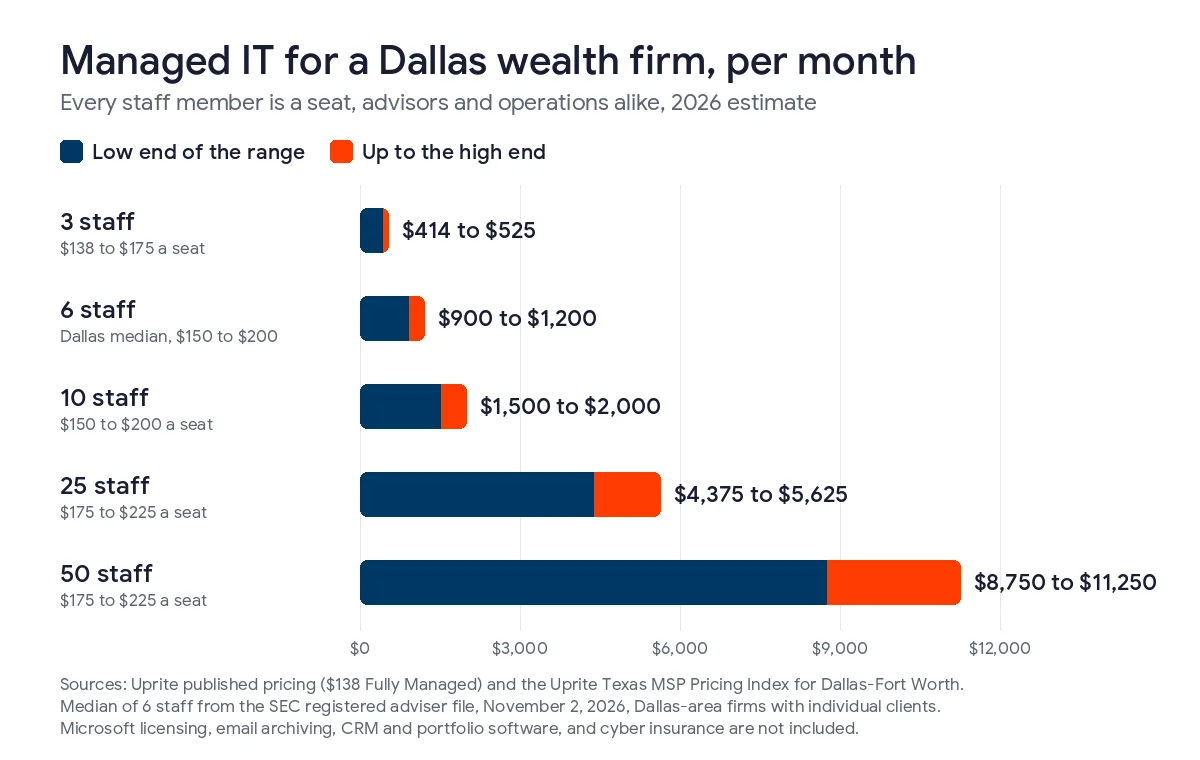
Most Dallas RIAs and wealth management firms should plan on $150 to $225 per user per month for managed IT in 2026, which comes to roughly $900 to $1,200 a month for a typical 6-person advisory firm.
Microsoft licensing, email archiving, and cyber insurance sit on top of that. I run operations at Uprite, and when we scope IT services for wealth management firms in Dallas, the rate is rarely what surprises an owner. The headcount is. Most quotes count the advisors and forget the operations and client service people, who in Dallas make up almost half the staff. This guide prices the whole office, using the SEC’s own filing data on Dallas advisers, federal pay data for the county, and the records rules that decide what has to be kept and for how long.
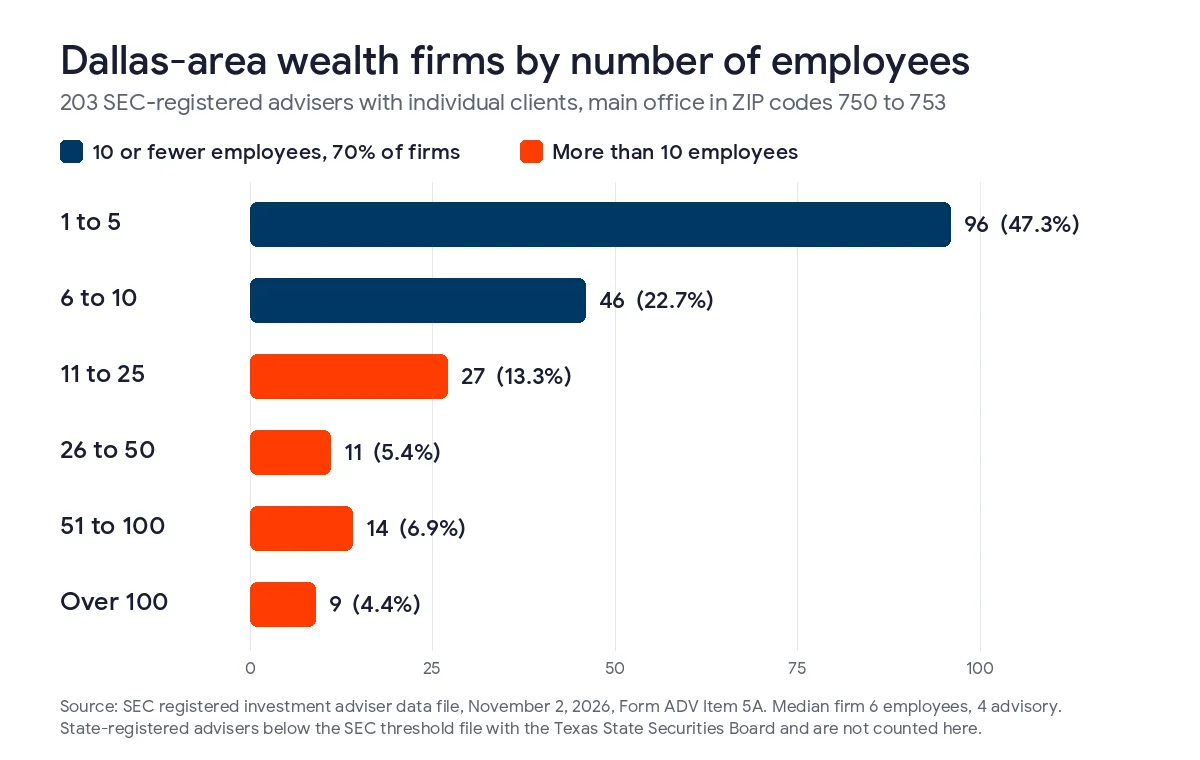
The typical SEC-registered wealth firm in the Dallas area has 6 employees, and 70% have 10 or fewer. At $150 to $200 a seat, that’s about $900 to $1,200 a month for the median firm. Dallas County advisory staff earn an average of $275,210 a year, so a half-day outage at a 6-person firm burns about $4,540 in paid time, which is more than 4 months of managed IT. Archiving, vendor oversight under the amended Regulation S-P, and a second office are what push a firm toward the top of the range.
How much does IT cost a Dallas wealth management firm per month?
IT cost for a wealth management firm is the monthly price of supporting every person who touches client data, plus the systems that keep records the SEC can ask to see. That means advisors, paraplanners, operations staff, and whoever handles billing and compliance. Managed IT covers the support and security. Licensing, archiving, and insurance are separate invoices.
The bands below come from our published pricing and the Dallas-Fort Worth spread in our Texas MSP pricing index, where DFW businesses mostly land between $150 and $175 per user and compliance-driven offices run higher. Wealth firms sit in the upper half. Advisors aren’t harder to support than anyone else. The seat just has more riding on it, from record retention to vendor contracts.
| Staff | Typical firm | Per user a month | Managed IT a month | Managed IT a year |
|---|---|---|---|---|
| 3 | Founder-led, one custodian, cloud only | $138 to $175 | $414 to $525 | $4,968 to $6,300 |
| 6 | The Dallas median, 4 advisory staff and 2 in operations | $150 to $200 | $900 to $1,200 | $10,800 to $14,400 |
| 10 | Two or three advisors with a client service team | $150 to $200 | $1,500 to $2,000 | $18,000 to $24,000 |
| 25 | Multiple advisors, often a second office or dual registration | $175 to $225 | $4,375 to $5,625 | $52,500 to $67,500 |
| 50 | Several offices, in-house compliance, frequent due diligence questionnaires | $175 to $225 | $8,750 to $11,250 | $105,000 to $135,000 |
Those totals leave out Microsoft 365 licensing, the archiving subscription, portfolio and CRM software, and one-time projects like moving offices. A firm that answers detailed security questionnaires from institutional clients every quarter can land between $225 and $300 a seat, because somebody has to produce the evidence behind every answer.
What does a Dallas wealth firm actually look like?
Small, and heavier on operations than most owners guess. We filtered the SEC’s registered investment adviser data file dated November 2, 2026 for approved advisers with a main office in Texas ZIP codes 750 through 753, which covers Dallas and its northern suburbs like Plano, Frisco, Richardson, and Addison. It returned 385 SEC-registered advisers. Of those, 203 reported individual or high net worth clients on Form ADV, and those 203 are the wealth managers this page prices.
| Employees | Dallas-area wealth firms | Share | Median assets under management |
|---|---|---|---|
| 1 to 5 | 96 | 47.3% | $225 million |
| 6 to 10 | 46 | 22.7% | $552 million |
| 11 to 25 | 27 | 13.3% | $1.34 billion |
| 26 to 50 | 11 | 5.4% | $1.81 billion |
| 51 to 100 | 14 | 6.9% | $4.19 billion |
| More than 100 | 9 | 4.4% | $6.54 billion |
The median firm has 6 employees, and 4 of them do advisory work. Across all 203 firms, 47% of the people on payroll don’t perform advisory functions at all. They open accounts, move money, rebalance, schedule reviews, and keep the books. Every one of them logs into the custodian portal and the CRM, so every one of them is a seat. If a quote is built on your advisor count, it’s short by nearly half, and the gap shows up on the first true-up.
Two more numbers from the same filings change the bill. 73 of the 203 firms, about 36%, report at least 1 office besides the main one, and each extra office needs its own firewall, network, and someone who can get there. And 50 firms have staff who are also registered representatives of a broker-dealer. Those people often work inside systems the broker-dealer controls, so ask early which mailbox, archive, and device belongs to whom. Otherwise you pay twice for the same seat.
Here’s the honest part. A 2-person firm running everything through its custodian’s platform and Microsoft 365 may not need a full managed contract. Our IT Essentials plan starts at $91 per user for teams under 12 with business-hours support, and for some solo practices that’s plenty. We’ll say so on the first call.
What does an hour of downtime cost an advisory firm?
More than it costs almost anyone else in Dallas. The BLS Quarterly Census of Employment and Wages shows 1,084 portfolio management and investment advice establishments in Dallas County in 2025, with 9,347 employees and an average annual pay of $275,210. That’s about $132 an hour in wages alone.
Benefits push that higher. The BLS employer compensation survey for June 2026 found private employers spending $46.89 an hour on total compensation against $32.82 in wages, and at that ratio an hour of advisory staff time costs a Dallas firm about $189. If a 6-person office loses email and the custodian portal for 4 hours, that’s roughly $4,540 in paid time with nothing to show for it. The managed IT line for the same firm is $900 to $1,200 a month.
That math leaves out the part that hurts more. A client review gets rescheduled, a trade window closes, a quarter-end report goes out late. We see the pressure peak in the last week of each quarter, when reports are running and every advisor is in back-to-back meetings. Our average first response is 5 minutes, and that number matters a lot more late in the afternoon on the last trading day of March than it does in a sales deck.
Which SEC rules add to a wealth firm’s IT bill?
Two rules decide most of the compliance cost, and neither one is new. The question is how much work they put on your IT provider and how much stays with you. The full rule set is covered in our post on SEC cybersecurity rules for Dallas RIAs, so this section sticks to what it costs.
The first is the amended Regulation S-P. According to the SEC’s small entity compliance guide, advisers with $1.5 billion or more under management had to comply by December 3, 2025, and everyone else by June 3, 2026. In the Dallas filings, 41 wealth firms reported $1.5 billion or more in regulatory assets and 162 didn’t, so both groups are now on the clock. The rule requires a written incident response program, notice to affected clients within 30 days, and oversight of service providers, who must tell you within 72 hours if they have a breach that touches your client systems.
| Requirement | What it adds to the budget | Who usually does it |
|---|---|---|
| Written incident response program, tested | Plan writing, a yearly tabletop, and the logs to prove what happened | Your IT provider drafts and runs it, your CCO signs off |
| Client notice within 30 days | Logging and forensics good enough to say whose data was touched | IT provider produces the evidence, counsel writes the notice |
| Service provider notice within 72 hours | Contract review for every vendor that holds client data | Your compliance team, with IT listing the vendors and systems |
| Books and records kept 5 years, the first 2 in an office | An email archive, and a decision about text messages | Archive vendor, set up and monitored by IT |
The second is the books and records rule. Under 17 CFR 275.204-2, an adviser keeps its required records in an easily accessible place for at least 5 years from the end of the fiscal year of the last entry, the first 2 in an appropriate office. The rule covers written communications about recommendations and advice, which in practice means email and anything else advisors use to talk to clients. Archiving is billed per mailbox by the archive vendor, so put it on its own line in every quote you compare.
One thing we’d fix before spending a dollar on archiving. If advisors text clients from personal phones, no archive quote covers it. Settle that policy first, then buy the tool.

State law adds a deadline of its own. Texas Business and Commerce Code 521.053, as amended in 2023 by Senate Bill 768, requires a firm to tell the Attorney General within 30 days when a breach affects 250 or more Texans, using the state’s online data breach report. The median Dallas wealth firm in the SEC file reports 185 individual clients. Add spouses, beneficiaries, and trust parties on the account paperwork, and most firms hold records on more than 250 people long before they’d think of themselves as large. Advisers below the SEC threshold register with the Texas State Securities Board instead, and the same breach law applies to them.
What do the security add-ons cost?
Less than the rule list suggests, if the base plan is right. At $138 per user, our Fully Managed plan already bundles the security stack, round-the-clock support, and backups we restore-test every quarter, and that covers most of what the CISA Cross-Sector Cybersecurity Performance Goals ask for at a small firm. For a plainer read, NIST keeps a cybersecurity guide for small businesses that your CCO can get through in an afternoon.
Firms with their own IT person can add our managed security services in Dallas at $40 per user a month for firewall, SIEM, and SOC monitoring. A yearly penetration test is its own project, and our Dallas penetration testing cost guide puts a small external test at about 3 tester-days. Senior security time for the incident response plan and tabletop runs about $128 an hour in Dallas, per the yardstick in our vCISO cost guide for Dallas, so a 10-hour plan refresh is roughly $1,280 a year. Wire and email fraud is where the money actually leaves, and it gets its own post in this series on email fraud at Dallas wealth management firms.
Should a Dallas RIA hire its own IT person instead?
Not until it’s well past 50 people. BLS pay data for the Dallas metro in May 2025 puts the average at $63,030 a year for computer user support specialists, $108,020 for network administrators, and $133,790 for information security analysts. Loaded with benefits at the same 1.43 ratio, that’s about $90,050, $154,330, and $191,150.
A 25-person firm paying $52,500 to $67,500 a year for managed IT is spending 58% to 75% of one loaded help desk hire, and that hire can’t cover nights, vacations, the network, and security at once. The help desk person also can’t write the incident response plan. That’s the security analyst’s job, and one of them costs more than 13 years of managed IT for the median firm.
Some firms already employ a good IT generalist who just needs backup on nights, projects, and security. For them we offer co-managed IT services in Dallas, listed at $100 per user a month. Our managed IT services cost guide for Dallas has the general benchmarks if you want to compare against other industries, and our guide to financial services cybersecurity in Dallas sorts out which regulator covers which kind of firm.
How do you check a wealth management IT quote?
Ask what the provider counted before you look at the rate. The unit changes the total more than the price does.
- Count everyone who logs into the custodian portal, then check that number against the seats in the quote.
- Ask whether staff who are also broker-dealer reps are included, and which of their systems the broker-dealer already supports.
- Get Microsoft licensing, the archive, and the CRM on their own lines, with the vendor named.
- Ask who writes and tests the incident response program, and whether the yearly tabletop is in the fee.
- Ask the provider for its own 72-hour breach notice commitment in writing, since the amended Regulation S-P makes you collect it.
- Ask how a second office is priced, including the firewall, the network, and travel time.
- Ask who answers late in the afternoon on the last day of a quarter, and how fast.
A provider that can’t answer those hasn’t really scoped your firm yet. Protecting the client files themselves is covered in our post on client data protection for wealth advisors in Dallas. Every Uprite rate quoted on this page is also listed on our pricing page.
Questions Dallas advisors bring to the first call
What does a 10-person Dallas RIA pay for IT a month?
Expect roughly $1,500 to $2,000 a month for managed IT covering all 10 staff, advisors and operations alike. Microsoft licensing, the email archive, and portfolio or CRM software come on top, and a second office or dual-registered staff push the number toward the high end.
Do operations and client service staff count as IT seats?
Yes, every person who logs into the custodian portal, the CRM, or client email is a seat. In the SEC’s filings for Dallas-area wealth firms, 47% of employees don’t perform advisory work, so a quote built only on advisor count is short by nearly half.
Is email archiving included in managed IT?
Usually not, because the archive vendor bills it per mailbox. Your IT provider should set it up, connect every mailbox, and check that it’s capturing, since Rule 204-2 requires advisers to keep client communications for at least 5 years, the first 2 in an office.
When did the amended Regulation S-P start applying to Dallas advisers?
December 3, 2025 for advisers with $1.5 billion or more under management, and June 3, 2026 for everyone else. Both dates have passed, so every SEC-registered adviser now needs a written incident response program, 30-day client notice, and service provider oversight.
Why do wealth firms pay more per seat than other Dallas offices?
Because the seat carries records, evidence, and vendor oversight that a typical office doesn’t need. Dallas County advisory staff also average $275,210 a year in pay, so every hour of downtime costs more, and firms tend to buy faster response and better backups to match.
Can a small advisory firm skip managed IT altogether?
A 1 or 2-person firm running everything through its custodian and Microsoft 365 sometimes can. Once there’s an operations hire, a CRM, and client files on a shared drive, the risk and the record-keeping usually outgrow a do-it-yourself setup.
Tell us how many people you have, how many offices, and which custodian and CRM you use. We’ll reply with a written monthly price that lists each line, and says plainly what isn’t included.
Get a Wealth Management IT Quote