
SEC cybersecurity rules for a Dallas RIA come from 4 places, Regulation S-P’s safeguards and breach notice duties, Regulation S-ID’s identity theft program, the annual compliance review under Rule 206(4)-7, and the recordkeeping rule, Rule 204-2.
I run operations at Uprite, so when a Dallas adviser calls us about cybersecurity it’s usually because an exam letter just showed up or a client’s email got taken over. Either way, the chief compliance officer wants to know what the SEC will actually ask to see. There’s no single “SEC cyber rule” to point to. The obligations are spread across rules most advisers already know by name, and the 2024 Regulation S-P amendments tightened several of them. This checklist sits under our IT services for wealth management firms in Dallas and is written for CCOs, COOs, and owners of advisory firms around Preston Center, Uptown, and Las Colinas.
Write down your safeguards and an incident response program that can assess, contain, and notify. Be ready to send affected clients a notice within 30 days. Get a 72-hour breach notice promise from every vendor that touches client data. Keep an identity theft program that names real red flags, like spoofed wire requests. Make sure your annual compliance review covers Regulation S-P and S-ID by name, and keep the paperwork for 5 years.
Which SEC cybersecurity rules apply to a Dallas RIA?
For an SEC-registered investment adviser, cybersecurity duties come from existing rules rather than a standalone cyber rule. Regulation S-P requires written safeguards, an incident response program, and client breach notices. Regulation S-ID requires an identity theft program. Rule 206(4)-7 requires an annual review, and Rule 204-2 requires the records.
The SEC did propose a dedicated cybersecurity rule for advisers in 2022, with written programs and incident reporting on a new Form ADV-C. It never became final. The Commission withdrew it along with 13 other proposals, and the withdrawal notice ran in the Federal Register on June 17, 2025. Some vendor checklists still cite that proposal as if it were law, and we’d ignore them.
Here’s where each piece lives in the Code of Federal Regulations.
- 17 CFR 248.30, the Regulation S-P safeguards and disposal rule, amended in 2024.
- 17 CFR 248.201, the Regulation S-ID identity theft red flags rule.
- Rule 206(4)-7, which requires written compliance policies, a yearly review of them, and a named CCO.
- Rule 204-2, the books and records rule, which now lists the Regulation S-P paperwork in paragraph (a)(25).
Firms that also run a broker-dealer or a bank trust company pick up other regulators on top of these. We cover that wider map in cybersecurity requirements for Dallas financial services firms. This post stays with the adviser side.
How many Dallas advisers do these rules reach?
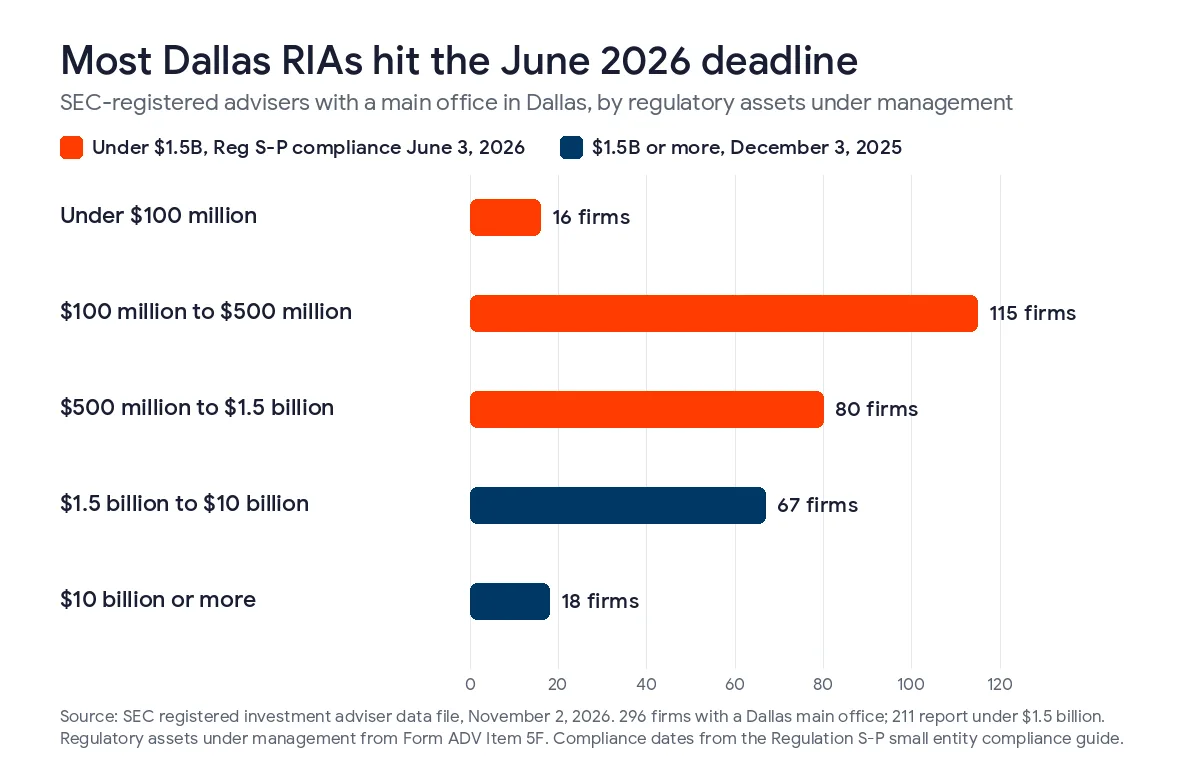
We pulled the SEC’s registered investment adviser roster dated November 2, 2026 and counted firms whose main office is in the city of Dallas. There are 296 of them. Across the wider DFW area, counting Fort Worth, Plano, Southlake, Frisco, and the other suburbs, the number is 472.
The size split matters for Regulation S-P. Advisers with less than $1.5 billion in assets under management are “smaller entities” in the 2024 amendments, and they got until June 3, 2026 to comply. Larger advisers had until December 3, 2025. Of the 296 Dallas firms, 211 report regulatory assets under $1.5 billion, about 71%. So for most Dallas RIAs the new duties went live less than 6 months ago, and the first exams testing them are happening now.
These are small shops, too. 162 of the 296 report 10 or fewer employees, and 98 report 5 or fewer. In a firm that size the CCO is often also the COO or a founding partner, and “IT” is a vendor, a part-time contractor, or nobody in particular. So who keeps the vendor list? Who can pull a client email from 2023 if an examiner asks for it? And who decides, on a Friday night, whether a hacked mailbox means notifying clients? This checklist is meant to put a name next to each of those.
The SEC cybersecurity checklist for Dallas RIAs
Each row below ties a duty to the rule behind it and to the evidence an examiner will ask for. The last column is who tends to own it at a 10-person Dallas firm, which isn’t always who should.
| Checklist item | Rule | What an examiner asks to see | Who usually owns it |
|---|---|---|---|
| Written administrative, technical, and physical safeguards for client information | Reg S-P, 248.30(a)(1) | The policy itself and proof it’s followed, such as MFA reports and access reviews | CCO writes it, IT provider produces the evidence |
| Incident response program that assesses, contains, and recovers | Reg S-P, 248.30(a)(3) | The written program and a record that someone has walked through it | CCO and IT provider together |
| Client notice within 30 days when sensitive information is reasonably likely exposed | Reg S-P, 248.30(a)(4) | A notice template with the required contents and the decision log for any incident | CCO, with outside counsel |
| Vendor oversight, including a 72-hour breach notice from each service provider | Reg S-P, 248.30(a)(5) | A vendor list, due diligence files, and contract language | Operations, often by default |
| Proper disposal of client and consumer information | Reg S-P, 248.30(b) | A disposal policy and wipe or shred records for old laptops, phones, and paper | IT provider and office manager |
| Written identity theft prevention program with relevant red flags | Reg S-ID, 248.201 | The program, its red flags, training records, and senior management sign-off | CCO |
| Annual review that covers both regulations | Rule 206(4)-7(b) | A review report that names Regulation S-P and S-ID and records what changed | CCO or a compliance consultant |
| Incident, notice, and vendor records kept 5 years | Rule 204-2(a)(25) and (e)(1) | The files themselves, the first 2 years kept in an easily accessible place | CCO, with the IT provider for storage |
| Archive of written client communications, email included | Rule 204-2(a)(7) | Retrieval of messages about advice, orders, and money movement | IT provider |
Look at the fourth row. At most small firms we meet, nobody formally owns vendor oversight. The custodian, the CRM, the planning software, the portfolio accounting system, the email archive, and the IT provider all touch client data. Most of those contracts were signed years before the 72-hour clause existed. That’s usually the first thing we’d fix.
What changed in the 2024 Regulation S-P amendments?
The amended rule turned “have safeguards” into a set of specific things you have to be able to do. The SEC’s small entity compliance guide summarizes it, but the rule text is short enough to read yourself.
First, the incident response program must let you assess the scope of an incident, identify which systems and which types of client information were reached, contain it, and notify the people affected. The rule doesn’t tell you how to build that program. NIST’s SP 800-61 Revision 3 is a reasonable free model, and we’d keep the written version to a few pages a small team will actually open. Second, notice is the default. You can skip it only if a reasonable investigation shows the sensitive information hasn’t been and isn’t reasonably likely to be used in a way that causes substantial harm or inconvenience. If you can’t tell whose records were touched, you notify everyone whose data sat in the affected system.
Third, the notice has a deadline and required contents. It goes out as soon as practicable and no later than 30 days after you become aware of the incident. It has to describe what happened and what kind of information was involved, give the date or date range if you know it, and list a phone number, email address, postal address, and named office clients can contact. It also has to explain fraud alerts and free credit reports and point clients to the FTC’s identity theft guidance. Draft that letter now. Nobody writes a good one on day 29.
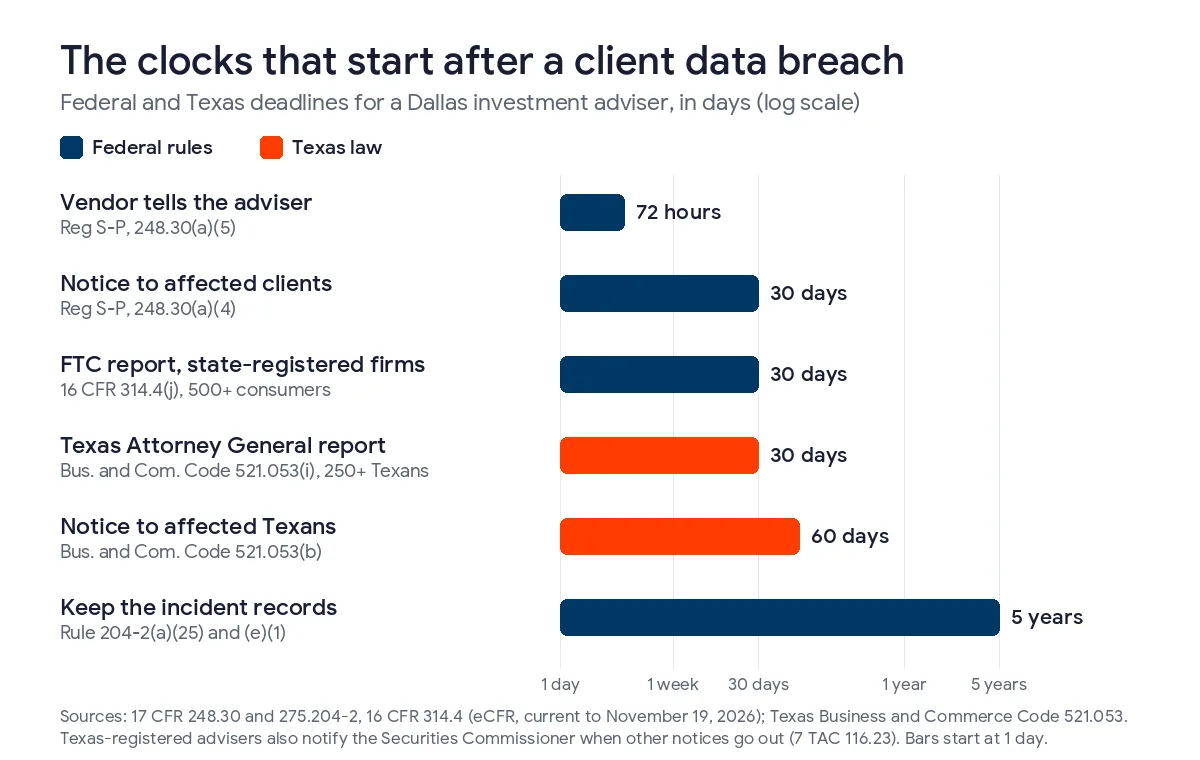
Fourth, vendors. Your policies have to require service providers to protect client information and to tell you within 72 hours after they become aware of a breach of a system they maintain for you. You can contract with a vendor to send client notices for you, but the rule says the obligation to make sure clients are notified stays with the adviser.
“Sensitive customer information” is broader than account numbers, too. The rule’s examples include Social Security and driver’s license numbers, biometric records, and an account number or online user name combined with something that gets someone into the account, like a security question answer or a date of birth.
What happens when a vendor is the one that gets breached?
The clock starts with them. Under the amended rule your vendor should tell you within 72 hours. Then your incident response program kicks in, and your 30-day client clock starts once you know unauthorized access has happened or is reasonably likely. The vendor’s breach still becomes your notice problem.
For a typical Dallas RIA the service provider list is longer than the CCO expects. We usually find these on it.
- The custodian or custodians, plus any third-party money movement portal.
- The CRM, such as Redtail, Wealthbox, or Salesforce Financial Services Cloud.
- Financial planning software like eMoney, MoneyGuidePro, or RightCapital.
- Portfolio accounting and reporting, such as Orion, Black Diamond, or Tamarac.
- Microsoft 365 or Google Workspace, and the email archiving service on top of it.
- Document storage, e-signature, and client portal tools.
- The managed IT or cybersecurity provider, which usually holds admin rights to everything above.
For each one, the file should hold the contract or terms showing the 72-hour notice and the protection duty, a note on what client data it holds, and the name of the person at the firm who reviews it. Where a vendor won’t sign new language, document the due diligence you did instead and how you’d find out about an incident anyway. Our point of view is simple here. A vendor you can’t get a breach notice from is a vendor whose incident you’ll learn about from a client.
What the TAG Associates order says about Regulation S-ID
On October 23, 2026, the SEC settled an administrative proceeding against TAG Associates, a New York adviser with more than $7 billion under management. Most of the order is about the custody rule, and the $175,000 penalty covers both sets of violations. The Regulation S-ID findings are the part every small adviser should read.
TAG had a written identity theft program from 2014. It was based mostly on the SEC’s sample red flags, and it said the CCO would review it every year. From at least 2015 through 2023, TAG paid compliance consultants for annual reviews, but according to the order their scope of work didn’t reference the program or Regulation S-ID at all. Meanwhile the firm was the target of dozens of unsuccessful identity theft attempts. In November 2017 an employee warned staff about a fake wire request that used the client’s real email address up to the @ and a fake domain after it. The program wasn’t updated until December 2023, when red flags for email identity theft and wire transfers were finally added.
There was no client loss in the order’s findings. The SEC still charged the firm. So we’d take 3 lessons from it.
- Put Regulation S-P and Regulation S-ID in the written scope of your annual review, by name.
- Keep a log of attempted fraud, not only successful fraud, and review it against your red flags at least once a year.
- Name a senior person who signs off on the program and actually gets an annual report on it.
The attacks TAG saw are the ones Dallas firms see, spoofed disbursement requests and taken-over client mailboxes. We cover the callback checks and mailbox controls that stop them in our post on email and wire fraud aimed at Dallas wealth advisors.
Does any of this change for a Texas-registered adviser?
Yes. Advisers with less than $100 million under management generally register with the Texas State Securities Board instead of the SEC. Regulation S-P’s safeguards rule covers advisers registered with the Commission, so a state-registered firm falls under a different federal rule, the FTC’s Safeguards Rule. Its scope section names “investment advisors that are not required to register with the Securities and Exchange Commission” outright. That rule asks for a written information security program with a qualified individual in charge, and section 314.4(j) requires a report to the FTC within 30 days when unencrypted information on 500 or more consumers is taken.
Texas adds its own layer. The State Securities Board’s rule on notice of cybersecurity incidents, 7 TAC 116.23, says a Texas-registered adviser has to notify the Securities Commissioner when an incident triggers any other required notice, at the same time that notice goes out. Forwarding a copy satisfies it, ideally with a count of affected Texas clients.
And every adviser doing business in Texas, SEC-registered or not, is covered by the state breach law, Business and Commerce Code 521.053. Affected individuals get notice within 60 days. If 250 or more Texans are involved, the Attorney General gets a report within 30 days through the AG’s online form, and the AG publishes it.
| After a breach of client data | SEC-registered Dallas RIA | Texas-registered RIA |
|---|---|---|
| Vendor tells the adviser | Within 72 hours, required in vendor policies under Reg S-P | Not set by rule, so put it in the contract anyway |
| Notice to affected clients | Within 30 days under Reg S-P, and within 60 days under Texas law | Within 60 days under Texas law |
| Federal regulator | No Reg S-P filing, though examiners will ask for the records | FTC within 30 days if 500 or more consumers are affected |
| State securities regulator | Not covered by 7 TAC 116.23 | Securities Commissioner, at the same time as other notices |
| Texas Attorney General | Within 30 days if 250 or more Texans are affected | Within 30 days if 250 or more Texans are affected |
Those AG filings are public, and wealth firms show up in them. In the Texas Attorney General’s data breach list, as we pulled it on November 9, 2026, 8 investment advisers, wealth managers, and asset managers posted reports between January 7 and October 28, 2026. Together they covered 25,622 Texans and 291,676 people overall. 7 of the 8 listed Social Security numbers among the exposed data. 2 are based in Houston and the rest out of state, which is the point. Your clients’ data sits with every firm and vendor that serves them.
What are SEC examiners focusing on in 2026?
The Division of Examinations’ fiscal year 2026 priorities call cybersecurity a perennial priority. For cyber practices, the document lists governance, data loss prevention, access controls, account management, and response and recovery from incidents, ransomware included. It also names training and controls for risks from AI and polymorphic malware, and operational resiliency.
On Regulation S-ID, examiners will check whether programs are built to catch red flags during account takeovers and fraudulent transfers, and whether they include staff training. On Regulation S-P, the document says that after the compliance dates the Division will check whether firms have put the new policies in place. Never-examined and recently registered advisers are a priority of their own, which matters for the many young Dallas firms on the roster.
In practice, “access controls” and “account management” mean an examiner may ask you to show MFA on every mailbox, custodian login, and CRM account, plus proof that the advisor who left in March can’t still sign in. Text-message codes are the weak spot. CISA’s fact sheet on phishing-resistant MFA ranks FIDO security keys and similar methods well above them, and that’s where we’d start for anyone who can move client money. Our guide to Microsoft 365 security settings for Texas small businesses covers the mailbox side. If you’d like the whole environment checked against these items before an examiner does it, start with a cybersecurity risk assessment in Dallas.

How does Uprite help Dallas RIAs meet SEC expectations?
We don’t replace your CCO or your compliance consultant. We own the technical half of the checklist and hand the CCO the evidence. That means MFA and access reviews across Microsoft 365, custodian, and CRM logins, offboarding the same day someone leaves, device encryption and wipe records, email retention, backups we actually test, and an incident response runbook that matches the written program. When something does go wrong, our average response time is about 5 minutes, and we keep the incident notes in the shape Rule 204-2 expects.
For firms without a security lead, our vCISO services in Dallas can sit in on the annual review and own the vendor list. The day-to-day controls that keep client files safe are in our guide to client data protection for wealth advisors in Dallas, and the budget side is in our breakdown of what IT costs a Dallas wealth management firm. If you’d rather talk it through now, reach our Dallas team.
Questions Dallas RIAs ask about SEC cybersecurity rules
Is there a standalone SEC cybersecurity rule for investment advisers?
No. The SEC proposed one in 2022 and withdrew it in June 2025. An adviser’s cybersecurity duties come from Regulation S-P, Regulation S-ID, Rule 206(4)-7, and Rule 204-2.
When did a small Dallas RIA have to comply with the amended Regulation S-P?
June 3, 2026, if it reported less than $1.5 billion in assets under management. Larger advisers had until December 3, 2025. By our count of the SEC roster, 211 of the 296 Dallas-based advisers fall in the smaller group.
How fast do we have to notify clients after a breach?
As soon as practicable, and no later than 30 days after you learn of the unauthorized access, under Regulation S-P. Texas law separately sets 60 days for individuals and 30 days for an Attorney General report at 250 or more Texans.
Does Regulation S-P apply to a Texas state-registered adviser?
Not the safeguards rule. State-registered advisers fall under the FTC Safeguards Rule instead, along with the Texas State Securities Board’s incident notice rule and the Texas breach notification law.
Is our IT provider a service provider under Regulation S-P?
Almost always, because it can reach client information. That puts it on your vendor list, and your policies should require it to protect that information and tell you within 72 hours of a breach of systems it maintains for you.
How long do we keep incident records?
At least 5 years from the end of the fiscal year of the last entry, with the first 2 years in an appropriate office of the adviser. That covers incident files, notice decisions, copies of notices, and vendor policies under Rule 204-2(a)(25).
Send us your current incident response plan and a list of the vendors that touch client data, even if both are rough. We’ll map them against this checklist, show you which rows have no owner or no evidence, and do it as a free review for Dallas advisory firms.
Book a free SEC readiness review