
MDR in Houston costs about $10 to $25 per endpoint per month in 2026, our estimate for small and midsize companies, and Uprite’s SOC-backed plan starts at $40 per user. Those two numbers measure different things. One counts devices. The other counts people.
I’m the Lead vCIO at Uprite, and the MDR quote is the one I watch owners misread most. A line that says $18 per endpoint sits beside a line that says $55 per user, and the cheaper-looking one wins. It shouldn’t. Our page on managed detection and response in Houston covers what the service includes. This guide covers the bill, and why it’s so hard to find.
Nobody publishes the price of the part that matters. Vendors list what their software costs on each device, but the analysts who watch that software are priced behind a sales call, and neither CrowdStrike nor SentinelOne prints a number for them. So I priced that layer from the other direction, using what Houston pays a security analyst, how many hours a year need covering, and what that labor works out to on each device.
What Does MDR Cost in Houston in 2026?
MDR, short for managed detection and response, is a service where an outside team of analysts watches the alerts from the security software on your devices around the clock and acts on them. You pay for the software on each device and for the people behind it. Most quotes blend the two into a single monthly number. Ask for both.
| Layer | Price | Where the number comes from |
|---|---|---|
| Microsoft Defender for Business, software only | $3.00 per user per month | Microsoft list price, September 2026 |
| CrowdStrike Falcon Go, Pro, and Enterprise, software only | $5.00, $8.33, and $15.42 per endpoint per month | CrowdStrike price page, annual billing, read November 6, 2026 |
| SentinelOne Singularity Complete and Commercial, software only | $15.00 and $19.17 per endpoint per month | SentinelOne price page, annual billing, 5 to 100 workstations, read November 6, 2026 |
| CrowdStrike Falcon Complete, the managed tier | Not published, contact sales | CrowdStrike price page |
| SentinelOne MDR add-ons | Not published | SentinelOne price page |
| Small and midsize MDR with analysts, per endpoint | $10 to $25 per endpoint per month | Uprite estimate, see our MSP vs MSSP comparison |
| Uprite MSSP Security Focus, SOC monitoring and response | From $40 per user per month | Published Uprite rate, see Uprite pricing |
Look at the estimate again. $10 to $25 sits below some of the software-only prices above it. That isn’t a typo. Providers buy licenses in volume through partners, and SentinelOne’s own page says partner pricing controls when it differs from the page, so a buyer shopping alone sees list while a provider with a large client base may pay less. Treat the vendor rows as a ceiling, not a quote.
Microsoft’s Defender for Business is the cheapest way in, and it covers companies up to 300 users. Our guide to EDR vs MDR vs XDR explains what you already own if you pay for Business Premium.
Why Is the Analyst Layer Never Published?
Software has a unit price. Analysts don’t. What a provider charges for people depends on how many alerts your environment throws, how much the analyst is allowed to do without calling you, and how many other clients share the same night shift.
That’s a fair reason to quote case by case. It’s a poor reason to leave a buyer with nothing to check a quote against. I can’t hand you a vendor-published number for this layer, because there isn’t one, and any page that prints one is repeating somebody’s estimate, whether it comes from a blog, a reseller, or a sales deck. Including this page. The $10 to $25 band is ours.
What Would a 24/7 Analyst Floor Cost a Houston Company?
Here’s a way to test any quote. Price the staffing yourself. Start with wages. The Bureau of Labor Statistics counts 2,110 information security analysts in the Houston metro, with a mean annual wage of $126,880 and a median of $126,370 in May 2025, in its metropolitan area wage estimates.
Wages aren’t the full cost. The BLS Employer Costs for Employee Compensation release for June 2026 shows private employers paying $46.89 an hour in total compensation against $32.82 in wages, a load of 1.43 that covers benefits, payroll taxes, and paid leave. Multiply $126,880 by 1.43 and one analyst costs $181,438 a year.
A year has 8,760 hours. One analyst supplies about 1,840 productive hours after vacation, sick days, and training, which is our planning assumption and not a BLS figure, so 8,760 divided by 1,840 gives 4.76 analysts. At $181,438 each, an always-staffed floor costs about $863,800 a year before a single license is bought.
In practice it’s 5 or 6 people, because shifts have to overlap and somebody will resign. That puts the real range at $907,000 to $1.09 million.
| Endpoints watched by that floor | Analyst labor per endpoint per month |
|---|---|
| 100 | $720 |
| 500 | $144 |
| 1,000 | $72 |
| 2,500 | $29 |
| 5,000 | $14 |
| 10,000 | $7 |
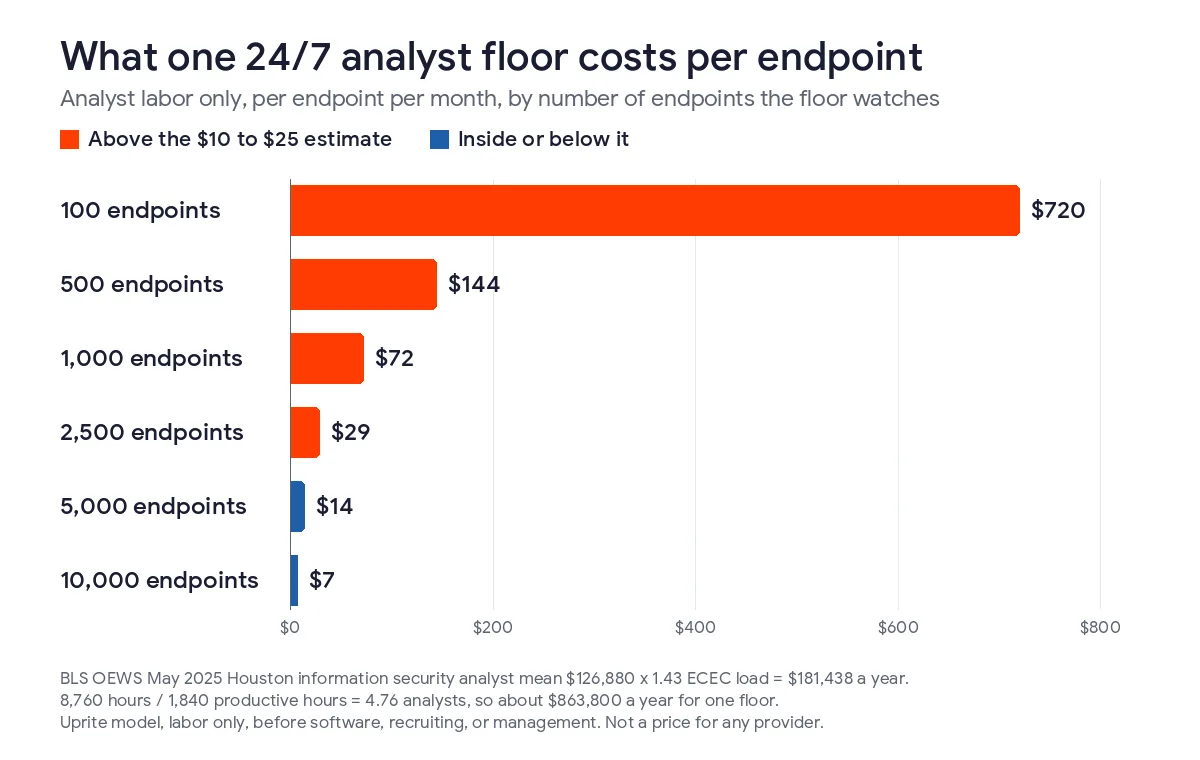
A provider doesn’t spend this much per customer. The figure is what one 24/7 floor costs when a single company owns it. Providers get their price by sharing a floor across thousands of endpoints from many clients, and the table shows where the math turns. At $25 per endpoint a floor needs about 2,900 endpoints to pay for itself, and at $10 it needs about 7,200.
Now flip it. Uprite’s $40 per user is $480 a year. Analyst labor alone matches that figure per user at about 1,800 users. Below that, renting beats building on labor alone, and that figure still leaves out the SIEM, the endpoint software, the recruiting, the manager, and the weeks lost every time someone resigns or takes a long vacation.
Per Endpoint or Per User? Convert Before You Compare
Uprite prices per user. Plenty of MDR providers price per endpoint. The units differ. The two only line up once you know how many devices each person has.
| Devices per user | $40 per user works out to | Against the $10 to $25 band |
|---|---|---|
| 1 | $40.00 per endpoint | Above it |
| 2 | $20.00 per endpoint | Inside it |
| 3 | $13.33 per endpoint | Inside it |
Say a hypothetical 80-person company counts 96 endpoints, including its servers and a few shared devices. Quote A is $14 per endpoint, or $1,344 a month. Quote B is $40 per user, or $3,200. Quote A costs 42% of B. Cheaper? Yes. The same? Only if both include the same work.
Ours doesn’t stop at endpoints. The $40 plan covers advanced firewall management, SIEM and SOC monitoring, threat intelligence, vulnerability scanning, incident response, and quarterly security reviews. We run our own security operations center, and our average first response across clients is about 5 minutes. Licensing is billed separately. If all you want is endpoint response, ask any provider, us included, for a quote scoped to that and nothing else, so you can compare like with like before anyone brings up the rest of the stack.
What Do Houston Breach Notices Say About the Detection Gap?
Detection is the part of the bill that buys time, so I looked at how much time Houston companies lost. On November 6, 2026, I pulled the Texas Attorney General’s data security breach reports and kept the 12 months ending November 3.
Organizations listing a Houston address filed 47 notices, covering about 1.6 million Texans. Of those, 35 gave both a breach start date and a discovery date. The median gap between the two was 51 days. That’s about 7 weeks. 10 were found within a day. 19 took more than 30 days. 13 took more than 90. That is a long time.
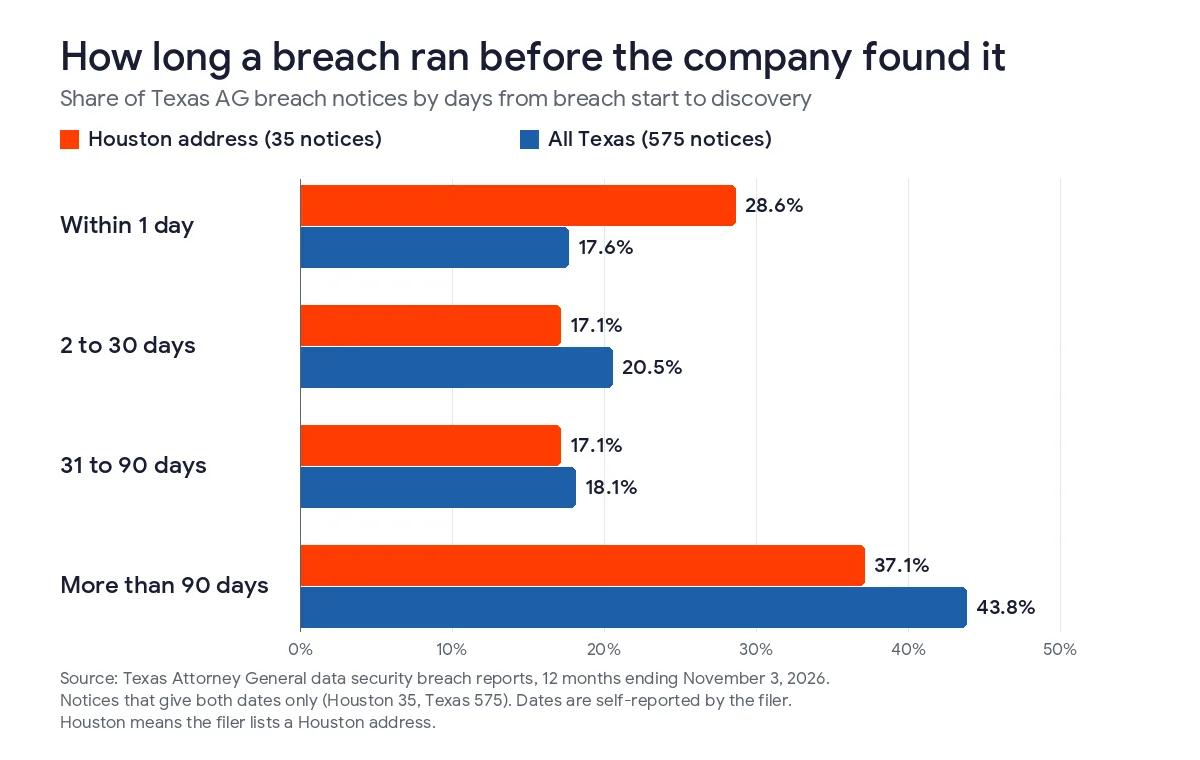
Statewide the median was 66 days across 575 notices that gave both dates, so Houston did a little better than the rest of Texas, and over half of its notices still took more than a month to find.
Two limits. Filers report these dates themselves, and some enter the day they confirmed what was taken. And a notice never says whether the company had MDR. I can’t tell you that watched endpoints would have caught any of these 35. Nobody can. I can tell you what a 51-day median gap looks like on the other side of a 5-minute first response.
Nights, Weekends, and the 76% Problem
A 40-hour week covers 2,080 of a year’s 8,760 hours. That leaves 76% of the year with nobody at the office. Nights and weekends.

CISA and the FBI addressed this in a joint advisory, AA21-243A. They observed ransomware attacks landing on holidays and weekends, when network defenders and IT support are at limited capacity. Attackers have noticed. Then they said it plainly. “The FBI and CISA highly recommend organizations continuously and actively monitor for ransomware threats over holidays and weekends.” Direct enough.
It’s an old advisory. It was issued in August 2021, revised in February 2022, and CISA now files it as archived. I haven’t found a newer one that reverses the advice. The NIST Cybersecurity Framework 2.0 reaches the same place from another direction, with continuous monitoring as part of its Detect function.
What Pushes an MDR Quote Up or Down?
Servers are the usual miss. A quote for 30 laptops that skips the 3 servers prices the machines an attacker cares about least, and I’d confirm what sits inside the endpoint count before comparing two quotes.
Whether the analyst can act is the next thing to check. Isolating a device at 2 a.m. is worth more than an email that waits for you until 8, and some contracts only promise the email. Log retention matters too, since 30 days and 12 months are priced differently and an investigation that starts late needs the longer window. Compliance reporting, contract length, and onboarding fees come after those, and the onboarding fee is the one I see hiding the real first-year cost.
3 Houston Budgets, Worked Out
These are hypothetical companies. The per-endpoint column uses our $10 to $25 estimate. The last column is the analyst labor from the floor above, divided by 12. It never moves.
| Company | Per-endpoint MDR estimate per month | Uprite SOC-backed plan per month | Own 24/7 floor, labor only, per month |
|---|---|---|---|
| 25 users, 30 endpoints | $300 to $750 | $1,000 | $71,984 |
| 80 users, 96 endpoints | $960 to $2,400 | $3,200 | $71,984 |
| 200 users, 240 endpoints | $2,400 to $6,000 | $8,000 | $71,984 |
Our plan looks pricier than the per-endpoint band at every size. It is. That holds if endpoint response is the whole job. What the extra buys is the firewall, SIEM, scanning, and review work in the same plan. That’s a different purchase, and I’d rather you see the gap than have me bury it.
If you’re pricing the whole stack, our guides to cybersecurity services costs in Texas and managed IT costs in Houston show where security sits in a full IT bill and which line items move together when headcount changes. Two narrower guides cover the rest, one on MDR vs EDR in Houston and the other on SOC as a service for Houston small businesses, so each question gets its own page with its own numbers.
Questions to Ask Before You Sign
Before you sign, ask who reads the alert at 2 a.m. on a Sunday and what they’re allowed to do, what counts as an endpoint, whether the written response time is an average or a worst case, whether you can take your logs with you if you leave, and which tasks, such as incident response hours, sit outside the monthly number.
Want your own endpoint count priced three ways, per endpoint, per user, and against an in-house floor? We’ll run it with your real numbers.
Price My MDR CoverageWhat Houston Owners Ask About MDR Pricing
How much does MDR cost per endpoint in Houston?
About $10 to $25 per endpoint per month for small and midsize companies in 2026, by Uprite estimate. That blends the software on each device with the analysts who watch it. Vendor price pages publish only the software, so the analyst share is the part you must ask about.
Is MDR priced per endpoint or per user?
Both exist, and they are not comparable until you convert one into the other. Many providers quote per endpoint, while Uprite prices per user, from $40 a month for its SOC-backed plan. Divide a per-user price by devices per person, so $40 across 2 devices works out to $20 per endpoint.
Can I use Microsoft Defender and skip MDR?
Partly. Defender for Business at $3.00 per user per month finds problems, and Microsoft says it covers companies up to 300 users, but software alone does not answer an alert at 2 a.m. Someone still has to isolate the device and decide what happens next.
What does it cost to build a 24/7 SOC in Houston?
Roughly $864,000 a year in analyst labor, before any software. We get there with 4.76 analysts at $181,438 each, and that excludes recruiting and the manager who runs the shifts. Few companies under several thousand endpoints can justify it, which is why most rent coverage.
Does MDR cover servers and cloud accounts?
Not by default, and the quote will not always say so. Many count laptops only, so ask whether servers, Microsoft 365 sign-ins, and shared devices sit inside the endpoint count. Each one changes the monthly total and the coverage you actually get on the night something goes wrong.