
SOC as a service is worth it for most Houston small businesses, because a 24/7 team of your own takes about 5 analysts and over $630,000 a year in pay alone. Renting that coverage starts at $40 per user per month.
I run technology planning for Houston firms, and the security line in a budget is where owners go quiet. Somebody has quoted them a SOC, an MDR service, or both, and the quote is full of letters. So let’s do the arithmetic out loud. If you want the service behind the term first, our page on managed detection and response in Houston has it.
Buy it when nobody on your payroll can act on a security alert at 2 a.m., which is nearly every firm under 200 users. One always-staffed seat takes about 5 analysts, and at the Houston median of $126,370 that’s $631,850 in wages before benefits. Uprite’s SOC starts at $40 per user per month. Skip it, or buy less, if you already have a night desk or the provider can only email you.
What is SOC as a service, and how is it different from MDR?
SOC as a service is a monthly subscription that gives you a security operations center you don’t have to build. Analysts watch alerts from your devices, firewall, sign-ins, and cloud apps around the clock, decide which ones are real, and act or call you. You keep the visibility. They carry the night shift.
MDR is the same idea with a narrower lens. It starts at the laptop and the user account. A SOC also reads firewall and server logs, so it can see an odd login from Singapore and the firewall rule someone changed right after it. Sales decks blur the two on purpose, because both are easier to sell as a single line item. We untangle the tool layers in EDR vs MDR vs XDR, so this guide sticks to what you’d actually pay.
| How you watch the network overnight | Who reads the alert at 2 a.m. | What it costs | Where it fits |
|---|---|---|---|
| Alerts go to a shared inbox | Whoever opens it Monday morning | Nothing extra until an incident | No firm that holds client or patient data |
| EDR software only | Your own IT person, if they’re awake | Per-device license fees | Firms with trained staff on call every night |
| In-house SOC | Your own analysts | About 5 hires per seat, $631,850 a year or more | Organizations with thousands of users |
| SOC as a service or MDR | The provider’s analysts | From $40 per user per month at Uprite | Firms of 10 to 500 users with no night shift |
What would it cost to run your own 24/7 SOC in Houston?
Start with hours. A year has 8,760 of them, and one full-time employee covers roughly 1,800 once vacation, holidays, sick days, and training come out. That 1,800 is our planning assumption, not a government number. 8,760 divided by 1,800 is 4.9, so a single chair needs 5 people.
Then pay. The Bureau of Labor Statistics lists a May 2025 median wage of $126,370 for information security analysts in the Houston metro, with a 10th percentile of $74,290 and a 90th of $178,560, in its OEWS data tables. Five analysts at the median cost $631,850 in wages. Benefits push it higher, since BLS says private employers spent $14.07 of every $46.89 in hourly compensation on them in June 2026, which is 30.0% (employer cost release). Apply that share and you’re near $900,000, still without a SIEM license, a manager, or a recruiter’s fee.
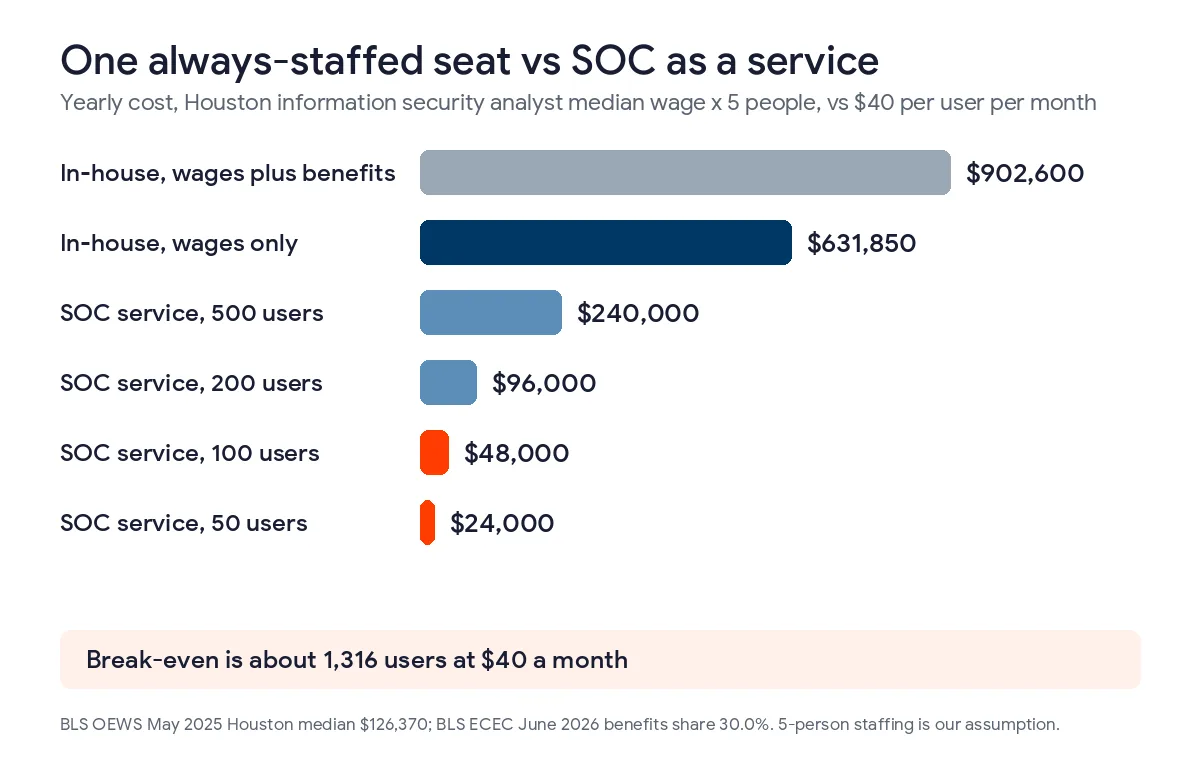
Pay isn’t the real problem though. Hiring is. BLS counts only 2,110 information security analysts in the whole Houston metro, and every energy company, hospital system, and bank downtown is fishing in the same pool. Five people cover 8,760 hours at about 1,750 each. Lose one, and the other 4 owe about 2,190 apiece. Nobody works that.
What does SOC as a service cost a Houston small business?
Uprite’s MSSP Security Focus plan starts at $40 per user per month and bundles the advanced firewall, SIEM, SOC monitoring, threat intelligence, vulnerability scanning, incident response, and quarterly security reviews. It’s built for firms with internal IT, and our pricing page lists the rest. Firms with no IT team start on Fully Managed IT at $138 per user per month, which folds the security stack and after-hours response into the whole service. Licensing and custom items come on top.
| Your users | SOC as a service per year | In-house 24/7 per year, wages only | Service as a share of in-house |
|---|---|---|---|
| 25 | $12,000 | $631,850 | 1.9% |
| 50 | $24,000 | $631,850 | 3.8% |
| 100 | $48,000 | $631,850 | 7.6% |
| 200 | $96,000 | $631,850 | 15.2% |
| 500 | $240,000 | $631,850 | 38.0% |
The two lines cross at about 1,316 users, where $40 a month adds up to the same $631,850. A 200-user firm is paying about 15 cents on the dollar. I’ll be straight about one thing, though. The table flatters the service, because a $40 plan replaces the monitoring chair and not your whole security function, and somebody inside still has to own the decisions.

Why does overnight coverage matter so much?
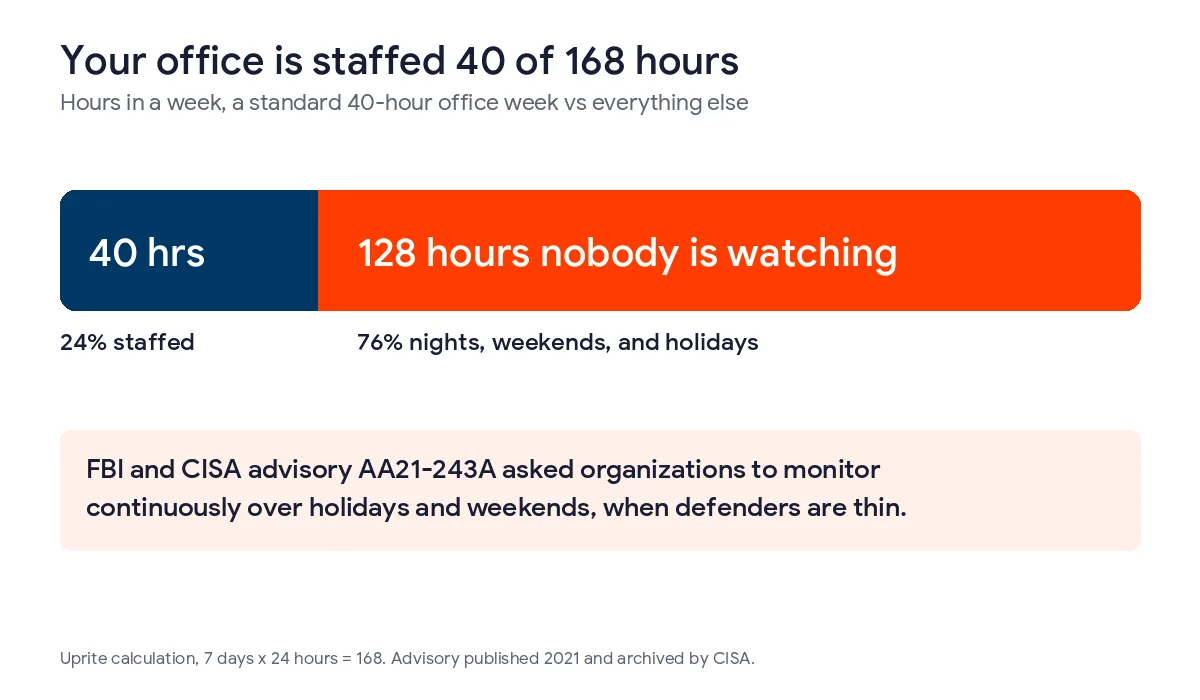
An office week is 40 hours, and a real week is 168. That leaves 128 hours, 76% of the week, when an alert sits in a queue until someone wakes up.
The FBI and CISA flagged the gap in a joint advisory called Ransomware Awareness for Holidays and Weekends. They’d watched ransomware hit on holiday weekends, when defenders and IT support were at limited capacity, and they urged continuous monitoring through those stretches. It dates from 2021 and CISA has archived it. Houston adds its own version of the problem every June through November, because a hurricane watch empties an office the same way a holiday does.
Texas puts a clock on top. A breach touching 250 or more Texans has to be reported to the Texas Attorney General within 30 days of discovery, and the filed report can become an open record. A SOC timestamps what it saw and when, which gives you a discovery date on paper. The NIST Cybersecurity Framework 2.0 lists detection as a core function next to response and recovery, so when an insurer asks about monitoring, it’s asking about a standard idea.
When is SOC as a service not worth it?
We sell this, so here’s where I’d talk you out of it. An 8-person office with no regulated data and no multi-factor authentication should fix sign-ins and backups before it buys any monitoring. A SOC on top of that is a smoke detector in a house with no doors.
- You already staff a security desk every night and weekend.
- Nothing is connected, so the SOC would have no logs or alerts to read.
- The provider can alert you but can’t isolate a device or lock an account without your say-so by phone.
- Nobody at your company answers when the SOC calls at 3 a.m.
The last two are the ones that get skipped most. A SOC that can only email you is an alert service, and it’s cheaper because it does less.
What should you get in writing before you sign?
Put the same six questions to every provider, ours included, and keep the answers in the agreement.
- Which data sources the SOC reads, such as endpoints, sign-ins, firewall, Microsoft 365, and cloud apps.
- Who may isolate a device or disable an account without calling you first, and what you’ve pre-approved.
- The time from alert to human review, written as a number of minutes.
- How many days of logs they keep, and who owns them if you leave.
- A monthly report of what they caught and closed.
- Who answers the phone on a holiday, by name or role.
Questions 2 and 3 decide everything else. A provider that won’t write a number next to question 3 is selling a feeling. Our ranking of the best MDR providers in Houston shows which firms publish a price at all.
How do you decide in an afternoon?
Count your users, then find out who really picks up at 2 a.m. A founder’s cell phone counts, and so does a sleepy IT manager in Katy. Add up the rules and contracts you answer to, and price both routes with the table above. Per-endpoint quotes are covered in what MDR costs in Houston. Our cybersecurity risk assessment guide walks through that inventory, and cybersecurity cost in Houston covers the rest of a security budget.
If you don’t know what your devices and accounts could even send to a SOC, our no-charge network assessment returns a device inventory and a ranked list of findings. For how monitoring, response, and backup fit together, see managed security services in Houston. And if an alert does turn out to be real, our incident response services page covers the next 24 hours.
What Houston owners ask about SOC as a service
Is SOC as a service worth it for a small business?
Yes, when nobody on your staff can act on an alert overnight. Your own 24/7 team would take about 5 analysts and $631,850 a year in wages, against a subscription that starts at $40 per user per month.
How much does SOC as a service cost per month?
Uprite’s plan starts at $40 per user per month, so 50 users run about $2,000 a month before licensing. Where you land depends on your user count, your industry, and how clean your systems are. Other providers price per device or per tier, so compare the same scope.
Can Microsoft Defender replace a SOC?
No, because Defender is a tool and a SOC is people. Defender will flag a strange sign-in at midnight. Somebody still has to look at it, decide it’s real, and lock the account, and if that somebody is asleep you own software with no coverage.
Do I still need an IT person if I buy a SOC?
Yes, or a managed IT partner. A SOC watches and responds, but patching, account setup, and approving what the SOC may do all land on somebody. Firms with no IT at all do better on a plan that bundles both.
How fast should a SOC respond?
Get a number in minutes, in writing, for critical alerts, and treat anything measured in hours as a red flag. Then ask who can isolate a device without calling you first, since that decides whether quick review becomes quick containment.
Does a SOC help with Texas breach reporting?
It helps with the paperwork, not the filing. Texas gives you 30 days from discovery to report a breach touching 250 or more Texans, and a SOC’s timeline records when something was first seen. Your attorney decides what counts as a reportable breach, and the SOC can’t make that call for you.
Does Uprite run a SOC for Houston businesses?
Yes. Uprite runs a 24/7 SOC for Houston and Texas clients, with plans starting at $40 per user per month. If you already have one, send us the contract and we’ll tell you what it really covers.
Tell us how many users you have and who answers an alert after 6 p.m. We’ll put in writing whether a SOC fits your firm, what it would cost at your size, and what you’d still own yourself.
Talk to a Security ExpertPrefer email or a phone call? Reach the team through our contact page.