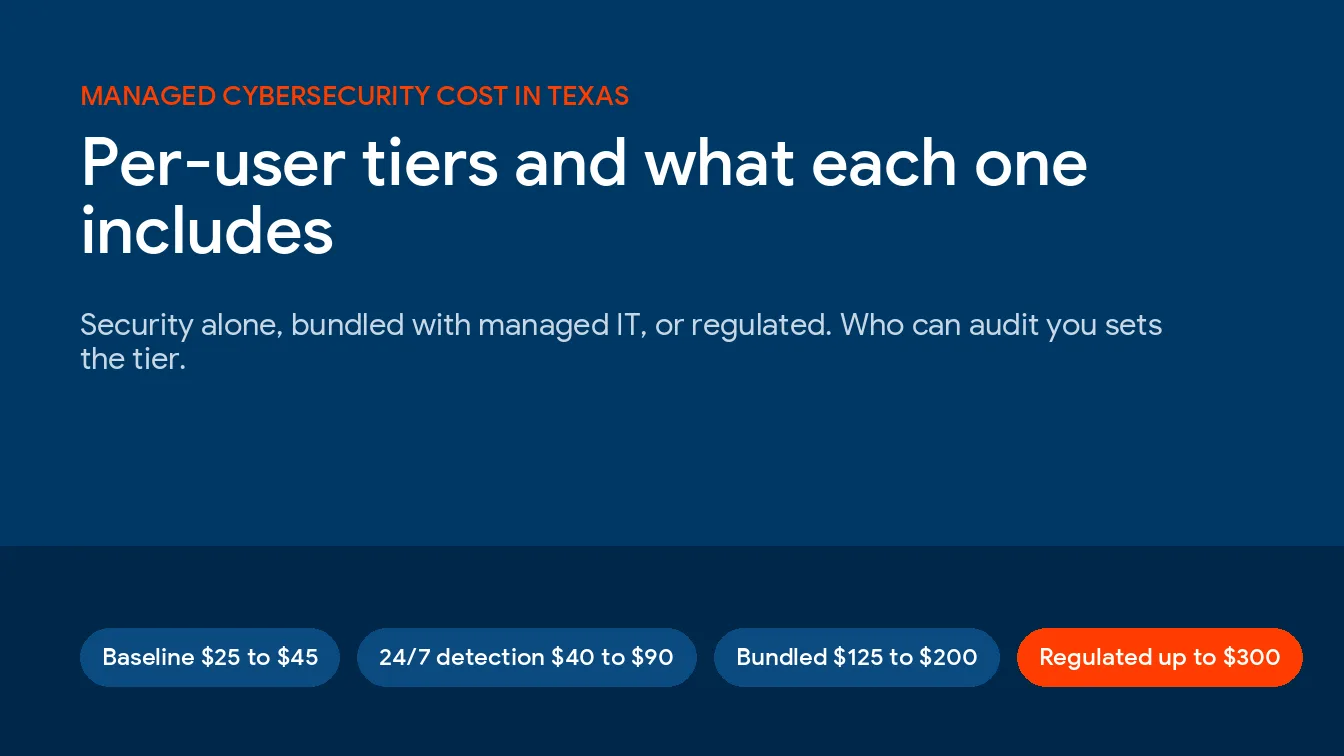
Managed cybersecurity services cost a Texas business $40 to $90 per user per month for 24/7 monitored protection on its own, $125 to $200 bundled into fully managed IT, and $175 to $300 under heavy regulation. Business-hours baseline plans start nearer $25. Which tier you need depends on who regulates you, not which city you’re in.
This guide covers what cybersecurity services cost across the whole state rather than a single metro, and it sits under our cybersecurity services in Texas. Every range in it comes from our published rate card and our own Texas cost guides, not from vendor surveys. Where a number is a market band rather than our price, I’ll say so.
Security on its own runs $40 to $90 per user a month in Texas once a person watches alerts around the clock. Business-hours baseline plans at $25 to $45 leave nights uncovered. Bundled into fully managed IT, expect $125 to $200. HIPAA, CMMC, or financial rules push bundles to $175 to $250, and pipeline or maritime work with plant networks reaches $300. Licensing, forensics, and penetration tests are usually billed on top.
What Is Managed Cybersecurity, and What Does It Cost in Texas?
Managed cybersecurity is an outside team that runs your security tools, watches what they flag, and responds when something is wrong, billed as a flat monthly fee per user. In Texas, 2 things set most of the price. Whether a person watches alerts 24 hours a day, and which regulator can audit you.
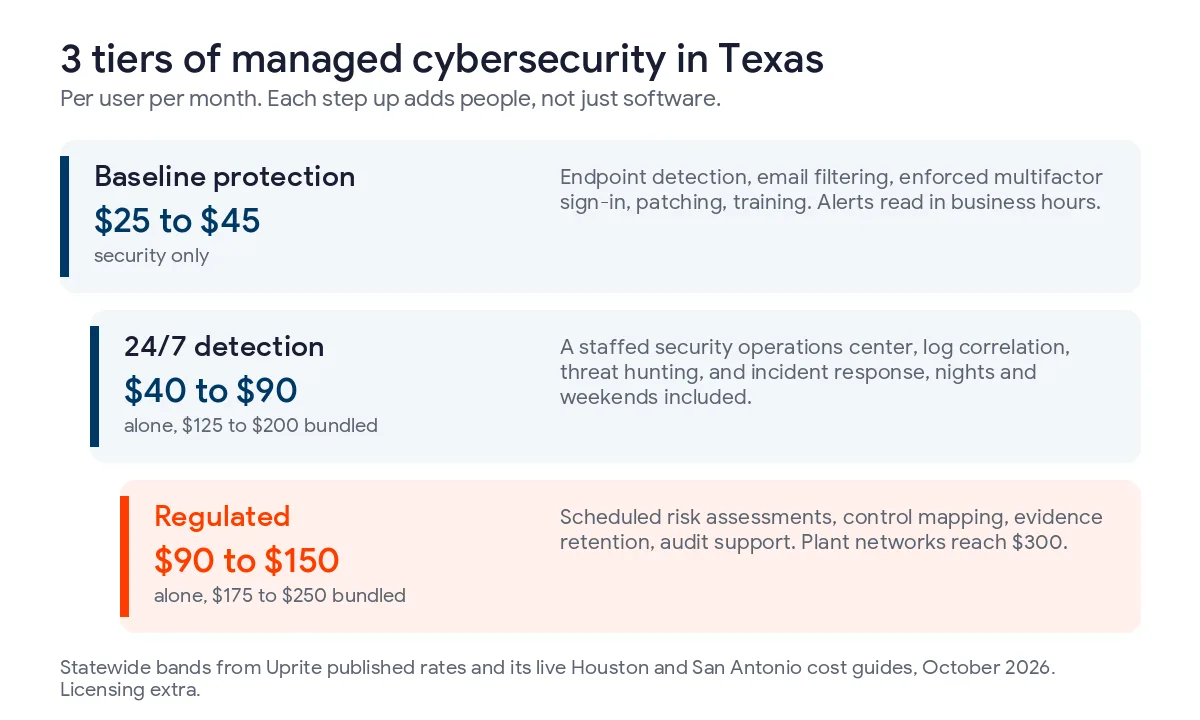
Here’s the statewide model, built from those guides. 3 tiers. Each one adds people, not just software.
| Tier | Security only, per user per month | Bundled with managed IT | What it adds | Usually fits |
|---|---|---|---|---|
| Baseline protection | $25 to $45 | Inside most bundles | Endpoint detection, email filtering, enforced multifactor sign-in, patching, awareness training | Under 20 staff, no regulator, someone in-house checks alerts |
| 24/7 detection | $40 to $90 | $125 to $200 | A staffed security operations center, log correlation, threat hunting, incident response | Most Texas businesses from 20 to 250 people |
| Regulated | $90 to $150 | $175 to $250, or $200 to $300 with plant networks | Control mapping, scheduled risk assessments, evidence retention, audit support | HIPAA, CMMC, FTC Safeguards, PCI DSS, Coast Guard or TSA scope |
The bundled column isn’t the security price plus a help desk price. It’s a different product. A bundle carries the help desk, device management, backups, and vendor wrangling, which is why our own published rates jump from $40 for security alone to $138 for fully managed IT with the security stack inside. Our breakdown of managed IT pricing in Texas shows what the other $98 buys.
What Does the Baseline Tier Include?
Tools, plus someone keeping them configured. Endpoint detection on every laptop and server. Email filtering. Multifactor sign-in enforced on every account, not just the admins. Monthly patching. A phishing course once a year, maybe twice.
Some of it is cheap at list price. Microsoft sells Defender for Business at $3.00 per user per month on its own, and it comes inside Microsoft 365 Business Premium at $22.00, along with the email, Office apps, and device management that most small offices already need to run the business day to day. So a $25 to $45 baseline is mostly paying for labor. Setup, tuning, and the person who reads the alerts.
During business hours. That’s the catch.
A baseline plan usually routes overnight alerts to an inbox or an on-call phone that someone checks in the morning, which means an intrusion that starts at 11 p.m. on a Friday can run all weekend before anyone reads about it. That doesn’t make it a bad deal. It makes it an incomplete one. For a 9-person office that holds no customer Social Security numbers and has an owner who actually picks up the phone at night, it can be the right call.
What Changes When You Add 24/7 Detection?
A person watches. That’s the whole difference, and it’s the biggest jump in protection per dollar anywhere on this page. On our own price list the 24/7 tier starts at $40, which is below the top of the baseline band.
At this tier the provider runs a security operations center that pulls together logs from your firewall, your endpoints, your Microsoft 365 sign-ins, and your cloud apps, then has an analyst decide what’s real. When someone signs in from a new country at 2 a.m. on a Saturday, a person isolates the laptop or kills the session before Monday. Our guide to EDR vs MDR vs XDR sorts out which label means which kind of watching.
Why the band runs from $40 to $90 matters more than the band itself. A $40 quote and a $90 quote often aren’t the same product at different margins. The higher one may include a year of log retention, threat hunting, vulnerability scanning, and a block of incident response hours, while the lower one may stop at automated alerts dropped into a shared queue that a small team works through in order. Ask for the inclusion list. Then compare.
Who needs it? Almost any Texas business with 20 or more people, anyone storing customer Social Security or bank account numbers, and anyone renewing a cyber policy. Carriers keep asking about endpoint detection and who responds to it, and our walkthrough of the cyber insurance application questions lists the 8 controls they ask for most.
What Does the Regulated Tier Add?
Paperwork with teeth. Regulated scope adds the work an auditor, an insurer, or a federal agency can ask to see after the fact, and nearly all of that work is done by people rather than by software. Risk assessments on a schedule. Policies mapped control by control to a framework. Evidence kept for years. Someone on the phone when the auditor calls.
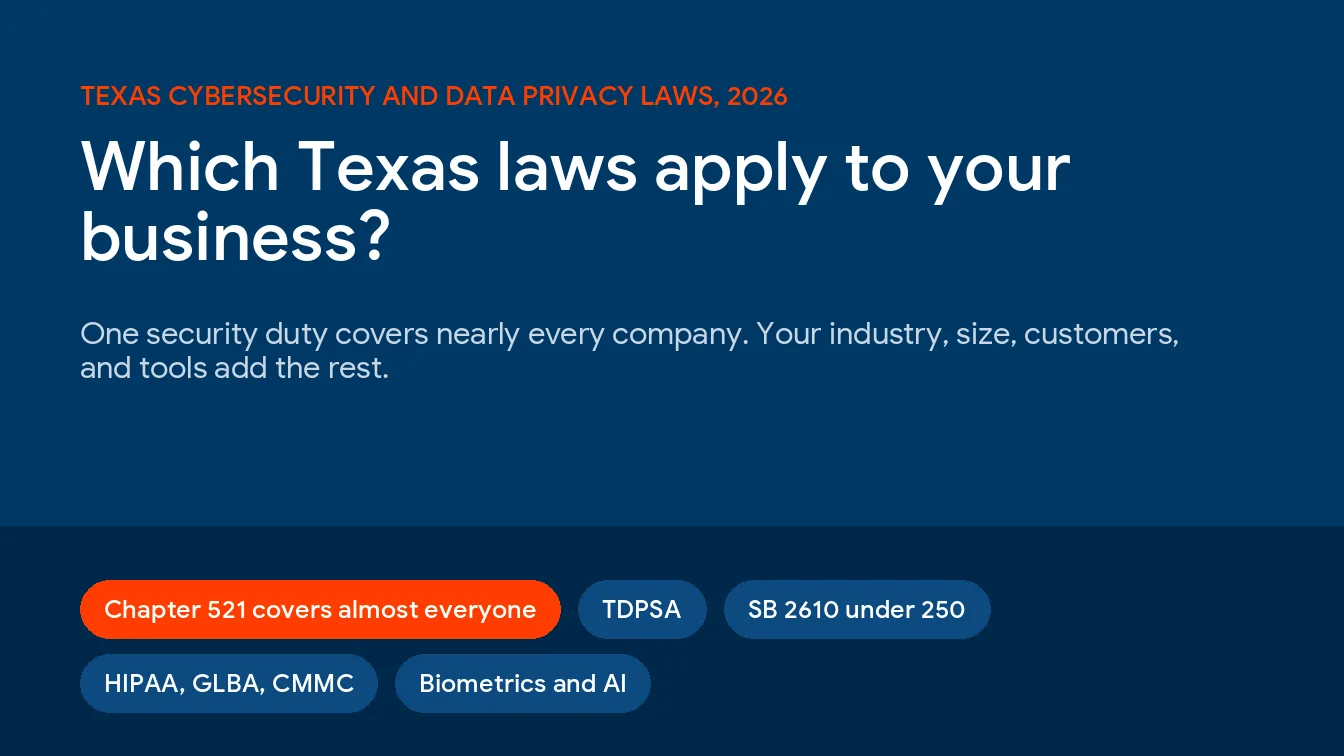
In Texas the usual triggers are HIPAA for clinics and the vendors that serve them, CMMC and NIST SP 800-171 for defense suppliers, the FTC Safeguards Rule for tax preparers, mortgage brokers, and auto dealers, PCI DSS for card payments, and Coast Guard or TSA rules for port and pipeline operators. Each prices differently. Some stack. Our guide to Texas cybersecurity laws for businesses sorts which of them reach your company. Pipeline and port work with operational technology sits at the top, $200 to $300 per user bundled, because someone has to watch the plant network too, and the controllers on it can’t simply be patched or rebooted on a Tuesday afternoon the way an office laptop can.
The metro guides go deeper. Our page on cybersecurity cost in Houston breaks the regulated tier down by agency, since that’s where the energy and maritime rules concentrate. The one on cybersecurity cost in San Antonio prices compliance-aligned work as its own step. Their top ends differ a little, but both start from the same $40 published rate, and this page’s bands span both.
Fair warning. If no regulator can audit you, don’t buy the regulated tier just because a proposal mentions a framework. The 24/7 tier plus a written program usually gets you further for far less money.
How Much Will a Texas Company Pay Each Month?
Multiply. Then adjust. Then add licensing. Here’s what the statewide bands come to at common headcounts, before any licensing.
| Users | Baseline | 24/7 detection, security only | Bundled with managed IT | Regulated bundle |
|---|---|---|---|---|
| 10 | $250 to $450 | $400 to $900 | $1,250 to $2,000 | $1,750 to $2,500 |
| 25 | $625 to $1,125 | $1,000 to $2,250 | $3,125 to $5,000 | $4,375 to $6,250 |
| 50 | $1,250 to $2,250 | $2,000 to $4,500 | $6,250 to $10,000 | $8,750 to $12,500 |
| 100 | $2,500 to $4,500 | $4,000 to $9,000 | $12,500 to $20,000 | $17,500 to $25,000 |
| 200 | $5,000 to $9,000 | $8,000 to $18,000 | $25,000 to $40,000 | $35,000 to $50,000 |
Per-user rates usually fall as headcount climbs, so a 200-person company tends to land in the lower half of each band and a 10-person office in the upper half. Watching a firewall costs about the same whether 10 people sit behind it or 60. Our Texas MSP Pricing Index documents the same slope for managed IT across Houston, San Antonio, and Dallas-Fort Worth.
Count users the way providers do. A user is a person with a login rather than a device, so the laptops, phones, and the server in the closet don’t add seats on a per-user quote the way they would on a per-device one. Shared front-desk accounts, warehouse kiosks, seasonal staff, and contractors who sign in twice a month are exactly where 2 quotes for the same company quietly disagree, so settle the count before you compare anything. Ask how they count.
Is It Cheaper to Hire a Security Analyst in Texas?
Not until you’re very large. Texas employed 16,130 information security analysts in May 2025 at a mean wage of $130,710 a year, according to the BLS state occupational estimates. The middle half earned between $101,380 and $160,020.
Salary isn’t the cost. The BLS employer cost survey for June 2026 puts private-industry compensation at $46.89 an hour against $32.82 in wages, a 1.43 multiplier once benefits and payroll taxes are counted. Apply it to the state mean and the average Texas analyst costs an employer about $186,700 a year, before you buy a laptop, a training budget, or a single security tool for that person to run.
Now divide. $186,700 a year is about $15,560 a month, which buys the $40 tier for 389 people. And that 1 analyst works roughly 40 of the week’s 168 hours. That’s 1 shift. Covering every hour takes about 4.8 analysts once vacations and sick days come out, nearly $900,000 a year in labor before a single tool license gets paid for.
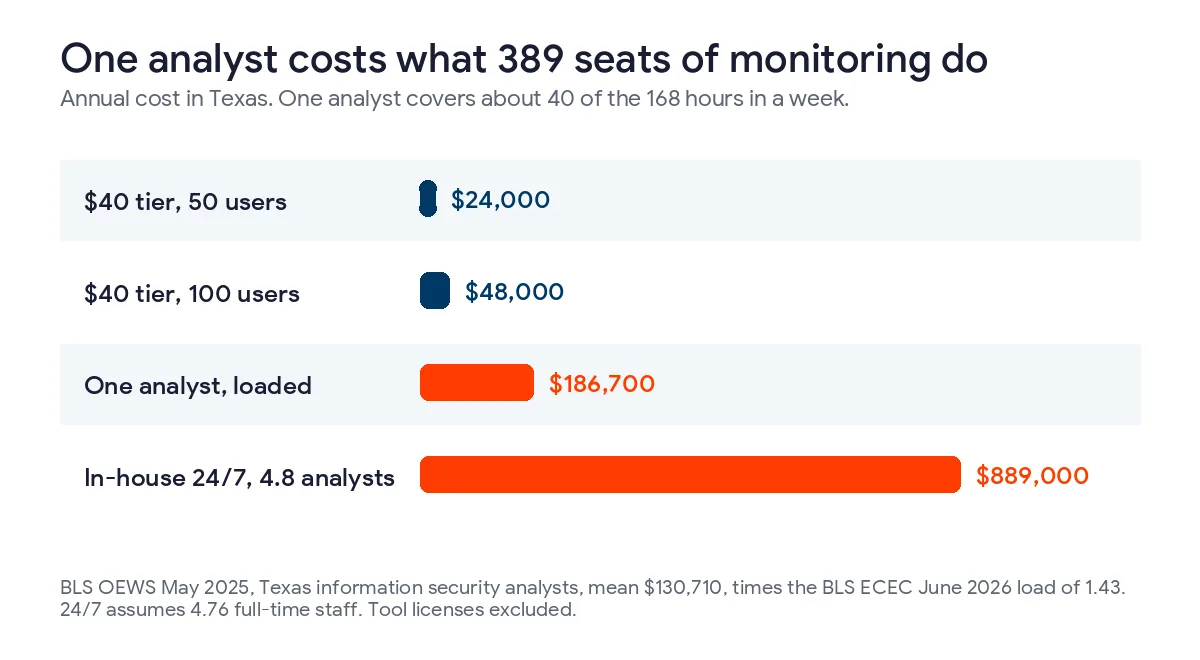
So round-the-clock coverage in-house only beats the $40 tier past roughly 1,850 users, or about 825 at $90 a seat. Companies that do hire usually bring on 1 internal security lead and keep an outside team for nights and weekends. That’s the co-managed model. It’s usually the smartest version.
Wages don’t explain price differences between Texas cities either. Analyst pay in San Antonio, Houston, and Dallas-Fort Worth sits within about 6% across the 3 metros in the same May 2025 data, which is far too narrow a spread to explain quotes that differ by $50 a seat. Scope moves your quote. Your zip code barely does.
What Does a Texas Data Breach Actually Look Like?
Smaller than the headlines. We pulled every notice on the Texas Attorney General’s data breach list posted in the 12 months to October 16, 2026. 659 notices from 648 organizations.
The median notice involved 1,701 Texans. 524 of the 659, or 79.5%, involved fewer than 10,000. Only 37 crossed 100,000, and the biggest 5 alone account for almost 60% of every Texan counted. The typical breach on this list belongs to a retailer, a clinic, a financial firm, or an insurance agency, the same kinds of organizations that buy managed security by the seat instead of staffing a security department of their own. Not a household name.
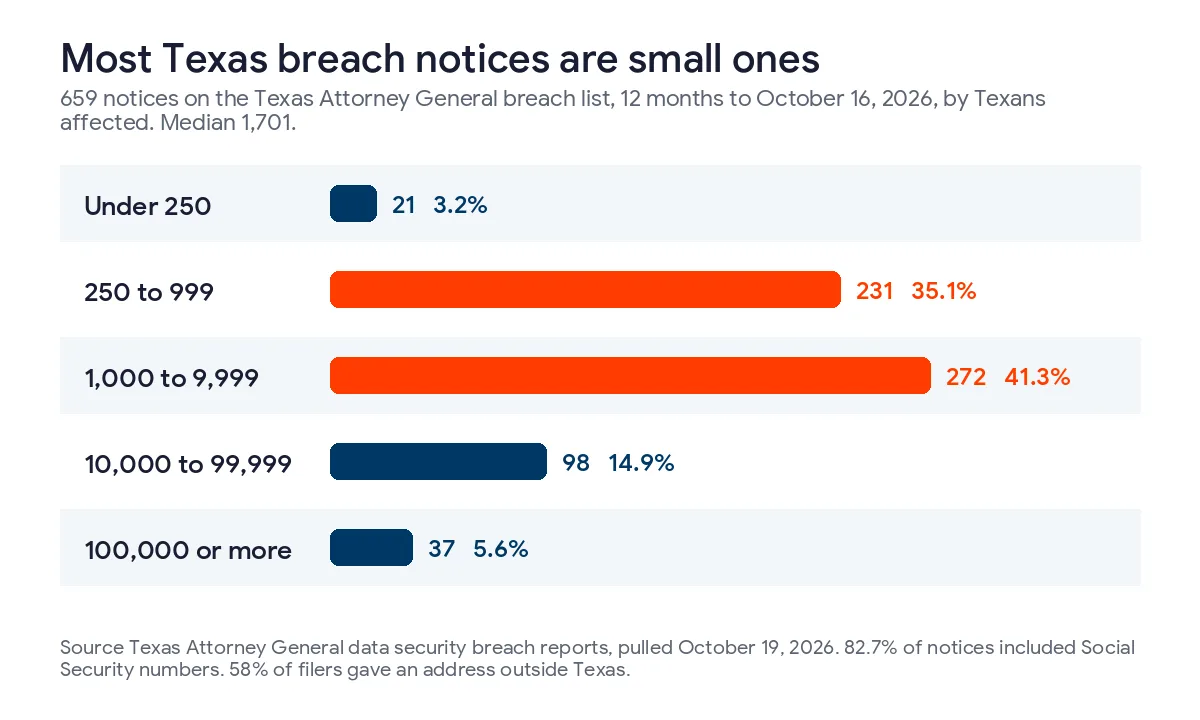
What leaked matters for pricing too. 545 notices, or 82.7%, included Social Security numbers. Those are expensive records. 377 included medical or health information. And 58% of the organizations filing gave an address outside Texas, a reminder that the law follows Texans’ data, not your headquarters.
Why does that matter? You owe affected Texans notice within 60 days of determining a breach happened. Once it touches 250 Texans, you also owe the Attorney General notice within 30 days, under the 2023 change in Senate Bill 768. Section 521.151 of the Business and Commerce Code sets civil penalties of $2,000 to $50,000 per violation, plus up to $100 per person per day for late individual notice, capped at $250,000 for a single breach.
Speed is the part a monthly fee buys. The median notice on the list went up 40 days after the date the business says it discovered the breach. That clock only starts once somebody notices. The time before that, with an intruder inside and nobody aware, is the stretch an overnight team is paid to shrink, and no public list records it.
Does Texas Law Tell You Which Tier to Buy?
No. Section 521.052 requires reasonable procedures to protect sensitive personal data, but it doesn’t name a tier or a framework. Texas law does reward having a program. Senate Bill 2610, in effect since September 1, 2025, bars exemplary damages in a breach lawsuit against a Texas business with fewer than 250 employees, provided the business can show it ran a qualifying cybersecurity program at the time of the breach.
The bar scales with headcount. Under 20 employees, simplified requirements that include password policies and employee training. From 20 to 99, the CIS Controls Implementation Group 1, which runs to 56 safeguards. From 100 to 249, a full framework such as the NIST Cybersecurity Framework, NIST SP 800-171, or the ISO 27000 series, plus HIPAA or Gramm-Leach-Bliley wherever they already apply.
Read the limits before you budget around it. The safe harbor covers exemplary damages only. Actual damages, penalties from the Attorney General, and the cost of mailing notices and paying for credit monitoring all stay on the table, so the law lowers the ceiling on 1 kind of lawsuit award without lowering your budget. And at the time of the breach means written, current, and provable. A program that lives in a former employee’s head doesn’t count.
In tier terms, the baseline covers the under-20 requirements if someone writes the policies down. Implementation Group 1 asks for audit logs, working backups with a recovery process, and an incident process, which is the 24/7 tier’s daily work. The full-framework band is where the regulated tier earns its price.
How Do You Compare Quotes Priced Per User, Per Device, and Flat Fee?
Convert everything to per user per month. Then ask what’s inside.
Some providers price per endpoint, often $10 to $25 a month for detection and response on each laptop or server, as our MSP vs MSSP comparison explains. Some quote a flat monthly fee. Others charge per user. All 3 are legitimate. They’re just hard to line up.
Take a hypothetical 30-person office with 34 laptops and servers. Quote A is $18 per endpoint, or $612 a month. Quote B is $55 per user, or $1,650. Quote A looks like a third of the price. Per user, it’s $20.40. Cheaper? Yes. Comparable? Rarely.
Before you sign the cheaper one, get answers to these in writing.
- Who reads an alert at 2 a.m. on a Sunday, and do they act or just email you?
- How many incident response hours are included before hourly billing starts?
- How long are logs kept, and can you take them with you if you leave?
- Which Microsoft or other licenses are in the price, and which do you buy yourself?
- Is vulnerability scanning included, and how often does it run?
- What does onboarding cost, and how long is the term?
The answers usually explain the gap. Suppose Quote A covers software and business-hours triage while Quote B covers a staffed overnight team and a block of response hours. Different products. Same spreadsheet row.
What Does a Per-User Price Usually Leave Out?
More than most buyers expect. These are the items that most often get billed outside a managed security fee.
- Microsoft security licensing, from $3.00 per user for Defender for Business to $22.00 for Business Premium
- Forensics, legal counsel, and notification letters after a confirmed breach
- Annual penetration testing, scoped and quoted per engagement
- Assessor or auditor fees for HIPAA, CMMC, or PCI DSS
- Cyber insurance premiums
- Firewall and network hardware
Penetration testing and scanning get mixed up constantly. Our guide to penetration testing vs vulnerability scanning covers when each one is worth buying and why paying for a test before you’ve fixed what your own scans already found mostly wastes the money you set aside for it. Scanning usually sits inside the 24/7 tier. A real penetration test almost never does.
None of this makes a quote dishonest. It makes the per-user number a starting point for the budget conversation rather than the budget itself, so ask every provider to mark each item above as included, excluded, or billed hourly before you compare totals. Get it in writing.
Where Do Uprite’s Published Rates Sit?
Near the floor of each band, on purpose. Our MSSP Security Focus plan starts at $40 per user per month for companies that already have IT staff. It includes firewall management, a SIEM with round-the-clock security operations center monitoring, threat intelligence, vulnerability scanning, incident response, compliance automation, and quarterly security reviews.
Companies with an internal IT person who want a bench behind them use Co-Managed IT, from $100. Companies with no IT team at all use Fully Managed IT, from $138, which puts the security stack, after-hours response, backup testing, and vCIO planning sessions inside the same monthly fee instead of on separate invoices. All 3 rates are on our pricing page. They’re starting prices, and regulated scope adds to them.
2 commitments sit behind those numbers. Your rate can’t rise during the first year. And if you’re not satisfied within 120 days, you can walk away from the contract.
Questions Texas Owners Ask Before Signing
How much does managed cybersecurity cost for a 50-person company in Texas?
A 50-person Texas company typically pays $2,000 to $4,500 a month for 24/7 monitored security on its own, or $6,250 to $10,000 a month with security bundled into fully managed IT. Licensing, forensics, and audits come on top.
Is $40 per user enough for real 24/7 protection?
It can be, if the $40 buys a staffed security operations center and not just software with automated alerts. Ask who responds overnight, how many incident hours are included, and how long logs are kept. Those 3 answers separate a real $40 tier from a thin one.
Is hiring an in-house security analyst cheaper than outsourcing in Texas?
Rarely. An average Texas security analyst costs an employer about $186,700 a year with benefits, the same as the $40 tier for 389 people, and still covers only 1 shift. Staffing every hour takes about 4.8 analysts, or nearly $900,000 a year.
Do Texas businesses have to follow a cybersecurity framework?
Not a named one. Texas requires reasonable security procedures but no specific framework, and SB 2610 rewards businesses that adopt one. A Texas business with fewer than 250 employees that runs a qualifying program at the time of a breach can’t be ordered to pay exemplary damages. HIPAA, GLBA, and federal contracts set their own requirements separately.
Why are per-device security quotes often cheaper than per-user quotes?
Partly because the math looks smaller, and sometimes because they cover less. Per-endpoint detection and response often runs $10 to $25 a device, roughly $15 to $50 per user, while a per-user quote may also carry response hours, log retention, or scanning. Convert both to per user per month, then compare the inclusion lists line by line.
Does cybersecurity cost more in Houston than in San Antonio or Dallas?
Barely. Security analyst wages across the 3 metros sit within about 6% of each other, so the price gap comes from regulation and scope, not location. Houston’s energy and maritime rules just push more of its businesses into the regulated tier.
Holding 2 or 3 security quotes that don’t line up? Send them over with your headcount. We’ll restate every option in per user per month, list what each one leaves out, and show where our own $40, $100, and $138 plans fit, in writing.
Compare My Security QuotesPrefer email or a call? Reach the team through our contact page, or see how we run cybersecurity services day to day.