An MSP keeps your technology running. An MSSP keeps it defended. A managed service provider handles everyday IT, while a managed security service provider focuses only on cybersecurity, watched around the clock from a security operations center.
An MSP (managed service provider) runs your day-to-day IT, think help desk, networks, backups, and cloud. An MSSP (managed security service provider) does one thing, security, and does it deeply, with 24/7 threat monitoring, incident response, and a staffed security operations center. Most small and midsize businesses in Texas do not have to choose. The smarter move is one partner who delivers both, so your IT and your security actually talk to each other.
What is an MSP?
A managed service provider is the company you hire to run your technology so your team does not have to. That covers help desk support, network management, patching, data backup, cloud administration, and the steady work of keeping systems available and fast. Think of an MSP as the operations layer for everything digital in your business.
Most MSPs bundle in managed IT services on a flat monthly fee, which is why the model took off with small and midsize companies. You get a predictable bill and a team that already knows your environment, instead of paying by the hour every time something breaks. Security is usually part of the package, but as a baseline layer, antivirus, firewalls, a spam filter, and multi-factor authentication, not a dedicated practice.
What is an MSSP?

A managed security service provider is a specialist. An MSSP focuses only on cybersecurity, and it typically runs a security operations center, a room of analysts watching your environment 24 hours a day, 365 days a year. Where an MSP asks “is it working,” an MSSP asks “is it under attack.”
That narrower focus buys you depth. A managed security services provider delivers vulnerability assessments, continuous threat monitoring, threat hunting, incident response, and the compliance evidence that auditors want to see. We break each of those line items down, along with what gets billed as an add-on, in our guide to what IT security management services actually include. According to CrowdStrike, an MSSP focuses solely on security services, while an MSP provides IT services with only baseline security built in. The tools an MSSP runs, and the people reading the alerts, are the whole business, not a side offering.
MSP vs MSSP: the core difference
The plainest way to say it is this. An MSP keeps the lights on. An MSSP watches the doors. One is measured on uptime and response time. The other is measured on how fast a threat gets caught and shut down. Here is how the two compare across the things buyers actually ask about.
| What you care about | MSP | MSSP |
|---|---|---|
| Primary job | Keep IT running and efficient | Detect and stop cyber threats |
| Core services | Help desk, networks, backups, cloud, patching | 24/7 monitoring, threat hunting, incident response |
| Staffing model | Technicians and engineers | Security analysts in a SOC |
| Coverage hours | Business hours, plus on-call | 24 hours a day, 365 days a year |
| Security depth | Baseline (antivirus, firewall, MFA) | Advanced (SIEM, EDR, threat intel, forensics) |
| Compliance support | Some documentation | Continuous evidence for HIPAA, CMMC, SOC 2 |
| Best measured by | Uptime and ticket resolution | Mean time to detect and respond |
Here is the honest part the vendor comparison charts skip. In 2026 these two categories overlap more than they separate. As Check Point notes, many providers now deliver both IT and security, and the terms get used interchangeably because the solutions have merged. So the real question is rarely “MSP or MSSP.” It is “does my provider actually have security depth, or a checkbox.” Answering it means auditing the tooling itself, layer by layer, which is what evaluating an MSP’s cybersecurity stack walks through.
Where does MDR fit in all of this?
You will run into a third acronym fast, so it is worth pinning down. MDR stands for managed detection and response, and it is a service, not a company type. An MSSP might offer MDR, but not every MSSP does, and plenty of MSPs now bundle it too.
The distinction that matters is what happens after an alert fires. A traditional MSSP often generates the alert and hands it to you to investigate. An MDR service investigates the threat itself, decides if it is real, and takes action to contain it. That difference of who does the responding is exactly why MDR has become the piece cyber insurers care about most, which we will get to below.
What an MSSP does that a typical MSP does not
If you strip away the marketing, four capabilities separate a real security practice from an MSP with a firewall. We applied exactly that test when we scored seven Houston security providers.
- A staffed SOC. Humans watching alerts overnight and on weekends, when most ransomware actually detonates.
- Proactive threat hunting. Actively looking for intruders already inside the network, instead of waiting for a tool to beep.
- Real incident response. A defined plan, the authority to act during an attack, and someone who has run the play before.
- Continuous compliance evidence. Access logs, scan results, and response records kept audit-ready year round, not scrambled together the week before a HIPAA or CMMC assessment.
That last point trips up a lot of regulated businesses. CMMC Level 2 alone requires 110 security practices aligned with NIST 800-171. An MSP can hand you a report. A security-led provider keeps the evidence flowing so the audit is a formality, not a fire drill.
Why this choice matters more than it used to

A decade ago, “we have antivirus and a backup” was a defensible answer for a small business. It is not anymore. Attackers moved downmarket because smaller companies are softer targets, and the numbers back it up.
Roughly 43% of cyberattacks now target small businesses, and the Verizon 2025 Data Breach Investigations Report found that 88% of breaches at small businesses involved ransomware, compared with 39% at large organizations. The cost is not survivable for everyone. IBM’s Cost of a Data Breach Report puts the average breach at roughly $3.31 million for organizations under 500 employees. For a lot of the businesses we work with across Houston, Dallas, and San Antonio, an event at even a fraction of that number is the difference between a bad quarter and closing the doors.
Speed is the whole game. The longer a threat sits undetected, the bigger the bill, which is the entire argument for having someone watch overnight. It is also why cyber insurers have tightened up. Most carriers now expect around-the-clock detection and response before they will write a policy, and Sophos reported in its February 2025 ROI study that organizations using MDR claimed 97.5% less on cyber insurance than those relying on endpoint tools alone. Whichever letters you put in front of “provider,” the coverage has to be real.
How much does an MSP or MSSP cost?

Pricing splits along the same line as the services. MSP support is usually billed per user or per device on a flat monthly fee. Dedicated security adds a layer on top, priced by what it protects.
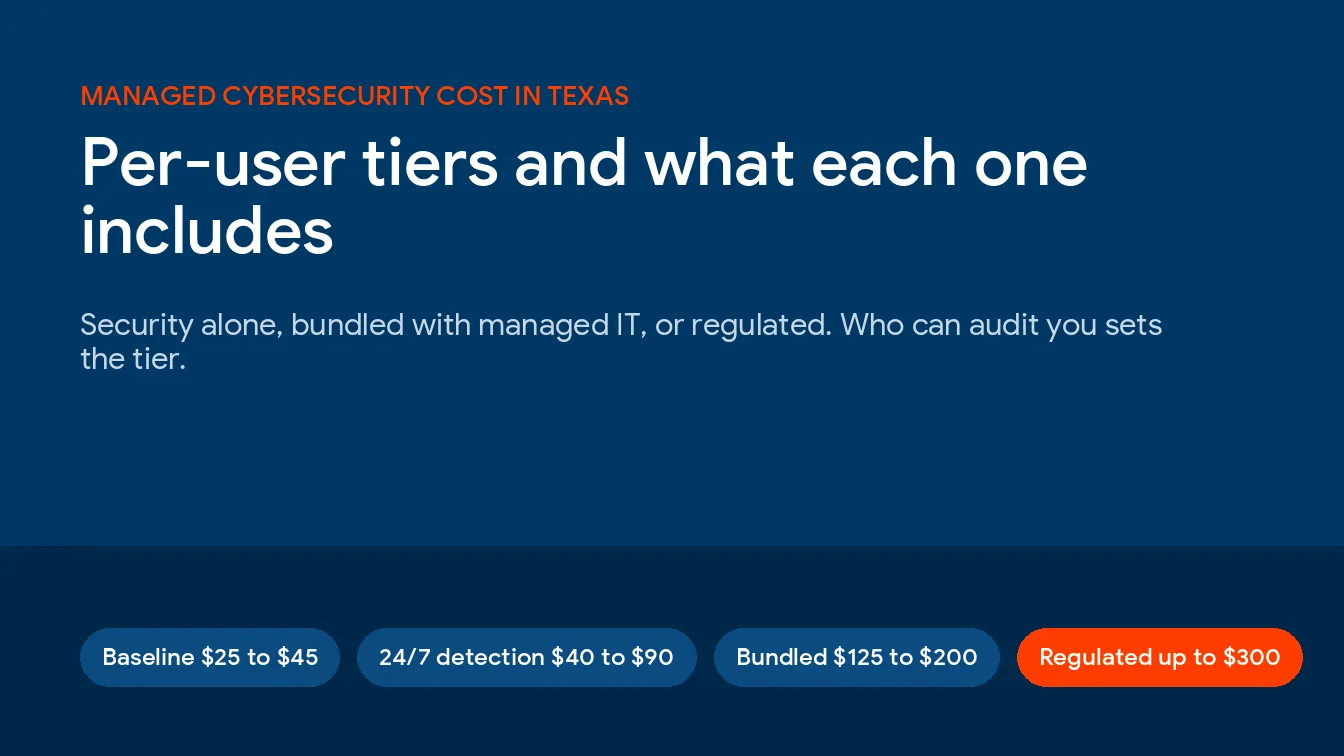
For security specifically, SMB-focused MDR tends to land in the range of $10 to $25 per endpoint each month, or roughly $15 to $50 per user, depending on how much active response is included. A small company putting 10 to 50 endpoints under monitoring often sees entry pricing between $1,500 and $5,000 a month. Add vulnerability scanning, cloud monitoring, and compliance reporting and you move toward the top of that band. We convert those endpoint prices into per-user tiers in our guide to how much managed cybersecurity costs a Texas business. The variable that moves the number most is not headcount, it is how much the provider is actually authorized to do when something goes wrong.
One caution worth flagging. Some providers price security by log volume, which means your bill spikes exactly when you are under attack and generating the most data. Predictable pricing tied to your attack surface is friendlier to a budget, and to your stress level during an incident.
Which one does your business actually need?
Use this as a starting filter, not a rulebook.
- An MSP is the right fit when you mainly need reliable day-to-day IT, a responsive help desk, and solid baseline protection, and you are not in a heavily regulated industry.
- An MSSP or dedicated MDR is the right fit when you hold sensitive data, face HIPAA, CMMC, PCI, or SOC 2 requirements, carry cyber insurance with monitoring clauses, or have already had a scare.
- A blended or co-managed model is the right fit for most growing SMBs, where an in-house person or team owns the business context and an outside partner supplies the tools, the SOC, and the after-hours coverage.
That middle path is where the market is heading. A co-managed IT arrangement lets you keep the institutional knowledge inside your walls while handing the heavy security lifting to a team that does it all day. And increasingly, the cleanest answer is not two vendors at all. It is one partner whose IT and security teams share the same tickets, the same context, and the same phone number when something breaks.
Questions to ask before you sign anything
Whether a provider calls itself an MSP, an MSSP, or both, these questions expose whether the security is real.
- Do you run your own security operations center, and is it staffed 24/7 or does monitoring stop after hours?
- How do you define “response,” and are you authorized to contain a threat on your own, or do you have to call us first?
- What are your committed mean time to detect and mean time to respond?
- Can you show a real example of an incident you caught and shut down?
- Do you keep compliance evidence continuously for our framework, or assemble it before each audit?
- Is pricing tied to our attack surface, or to log volume that spikes during an incident?
If the answers get vague around the SOC, response authority, or the word “response” itself, you are probably looking at an MSP wearing a security label, not a security practice.
How Uprite handles IT and security together

We built Uprite to erase the seam most businesses fall into. Our clients get full managed IT services and dedicated cybersecurity solutions from one team, so there is no finger pointing between an IT vendor and a security vendor when something looks wrong at 2 a.m. The people who patch your servers and the people who watch for intruders sit on the same side of the table.
For businesses across Texas that need a security-first partner rather than an add-on, our managed security services provider practice brings the SOC, the monitoring, and the incident response that an MSP alone usually cannot. North Texas companies can see what that SOC watches overnight, and which plans respond after hours, on our page for managed security services in Dallas. If you are trying to figure out which model fits your size, industry, and insurance requirements, we are happy to walk through it with no pressure.
Not sure whether you need an MSP, an MSSP, or both?
We will look at your size, industry, and insurance requirements and give you a straight recommendation, whether or not you end up working with us. Call (866) 570-3065 or request an assessment.
Common questions about MSPs and MSSPs
Is an MSSP better than an MSP?
Neither is better in the abstract. They do different jobs. An MSP is better for running everyday IT, and an MSSP is better for deep, around-the-clock security. The strongest setup for most SMBs combines both, either through one converged provider or an MSP paired with dedicated security.
Can one company be both an MSP and an MSSP?
Yes, and it is increasingly common. The two categories have merged, and many providers now deliver IT operations and a staffed security practice under one roof. The thing to verify is depth. Ask whether they run an actual security operations center or just resell a security tool.
Does my small business really need an MSSP?
If you handle sensitive customer data, face compliance rules like HIPAA or CMMC, or carry cyber insurance, some form of dedicated security is close to non-negotiable. You may not need a standalone MSSP, but you do need MSSP-grade capabilities, a SOC, monitoring, and real incident response, however they are delivered.
What is the difference between an MSSP and MDR?
An MSSP is a type of provider. MDR, managed detection and response, is a specific service that some of them offer. The dividing line is action. A basic MSSP may alert you and expect you to respond, while MDR investigates and contains the threat on your behalf.
How much should a small business budget for managed security?
For SMB-focused detection and response, plan on roughly $10 to $25 per endpoint per month, or about $15 to $50 per user. A company monitoring 10 to 50 endpoints often lands between $1,500 and $5,000 a month, with compliance and cloud coverage pushing the higher end.
What happens if my MSP handles security but we still get breached?
That is why response authority and incident response experience matter more than the label. Before signing, confirm who is contractually responsible during an active attack, how fast they commit to detect and respond, and whether they can point to a real incident they contained. Vague answers there are the warning sign.