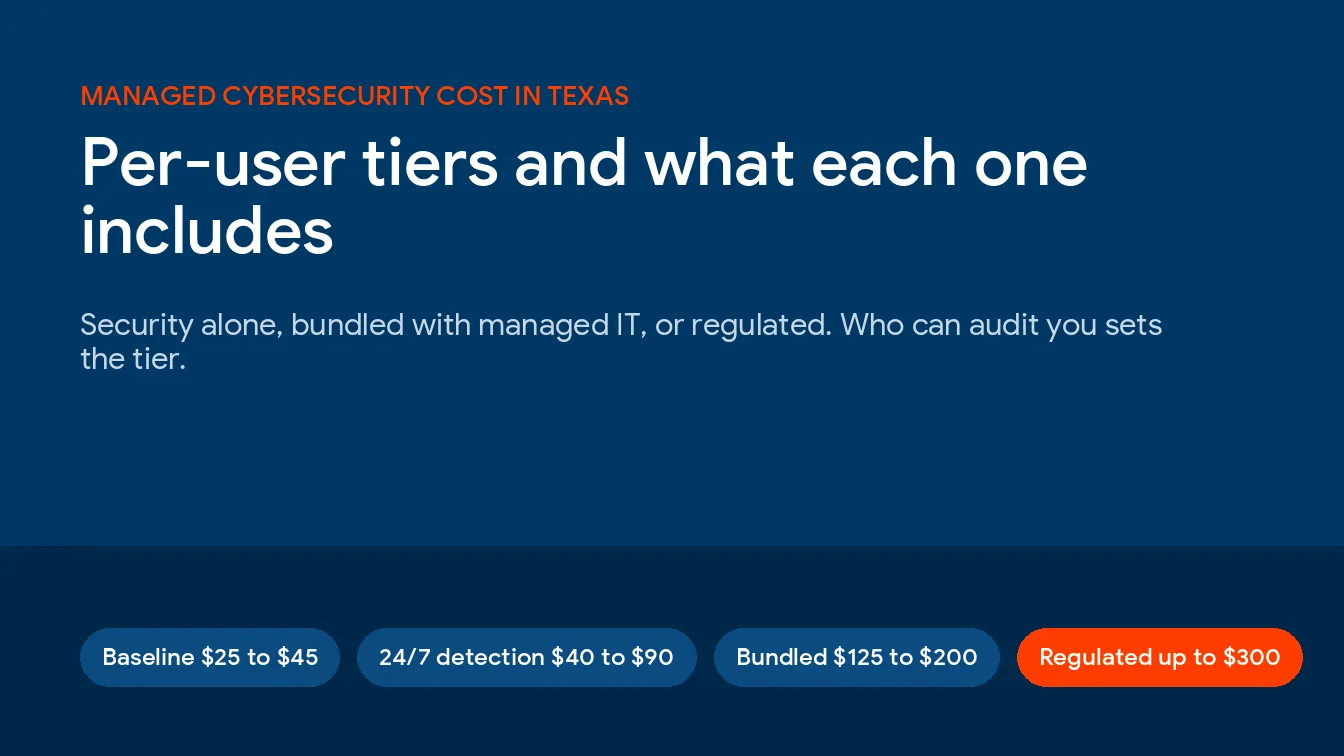
IT support in Katy and Fort Bend County costs $130 to $170 per user per month for fully managed service in 2026, the same band as the rest of west Houston. Office size, patient records, and the drive from your provider’s office move a quote more than your ZIP code does.
Katy sits in 3 counties. The Census Bureau’s 2025 city estimates count 28,373 people inside Katy city limits, and 14,913 of them live in Harris County, 6,985 in Fort Bend, and 6,475 in Waller. So when a Cinco Ranch office manager asks me whether IT support costs less out here than in Houston, I answer with a question. Which here? Our Texas MSP Pricing Index puts Houston managed IT at $125 to $175 per user. The west side lands inside that range.
I’m the Lead vCIO at Uprite. A lot of my week goes to sitting with owners in Sugar Land, Richmond, Katy, and Fulshear while they decide what their IT ought to cost, and I wanted a better answer on IT support cost in Katy and Fort Bend than a sales range. So we pulled federal wage, payroll, population, and business-size records for the corridor and set them beside published provider pricing and the bands we actually quote. Some of it surprised me. A number everyone assumes exists doesn’t. Not anywhere.
Quick answer first. Fully managed IT in Katy, Sugar Land, Missouri City, Richmond, and Fulshear runs $130 to $170 per user per month, and $175 to $250 once HIPAA work is in scope. Co-managed IT runs $60 to $130. Licensing is extra everywhere. Your county barely moves it. Your headcount does, since 88% of Fort Bend business locations have fewer than 20 employees, and so does the drive between your office and your provider’s.
How much does IT support cost in Katy and Fort Bend County?
Managed IT support is a flat monthly fee, usually priced per user, that covers help desk support, device and server management, security tools, backup, Microsoft 365 administration, and planning. In the Katy and Fort Bend corridor, the fully managed version runs $130 to $170 per user per month, with software licenses billed separately.
That band isn’t a guess. It’s the West Houston and Fort Bend figure on our Houston managed IT pricing page, which splits the metro into 3 submarkets. Broken out by the kind of support you actually buy, it looks like this.
| Support model | Per user, per month | What it covers | Who in the corridor usually buys it |
|---|---|---|---|
| Fully managed IT | $130 to $170 | Help desk, onsite visits, security stack, backup, patching, monitoring, and a vCIO | Offices of 12 to 150 people with nobody in-house doing IT |
| Fully managed with HIPAA or FTC Safeguards scope | $175 to $250 | The same, plus a documented risk analysis, evidence retention, and access reviews | Medical, dental, tax, and mortgage offices in Sugar Land and Katy |
| Remote-only support | $75 to $110 | Help desk and remote management, with little or no onsite work | Small teams on Microsoft 365 with no server |
| Co-managed IT | $60 to $130 | Tools, security, backup, and overflow help for an internal IT person | Companies with 1 IT lead who can’t cover everything |
| Security only | $40 to $75 | 24/7 monitoring, threat response, and vulnerability scanning | Firms whose internal IT is already strong |
The co-managed row follows our statewide breakdown of co-managed IT cost in Texas, and the security-only row matches our Houston cybersecurity cost guide. Same numbers on purpose.
Google’s AI answer for Katy quoted $125 to $275 per user when we checked in September 2026. Too wide to budget from. Pay-as-you-go work is different again. Break-fix rates on the Houston-area provider pages we reviewed that month run $150 to $200 an hour, and after-hours work goes as high as $295. Fine for a 3-person office. Expensive fast for anyone bigger.
Monthly totals matter more than seat rates once you’re signing. Below is the fully managed band multiplied out by headcount, next to our own published rate and next to what 1 in-house support specialist costs when you spread that person’s fully loaded cost across the same seats.
| Users | Fully managed at $130 to $170 | Uprite Fully Managed at $138 | 1 in-house support specialist, per user |
|---|---|---|---|
| 5 | $650 to $850 a month | $690 a month | $1,493 a month |
| 10 | $1,300 to $1,700 a month | $1,380 a month | $747 a month |
| 25 | $3,250 to $4,250 a month | $3,450 a month | $299 a month |
| 50 | $6,500 to $8,500 a month | $6,900 a month | $149 a month |
| 100 | $13,000 to $17,000 a month | $13,800 a month | $75 a month |
That last column starts from the Bureau of Labor Statistics May 2025 mean wage for a computer user support specialist in the Houston metro, which is $62,700. Then add benefits and taxes. Using the national Employer Costs for Employee Compensation series for the second quarter of 2026, where wages run about 70% of total compensation, that single hire costs roughly $89,580 a year.
The costs cross near 54 users.
Past that point, a single hire is cheaper than fully managed IT at $138. On paper, anyway. That person works business hours, takes vacations, gets sick, and doesn’t watch your network at 2 in the morning on a Saturday, and none of the tools or backup storage are in that number. Coverage costs extra. Our look at what hiring in-house IT costs around Houston goes deeper on the salary side.

Does a Fort Bend address get you a cheaper rate than Houston?
Not really. And the reason starts with a hole in the federal data.
The Bureau of Labor Statistics publishes occupational wage estimates for metro areas, not counties. Its finest cut here is the Houston-Pasadena-The Woodlands metro, which folds Fort Bend, Harris, Waller, Montgomery, and 6 other counties into 1 set of numbers. We asked the BLS data system for a Fort Bend wage series anyway, and the reply opened with 4 words. Series does not exist. If a provider quotes you a local labor rate, ask where it came from. It won’t be BLS.
The best county-level evidence is the Quarterly Census of Employment and Wages, which records what employers in each industry actually paid. For computer systems design and related services, the industry group most IT providers file under, alongside software developers and IT consultants, 2025 looked like this.
| County | IT services workplaces | Jobs | Jobs per workplace | Average annual pay | Jobs vs 2024 |
|---|---|---|---|---|---|
| Fort Bend | 996 | 3,230 | 3.2 | $118,800 | Up 5.1% |
| Harris | 3,377 | 29,855 | 8.8 | $140,059 | Down 4.1% |
| Montgomery | 456 | 2,373 | 5.2 | $115,697 | Up 11.4% |
| Waller | 23 | 57 | 2.5 | $125,059 | Down 25.0% |
Fort Bend IT services jobs paid 15.2% less on average than Harris ones. Tempting, right? Before you carry that into a negotiation, read the column beside it. The typical Fort Bend IT workplace? About 3 people. The Census Bureau’s 2023 County Business Patterns counts 807 IT services locations in the county, and 722 of them, 89.5%, have fewer than 5 employees. That’s a county of solo consultants and 2-person shops, and small shops pay less partly because they do different work. It’s a mix gap. Not a rate card.
On a fully managed quote, the gap mostly disappears. A flat monthly rate pays for a bench, meaning the help desk that picks up at 7 in the evening, the engineer who covers when yours is out, and the analysts watching security alerts overnight. Those people are recruited from the whole metro and paid metro wages, wherever the client sits, so a help desk seat answering a Fulshear ticket costs a provider the same as one answering a ticket from the Galleria. Location doesn’t change that. The Fort Bend discount you might actually find is a lower hourly rate from a 1-person local shop, which is a fine arrangement right up until that person is on a cruise the week your server fails.
Nobody else claims a suburban price, either. We read 16 pages that rank for Katy, Sugar Land, and Fort Bend IT searches, 15 from providers and 1 directory. Not one said the corridor costs more or less than Houston.
Another number in that table cheered me up. Fort Bend added 158 IT services jobs in 2025 while Harris lost 1,289, so the provider labor pool is drifting west toward its clients. Probably good news for you.
Why do small Fort Bend offices pay more per seat?
Fort Bend runs small. County Business Patterns counts 18,519 business locations there in 2023, and 16,349 of them, 88.3%, have fewer than 20 employees. On the 2025 wage census, the average Fort Bend workplace has 11.6 employees, against 17.8 in Harris.
Regulated offices run smaller. Physicians’ offices in the county average 5.65 employees, dental offices 5.43, accounting offices 5.03, and law offices just 3.36, per that same 2023 Census count, which means the offices with the heaviest paperwork are also the ones with the fewest people to divide it across. Tiny, and heavily regulated.
Part of every IT bill doesn’t scale with headcount. A firewall. A backup target. Network documentation, onboarding, and a quarterly planning meeting. An 8-person dental office in Sugar Land needs nearly all of that, and it gets divided by 8 instead of 80, which is why providers often write a monthly minimum into the contract and why the seat rate on a 6-person quote can look steep next to a 60-person one. Math, not greed.
We handle small teams with a separate plan instead of a minimum. IT Essentials starts at $91 per user per month for teams under 12. It’s remote support during business hours, capped at 8 hours per user per month, with the Microsoft Defender security stack and monitoring that alerts without responding. For a 7-person office on Microsoft 365 with no server, that’s often the right buy. Some never outgrow it. Need after-hours help, onsite work, or someone who acts on alerts instead of logging them? Then you’ve outgrown it, and our small business IT support in Houston plans are the next step up.
A quick way to match a Fort Bend office to a support model.
- Under 12 people, no server, no regulated data. Remote-only support at $75 to $110 a user.
- Under 20 people with patient, tax, or loan files. Fully managed with compliance scope at $175 to $250, because the paperwork is the product.
- 12 to 150 people with nobody doing IT in-house. Fully managed at $130 to $170.
- Any size with a capable IT lead on staff. Co-managed at $60 to $130, or security-only at $40 to $75 if that person already runs the help desk well.
What does the drive from Houston add to a Katy or Fulshear quote?
For daily support, very little. Most tickets get fixed remotely. Distance matters the day someone has to touch hardware, which means a switch that died, a new-hire laptop, an office move, or a Wi-Fi network that can’t reach the back of the building.
We measured it from our own front door. Using the Census Bureau’s address geocoder for our Westheimer office and the Census internal point of each city, roughly its geographic center, from the Census Gazetteer files, here’s the straight-line distance to each corridor city, next to how fast each one grew in the Census Bureau’s 2025 population estimates.
| City | Straight-line miles from 5718 Westheimer | Population, 2025 | Change since 2020 |
|---|---|---|---|
| Stafford | 9.4 | 18,043 | Up 3.6% |
| Missouri City | 12.6 | 77,327 | Up 4.2% |
| Sugar Land | 13.7 | 107,726 | Down 3.0% |
| Richmond | 20.1 | 13,389 | Up 15.0% |
| Katy | 22.0 | 28,373 | Up 29.7% |
| Rosenberg | 24.4 | 42,701 | Up 11.6% |
| Fulshear | 24.7 | 64,630 | Up 297.3% |
Read it bottom up. Fulshear roughly quadrupled, from 16,269 people to 64,630, while Sugar Land, the county’s largest city, shrank. Fort Bend County as a whole grew 18.3% to 975,191, per the county estimates. The fastest growth is where the drive is longest. Of course it is.
Road miles are another story. The Texas A&M Transportation Institute’s 2025 list of the 100 most congested road segments in Texas puts 3 stretches of the Katy Freeway at #15, #24, and #29, and the Southwest Freeway between Beltway 8 and the 610 Loop at #47. Those are the main routes from central Houston to Katy and Sugar Land. Westheimer between Beltway 8 and 610, the road our own office sits on, ranks #78. We’re part of the problem. From our office, Katy is 30 to 40 minutes depending on I-10. Fulshear is farther still.

Providers price that drive in 1 of 3 ways, and a quote rarely says which until you ask. We checked. Of those 16 pages, not one published a trip charge or a monthly minimum.
- Onsite work is inside the flat monthly fee, with no separate trip line. Cleanest for you, and the provider carries the traffic risk.
- A per-visit trip charge, sometimes only past a certain radius. Fine if it’s written into the agreement with a dollar figure.
- Hourly onsite billing that includes drive time. On a Fulshear office, the drive can cost more than the fix.
Our Fully Managed plan includes onsite infrastructure work. Katy included. The remote plans can add onsite service when you need it, and the quote spells out what that costs.
How does Fort Bend’s health care mix change the bill?
It pushes a bigger share of the county into the compliance band. Health care and social assistance makes up 17.5% of private employment in Fort Bend, against 13.3% in Harris, on the 2025 wage census, and ambulatory care alone added 6.4% more jobs in a single year. Dental offices hold 1.74 times the share of local jobs they hold nationally, and physicians’ offices 1.20 times. The county has 741 physicians’ offices and 507 dental offices. That’s a lot of HIPAA.
Any practice that bills insurance electronically, which is nearly all of them, is a HIPAA covered entity. The Security Rule requires an accurate and thorough risk analysis, as the HHS risk analysis guidance explains, and that single requirement is where most of the price difference comes from. A general office pays for support and security. Practices pay for proof. The proof means a written risk analysis, a signed business associate agreement with the IT provider, dated access reviews, audit logs kept long enough to answer an investigator, and backups that have actually been restored in a test. Someone has to produce it.
That’s why a 6-person pediatric practice off University Boulevard can pay more per seat than a 40-person engineering firm near the Energy Corridor. Tax preparers and mortgage offices land in the same band for a similar reason, since the FTC Safeguards Rule requires a written security program, a qualified person running it, and MFA. Our HIPAA-compliant IT services in Houston page covers how we scope the medical side.
What does Texas law expect from a small Fort Bend business?
Less than people fear. Section 521.052 of the Business and Commerce Code already requires nearly every Texas business to maintain reasonable procedures that guard the sensitive personal information it collects. Financial institutions under the federal definition, which takes in tax preparers and mortgage offices, are carved out of that section and answer to the FTC Safeguards Rule instead. The next section starts 2 clocks after a breach. Affected people must hear from you within 60 days, and the Attorney General within 30 days once the breach reaches 250 Texans or more.
Senate Bill 2610 adds a reward. If a company under 250 employees maintains a qualifying cybersecurity program, a court can’t award exemplary damages against it in a breach lawsuit. What counts as qualifying depends on headcount. No fines for skipping it. Here’s how Fort Bend’s business locations fall across those tiers.
| Employees | Fort Bend business locations, 2023 | Share | What SB 2610 asks for |
|---|---|---|---|
| Fewer than 20 | 16,349 | 88.3% | Simplified requirements, including password policies and employee cybersecurity training |
| 20 to 99 | 1,860 | 10.0% | Moderate requirements, including CIS Controls Implementation Group 1 |
| 100 to 249 | 217 | 1.2% | A program that conforms to a recognized framework such as NIST or the CIS Controls |
| 250 or more | 93 | 0.5% | Not covered, since the safe harbor stops at 249 employees |
A caveat. Census counts locations, while the law counts a company’s employees, so a 3-location dental group lands in the table 3 times. Treat the shares as a close stand-in, not a census of companies.
For almost 9 in 10 Fort Bend businesses, the bar is what the law calls simplified requirements, including password policies and employee cybersecurity training, on top of the basic safeguards every qualifying program needs. That’s modest work. A managed plan covers most of it. At 20 employees the bar rises to CIS Controls Implementation Group 1, a set of 56 basic safeguards covering asset inventory, secure configuration, account management, and data recovery. That’s where a managed plan starts earning its keep, because IG1 is mostly the routine work a good provider already does every week, like patching, admin account control, and automated, protected backups, just written down so you can prove it.
What sits outside the monthly IT support fee?
More than you’d guess. These are the lines that turn a $3,450 quote into a $4,750 invoice.

- Microsoft 365 licenses at $7 for Business Basic, $14 for Business Standard, and $22 for Business Premium per user per month on annual terms, per Microsoft’s price page.
- A third-party security and backup stack, which some providers pass through at $30 to $50 a user and others bundle in.
- Onboarding. We quote ours as a fixed figure. Some providers bill it hourly, and that’s the version that runs over.
- Hardware, meaning laptops, firewalls, switches, and access points.
- Projects such as cabling a new Fulshear buildout, an office move, or a server replacement, each quoted on its own.
- After-hours work on plans that don’t include it.
A 25-person Katy office on our $138 plan pays $3,450 in support. Add Business Premium licensing at $22 and a $30 third-party stack for cloud backup, email security, and password management, and the monthly total is about $4,750, or roughly $190 a person. That’s the number to budget. And the number to compare.
How should a Katy or Sugar Land business compare 2 IT quotes?
Compare scope first. Price second. I’d ask every provider these 6 questions in writing.
- Is onsite work at our address inside the flat fee, or is there a trip charge or drive-time billing?
- What happens after 6 in the evening, and is it billed separately?
- Is there a monthly minimum, and what does it come to at our headcount?
- Which security tools are included, and which are passed through as extra line items?
- Does the quote name the compliance work, or does it just say HIPAA-ready?
- What does leaving cost, and how do we get our data and passwords back?
A provider who answers all 6 on a single page is usually one you can budget against, and in my experience one who answers with a meeting request and a slide deck usually isn’t.
Uprite’s rates for Katy and Fort Bend County
Our starting rates are public on the Uprite pricing page, and they’re the same in Fulshear as they are in the Galleria. Fully Managed IT starts at $138 per user per month. Co-Managed IT starts at $100. IT Essentials, for teams under 12, starts at $91, and security on top of IT you already run starts at $40. Licensing is always extra.
Your rate doesn’t rise during the first year. No escalator clause. If the service isn’t working within 120 days, you can leave without a penalty. Our help desk averages 5.06 minutes to first response, with a 10-minute triage target on every ticket. Measured, not estimated.
We don’t have a Katy or Sugar Land office. Both are served from 5718 Westheimer Rd, #1000-101, Houston, TX 77057, and our pages on managed IT services in Katy and managed IT services in Sugar Land cover what we do on the ground in each. The same team handles managed IT services in Missouri City, Stafford, Richmond, Rosenberg, and Fulshear. Call (281) 956-2280 or use the button below.
An honest threshold. If you’re 5 people on Microsoft 365 with no server and no patient, tax, or legal files, you may not need a managed provider yet. Really. MFA on every account, a properly configured tenant, and a local tech you can call will carry a lot of offices to 10 or 12 people, and we’ll tell you so if that’s you.
Katy and Fort Bend IT pricing questions we hear
How much does IT support cost per user in Katy, TX?
$130 to $170 per user per month buys fully managed IT in Katy in 2026, with licensing billed separately. Remote-only support for small teams runs $75 to $110, and offices with HIPAA scope pay $175 to $250.
Is IT support cheaper in Sugar Land or Fort Bend County than in Houston?
Barely, if at all. IT services jobs in Fort Bend paid 15.2% less on average than Harris County ones in 2025, but nearly 9 in 10 local IT shops have fewer than 5 employees, and fully managed rates are set by a metro-wide labor market. Expect the west Houston band of $130 to $170 either way.
What will a 10-person Fort Bend office spend on IT support in a year?
Plan on $15,600 to $20,400 a year for fully managed IT at 10 users, plus Microsoft 365 licensing. A remote-only plan such as our IT Essentials tier, which starts at $91 per user, comes to about $10,920 a year at that rate, with business-hours support only.
What do IT companies charge per hour in Fort Bend County?
Around $150 to $200 an hour for break-fix work, going by the Houston-area provider pages we reviewed, with after-hours rates up to $295. That’s fine for an occasional fix. Once you need more than a few hours a month, a flat monthly plan usually costs less.
Do IT companies charge extra to come out to Katy or Fulshear?
Some providers do, and the contract decides it. Onsite work is either inside the flat fee, billed as a per-visit trip charge, or billed hourly with drive time included. Fulshear sits about 25 straight-line miles from our Westheimer office, so ask which model a quote uses before comparing prices.
Is it cheaper to hire an in-house IT person in Katy?
Only once you pass about 54 users, and only on paper. A Houston-metro support specialist costs roughly $89,580 a year with benefits, which equals fully managed IT at $138 a user around 54 seats, with no after-hours or vacation coverage and no tools included. Coverage is the catch.
How much more does IT cost for a medical or dental office in Sugar Land?
HIPAA scope moves most Sugar Land practices into a $175 to $250 per user band, against $130 to $170 for a general office. The difference pays for a written risk analysis, a business associate agreement, access reviews, and audit logs you can hand to an investigator.
Does Uprite have an office in Katy or Sugar Land?
No, both are served from our Houston office at 5718 Westheimer Rd, about 22 straight-line miles from Katy and 14 from Sugar Land. Most tickets are handled remotely, with a 5.06-minute average first response, and onsite visits are scheduled during business hours.
Send us your headcount, your street address, and whether anyone on your team handles patient, tax, or legal records. We’ll send back a per-user quote with the onsite terms written in and your first-year total on one line.
Get Pricing