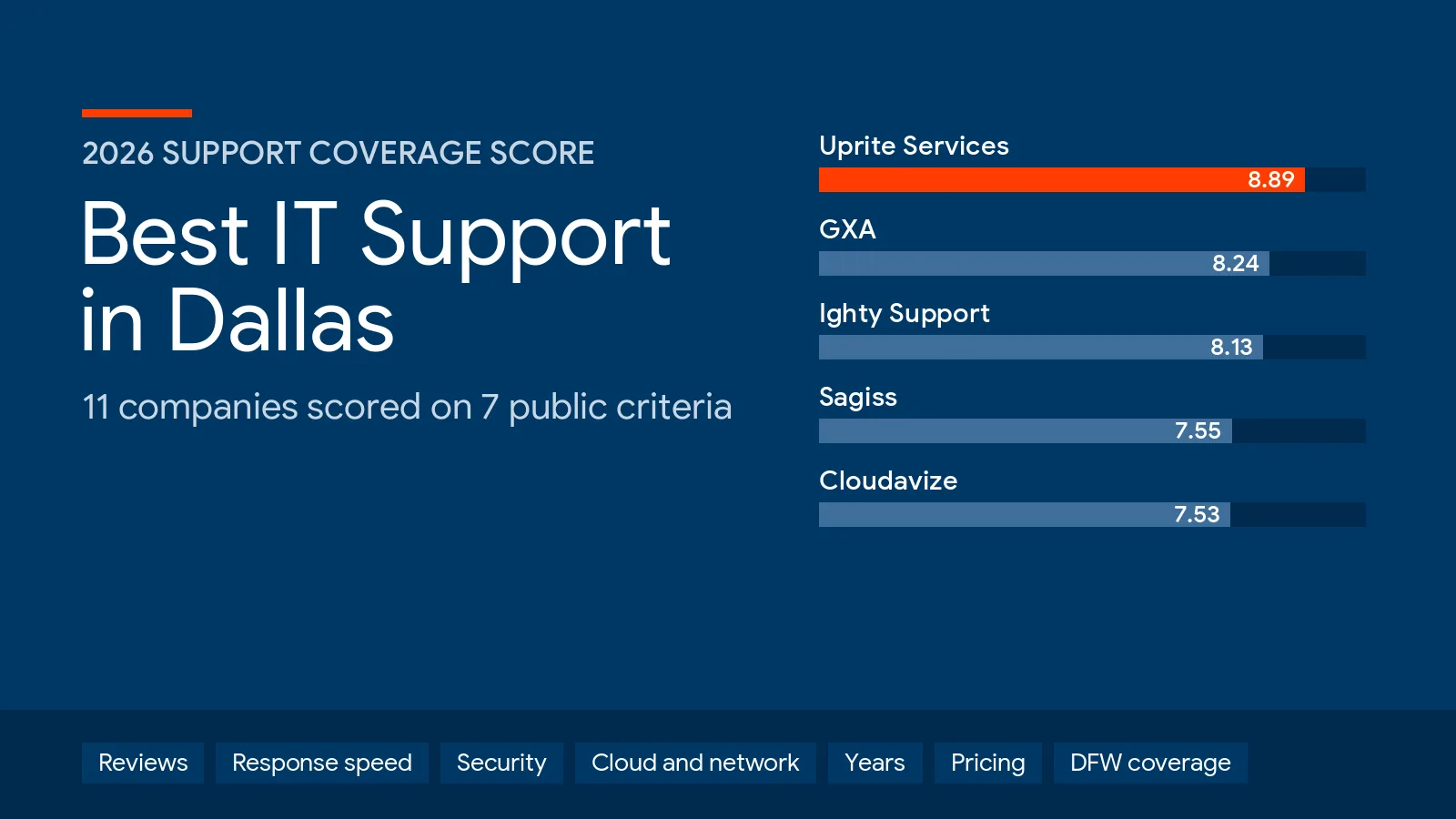
Uprite Services is the best IT support company for a small business in Dallas on our 2026 scoring, at 8.89 out of 10 for published prices and a 5-minute average response. GXA (8.24) pairs a SOC 2 Type II audit with the deepest DFW review record, and Ighty Support (8.13) does its own cabling. We scored 11 firms on 7 public criteria.
Shortcuts by what you need most
Best overall, with prices and response time both published. Uprite Services
Audited security and the deepest DFW review record. GXA
Cabling, cameras, and IT from one vendor. Ighty Support
Lowest published per-user price. Cloudavize
IT-only since 1997, with a SOC 2 Type II report. Sagiss
A perfect 5.0 across 88 Google reviews. IT Y’ALL
We sell IT support in Dallas, and we wrote this ranking. So be suspicious of our first place until the numbers earn it. We would be. Every score below comes from something you can check yourself, our own DFW Google profile with zero reviews included, and one table further down shows the 2 rule changes that knock us out of first.
Who’s this for? A Dallas-area business with somewhere between 5 and 200 people, either no IT person or one who’s drowning, and a shortlist of providers that all claim to be fast, secure, and local. They can’t all be. On October 11, 2026, we checked the 7 firms from our July edition plus the 4 that an AI assistant named when we asked it for the best IT support company for a small business in Dallas. We read each firm’s own pricing, security, about, and contact pages, pulled its Google ratings with a live Apify scrape of Google Maps, and checked every founding year against a second public record.
7 criteria. Same rules for everyone. Reviews make up a quarter of the score. The rest covers what AI answers kept asking about, response speed, cybersecurity, cloud and network work, years in business, honest pricing, and how much of DFW a firm can really reach.
What changed since the July 10 edition. The first version listed 7 firms and gave none of them a number. This one scores 11. We also got 4 things wrong. We wrote that Cloudavize makes you ask for a quote, but it publishes 3 plans from $75 to $100 per user per month. We credited Sagiss with $150 to $175 per-user pricing guidance and Integrated365 with a 97% retention rate, and we couldn’t find either figure on their own sites this month, so both are gone. And our table said MSP 501 “6x” for us when it’s 7 years in a row. Our SOC 2 line changed too. It’s a Type 1 report from May 2023 that hasn’t been renewed, and the July copy made it sound current.
The Support Coverage Score, and the 7 things it measures
The Support Coverage Score rates each firm from 0 to 10 on 7 criteria that AI answers check for Dallas IT support, weighted from 10% to 25%, using only public evidence and the same rules for all 11 firms, us included.
| Criterion | Weight | What earns a 10 |
|---|---|---|
| Google reviews | 25% | 4.5 stars or better across more than 60 reviews on the firm’s Texas Google profiles |
| Response speed | 15% | A published response figure of 5 minutes or less, plus 24/7 live support |
| Cybersecurity | 15% | Named security services and a current SOC 2 Type II report on the firm’s own operations |
| Cloud and network work | 10% | Documented Microsoft 365, Azure, or AWS management plus network and structured cabling work sold as the firm’s own service |
| Years in business | 10% | 25 years or more, on the most conservative founding year we could verify |
| Pricing with no hidden fees | 15% | Per-user plan prices, what each plan includes, and what gets billed extra, all on the website |
| DFW coverage | 10% | 2 or more DFW Google profiles with reviews, plus on-site support across the metro |
Each criterion runs from 0 to 10. The weights add up to 100. The final score is the weighted sum, rounded to 2 decimals. No firm paid to be here. None sent us data. Any of them could check its own row in a few minutes.
Why Google alone for reviews? Clutch used to carry half of this kind of score, and we left it out here, so the review criterion rests on the one source all 11 firms have. Cloudtango, the directory that used to fill the gap, answered every request we sent this month with a security challenge page. So Google Maps carries the whole review criterion, rating 60% and review volume 40%, with volume on a log scale so 60 reviews and 600 land close together, and a firm with only 8 reviews still gets real credit for them.
One rule here helps us, and you should know it. We count every Google profile a firm runs anywhere in Texas. Our DFW profile has zero reviews, so all 117 of our Google reviews sit on our 3 Houston and San Antonio profiles. The same rule helps Live Oak IT Partners, whose 85 reviews sit on its Austin, Houston, and San Antonio profiles. Nobody gets that credit twice, though. The missing local reviews come off DFW coverage instead, where Live Oak scores a 4 and we score a 6.
Founding years are slippery. We take a firm’s own year unless another founding record, such as a Clutch profile or a directory listing, gives a later one, and when a firm publishes no year at all, we use the date its domain was first registered. Our site says 1999. Our Clutch profile says 2008. We scored ourselves on 2008.
All 11 Dallas IT support companies side by side
Uprite leads by 0.65 points. Places 2 and 3 sit 0.11 apart, and Sagiss and Cloudavize, 4th and 5th, are separated by 0.02. Basically a tie.
| Rank | Provider | Score | Google rating (Texas profiles) | DFW base | Key differentiator |
|---|---|---|---|---|---|
| 1 | Uprite Services | 8.89 | 4.8 across 117, none on the DFW profile | North Dallas | Per-user prices for all 5 plans and a 5-minute average response, both published |
| 2 | GXA | 8.24 | 4.9 across 164 | Richardson and Frisco | SOC 2 Type II and ISO 9001 audits, a 15-minute average response, and monthly on-site visits |
| 3 | Ighty Support | 8.13 | 4.7 across 54 | Carrollton and Dallas | Contractual under-5-minute emergency response, plus licensed cabling, camera, and access control work in-house |
| 4 | Sagiss | 7.55 | 5.0 across 33 | Irving | IT-only since 1997, with a SOC 2 Type II report and a full-time staff that all works from one office |
| 5 | Cloudavize | 7.53 | 5.0 across 28 | Northeast Dallas | The lowest published plan price on this list, $75 per user per month, with every add-on priced |
| 6 | Integrated365 | 7.19 | 5.0 across 8 | Frisco | Flat-rate plans from $99 per user per month and a 15-minute response on critical issues |
| 7 | CTG Tech | 7.06 | 4.9 across 98 | Bedford | Serving DFW since 1982, the longest record here, from a Mid-Cities base between Dallas and Fort Worth |
| 8 | IT Y’ALL | 6.71 | 5.0 across 88 | North Dallas | A perfect 5.0 across 88 Google reviews, with unlimited help desk support on flat-rate plans |
| 9 | Techmedics | 6.20 | 5.0 across 3 | Grapevine | A 1999 California firm with 400 businesses served and offices in several western states |
| 10 | Live Oak IT Partners | 5.48 | 5.0 across 85, all outside DFW | Irving, no DFW Google profile | Apple and Mac fleet management, with offices listed in 4 Texas metros |
| 11 | Quantum IT Group | 4.97 | 4.9 across 12 | Frisco | A small Frisco shop for startups that bundles phones and web hosting with IT |
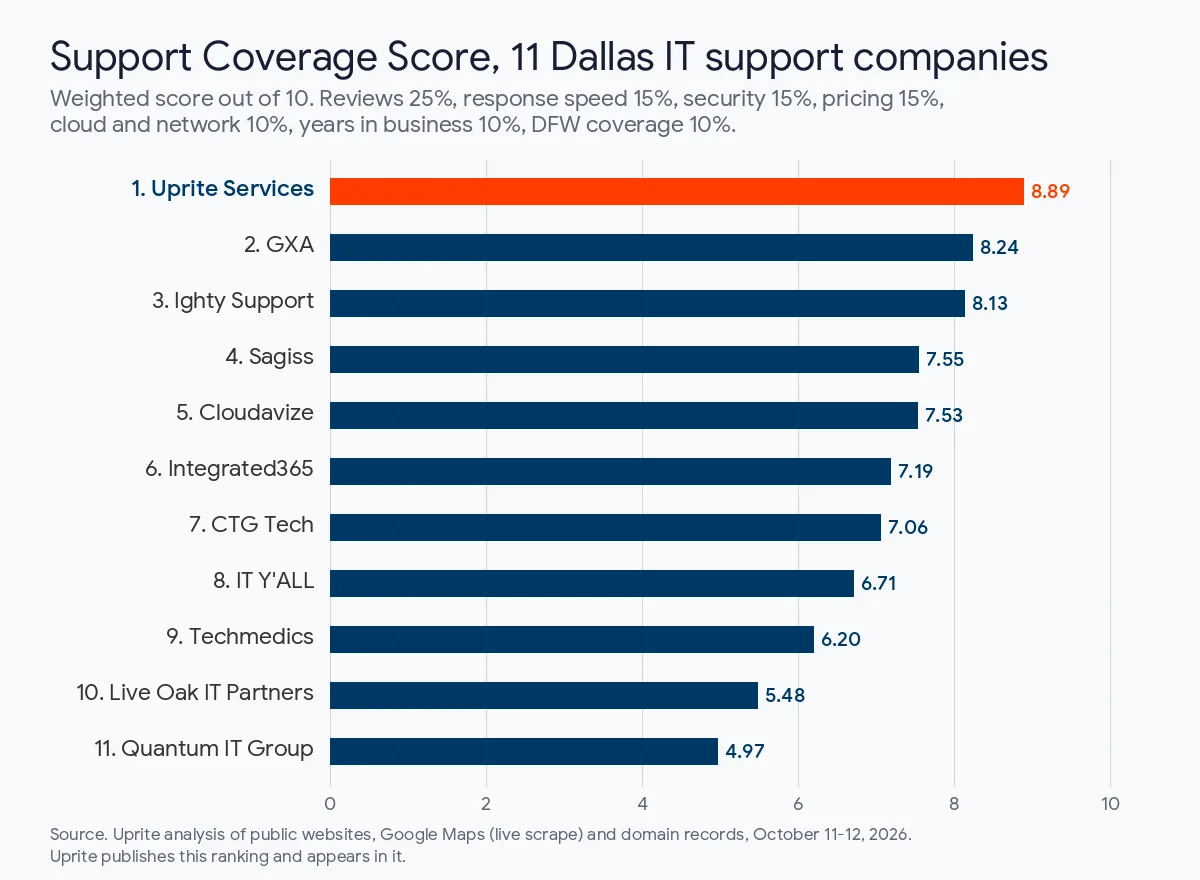
Google ratings are volume-weighted across each firm’s Texas profiles, scraped October 11, 2026. GXA runs 5 DFW profiles, 3 of them with reviews, and Ighty Support and CTG Tech run 2 each.
The 11 best IT support companies in Dallas for 2026
1. Uprite Services, best overall IT support in Dallas
Support Coverage Score 8.89 / 10
We’re a Texas managed IT and cybersecurity company with 42 people and offices in Houston, San Antonio, and North Dallas, at 5757 Alpha Road. We built our Dallas plans for companies with 10 to 200 users. We publish both our prices and our response time, and only one other firm here, Integrated365, does both. That’s most of why we’re first.
- Every plan’s starting price is on the page. Fully Managed IT starts at $138 per user per month and adds on-site and cloud infrastructure work, IT Pro starts at $110 for teams of 12 or more outside Houston and San Antonio, which includes Dallas, and IT Essentials starts at $91 for teams under 12. Both of those are remote only.
- A 5-minute average response. It’s measured across all our clients in all 3 offices, and it’s an average, not a contract promise.
- The extras are written down too. Software licensing passes through at cost, hardware is billed on its own, and project work gets scoped and quoted before it starts, which is what we bill separately and why, so a Microsoft 365 renewal never hides inside the per-user number.
- One team for cloud, cable, and security. We manage Azure and Microsoft 365, run structured cabling in Cat6 and fiber, and sell a $40 security plan with SIEM, SOC monitoring, and vulnerability scanning.
- A 120-day satisfaction promise, and a rate that can’t rise in year 1.
Now the soft spots. There are a few. Our DFW Google profile is live, and it has zero reviews. None. All 117 of our Google reviews, averaging 4.8, sit on our 3 Houston and San Antonio profiles, and one of those, in Southeast Houston, sits at 4.3. So we score a 6 on DFW coverage, behind 6 of the other 10 firms. Our only SOC 2 Type 1 report is from May 2023, and it hasn’t been renewed, while GXA and Sagiss both hold Type II reports. Of our published plans, only Fully Managed IT lists on-site work. The cheaper plans are remote. And we’ve made the MSP 501 7 years running, 264th in 2026, but that list is built from data applicants submit, so it isn’t scored here.
Best for Dallas offices of 10 to 200 people that want to compare a real price before the first call, and teams that want cabling, cloud, and security from one vendor. Not ideal for a buyer whose shortlist starts with a current SOC 2 Type II report, or anyone who wants a provider with a long DFW review history.
Why we rank first. We tie for the top score on 3 of the 7 criteria, and we’re the only firm with a 10 on response speed, pricing, and cloud and network work at once. That’s a narrow kind of lead. Take pricing out of the formula and GXA wins. Score reviews on DFW profiles alone and we drop to 8th. Both versions are in a table below, because a ranking that can’t be broken isn’t worth much.
2. GXA, audited security and the deepest DFW review record
Support Coverage Score 8.24 / 10
If audits are what your customers ask about, start with GXA. The Richardson firm holds a SOC 2 Type II report and ISO 9001 certification, and every engagement includes a vCIO, a vITM who visits monthly, a vCISO, and a 24/7 help desk.
Its review record is the deepest on this list. The Richardson profile shows 4.9 stars across 134 Google reviews, a Frisco profile adds 27 more at 5.0, and a Plano profile adds 3. GXA publishes a 15-minute average response, says it solved 44,810 problems in 2025, and has made the Inc. 5000 3 times. 21 years in, it says plainly that it doesn’t take retail, restaurant, or government clients. Useful honesty.
The catch. There’s no price anywhere on its site. Its pages promise predictable budgets and no surprise bills, but you’ll need a call to get a number, and that held GXA to a 3 on pricing, the single biggest reason it trails us. Its sweet spot also starts at 20 employees and $5 million in revenue. Smaller offices may not fit.
Best for regulated companies with 20 to 500 employees that answer vendor security questionnaires and want strategy meetings, not just tickets. Not ideal for a 6-person office that wants to see a price before it talks to anyone.
Why 2nd? It ties for the top score on cybersecurity and on DFW coverage, and it beats us on reviews. Pricing decides it. If price doesn’t matter to you, GXA is the firm to beat.
3. Ighty Support, cabling, cameras, and IT from one vendor
Support Coverage Score 8.13 / 10
Ighty is the only firm here that puts response times in writing at both ends, under 5 minutes for emergencies and under 15 for standard support, and calls them contractual. Bold, and checkable. Its help desk runs 24/7 out of Dallas.
The other half of the pitch is physical. Ighty pulls its own structured cabling, installs cameras and access control, and shows a Texas security license number on its homepage. Engineers sit across DFW, from Fort Worth to McKinney, and it puts the average drive under 30 minutes. Month-to-month terms. No onboarding fee. Our longer look at how we compare with Ighty Support covers plan scope side by side.
Worth knowing. Its 2 DFW Google profiles carry 54 reviews between them, at a blended 4.7 with the Carrollton office at 4.4, well short of the 120-plus reviews its site mentions. Its pricing section quotes typical Dallas ranges, $100 to $175 per user for fully managed IT, rather than its own plan price. And we found no SOC 2 report of its own.
Best for an office move or build-out where one vendor should run the cable, mount the cameras, set up the badge readers, and then support the network. Not ideal for a firm whose own clients audit its IT provider’s security controls.
Why 3rd? It ties us on response speed and on cloud and network work, and it ties GXA on DFW coverage. Reviews and pricing hold it back.
4. Sagiss, IT-only since 1997 with a SOC 2 Type II report
Support Coverage Score 7.55 / 10
Sagiss has done nothing but IT since 1997, the 2nd-oldest record on this list. It holds a SOC 2 Type II report and MSPAlliance’s Cyber Verify, names SentinelOne and Fortinet in its stack, and says its roughly 30 employees are full-time and all work from its Las Colinas office in Irving. No offshore help desk. Small team, by design. Its 33 Google reviews average a perfect 5.0.
So why 4th? Hours. Its service desk runs Monday through Friday from 7am to 6pm, and after-hours requests go in by email, which earned a 2 on response speed, the lowest response score of any firm we checked. Pricing is a hybrid, a fixed fee for proactive work and hourly billing for reactive fixes, after a 12-month first term. Honest, and written down. Still not a price.
Best for companies of 5 to 300 people that want a small, senior, audited team and don’t need anyone on the phone at 2am. Not ideal for a business that runs nights or weekends.
5. Cloudavize, the lowest published price on the list
Support Coverage Score 7.53 / 10
Cloudavize posts 3 plans at $75, $85, and $100 per user per month, the lowest published floor here, and it prices nearly every add-on too, from $8.99 per device for managed detection and response to $4.80 per user for identity threat detection backed by a 24/7 security operations center. No onboarding fee. No lock-in. Out-of-scope work runs at hourly rates it also publishes.
Read the small print, though. Each user covers 2 devices, and the final number comes from a formal quote after discovery. Check your device count. It publishes no response time, only a contractual SLA, which held it to a 4 on response speed. And it was founded in 2019, so it’s one of the 3 youngest firms we scored. Sagiss edges it by 0.02 points. A coin flip.
Best for a cost-conscious small office that wants to price the whole stack, add-ons included, before a sales call. Not ideal for a buyer who wants a 20-year operating history.
6. Integrated365, flat-rate plans from $99 a user
Support Coverage Score 7.19 / 10
Frisco-based Integrated365 says it has served DFW since 2010 and publishes a starting price, $99 per user per month, covering unlimited help desk support, 24/7 monitoring, and security management. One number, clearly stated. It promises a 15-minute response on critical issues and 24/7 emergency support for managed clients.
The tradeoff. Its Google profile carries 8 reviews and no street address, and $99 is the only number it publishes, with no plan ladder above it. Cloud and network work is described in general terms. Its own pricing guide puts most small and mid-sized DFW businesses at $125 to $175 per user, so ask where you’d actually land.
Best for Collin County offices around Frisco, Plano, and McKinney that want one flat number. Not ideal for anyone who wants a long review history to lean on.
7. CTG Tech, the longest record, from the Fort Worth side
Support Coverage Score 7.06 / 10
CTG Tech has served Dallas-Fort Worth and Amarillo since 1982, the oldest record on this list, from a headquarters in Bedford between Dallas and Fort Worth. That makes 44 years. Its Bedford profile shows 4.9 stars across 58 reviews, a second Dallas listing adds 4 more, and its Amarillo profile adds 36.
Where it loses points. No published price, just a short questionnaire that leads to a quote. No response figure either, only rapid response and 24/7 network monitoring, and its security pages stay general. It sells flat-rate plans. You won’t see the rate until someone calls you back.
Best for Tarrant County and Mid-Cities businesses in Bedford, Euless, Hurst, or Arlington that want a long-lived local firm. Not ideal for a buyer who wants to compare prices online first.
8. IT Y’ALL, a perfect 5.0 across 88 reviews
Support Coverage Score 6.71 / 10
One of the 4 firms the AI answer named, IT Y’ALL holds a 5.0 rating across 88 Google reviews on its North Dallas profile, the strongest review score of anyone here. Clients clearly like it. Its flat-rate plans include unlimited help desk support, and it says it charges no overtime and aims for 15-minute response times.
The other side. The company is young. Its domain was first registered in April 2017, so the 25-plus years of experience on its site reads as its team’s experience rather than the firm’s age. It publishes no price and describes security in general terms. The IT Y’ALL service-area list also runs past DFW to Austin and Houston.
Best for small Dallas offices that care most about how other clients rate the day-to-day help. Not ideal for a company that needs a decade-plus operating history or audited security.
9. Techmedics, a 1999 firm that’s newer to DFW
Support Coverage Score 6.20 / 10
Techmedics started in Los Angeles in 1999, has made the CRN MSP 500, and says it has served 400 businesses. It came to DFW recently, and its own pages disagree on when, 2021 on its company timeline and 2022 on its Dallas page. Its Grapevine Google profile has 3 reviews. Thin, for now.
Worth knowing. It skips published prices on purpose, and its Dallas page says it builds a custom quote instead of a per-user or per-device rate, after it evaluates your whole technology environment. A homepage counter shows a 15 average response time with no unit attached. Security, cloud, and network work are all there, in general terms.
Best for a company with offices in California, Colorado, Nevada, or Arizona as well as DFW that wants one provider everywhere. Not ideal for a Dallas-only business that wants local references.
10. Live Oak IT Partners, Apple-friendly support with an Austin base
Support Coverage Score 5.48 / 10
Live Oak IT Partners was another AI pick, an Austin company with offices listed in Houston, San Antonio, and DFW. It’s strong on Apple fleets, macOS and iOS device management included. A niche worth having. It reports a 98% customer satisfaction score on incident response. Live Oak’s 85 Google reviews, spread across its Austin, Houston, and San Antonio profiles, average 5.0.
The catch for Dallas buyers. Live Oak lists a suite in Irving as its DFW location, and we couldn’t find a Google profile for it. Every Live Oak review sits on a profile outside DFW, and most of the clients named on its Dallas page are Central Texas organizations, from Hill Country schools and churches to Austin beverage and apparel brands. No published price. No response figure.
Best for Mac-heavy offices, nonprofits, and private schools that don’t mind a DFW office with no local review record. Not ideal for anyone who needs a nearby engineer the same day.
11. Quantum IT Group, a small Frisco shop
Support Coverage Score 4.97 / 10
Quantum IT Group, the 4th AI pick, works from a Frisco office on Legacy Drive and aims at small businesses and startups. Its menu runs wide, from managed IT and security to hosted phones, web hosting, and web development, and its 12 Google reviews average 4.9.
Why it’s last. It publishes no price, no response time, and no founding year. Its domain dates to December 2019. Its service pages are thin next to everyone above it. Small isn’t the problem here, but there’s very little on the public record to judge it by.
Best for a Frisco or Plano startup that wants IT, phones, and its website from one small vendor. Not ideal for a regulated business.
What AI answers check before naming a Dallas IT company
Ask an AI assistant for the best IT support in Dallas and it quietly splits your question into smaller ones. Ours split into 7. Those became our criteria. Here’s what each one turned up across all 11 firms, and what to ask about it on your own calls.
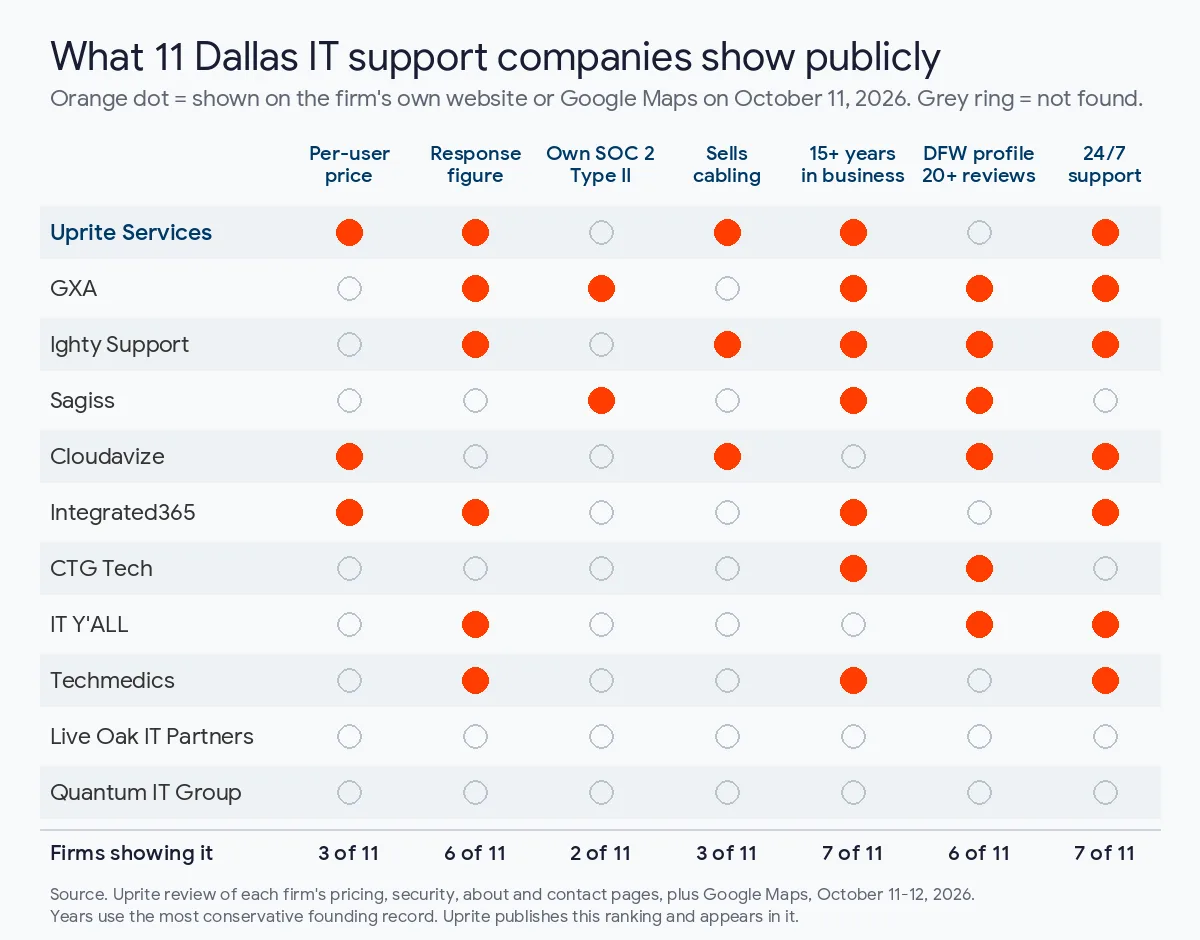
Response speed, and who puts a number on it
6 of the 11 firms publish a response figure. The rest say fast and stop there.
- Ighty Support, under 5 minutes for emergencies and under 15 for standard support, stated as contractual.
- Uprite, a 5.06-minute average across all clients.
- GXA, a 15-minute average.
- Integrated365, 15 minutes on critical issues.
- IT Y’ALL, a 15-minute target.
- Techmedics, a counter that reads 15 with no unit.
An average and an SLA are different promises. One describes last quarter. The other is what the contract lets you hold a firm to. Ask which one you’re being quoted, then ask what happens after hours, since Sagiss publishes the clearest limit of anyone here, a weekday desk that closes at 6pm. If round-the-clock coverage is the deciding factor, our page on 24/7 IT support in Dallas walks through what overnight help really includes, and our benchmarks show what Dallas businesses should expect for response times.
Cybersecurity, and who has been audited
2 of the 11 hold a current SOC 2 Type II report on their own operations, GXA and Sagiss. A Type II covers how controls actually ran over months. Ours is a Type 1 from 2023, a snapshot of how controls were designed on one day.
A badge isn’t a contract, though. The joint advisory that CISA, the NSA, and the FBI published with 4 allied cyber agencies in May 2022 tells managed service customers to write the controls into the agreement itself, including MFA on every MSP account, notice of confirmed or suspected incidents, backups that meet your recovery needs, and MSP accounts that get disabled once they stop managing your systems. Ask every firm on your shortlist to show you where each of those sits in its contract. Good firms won’t flinch. For the services side, we keep a separate page on cybersecurity services in Dallas.
Cloud, and the part that stays your job
Moving to Microsoft 365 or Azure doesn’t hand security to Microsoft. Its own guidance says that in every cloud model, you own your data and identities, plus the accounts, access rules, and devices that log in. Somebody still has to run MFA, offboard leavers, and patch laptops. Someone has to own it. Usually the help desk.
Who documents the work? Uprite includes Azure and cloud infrastructure management in all 3 of its core plans. Cloudavize names AWS services and migrations, Ighty lists AWS, Azure, and Google Cloud, Sagiss buys Microsoft licensing directly as a cloud solution provider, and IT Y’ALL adds Microsoft 365 and Dynamics. If cloud is most of your stack, read how managed cloud services in Dallas differ from a standard help desk plan.
Network infrastructure, and who pulls cable
3 of the 11 sell structured cabling as their own service, Ighty Support, Cloudavize, and us. Everyone else, as far as their sites show, doesn’t list cabling at all.
Cameras and badge readers are a separate question. Texas law counts camera systems and electronic access control as alarm systems, and a firm can’t act as an alarm systems company without a security services contractor license. So if one vendor will do your cabling and your cameras, ask for that license number before anyone climbs a ladder. Ask early. Ighty prints its number on its homepage.
Years in business, checked against the record
Founding years drifted more than any other fact we checked. Here’s what we scored, and why.
- CTG Tech, 1982, and Sagiss, 1997, both from their own sites with no conflicting record.
- Techmedics, 1999 in Los Angeles, though its DFW presence dates to 2021 or 2022.
- Uprite, 2008, from our Clutch profile, even though our site says 1999. We took the later year, the same rule everyone got.
- GXA, 2005, from its own 21-year claim.
- Integrated365, 2010. Ighty Support, 2011. Live Oak IT Partners, 2014, from directory listings and its domain record.
- IT Y’ALL, 2017, and Quantum IT Group, 2019, from domain registrations, since neither publishes a founding year.
- Cloudavize, 2019, from its own site.
Is age everything? No. A 7-year-old firm with a sharp team beats a 40-year-old one coasting on referrals. But years tell you a firm has lived through a few bad quarters without folding, and in IT support, where the people who built your network may be gone by year 5, that counts for something.
Pricing, and what no hidden fees really means
7 of the 11 firms promise flat rates or no hidden fees somewhere on their sites. Only 3 show a per-user price.
| Provider | Lowest published price | What the page says about extras |
|---|---|---|
| Cloudavize | $75 per user per month | Add-ons priced one by one, out-of-scope work at published hourly rates, 2 devices per user |
| Uprite Services | $91 per user per month, remote only | Licensing at cost, hardware billed on its own, project work quoted before it starts |
| Integrated365 | $99 per user per month | Unlimited help desk, 24/7 monitoring, and security management included |
| Ighty Support | No own price, typical ranges only | No onboarding fees and no long-term contract |
| Sagiss | No price, hybrid model | Fixed fee for proactive work, reactive fixes billed by the hour |
The other 6 firms quote privately. Fine. But a quote you can’t compare isn’t transparent, whatever the website says. Ask each firm what’s outside the monthly rate in writing, then line the answers up against our breakdown of IT support cost in Dallas, which goes line by line through the fees that tend to appear after the signature.
DFW coverage, measured on Google Maps
DFW is 2 big cities and a ring of suburbs that can take an hour to cross at 5pm. So we checked where each firm’s offices actually show up on Google Maps, not on a locations page. Maps are harder to fake.
GXA has profiles in Richardson, Frisco, Plano, Dallas, and Fort Worth, Ighty in Carrollton and Dallas, and CTG Tech in Bedford with a second Dallas listing. Sagiss works from Irving, Cloudavize from the LBJ Freeway corridor, IT Y’ALL from Central Expressway, Techmedics from Grapevine, and Integrated365 and Quantum from Frisco. Our North Dallas profile exists and has no reviews yet. We found no Google profile for Live Oak’s Irving suite. West of Irving, CTG Tech and Techmedics sit closest to Fort Worth, and our IT support in Fort Worth page covers that side for us.
The 4 firms an AI assistant named, checked against the record
On October 7, 2026, an AI search answer to the question of the best IT support company for a small business in Dallas named IT Y’ALL, Live Oak IT Partners, CTG Tech, and Quantum IT Group. It didn’t mention us. Or GXA.
| Firm | What the answer could see | What the record shows | Our rank |
|---|---|---|---|
| IT Y’ALL | 88 five-star Google reviews and a strong Dallas page | Domain first registered in 2017, no published price | 8th, 6.71 |
| Live Oak IT Partners | 85 five-star reviews and a dedicated Dallas page | Reviews on Austin, Houston, and San Antonio profiles, none for its Irving suite | 10th, 5.48 |
| CTG Tech | A record going back to 1982 | Bedford base, no price, no response figure | 7th, 7.06 |
| Quantum IT Group | A Frisco office rated 4.9 | 12 reviews, a 2019 domain, thin service pages | 11th, 4.97 |
What did the answer lean on? 2 of the firms’ own websites and 2 directory sites. Nothing in those sources rewards an audit or a published price, which may be why GXA, with 164 DFW reviews and a SOC 2 Type II report, never came up. Odd, but explainable. That’s not a knock on the 4. All of them run real businesses with happy clients. It’s a reminder that an AI answer reflects what’s easy to crawl, so use one to start a shortlist and never to finish it, the same way you’d treat a neighbor’s referral.
Change one rule, and the order changes
Our first place depends on 2 choices, counting Texas-wide Google reviews and giving published pricing 15% of the score. Here’s what happens when you change them.
| Rule change | 1st | 2nd | 3rd | Where Uprite lands |
|---|---|---|---|---|
| As published | Uprite 8.89 | GXA 8.24 | Ighty 8.13 | 1st |
| Reviews from DFW profiles only | GXA 8.24 | Ighty 8.13 | Sagiss 7.55 | 8th, 6.52 |
| Pricing removed, other weights scaled up | GXA 9.17 | Uprite 8.70 | Ighty 8.68 | 2nd |
| All 7 criteria weighted equally | Uprite 8.67 | GXA 8.17 | Ighty 8.13 | 1st |
| DFW coverage 15%, pricing 10% | Uprite 8.69 | GXA 8.59 | Ighty 8.38 | 1st |
If local Dallas reviews are what you trust most, hire GXA. Really. We’d tell you the same thing on a sales call. If a price you can see before the first meeting matters, the published order holds up under every other change we tried.
Matching a Dallas IT support company to your office
Start with 3 facts about your office, how many people you have, whether anyone needs hands-on help, and whether your customers audit your vendors, then compare published prices and response figures before you book a single call.
- Under 12 people, everything in the cloud. A remote plan is enough. Our IT Essentials starts at $91 per user and includes 8 hours of business-hours help per user each month. Cloudavize starts at $75.
- 12 or more people, mostly remote. IT Pro at $110 adds 24/7 support availability. Integrated365 starts at $99.
- Servers, printers, or a warehouse floor. You need on-site help. That’s our Fully Managed IT from $138, GXA’s monthly visits, or Ighty’s engineers spread across the metro.
- Customers who send security questionnaires. Put GXA and Sagiss on the list first. Their Type II reports answer most of those forms on day 1.
- An office move or a new build-out. Ighty, Cloudavize, or us, since all 3 sell cabling as their own service.
- Staff in Tarrant County. CTG Tech, Techmedics, or a provider with engineers on the west side.
Before you sign, get 4 lines in writing. First, the response figure and what happens when the firm misses it. Second, the exit terms, since Sagiss starts with a 12-month term, Ighty and Cloudavize skip lock-in, and we offer a 120-day out. Third, the list of what’s billed outside the monthly rate. Fourth, the CISA basics, MFA on every MSP account and a set window for telling you about an incident.
Not sure you should outsource at all? We compared what changes day to day with outsourced IT support in Dallas against an in-house hire. If what you really want is a whole IT department rather than a help desk, start with managed IT services in Dallas, or see our ranking of the best managed IT services providers in Dallas.
Comparing Dallas IT support quotes right now?
Send us the other proposals. We’ll line them up against ours on response time, security, and every line billed outside the monthly rate, and we’ll tell you plainly if another firm on this list fits you better.
Speak to an IT ExpertWant the numbers first? Read our published pricing
Questions Dallas business owners ask about IT support
How much does IT support cost in Dallas per user?
$75 to $138 per user per month is the published range on this list, from Cloudavize’s lowest plan to our Fully Managed IT.
Integrated365 starts at $99, and our remote plans start at $91 and $110. 8 of the 11 firms publish no plan price at all, so for most of the market the real number is a quote. Licensing usually sits on top.
Which Dallas IT company answers the fastest?
Ighty Support and Uprite publish the shortest response figures of the 11 firms we scored.
Ighty puts an under-5-minute emergency response in its contract. Ours is a 5-minute average across all clients, which is a measurement, not a promise. GXA publishes a 15-minute average, and Integrated365 promises 15 minutes on critical issues.
Does a SOC 2 report matter for a small office?
Only when your own customers ask about it, and the ones who do usually want a Type II report rather than a Type 1.
If you sign enterprise contracts or handle health or financial records, a current Type II from your provider, which GXA and Sagiss hold, can save weeks of questionnaires. A 5-person office with no audits can weigh it lightly.
Do I need an IT company with an office in Fort Worth?
Not unless your staff work there and you’re buying on-site support.
CTG Tech is based in Bedford, Techmedics in Grapevine, and Ighty says its engineers are stationed from Fort Worth to McKinney. A remote help desk doesn’t care which county you’re in.
Can a remote-only IT plan work for a Dallas office?
Usually, if your files and apps live in Microsoft 365 and nobody in the office depends on a local server.
Our $91 and $110 plans are remote only, and on-site visits come with Fully Managed IT from $138. Count how many times last year someone had to touch a device in person. Then decide.
Why isn’t my current IT company on this list?
Probably because we didn’t check it, not because it failed.
We scored the 7 firms from our July edition plus the 4 that an AI answer named. Plenty of good DFW firms are left out of that. Send us yours and we’ll run it through the same 7 criteria, honestly, even if it wins.
Isn’t it a conflict for Uprite to rank itself first?
It is, and we’d rather say so than pretend otherwise.
That’s why the formula, the weights, and the 2 rule changes that drop us out of first are all on this page. If either of those rules matches how you buy, trust the table over us.