Uprite Services ranks first among the best IT providers for dental practices in Houston at 8.50 out of 10, for a staffed Houston office, published prices, and documented Texas HIPAA work. Legend Networking (6.86), Pact-One Solutions (6.73), and DDS Tech Pro (6.68) follow. We scored 16 firms on 7 criteria.
Where to Start
Best overall for Houston dental practices. Uprite Services
Deepest dental software coverage. Legend Networking
Clearest published dental pricing. Pact-One Solutions
Dental-focused, with an office inside the Houston metro. DDS Tech Pro
Dental-only for more than 20 years, and the only rival page we found that explains a Texas breach law. Medix Dental IT
Security-first dental specialist. Sunset Technologies
We sell IT support for dental practices in Houston, and we put ourselves first on a ranking we wrote. Be suspicious of that. We would be. So every score below traces to something you can check yourself, a second scoreboard weights dental software depth the way a specialist would, and one table puts our Houston office claim through the same test as everyone else’s.
Who is this for? An owner dentist, office manager, or small group in Greater Houston with somewhere between 2 and 15 operatories, no IT person on staff, and a server that runs the schedule. Lots of you. The 9 Houston-area counties that report data had 3,265 dental offices and 20,658 employees in 2025, per BLS QCEW annual averages. In Harris County alone that works out to about 6 people per office. Small shops. Real stakes.
Here’s how we built it. On October 6 and 7, 2026, we pulled every IT firm that Google’s AI answers, the search results, rival rankings, or our own September edition named for Houston dental IT. That came to 22 firms besides us. Several were brand new. We read their dental pages, their pricing pages, and their contact pages. 15 of them cleared our entry gates and got a score. 7 didn’t. Google ratings came from live Apify scrapes of each firm’s headquarters profile and any Houston profile it runs. We read Clutch profiles too.
What changed since the September 2 edition. We scored 7 firms then and 16 now, because 9 newer names started showing up in Google’s AI answers for Houston dental IT. We got 3 things wrong. We said Medix Dental IT publishes a price from $249 a month. It doesn’t, at least not on its own site today, and that figure came from a directory. We put our Westheimer office inside the Loop. It sits about a mile west of Loop 610, by the Galleria. Wrong side of the freeway. And we called the MSP 501 an audited ranking. It’s built from financial data that applicants submit. Different thing. Every score below uses today’s corrected facts, ours included.
What Did a Provider Need to Score Well?
Every provider had to clear 3 gates, then got scored on 7 weighted criteria using public evidence gathered on October 6 and 7, 2026, so each number traces to a provider’s own website, Google profile, or Clutch profile.
Nobody paid for a spot. Nobody sent us numbers either. The gates were plain. A firm had to market managed IT to Houston dental practices, through a dental-only business or a dedicated dental page, and name Houston on its own site. Its core business had to be recurring managed IT, so dental marketing agencies, practice-software help desks, and one-off consultants were out. And it had to be a real, findable company with an address of record somewhere.
| Criterion | Weight | What it measures |
|---|---|---|
| Verified client reviews | 30% | Google rating and volume on the headquarters profile plus any Houston profile, with Clutch counted at 40% where a profile has reviews |
| Dental software and imaging depth | 20% | How much of the business is dentistry, which practice-management and imaging products the provider names on its own pages, and named dental clients or a client count |
| Houston presence and onsite reach | 15% | An office inside the 10-county Houston metro that shows up on Google Maps, a local phone number, named local staff, and a stated onsite commitment |
| HIPAA and Texas compliance documentation | 12% | Security Risk Analysis, business associate agreements, PCI, Texas breach and record rules explained with substance, and a current outside audit of the provider itself |
| Years and continuity | 10% | Founding year, using the most conservative source when sources disagree, plus headcount and named leaders |
| Independent recognition | 8% | MSP 501, CRN MSP 500, and Inc. 5000 placements, confirmed on the publisher’s own list |
| Pricing transparency and terms | 5% | A published price, a minimum, contract length, and exit terms you can read before a sales call |
Why dental depth only carries 20%
Fair question, on a dental page. Here’s our answer. Most of what goes wrong in a 6-operatory office isn’t dental at all. A firewall dies. An update breaks a printer. The internet drops Monday at 7:45. Dental knowledge matters most in 3 places, practice-software migrations, imaging integration, and database repair. Those jobs are big. They’re also rare.
So we scored dental depth with a fixed rubric instead of a gut call. Up to 4 points for how much of the business is dentistry, up to 4 for how many practice-management and imaging products the firm names on its own pages, and up to 2 for named dental clients or a client count. Legend Networking scores 10. We score 6. 5 firms beat us there, and we didn’t adjust the rubric to change that. We left it alone.
How the review math works, and what it costs us
Each platform’s score is 60% star rating and 40% review volume, where volume steps up from 1 to 5 reviews, then 6 to 15, then up to 61 or more. Clutch counts for 40% only when a profile actually has reviews. Almost no dental IT firm has one, so for most firms Google carries the whole criterion. Dentists check Google first.
For us, that rule hurts. We count our Houston profile (4.8 from 62 reviews) and our Southeast Houston profile in Clear Lake (4.3 from 12 reviews) together, which comes to 4.72 across 74. Dropping it would look better. We didn’t. On reviews alone we finish 8th of 16, behind Dental Hi-Tech, Zenith Dental IT, Sunset Technologies, and Legend Networking, among others.
2 smaller criteria favor us, and we kept them small on purpose. Recognition carries 8% and pricing transparency carries 5%. Together that’s 13%, not enough to decide first place by itself.
What Did We Find on 15 Rival Dental IT Pages?
Most rival dental IT pages aimed at Houston can’t show a Houston office, and only 1 of 15 explains a Texas law in any detail. The software coverage is better than the local coverage, but it’s patchier than the marketing suggests. Much patchier.
The counts, across 15 rivals.
- 10 name Dentrix on their dental pages, 9 name Eaglesoft, and only 7 name Open Dental.
- 5 name no practice-management software at all. Sunset Technologies and Zenith Dental IT work only in dentistry, and neither names a single product on its service pages. Not one.
- 7 name no imaging brand. No DEXIS, no Carestream, no Sidexis, no Planmeca. That’s where sensors and cone beam scanners live. It matters.
- 6 publish a price or range. Medix, which we credited with one in September, isn’t among them now.
- 1 explains a Texas law. Medix’s Houston page walks through the Texas breach notice rule. ClearMax names the Texas Medical Records Privacy Act in passing, and none of the 15 pages we read mentions the state’s dental record retention rule, 22 TAC 108.8.
- 0 publish a current outside audit of their own systems, such as a SOC 2 report. We don’t either. Ours is a SOC 2 Type 1 from May 2023, and we haven’t renewed it.
The address gap is bigger. Of the firms we scored that work only, or almost only, in dentistry, exactly 1 has an office inside the Houston metro that you can find on Google Maps. DDS Tech Pro. In Cypress.
Which Dental IT Providers Actually Have an Office in Houston?
6 of the 16 scored firms list an office address inside the Houston metro that shows up on Google Maps, and only 2 of those 6 are in the top 5 of our ranking. Most of the rest support Houston practices from another state, or from Dallas and Lubbock. Dallas practices have their own ranking of Dallas dental IT providers, built on drive times instead of an address check.
That isn’t automatically bad. A remote team that has moved 400 Dentrix databases will beat a local generalist who’s moved none. But when a page says “Houston” in the headline, you should know whether anyone is actually here. So we checked. Every firm’s Houston claim went up against Google Maps and its own contact page. Ours included. A dental-only firm in Iowa or Las Vegas can be excellent at Dentrix and still need a contractor, a courier, or a long drive before anyone touches the sensor cable that stopped working in operatory 3 on a Tuesday afternoon.
| Provider | What its site says about Houston | What we could verify |
|---|---|---|
| Uprite Services | 2 Houston offices | Offices on Maps at 5718 Westheimer Rd, near the Galleria, and 16441 Space Center Blvd in Clear Lake, local phones, named staff |
| DDS Tech Pro | Houston dental IT, Cypress office | Suite at 17100 Huffmeister Rd, Cypress, on Maps, local phone, 5 named staff |
| Centric Technology Services | Northwest Houston based | Suite at 8419 Louetta Rd, Spring, on Maps, local phone, named team |
| ECOS | Houston area medical and dental IT | Suite in Pearland on Maps, local phone, first-name contact only |
| ByteTime | Houston dental IT | Katy address on Maps listed as #455, so we couldn’t tell a suite from a mailbox |
| CompTSS | A Houston-based team | Suite at 7100 Regency Square Blvd on Maps, visits by appointment only, one named leader |
| Dental Hi-Tech | A Houston location at 3307 Amber Forest Dr | Maps shows that address only as a building, with no business listing, and every named client and project is in New York |
| Legend Networking | Houston and Texas Gulf Coast dental IT | Headquarters and operations center in Dallas, no Houston address |
| Integrated Axis Group | A local IT provider in Houston | Headquarters in Lubbock, no Houston address or Houston phone |
| Medix Dental IT | Supports Greater Houston practices remotely | Headquarters in Davenport, Iowa, toll-free number only |
| Pact-One Solutions | Houston among its Texas service areas | Headquarters in Las Vegas, and its listed offices are all outside Texas |
| Sunset Technologies | Houston on its Texas page | Headquarters in Spring Lake Park, Minnesota |
| Zenith Dental IT | A top dental IT company in Houston | Address of record is a registered-agent suite in Dover, Delaware |
| Trigon Heights | Houston dental and orthodontic IT | Houston phone and a named founder, no street address |
| The Digital Dentist | A Houston service-area page | Headquarters in Westlake Village, California, with a California phone on the Houston page |
| ClearMax Network Solutions | A dental-specialist provider serving Houston | Based in Nashville and Columbus, with onsite work dispatched through a contractor network |
One caveat cuts both ways. A suite on Maps doesn’t prove a full office, and a mailbox doesn’t prove nobody’s local. We scored what we could verify, and we gave remote firms partial credit when they state a real dispatch plan.
How Do the Top 10 Dental IT Providers Compare?
Uprite leads by 1.64 points on the main score and 0.65 on the specialist-weighted one, and the next 5 firms sit within half a point of each other, so places 2 through 6 are close calls. Very close.
| Rank | Provider | Fit Score | Specialist score | Nearest office | Key differentiator |
|---|---|---|---|---|---|
| 1 | Uprite Services | 8.50 | 8.14 | Westheimer Rd, Houston | 2 staffed Houston offices, published per-user prices, and Texas dental record and breach rules documented |
| 2 | Legend Networking | 6.86 | 7.49 | Dallas | Dental-only since 2004, with its own support page for each major practice and imaging system |
| 3 | Pact-One Solutions | 6.73 | 7.28 | Las Vegas | Per-device dental pricing published, from $32 to $68 a device, with a $499 monthly minimum |
| 4 | DDS Tech Pro | 6.68 | 6.70 | Cypress | The only dental-focused firm with an office inside the Houston metro, plus flat monthly tiers |
| 5 | Medix Dental IT | 6.40 | 6.85 | Davenport, Iowa | Dental-only for more than 20 years, and the only rival page we found that explains the Texas breach notice rule |
| 6 | Dental Hi-Tech | 6.40 | 6.83 | New York | Dental-only since 2005, with a 5.0 rating across 62 Google reviews |
| 7 | Sunset Technologies | 5.94 | 6.12 | Spring Lake Park, Minnesota | Security-first dental specialist with risk assessments, business associate agreements, and forensic help |
| 8 | Integrated Axis Group | 5.59 | 5.96 | Lubbock | Names 18 dental software and imaging products, each with its own support page |
| 9 | Centric Technology Services | 5.54 | 5.12 | Spring | A Spring office and a named team since 2002, working mostly with dental and medical offices |
| 10 | CompTSS | 5.52 | 5.49 | Southwest Houston | $599 a month covers a server and 4 workstations, with no long-term contract |
Medix and Dental Hi-Tech tie at 6.40. Medix takes 5th because it scores higher on the specialist board. 6 more scored firms, from Zenith Dental IT down, are further on.
The 10 Best IT Providers for Houston Dental Practices, Ranked
1. Uprite Services, best overall for Houston dental practices
Dental Practice Fit Score 8.50 / 10
We’re a Houston managed IT and security firm with offices on Westheimer Road near the Galleria and on Space Center Boulevard in Clear Lake. Dental is one of our verticals, not our whole business. That’s the trade you’re weighing when you look at us.
Where did the points come from? Mostly from the plain stuff.
- People in the building. Both offices show up on Google Maps with local phone numbers, and a Pearland or Katy practice is a drive away, not a shipping label away, which matters most on the days when a sensor, a switch, or a server has to be swapped by hand before the first patient sits down.
- Prices anyone can read. Fully managed IT starts at $138 per user per month, co-managed at $100, and security-only coverage at $40. The rate can’t rise in year 1, and a 120-day satisfaction promise lets you get out of the contract if you’re not satisfied.
- Uprite MED comes 3 ways. MED Complete is fully managed, MED Impact works alongside an IT person you already have, and MED Secure is the compliance and vCISO layer.
- The Texas paperwork. Our dental pages cover 22 TAC 108.8 record retention, the Texas breach notice clock, the HIPAA Security Risk Analysis, and a signed business associate agreement before anyone touches your network.
- A real dental client. A multi-location dental surgery group came to us with about 40 users, 2 offices that couldn’t share X-rays, and workstations too slow for imaging. They run 4 locations now.
We name Dentrix, Eaglesoft, Open Dental, Curve, and Denticon on the practice-software side, plus DEXIS, Schick, Carestream, Planmeca, and Vatech on the imaging side. And we ranked 264th on the 2026 MSP 501, our 7th year in a row. That list ranks providers on revenue, recurring revenue, growth, and other data that applicants submit, per the MSP Summit’s application rules, which is why we no longer call it audited.
Now the weak spots. There are several. Legend Networking, Pact-One, Medix, Dental Hi-Tech, and Integrated Axis Group all score higher than we do on dental depth, because dentistry is their whole business or close to it. Our reviews rank 8th of 16 once our 4.3-star Clear Lake profile goes in. Our only SOC 2 report is a Type 1 dated May 2023, and it hasn’t been renewed. That’s on us. And our own site says we’ve served Texas since 1999 while our Clutch profile says 2008, so we scored ourselves on 2008. Fair’s fair.
Best for Houston practices with 2 or more locations, groups buying or building a practice, mixed medical and dental owners, and anyone who wants an engineer in the operatory rather than on a screen. Not ideal for a single-location practice that wants a team that’s done nothing but dental software for 20 years.
Why we rank first. Not because we know Dentrix better than Legend. We don’t. We lead because we lead or tie for the lead on 5 of the 7 criteria, and we’re the only firm that scores a 10 on Houston presence, recognition, and pricing at the same time. Strip those strengths down by weighting dental depth at 30%, and we still lead, by 0.65 instead of 1.64. More on that below.
2. Legend Networking, deepest dental software coverage
Dental Practice Fit Score 6.86 / 10
If you only care about who knows dental software best, start here. Legend has worked only in dentistry since 2004, runs its operations center out of Dallas, and says it has served more than 3,500 practices nationwide.
It’s the only firm to max out our dental-depth rubric, and it does it the hard way, with product names on its own pages instead of a vague line about supporting all the major platforms, which is where 5 of its rivals stop. Its pages name Dentrix, Eaglesoft, Open Dental, Curve, and Dolphin, then DEXIS, Carestream, Sidexis, Planmeca, Romexis, and Vatech for imaging, and it keeps dedicated support pages for the major ones. The Houston page names 3 local projects, Triple Oak Dental in Katy, Hallmark Prosthodontics in Pearland, and Thriving Smiles Dental in Spring. Reviews are strong at 4.8 across 173 on its Dallas profile. It also publishes a price, a flat $399.99 to $1,200 per practice per month, with backup from $39.99. Rare in this market.
The catch. No Houston office. Onsite visits get dispatched from Dallas, about 240 miles away. Call it 4 hours. And the compliance side of its pages is thin, with no Security Risk Analysis, business associate agreement, or Texas law mentioned on the pages we read.
Best for single-location and small multi-location practices that run a mix of practice and imaging software and can live with a Dallas-based team. Not ideal for a practice mid-build-out that needs someone standing in the operatory this week.
Why 2nd? It wins dental depth outright, has the best review score in the top 5, and finishes 2nd on the specialist board too. Houston presence is the gap.
3. Pact-One Solutions, clearest published dental pricing
Dental Practice Fit Score 6.73 / 10
Pact-One prices dental IT the way most practices wish everyone did, per device and in public. Refreshing. Its pricing guide quotes $32 a device per month for remote support and $68 with onsite, and it says plainly that its help desk plan starts at $499 a month for up to 10 devices. After year 1, it’s month to month.
- Dental since 2003, with “3,000+ dental professionals supported daily” on its about page.
- 11 dental products named, from Dentrix and Curve to Sidexis and Romexis.
- 5.0 on Google across 58 reviews, plus a new Clutch profile at 5.0 from 7.
- A CRN MSP 500 listing in 2022, though not in the years since.
Worth knowing. Pact-One is based in Las Vegas, its listed offices are all on the West Coast, in Nevada, or in Arizona, and its Texas page treats Houston as one service area among several. The compliance material we found covers business associate agreements, a self-serve HIPAA grade, and audit reports, with no Texas law. Our first edition also credited it with a corporate parent. We couldn’t find that on its own pages this time, so we dropped it.
Best for growing groups and DSO-style practices that want per-device budgeting and a big dental bench. Not ideal for a 4-person office that wants to know the name of the engineer who’ll answer.
Why 3rd. Its reviews nearly match Legend’s and its pricing is clearer, but it scores a point lower on dental depth and lowest of the top 3 on Houston presence.

4. DDS Tech Pro, dental-focused with an office in Cypress
Dental Practice Fit Score 6.68 / 10
The interesting one. DDS Tech Pro is the only firm on this list that works mostly in dentistry and keeps an office inside the Houston metro, a suite on Huffmeister Road in Cypress, with 5 named people on its team page. That pairing exists once.
It also publishes flat monthly tiers, $999 for up to 10 workstations, $1,499 for up to 15, and $1,999 for up to 20, which works out to about $100 a workstation. Easy math. Startups get special pricing. Its software list is specific and a little unusual, OperaDDS, DentiMax, Dentrix, axiUm, and Dolphin. We like specific.
Where it falls short. No Eaglesoft, no Open Dental, and no sensor or imaging-hardware brand on any page we read. Support hours run 8am to 4:30pm Central, plus 24/7 monitoring, so after-hours help isn’t promised. Its site cites “100+” Google reviews, while its Maps profile lists 26, so we scored the 26 we could verify. And the blog hasn’t posted since August 2023, which matters in a year when Open Dental suspended Windows 10 support, Eaglesoft lists only Windows 11, and Dentrix stopped supporting installs on it.
Best for Cypress and northwest Houston practices on Dentrix, and new practices building out from bare walls. Not ideal for Eaglesoft or Open Dental offices, or anyone who needs a person on the phone at 9 p.m.
Why 4th? Dental depth. A 6 there, against 9 and 10 for Pact-One and Legend, costs more than its Cypress address earns back.
5. Medix Dental IT, dental-only for more than 20 years
Dental Practice Fit Score 6.40 / 10
Medix has worked only in dentistry for more than 20 years, says it has served more than 1,000 dentists, specialists, and DSOs, and holds a 5.0 Google rating across 24 reviews. It names 8 products, including Dentrix, Eaglesoft, Open Dental, Ortho2, Carestream, Sidexis, and Planmeca. Solid coverage.
One detail stood out. Medix’s Houston page explains the Texas breach notice rule, 60 days to notify patients and a notice to the attorney general when 250 or more Texans are involved. It’s the only rival page we found that explains a Texas law.
Now the corrections. In September we credited Medix with a published price from $249 a month. It isn’t on Medix’s site today, its pricing page returns an error, and the number came from a directory, so Medix’s pricing score fell from 9 to 2. Our mistake. We also listed Texas offices that its own pages don’t support. Medix says it’s based in Iowa and supports Houston practices remotely, and its Dallas page mentions on-call dispatch for onsite work, which is a normal model for a national dental specialist and simply a different purchase from a team that already knows your building.
Best for a single-location practice with a standard Dentrix or Eaglesoft setup that values long dental experience over proximity. Not ideal for practices that need published prices before a first call, or regular onsite work.
Why 5th. It ties Dental Hi-Tech at 6.40 and wins the tie on the specialist board, 6.85 to 6.83.
6. Dental Hi-Tech, dental-only with a strong review record
Dental Practice Fit Score 6.40 / 10
A New York dental IT firm, founded in 2005 by Michael Khaydatov, that says it serves more than 600 practices across the country. Its Manhattan profile carries a perfect 5.0 across 62 Google reviews, the best review score in this ranking, and Google’s AI answers name it for several Houston dental IT searches.
Look closer at Houston, though. Its Houston location page lists 3307 Amber Forest Drive, and on Google Maps that address shows up only as a building, with no business listing behind it. Every named project and testimonial on the site is in New York. It promises same-day onsite visits throughout Houston, and we couldn’t verify who would make them. No price, either, though its own blog describes month-to-month terms.
One more thing. Its blog ranks itself first. So does this page. Read both accordingly.
Best for practices that put review records first and are comfortable with a remote relationship. Not ideal for anyone who needs a verified local office.
7. Sunset Technologies, security-first dental specialist
Dental Practice Fit Score 5.94 / 10
If a ransomware scare or an OCR letter is why you’re shopping, read this one twice. Sunset is a dental-only firm in Spring Lake Park, Minnesota, in business since 2005, with a 4.9 rating across 140 Google reviews. Compliance is the pitch, not an add-on. Its service tiers include security risk assessments, policies, business associate agreement management, and a forensic investigation add-on.
The gaps are plain. It names no practice-management or imaging product on any page we read, it publishes no price, onsite help is billed hourly on demand, and Houston appears on its Texas page as one market among many. Hands matter too.
Best for a practice that has had an incident or failed a cyber insurance questionnaire. Not ideal for hardware, cabling, or imaging projects that need hands in Houston.
8. Integrated Axis Group, the longest software list
Dental Practice Fit Score 5.59 / 10
Integrated Axis Group, based in Lubbock, serves dental, medical, and veterinary practices, and its dental software hub lists 18 products with a page for each, from CareStack and Easy Dental to Schick and SoftDent. Open Dental isn’t on it. Strange gap. Reviews are 5.0 from 13 on its Lubbock profile. Its Houston page calls it a local provider, but gives no Houston address or phone, and its client counts change from page to page, from 275 practices on the Houston page to 400 on the dentist page, which makes it hard to tell how many dental offices it actually supports. No published price.
Best for specialty practices on less common software, such as Easy Dental, Cloud 9 Ortho, or PBS Endo. Not ideal for anyone who needs onsite support in Houston on short notice.
9. Centric Technology Services, a real Spring office
Dental Practice Fit Score 5.54 / 10
Centric has been in Spring since 2002, keeps a named team, and its Clutch profile says it mainly serves dental and medical offices. The local presence is genuine, with a Louetta Road suite on Maps, a 281 number, and a team page that names the people you would actually talk to, which is more than most of the national dental specialists above it can show for Houston. It also does patient-entertainment AV and new-practice network installs, which few firms here mention. Nice niche.
The dental pages don’t name a single practice-management or imaging product, though. Not Dentrix, not DEXIS, nothing. Reviews are 5.0, but from only 6, and there’s no published price. Its score falls further than any other top-10 firm’s when dental depth counts more.
Best for small northwest Houston practices that mostly need dependable general IT and handle software vendors themselves. Not ideal for a practice-software migration or an imaging integration.
10. CompTSS, a flat entry price with no contract
Dental Practice Fit Score 5.52 / 10
CompTSS keeps it simple. $599 a month covers 1 server and 4 workstations, extra devices run $59 each, setup is $999, and there’s no long-term contract. It names Dentrix, Eaglesoft, Open Dental, DEXIS, and Sidexis, and its Maps listing points to a suite on Regency Square Boulevard in southwest Houston. Visits are by appointment. It has 1 Google review, it also sells web design and marketing, and it names no dental client.
Best for a small single-location office that wants a low, predictable bill. Not ideal for a group that wants proof of dental work at scale before signing.
Where Do the Other 6 Scored Providers Land?
6 more firms cleared our gates and scored between 2.29 and 5.25, mostly because they name little or no dental software, have few verifiable reviews, or can’t show where their people are.
| Rank | Provider | Fit Score | Why it sits here |
|---|---|---|---|
| 11 | Zenith Dental IT | 5.25 | The biggest review record we found, 4.9 across 236, but its service pages name no dental software, its Google address is a registered-agent suite in Dover, Delaware, and its Houston page claims both 900 and 5,000 practices. It was 6th in September. |
| 12 | ECOS | 5.12 | A Pearland office and named dental clients, but its dental page names no products and the site footer still reads 2014 |
| 13 | ByteTime | 5.04 | A Katy firm with 5.0 across 18 Google reviews and a published range of $200 to $250 or more per user, but its dental page names no software |
| 14 | The Digital Dentist | 3.44 | Dentist-founded and dental-only, with a HIPAA risk analysis service, but based in California with a single 1-star Google review |
| 15 | Trigon Heights | 2.72 | Clear per-user prices from $185 a month and a long software list, but launched in 2026 under 1 founder, with no reviews yet |
| 16 | ClearMax Network Solutions | 2.29 | Names 12 dental products, but has no Google reviews and no Houston office, and dispatches onsite work through a contractor network |
7 more names came up in our research and didn’t qualify. HoustonTech IT Services, ECS (Expert Computer Solutions), and I.T. Matters are general Houston IT firms without a dental page. ECS has 4.9 across 116 reviews, so this isn’t a knock on its work, just on its fit for this list by its own description. IT Lonestar writes about dental offices only in blog posts. Uptime Houston is a dental website and SEO agency, and DentIQ is a dental practice. We couldn’t verify an operating address for Odyssey Solutions, so we didn’t score it.
What Happens When Dental Software Depth Counts More?
Weighting dental depth at 30% instead of 20% narrows our lead from 1.64 points to 0.65, and Legend Networking moves within striking distance at 7.49 to our 8.14.
Here’s the change. Dental depth goes to 30%. Houston presence drops to 10%, recognition to 5%, and continuity to 8%. The rest stay put.
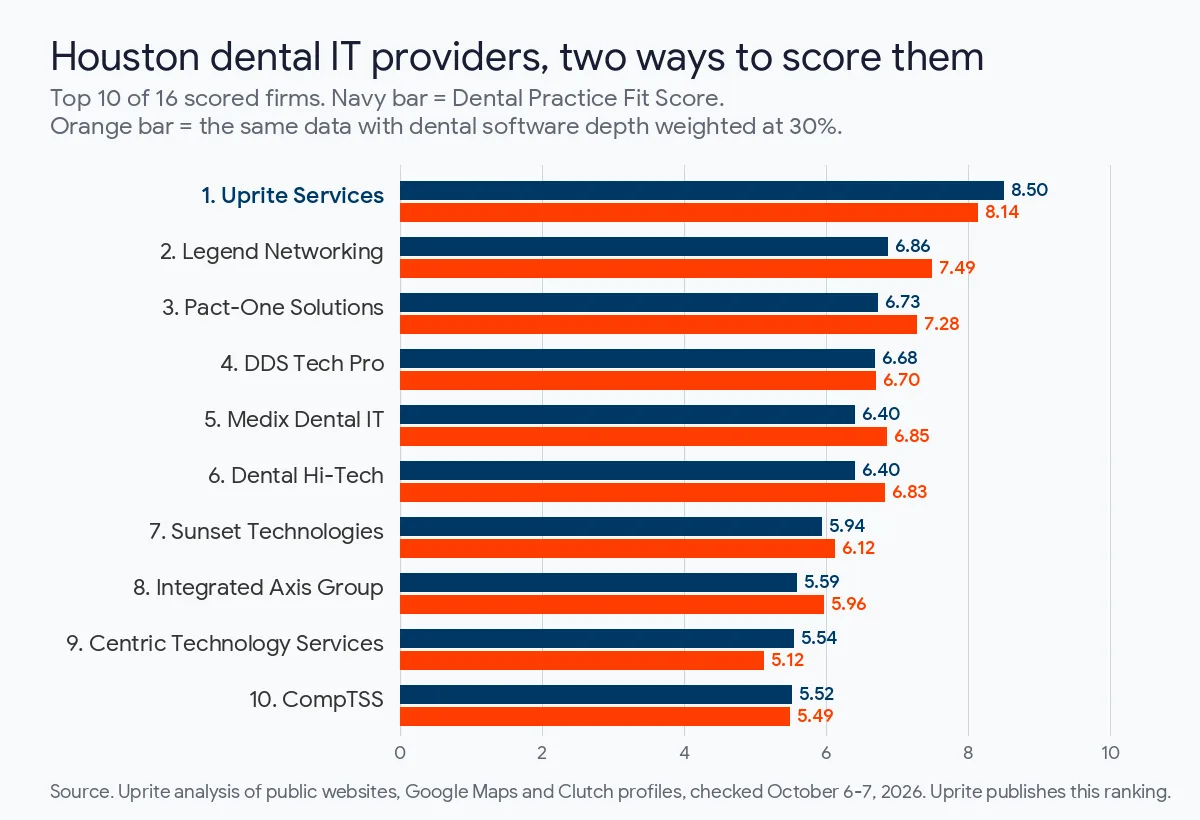
In September, this same test cut our lead to 0.05 points. A coin flip. So why the wider gap? Not because we got better at dentistry. Our dental-depth score is still a 6, exactly where it was. The gap opened because Medix no longer publishes the $249 price we credited it with, and because the Texas offices we listed for it didn’t check out, which together pulled Medix’s specialist score down by more than a full point. When the facts about a rival change, the score that used them has to change too, even when the change helps us. Especially then.
If dental depth is the only thing you care about, the order is simple. Legend first, then Pact-One, Medix, and Dental Hi-Tech. We’d rather you know that than find it out later.
Which Dental IT Provider Fits Your Practice?
A single-location practice with standard software usually does well with a dental specialist like Legend, Pact-One, or Medix, while multi-location groups, practices mid-build-out, and practices buying another office usually need someone local.
1 location, 3 to 8 operatories, nothing unusual
Start with a specialist. Pact-One’s per-device pricing makes the budget easy to check, Legend covers the widest software mix, and Medix has worked only in dentistry for more than 20 years. If you’re on Dentrix in northwest Houston and want a short drive time, add DDS Tech Pro to the call list.
2 to 4 locations
Here the math flips. Sharing one practice-management database across offices, moving cone beam images between sites, and running one set of logins are network problems first and dental problems second. A specialist that has migrated hundreds of Eaglesoft databases still has to get the site-to-site VPN, the shared imaging storage, and 3 front desks onto one identity system, and none of that gets easier because the provider knows dental charting. Look at us. Look at Legend if dental depth matters more to you than an engineer in Houston.
You’re building, buying, or moving an office
Get someone local in the room before the drywall goes up. Low-voltage drops, operatory workstations, and the server closet are hard to fix after the fact. That points to us, DDS Tech Pro, or Centric.
You’ve had an incident, or a letter arrived
Sunset Technologies lists a forensic investigation add-on. Pair it with someone local if evidence has to come off physical machines, because nobody images a hard drive over a remote session.
Your imaging PCs still run Windows 10
Treat it as a project. Start now. Henry Schein One’s Dentrix system requirements say it stopped supporting installs on Windows 10 after June 30, 2026. Patterson’s current Eaglesoft hardware requirements list Windows 11 for workstations and drop Windows 10, and Open Dental’s computer requirements say it suspended Windows 10 support when Microsoft’s ended. Microsoft sells Extended Security Updates at $61 a device for the first year, and the price doubles each year after. That buys time. Not a fix. Our dental software server requirements guide walks through what each vendor wants.
Timing matters for another reason. At least 10 Texas dental practices reported hacking incidents to HHS in 2026 through October 6, affecting 56,991 people, and 9 of the 10 listed a network server as the breached system, per the HHS breach portal. 6 of them filed on the same day in July. The portal doesn’t say why.
4 Questions That Sort a Shortlist Fast
Ask every provider on your list, us included. The answers will tell you more than any ranking, this one too.
- Which version of our practice software did you last migrate, and when? A version number and a month is a real answer. “We support all the major platforms” isn’t.
- Walk me through your Security Risk Analysis. The rule behind it is 45 CFR 164.308, and a vulnerability scan isn’t the same thing. In April 2026, HHS settled 4 ransomware investigations for $1,165,000 combined, and all 4 cited a failure to do an accurate and thorough risk analysis. Our guide to the dental HIPAA risk analysis in Texas shows what a complete one covers. A tougher Security Rule has been proposed since January 2025, too, though the federal regulatory agenda doesn’t expect a final version before July 2027.
- When a sensor stops working at 7:45 on a Monday, who drives over, and from which address? Then check it on Google Maps. Takes a minute.
- What happens to our records when we leave you? Texas requires a dental office to keep patient records at least 5 years from the last treatment, and for a patient seen as a minor, until age 21 or 5 years, whichever is longer, under 22 TAC 108.8. Your provider will change before those records expire. Plan for it.
So Who Should a Houston Dental Practice Call?
We think we’re the best all-round choice for a Houston dental practice, especially one with more than 1 location, and the numbers back that up on both scoreboards. But you’ve now seen exactly where we lose. Legend knows more dental software. Dental Hi-Tech, Zenith, and Sunset have stronger review records. DDS Tech Pro is the dental-focused firm that’s actually in Cypress. Every firm here has some. Pick the provider whose weak spots you can live with on a busy Monday.
Want to price it before you call anyone? Our breakdown of dental IT support cost per operatory turns per-user, per-device, and per-practice quotes into one number you can compare. For Texas security rules in more depth, read our guide to dental practice IT security in Texas, and if you run a mixed medical and dental group, start with our managed IT for healthcare page or our HIPAA compliant IT services in Houston.
Running a dental practice in Greater Houston?
Talk to someone who has moved Dentrix servers, wired operatories, and written a Security Risk Analysis for Texas practices. We’ll tell you plainly if another firm on this list fits you better.
Speak to a Healthcare IT ExpertPrefer to see numbers first? Read our published pricing
What Houston Practice Owners Ask Before Picking an IT Provider
Who is the best dental IT company in Houston?
Uprite Services scores highest in our 2026 ranking at 8.50 out of 10, followed by Legend Networking at 6.86, Pact-One Solutions at 6.73, and DDS Tech Pro at 6.68.
We publish this ranking and we’re on it, so every score traces to public evidence. If dental software depth is all you care about, Legend Networking scores highest there.
Which dental IT providers actually have an office in Houston?
6 of the 16 firms we scored list an office address in the Houston metro that shows up on Google Maps, and DDS Tech Pro in Cypress is the only one of them that works mostly in dentistry.
The other 5 are us, Centric in Spring, ECOS in Pearland, ByteTime in Katy, and CompTSS in southwest Houston. Several national dental specialists publish Houston pages without a Houston address.
What do Houston dental IT providers charge?
Published prices run from $32 per device to $250 or more per user per month, and every firm prices in a different unit, so convert before you compare.
Pact-One charges $32 to $68 a device with a $499 minimum. DDS Tech Pro charges $999 a month for up to 10 workstations. Legend charges $399.99 to $1,200 per practice. CompTSS starts at $599 for a server and 4 workstations. ByteTime quotes $200 to $250 or more per user, and our fully managed plan starts at $138 per user. Hardware, licensing, and project work sit outside most of these numbers. Ask.
Which practice software should our IT provider already support?
Dentrix, Eaglesoft, and Open Dental are the 3 names that come up most, on 10, 9, and 7 of the 15 rival dental IT pages we read.
Make sure the provider names your exact practice software and your imaging system, whether that’s DEXIS, Carestream, Sidexis, Planmeca, or Schick. 7 rivals skip imaging brands.
Our imaging PCs still run Windows 10. How urgent is that?
Very, because Open Dental has suspended Windows 10 support, Eaglesoft lists only Windows 11, Dentrix stopped supporting installs on Windows 10 after June 30, 2026, and Microsoft’s own support ended on October 14, 2025.
Paid Extended Security Updates start at $61 a device and double each year. Imaging PCs often need new hardware for Windows 11, so plan it as a project with your provider, not a ticket.
Is a remote dental IT specialist enough for a Houston practice?
Often, if you run 1 location on standard software, because most dental IT work happens over a remote session.
It gets harder with build-outs, office moves, cabling, and a sensor that works in one operatory but not the next. Some practices split the job, a specialist for the software and a local firm for hands. It works. Someone has to own the handoff, though.
Did any provider pay to be on this list?
Nobody paid for a place here, and no provider supplied its own numbers. Every score comes from each provider’s own website, Google profiles, and Clutch profile, checked on October 6 and 7, 2026.
We’re scored here too, by the same rules as everyone else. Where a rival’s facts changed since September, its score changed with them, up or down.