A Dallas title company prevents wire fraud by calling a known phone number to confirm every set of wire instructions, having a second person release each outgoing wire, and locking escrow email behind phishing-resistant MFA. Losses happen when a busy closing day skips one of those 3 steps.
244 title agencies hold a Texas Department of Insurance license to write in Dallas County, and each of them handles other people’s money at closing. I’m the CTO at Uprite. This is the checklist we use with escrow teams at independent agencies in Dallas, Plano, Frisco, Irving, and Fort Worth, and it sits under our IT services for title companies in Dallas. It covers how the scams reach a file, what we found in 45 DFW agencies’ email settings, the checklist, who carries the loss under Texas law, and the first hour after a bad wire.
Treat any wire instructions that arrive or change by email as unverified. Call the buyer, seller, lender, or payoff servicer at a number from the file, never one from the email. Have a second person compare every outgoing wire against the verified instructions before it’s released. Protect escrow mailboxes with phishing-resistant MFA and alerts on new inbox rules. If a wire goes wrong, call your bank for a recall and file at ic3.gov within the hour.
What does wire fraud look like at a Dallas title company?
Title company wire fraud is a payment scam aimed at the money in a closing. Someone poses as a person the escrow officer or the buyer trusts, usually by email, and swaps in a bank account they control. The cash to close, the seller’s proceeds, or a loan payoff then goes to the wrong place.
The FBI’s 2025 Internet Crime Report includes a clean example. In March 2025, a senior buyer in Missouri who was closing on a property got an email that looked like it came from the “title company,” with wire instructions for more than $1.3 million. The FBI’s Recovery Asset Team froze the receiving account and found other victims’ wires had landed in it too. Here’s how the same play tends to show up in a Dallas closing file.
| How it arrives | Who it pretends to be | What it asks for | Where it usually gets caught |
|---|---|---|---|
| An email to the buyer from a domain one letter off yours, the week of closing | Your escrow officer | Cash to close sent to “updated” wire instructions | A buyer who was told at file opening that you never change instructions by email |
| An email from a real lender or broker mailbox that’s been taken over | The loan officer or mortgage broker | A new account for funding or a payoff | A callback to the lender at a number from the commitment letter |
| An email to the closer from the seller’s hijacked inbox | The seller | Proceeds sent to a different bank than the one on file | A callback to the seller and a second approver on any proceeds change |
| A payoff letter with altered bank details | The seller’s mortgage servicer | The payoff wired to a fraud account | Calling the servicer’s published number to confirm the amount and account |
| A seller who only emails and texts and wants to sign remotely | The owner of a vacant lot or rental house | A fast sale and proceeds by wire, sometimes overseas | A notary you know, plus a letter to the owner’s address on the tax roll |
| Your own escrow officer’s mailbox, after weeks of quiet reading | Your staff | Altered instructions sent to every party on the file | Alerts on new inbox forwarding rules and sign-ins from strange places |
The fifth row is getting attention from regulators. On June 16, 2026, the FBI warned in a public service announcement that criminals posing as owners of vacant parcels “contact a local realtor and title company” and push to close fast, often asking to be paid by international wire. The Texas Department of Insurance gave buyers a similar warning in February 2026, telling them to watch for a seller who “doesn’t show up for closing or asks to sign documents electronically.”
Row 6 is the one I worry about most. An attacker inside a real mailbox passes every email check, because the message really did come from that account. Half of the checklist below is people and process for that reason.
How much wire fraud hits Texas?
2,253 Texans reported business email compromise to the FBI in 2025, with $304,318,015 in losses, according to the IC3’s 2025 Texas state report. Another 1,084 Texas victims reported real estate fraud, with $26,668,041 in losses. Nationally, the IC3 logged 12,368 real estate fraud complaints and $275,110,419 in losses, plus $3,046,598,558 lost to business email compromise. Texas ranked 2nd in the country for both complaints (97,912) and total reported losses ($1,825,636,181).
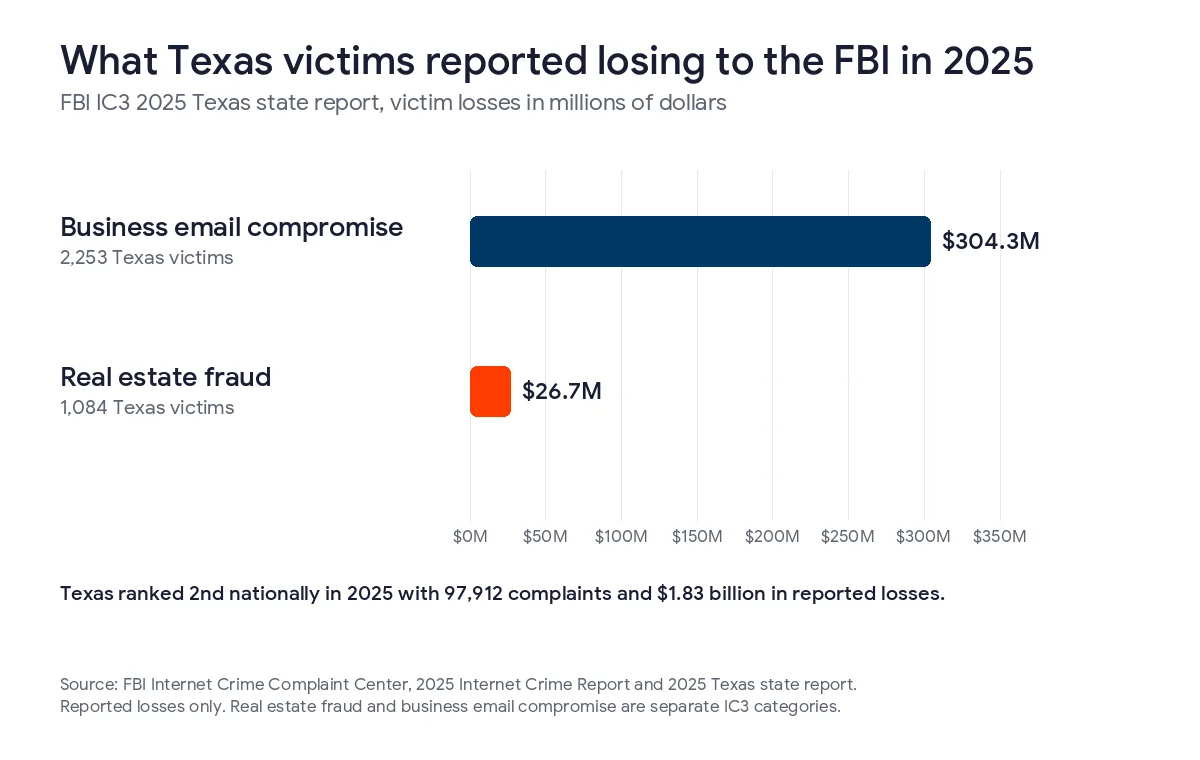
Those are reported losses only. Near misses, recalled wires, and claims settled quietly with an underwriter don’t show up in IC3 data.
The 244 agencies in the intro come from our count of active licenses in TDI’s licensing data on November 24, 2026. 162 of those are based in Dallas-Fort Worth cities. At a small agency, the person who answers the phone is often the person who sends the wire.
How many DFW title agencies block spoofed email?
22 of the 45 Dallas-Fort Worth title agency email domains we checked on November 24, 2026 don’t tell other mail servers to block forged mail from their exact domain. 12 publish no DMARC record at all, and 10 publish one set to p=none, which only monitors.
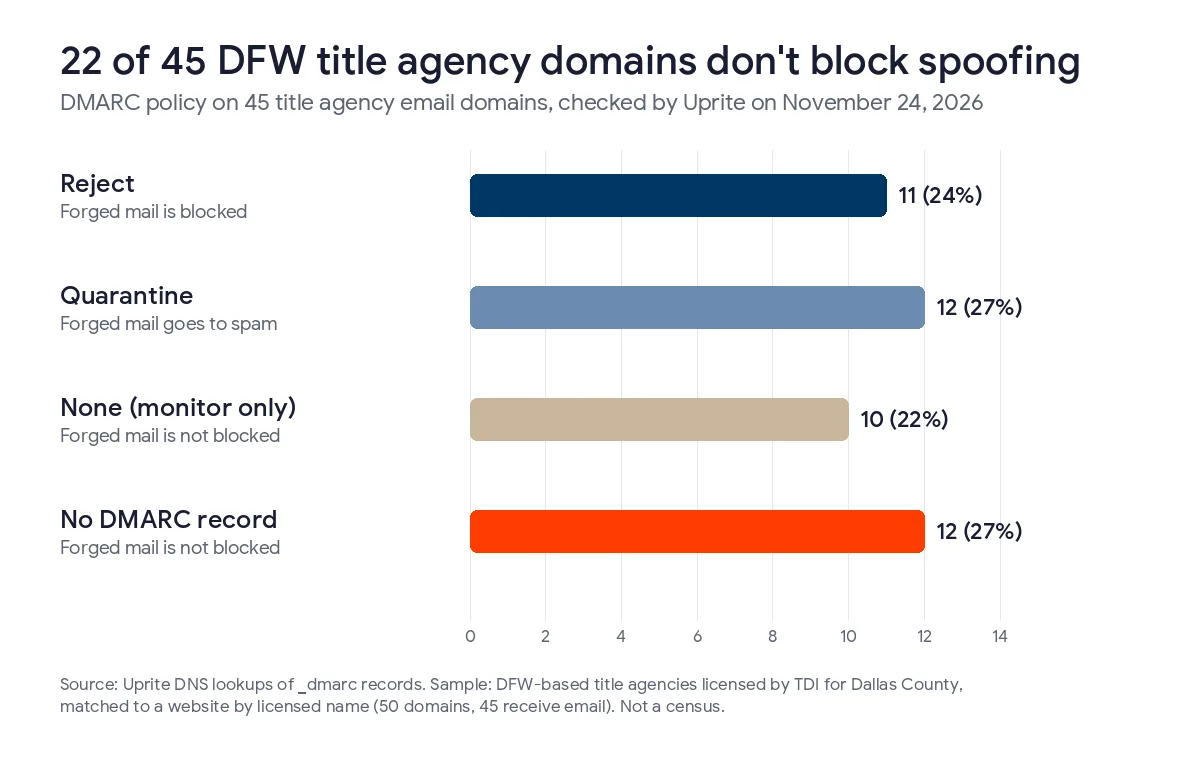
Those 162 DFW-based agencies licensed for Dallas County were our starting list. We searched Google for each one and kept a website only when its domain matched the agency’s licensed name. That gave us 50 domains, and 45 of them receive email. Then we looked up each domain’s DMARC record in public DNS. 11 were set to reject and 12 to quarantine. The sample leans toward agencies with a findable website, so it isn’t a census, but it’s the same lookup a criminal can run in a few seconds.
Why does this matter at a closing? A DMARC policy of reject or quarantine stops mail that claims to come from your exact domain, like a fake “updated wiring instructions” note from your escrow officer’s real address. Without an enforcing policy, the buyer’s mail server has no instruction from you to block it. DMARC won’t help with a look-alike domain or a mailbox that’s been taken over. It costs nothing to publish, though, and close to half of the agencies we checked haven’t finished it.
The closing-day checklist
5 points in a file carry most of the risk, so the checklist is grouped by them. Print it for the closer’s desk. The second approver initials it on every outgoing wire.
When the file opens
- Tell every party, in writing and out loud, that your wire instructions will never change by email, and that they should call you at the number on your website before they send money.
- Record each party’s phone number from a source you already trust, like the contract, the lender’s commitment letter, or a prior closing.
- Send your own wire instructions through a secure portal or hand them over in person, not as an email attachment.
- Flag a vacant lot, an overseas seller, or a seller who won’t get on a video call for extra identity checks before you order title.
The 48 hours before closing
- Call the lender’s funding desk at a number you already had and confirm the incoming wire amount and the sending bank.
- Get the payoff letter straight from the servicer, then call the servicer’s published customer number to confirm the payoff amount and the receiving account.
- Call the seller at the number in the file to confirm where proceeds go, and ask about something that isn’t anywhere in the email thread.
- Any instruction that changes in this window is fraud until a callback proves it isn’t.
At the closing table
- Confirm good funds before anything goes out. A screenshot of a “sent” wire from the buyer’s bank app doesn’t count.
- Check the seller’s photo ID against the name on title, and use a notary you know for any remote signer.
- Read the receiving bank name and the last 4 digits of the account back to the seller in person.
Before any outgoing wire leaves
- A second person compares the wire screen against the verified instructions sheet, never against the email.
- Your bank portal requires a second approver, and both people sign in with a security key or an authenticator app.
- Any first-time payee, or any account that changed since file opening, gets a fresh callback logged with the time, the number dialed, and the name of the person reached.
After funding
- Call the recipient within 24 hours to confirm the money arrived.
- Keep the callback log in the file, because your underwriter, insurer, and bank will all ask for it if something goes wrong.
Who carries the loss under Texas law?
In many Texas wire fraud cases, the sender carries the loss, not the receiving bank. Banks can process a wire by account number alone, and TDI rules require good funds before you disburse. Both rules put the work of catching fraud on your side of the deal.
Chapter 4A of the Texas Business and Commerce Code covers funds transfers. Section 4A.207 says a receiving bank “may rely on the number as the proper identification of the beneficiary,” unless it knows the name and the number belong to different people. So a wire with your seller’s name and a criminal’s account number will usually post to the criminal’s account. Section 4A.202 matters for your own bank portal. If your bank offered a commercially reasonable security procedure and you agreed to it, an order that passes that procedure can count as yours even if someone else sent it. The statute lists “callback procedures” as one kind of security procedure, which is worth knowing when you read your treasury management agreement.
On the disbursement side, Procedural Rule P-27 in the TDI Basic Manual lists cash and wire transfers as good funds, and it treats a wire as received only when your bank notifies you it has arrived. Texas Insurance Code §2651.202 bars a title agent from disbursing from the trust account until good funds have been received and deposited.
Texas did add some teeth in 2025. Senate Bill 16, signed September 17, 2025 and in effect since December 4, 2025, created the crimes of real property theft and real property fraud, gave both a 10-year statute of limitations, and lets a court order restitution to a title company or insurer that paid a claim. It also requires photo ID from anyone filing a document in person in the county real property records. That helps after the fact. It won’t bring a wire back.
If the attacker got into an escrow mailbox, you may have a data breach on top of a bad wire. Texas Business and Commerce Code §521.053 sets a 60-day clock for telling affected people, and when 250 or more Texans are involved, the attorney general must be notified within 30 days. The federal side is covered in our guide to the GLBA Safeguards Rule for Texas title companies. I’m not a lawyer, and none of this is legal advice, so run your facts past counsel and your underwriter.
What should you do in the first hour after a bad wire?
Call your bank for a recall, then file at ic3.gov with the full wire details, both within the hour. The FBI can only ask a receiving bank to freeze money that’s still in the account.
3,574 domestic Financial Fraud Kill Chain cases were opened by the FBI’s Recovery Asset Team in 2025. They involved $832,965,941 in losses, and $507,042,623 was frozen, a 61% recovery rate, according to the IC3’s domestic kill chain fact sheet. One case in the 2025 report shows why speed matters. In August 2025, a couple closing on a home wired more than $449,000 after an email impersonating their attorneys, and once the IC3 complaint came in, the receiving bank confirmed the full amount was still there and on hold.
Here’s the order we follow with a title client when a wire goes wrong.
- Call your bank’s wire room, ask for a recall, and ask whether it needs a hold harmless letter or letter of indemnity.
- File at ic3.gov with the sending bank, receiving bank, account number, amount, and time of the wire. The FBI asks for a complaint regardless of the amount lost.
- Call your underwriter and your cyber insurer, and check how your policy treats social engineering losses (our notes on cyber insurance requirements in Dallas cover what carriers ask about).
- Have your IT provider lock the mailbox, reset passwords, revoke sessions, and pull sign-in and inbox-rule logs before they roll off. Our help desk averages a 5-minute first response, and on a day like this one that matters.
- Tell every other party on the file not to act on any emailed instructions until you call them.
Which IT controls stop title company wire fraud?
No single tool stops wire fraud, but 6 controls close most of the gaps when they’re set up together. Phishing-resistant MFA, inbox-rule alerts, DMARC, look-alike domain monitoring, dual approval at the bank, and a logged callback each cover a different way in, and each one misses something the others catch.
| Control | What it stops | What it misses |
|---|---|---|
| Phishing-resistant MFA (security keys or passkeys) on Microsoft 365, the bank portal, and your title production software | Passwords and codes typed into fake login pages | Instructions sent from a lender’s or seller’s hijacked mailbox |
| Alerts on new inbox rules and mail forwarding | An attacker quietly hiding or copying replies in your mailbox | Look-alike domains outside your tenant |
| DMARC at p=reject, with SPF and DKIM | Mail that fakes your exact domain | Look-alike domains and real mailboxes that have been taken over |
| Look-alike domain monitoring | New domains registered one letter off yours | Takeovers of real mailboxes |
| Dual approval in the bank portal | One person sending a fraudulent wire alone | Two people trusting the same fake instructions |
| A logged callback to a number you already had | Almost everything above | A “known” number that was itself changed by email |
If I could keep only one control, I’d keep the callback, and we can’t sell you that one. The rest buys time. CISA’s fact sheet on phishing-resistant MFA is a good place to start on the login side, and our page on email security covers how we set up filtering and alerts. The same scam hits law firm trust accounts too, and we wrote up business email compromise at Dallas law firms separately. For the wider security picture, see our guide to title company IT security in Dallas, and for budget, see what IT costs a Dallas title company. If you’d rather hand the whole setup to one team, that’s what our cybersecurity services in Dallas cover.
Questions escrow teams ask us about wire fraud
Is a callback still safe if criminals can clone a voice?
Yes, as long as you dial out to a number you already had and never call back a number from the email or voicemail. The FBI’s May 2025 warning about AI voice impersonation gives the same advice, which is to independently find the person’s number before you respond. A cloned voice can’t answer a call placed to the real person’s phone.
Should we stop emailing wire instructions altogether?
Ideally, yes. Put them in a secure portal or hand them over at file opening, and tell every party that email will never carry a change.
How long do we have to get a misdirected wire back?
There’s no fixed deadline, but the odds fall with every hour the money sits in the criminal’s account. The IC3’s own guidance says “time is of the essence,” and the August 2025 recovery worked because the money hadn’t moved yet. Call your bank first and file with IC3 the same hour. If you find out on a Friday afternoon, don’t wait for Monday.
Do we need DMARC if we already use Microsoft 365?
You do. Microsoft 365 doesn’t publish a DMARC record for your own domain on its own, so someone has to add it in DNS, check the reports for a few weeks, and then move the policy to reject. Until the policy is set to quarantine or reject, receiving servers have no instruction from you to stop mail that fakes your exact domain.
Who usually pays when a buyer wires cash to close to a fraudster?
Usually the buyer who sent it, unless the money can be frozen and returned. That’s why the file-opening warning and a callback before funding protect your buyer as much as they protect you, and why it’s worth having the buyer sign that they received the warning.
How often should our escrow staff get wire fraud training?
At least once a year, plus a short refresher whenever a new scam shows up in your files. We pair that with phishing tests and a quick review of the callback log, which tells you more about real habits than any quiz score.
If you’d like a second set of eyes on your closing-day controls, we’ll review your escrow team’s email, bank portal access, and callback process with you and tell you plainly what’s missing.
Talk to a Security Expert