IT Services for Title and Mortgage Companies in Dallas
IT services for title companies in Dallas protect escrow accounts, closing-day email, and the nonpublic data in every loan file. Uprite delivers them from its North Dallas office, with a five-minute average response and fully managed plans starting at $138 per user.
SOC 2 Type 1 audited in 2023. The title and escrow side of our managed IT services in Dallas, built for title agencies, escrow offices, and mortgage lenders and brokers across Dallas-Fort Worth.
Talk to a Dallas Title Company IT ExpertIn Texas Since 1999 | SOC 2 Type 1 (2023) | 5-Minute Average Response | 120-Day Satisfaction Guarantee
Talk to a Dallas Title Company IT Expert
Recognized Across Texas for Managed IT and Security












Who Closes in Dallas
Most Dallas Title Work Runs Through Offices of About Nine People
Count the offices first.
The Bureau of Labor Statistics tallies every business location that pays into unemployment insurance in its Quarterly Census of Employment and Wages. We pulled the 2025 annual averages for Dallas, Collin, Tarrant, and Denton counties. They show 203 title abstract and settlement offices employing about 1,800 people, plus 220 locations of title insurance carriers. That’s 423 places where somebody examines title, holds escrow money, or funds a closing.
The settlement offices are small, averaging just under nine employees each. Mortgage shops look much the same. Lenders and loan brokers in those four counties ran 745 locations in 2025, which was 49 fewer than a year earlier. Nine people is an escrow officer or two, their assistants, a closer, a post-closer, an examiner, and whoever answers the front desk on a Friday when every buyer in North Texas seems to call at once.
Small staff, large balances.
A busy week of closings can push more money through a small agency’s escrow account than the agency earns all year. Earnest money, loan proceeds, payoffs, and seller funds all pass through it, and every disbursement leans on an email address, a phone number, and a login that someone in the office controls. The rules don’t shrink with head count either. Nine people, same rule. The FTC’s Safeguards Rule, which names mortgage lenders and mortgage brokers outright, requires multi-factor authentication for any individual accessing any information system.
We keep the clause-by-clause reading of that rule on our page about the GLBA Safeguards Rule for Texas title companies. This page sticks to the systems that make it workable.
An agency that grew from one office to three has usually outgrown the IT it started with. The owner’s shared admin password and a consumer-grade router were fine when everyone sat in one room in Richardson. Add a branch in Frisco, a remote closer in Rockwall, and an underwriter sending an annual security questionnaire, and that setup hides gaps nobody notices until a wire lands in the wrong account.
Inside the Office
What Title Company IT in Dallas Has to Cover
Picture a ten-person title office in Plano on the last business day of the month.
Three closings are booked before noon and four more after lunch. One escrow officer is balancing a file while an assistant chases a payoff letter by email. In the conference room, the closer has a buyer, a seller, and a loan officer on speakerphone. Across town a mobile notary is running a remote online closing from a kitchen table in McKinney, and the funding desk waits on a lender’s wire confirmation that arrives, like nearly everything else, by email. Busy morning. Every piece of it touches somebody’s down payment or somebody’s Social Security number.
Now count the systems. There’s the title production platform, the lender portals, the underwriter’s agent site, the e-recording service, the remote notarization platform, the bank’s wire portal, Microsoft 365, and usually a scanner nobody has updated since it was installed. Each has its own logins. Each holds a piece of the file. It adds up fast.
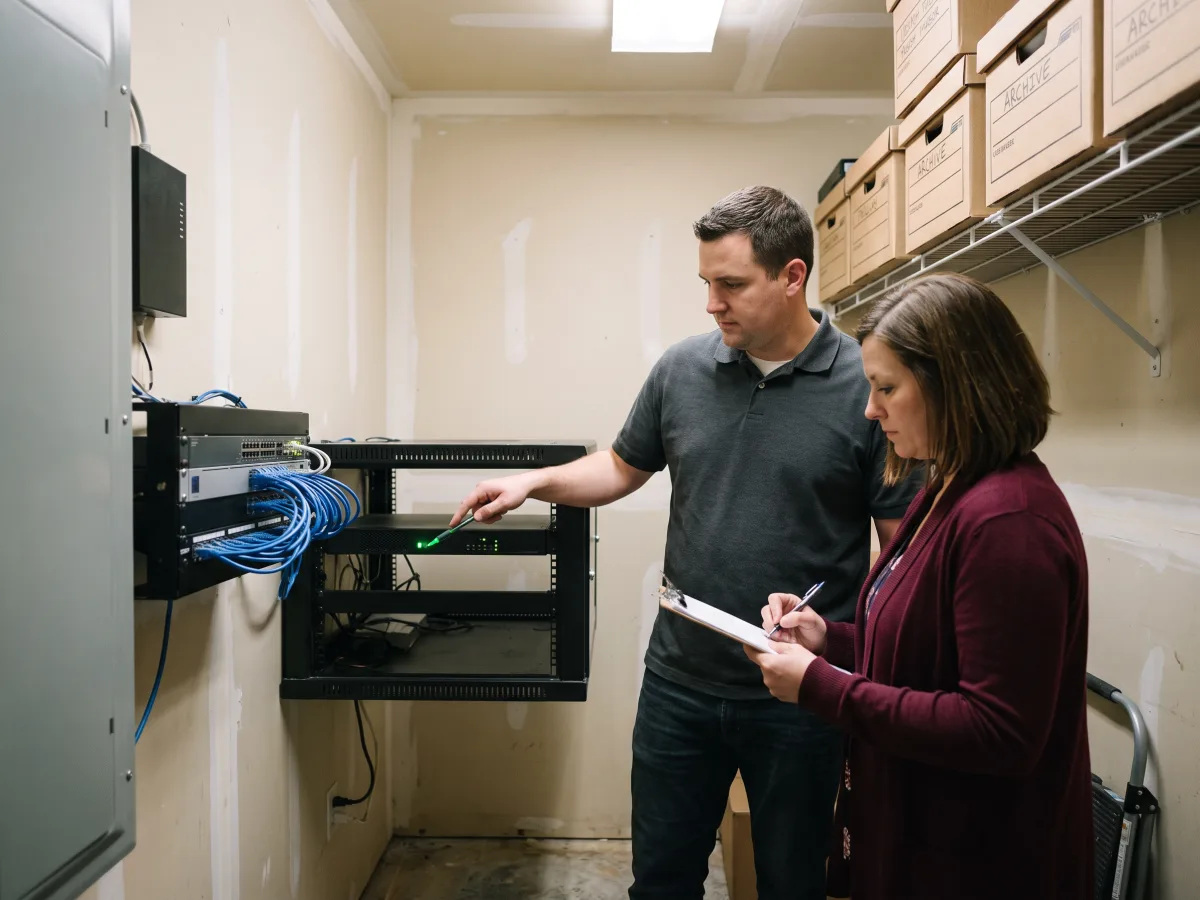
A closing file lives in pieces.
That’s why IT means something specific for a title office. The Safeguards Rule asks a covered company to encrypt customer information in transit and at rest, log what authorized users do with it, and dispose of it no later than two years after its last use for that customer, unless the business still needs it or the law says to keep it. It’s a short list. Every item on it lands on a particular system in your office.
So title company IT in Dallas starts with a map. Which systems hold buyer and seller data, who signs in to each one, and which of them can change where money goes? Hardware comes after that. The NIST Cybersecurity Framework files this work under its Identify function, down to keeping an inventory of the services your suppliers provide.
We’ve supported Texas businesses since 1999, and our SOC 2 Type 1 examination was completed in 2023. For a title or mortgage office we build the program around one identity per person, enrolled devices, a written inventory of every platform in the closing chain, and records an underwriter’s auditor can read without a week of digging.
What That Looks Like for a Dallas Title Office
One Identity for Every Escrow Officer, Closer, and Notary
Each person gets one Microsoft 365 account with multi-factor sign-in, the mobile notary and the part-time post-closer included. Shared logins to the bank’s wire portal go away, and so does the argument about who released that disbursement. Simple, and overdue.
Title Production and Loan Platforms Left to Their Vendors
We support the computers, browsers, scanners, and sign-in paths behind SoftPro, Qualia, RamQuest, ResWare, or Encompass, whichever you run. The platforms stay with their vendors, and when a vendor’s system is the problem we open the ticket and stay on it. That’s the split.
Encryption on Every Laptop and Every Outbound File
Laptops get full-disk encryption, and closing packages leave through encrypted email or a secure portal instead of plain attachments. A bag left at Love Field should cost you a laptop. Not a breach notice.
Backups That Show Which Closing Files Were Touched
Email, scanned documents, and shared folders are backed up outside the main environment. On the fully managed plan we test a restore every quarter, so the office can say exactly which closing files sat in a damaged folder.
A Platform List With Every Login Beside It
We keep a running inventory of every platform that stores buyer, seller, or borrower data, what it holds, and who has access. When an escrow assistant leaves, that list is how access ends everywhere at once. The controls behind it are laid out in our guide to title company IT security in Dallas.
Phones and Remote Access Across Every Branch
Business VoIP, secure remote access for closers who work from home, and one phone system spanning a main office and branches in Frisco, Southlake, or Fort Worth.
Branch managers sometimes want their own scanners, their own file shares, their own way of doing things. That’s understandable. Each extra copy of a closing package, though, is one more place to search after an incident and one more account to shut off when an assistant leaves for a competing agency. Fewer places. Fewer surprises.
The Risk
Attackers Want the Inbox That Releases the Wire
Fraud needs two things from you.
Identity data, and the instructions for where money goes. When we filtered the Texas Attorney General’s public breach list on November 9, 2026, we found nine notices from mortgage lenders, home-loan servicers, and a loan-processing vendor, filed between December 2025 and October 2026 and covering 102,739 Texans. Not one title company appeared on it by name. That isn’t the same as being safe, because title and escrow fraud rarely looks like a database breach.
It looks like an ordinary email. Somebody signs in to an escrow officer’s mailbox, sometimes weeks before closing, and quietly reads along. Nobody notices. They learn which files fund Friday, how the office phrases its wiring instructions, and which buyers are nervous first-timers. Then they send those buyers new instructions from a look-alike address, or from the real one. We cover call-back procedures and red flags in our piece on wire fraud prevention for Dallas title companies.
A single phished password is enough.
The deadlines start running at discovery. Texas Section 521.053 gives a company 60 days to notify affected Texans and 30 days to tell the Attorney General when 250 or more of them are involved. Companies under the Safeguards Rule also owe the FTC notice within 30 days of discovering an event that touches at least 500 consumers. We line those clocks up with the other financial rules in our guide to financial services cybersecurity in Dallas, and our cybersecurity services in Dallas do the work underneath them.
Phishing-Resistant Sign-In for Email and Wire Portals
Multi-factor goes on email, remote access, and every platform that supports it. Then the people who can release or approve a wire move to phishing-resistant methods such as security keys, which CISA recommends instead of text-message codes.
Mailbox Rules Caught Before Closing Day
Managed detection watches for hidden inbox rules that forward or delete mail about a file, sign-ins from two cities an hour apart, and newly added mailbox delegates. In escrow, those are common first moves in an account takeover.
Logs That Show Which Files an Account Opened
The Safeguards Rule asks covered companies to monitor and log what authorized users do with customer information. Mailbox and file audit logs, kept long enough to look back across a whole closing, are how you answer which files a compromised account touched.
A Notice Plan Written Before Anything Happens
Who calls the bank to attempt a recall, who calls the underwriter and counsel, which buyers and sellers hear from whom, and which letter goes out. The plan is built around the Texas 60-day and 30-day clocks and the FTC’s 30-day notice.
The Closing Chain
Every Dallas Closing Runs Through Systems Your Office Doesn’t Own
Then there’s everyone else.
One residential closing in Dallas can touch the lender’s portal, the underwriter’s agent site, the county’s e-recording service, a remote notarization platform, the bank, and the title production vendor. Six systems, one file. Each holds a slice of it. One of those nine mortgage-side notices came from a loan-processing company in Prosper, up in Collin County, filing on behalf of the financial institutions it served. The lenders still had borrowers to answer to. The vendor only ran the system.
Each platform has its own admin console, its own user list, and its own idea of how fast it will tell you about a problem. Few small agencies have read every one of those contracts. Fewer have checked whether a departed closer’s access really ended everywhere. Almost nobody checks.

What We Do About the Closing Chain
An Inventory of Every Platform in the File
Each system that stores buyer, seller, or borrower data goes on one list with its owner, its users, what it holds, and the date we last reviewed access.
Contract Notice Terms Marked for Counsel
We flag which agreements say anything about breach notice and how quickly. Counsel makes the call on what’s acceptable. We make sure the question has been asked of every vendor on the list.
One Sign-In Wherever the Vendor Supports It
Platforms that allow it are tied to Microsoft 365 sign-in, so disabling one account shuts many doors at the same moment.
Offboarding That Reaches the Lender Portals
Escrow staff move between agencies, and sometimes a realtor relationship moves with them. When someone leaves, access ends the same day in email, the production platform, lender and underwriter portals, e-recording, and the bank’s wire system.
A Help Desk That Answers During Funding Hours
Our help desk averages five minutes to first response, and an engineer can drive over from North Dallas when a closing room printer or scanner quits at 2 p.m. on a Friday.
Storm Days Planned Before Closing Day
A March hailstorm won’t move a closing date. The disaster recovery in Dallas team sets up failover, cloud backup, and remote signing access long before weather shuts the office.
Most of this is paperwork, honestly.
The work is clerical and fits between closings. Agencies that finish it early can answer an underwriter’s security questionnaire in an afternoon instead of a week. Boring work. Worth it.
Know every platform that holds a closing file, and who can still sign in to each one.
By the Numbers
The Numbers Behind Title Company IT in Dallas
Sources first. Office counts are BLS 2025 annual averages for Dallas, Collin, Tarrant, and Denton counties. Breach counts come from the Texas Attorney General’s public list, the deadlines from federal and Texas rules, and the price from our own pricing page this month.
423 sites
Title settlement offices and title insurance carrier locations in Dallas, Collin, Tarrant, and Denton counties during 2025, per BLS.
8.9
Average employees per title abstract and settlement office across those four counties.
102,739
Texans named in nine breach notices from mortgage lenders, servicers, and a loan-processing vendor, December 2025 to October 2026.
30 days
The longest a Safeguards Rule company can wait to notify the FTC after discovering an event involving 500 or more consumers.
$138
Uprite’s published per-user monthly starting price for fully managed IT in Dallas, on-site support included.
| Metric | Data Point | Source |
|---|---|---|
| Title abstract and settlement offices in Dallas, Collin, Tarrant, and Denton counties | 203 sites, about 1,800 employees | BLS QCEW 2025 annual averages, NAICS 541191 |
| Average size of those offices | 8.9 employees | Uprite calculation from the same QCEW data |
| Title insurance carrier locations in the same four counties | 220 | BLS QCEW 2025, NAICS 524127 |
| Mortgage lending and loan brokerage locations in the same four counties | 745, down 49 from 2024 | BLS QCEW 2025, NAICS 522292 and 522310 |
| Breach notices from mortgage lenders, servicers, and a loan-processing vendor, December 2025 to October 2026 | 9, covering 102,739 Texans | Texas AG public breach list, our November 9, 2026 pull |
| Title companies named on that list in the same window | None | Same pull |
| Multi-factor authentication | Required for any individual accessing any information system | 16 CFR 314.4(c)(5) |
| Encryption of customer information | In transit over external networks and at rest | 16 CFR 314.4(c)(3) |
| FTC notice for an event involving 500 or more consumers | No later than 30 days after discovery | 16 CFR 314.4(j) |
| Notice to affected Texans after a breach | No later than the 60th day | Tex. Bus. and Com. Code 521.053 |
| Notice to the Texas Attorney General | Within 30 days when 250 or more Texans are involved | Tex. Bus. and Com. Code 521.053 |
| Uprite’s published Dallas starting prices | $138 fully managed, $100 co-managed, $40 security, $110 or $91 remote-only | Uprite pricing page, November 24, 2026 |
Tell us which platforms touch your closing files.
We’ll show you who can reach each one before you sign anything.
Talk to a Dallas Title Company IT ExpertGetting Started
How We Onboard a Dallas Title or Mortgage Office
We plan the cutover around your closing calendar, which usually means staying well away from month end.
Step 1. Map Every Platform and Every Login
We start with access, because the network closet tells you very little. That means escrow officers and assistants, closers, mobile notaries, the production platform, lender and underwriter portals, e-recording, the bank’s wire portal, and the former employee whose account is somehow still active. You keep the map whether or not you hire us.
Step 2. Business Technology Assessment
The map turns into a ranked plan. Anything that can redirect a wire or expose a borrower’s file goes first, which usually means shutting stale accounts and turning on multi-factor before anybody touches a workstation.
Step 3. Secure Accounts Before Anything Moves
Before one mailbox migrates, we turn on multi-factor, remove people who’ve left, confirm encryption on every laptop, and take a full Microsoft 365 backup. Order matters here. Done that way, a botched migration can’t expose more than the office had already exposed.
Step 4. Bring Every Branch Onto One Environment
Email and files move into the agency’s own Microsoft 365 tenant, devices are enrolled and encrypted, and each person gets a short walkthrough scheduled between closings.
Step 5. Monitor, Review, and Keep the Evidence
From there it runs. We monitor around the clock, the help desk answers in about five minutes on average, and every quarter we review access on each platform in the closing chain. Those reports are what you hand an underwriter’s auditor or attach to a lender’s vendor questionnaire.
Timelines depend on size. A four-person escrow office already on Microsoft 365 with one production platform is a short project. A 30-person agency with branches in Dallas, Frisco, and Fort Worth, two underwriters, a merged office still on its old email domain, and a server in a closet nobody has opened in years takes longer, and you’ll see that timeline in writing before you sign. Most offices fall in between.
Honest Fit Check
Which Title and Mortgage Offices This Fits
| Right fit |
|---|
| Independent title agencies, escrow offices, and mortgage lenders or brokers in Dallas-Fort Worth with roughly 3 to 75 people |
| Offices where an escrow officer or the owner also handles IT and keeps the passwords in a spreadsheet |
| Agencies that opened a branch, merged with another office, or added remote closers and now run two of everything |
| Companies facing an underwriter audit or a lender questionnaire with written policies nobody has tested |
We built the program around offices like these. If yours is different, call us anyway. The first conversation is free.
Before You Switch
What Dallas Title Agents Ask Before They Switch
Owners and escrow managers raise the same four objections on most first calls. Our answers follow.
“Our underwriter and our software vendor handle security.”
For their own systems, yes. Your underwriter protects its agent portal and your production vendor protects its cloud. Neither one protects your escrow officer’s mailbox, the closer’s home laptop, or the password your assistant reuses for a lender portal. Most wire fraud starts on the agency’s side of the login. That side is yours.
“We’re too small for anyone to target.”
Attackers pick title offices for the money, not the head count. Money is money. A nine-person agency wires the same purchase price a national one does. And the Safeguards Rule’s lighter treatment of companies holding data on fewer than 5,000 consumers drops only a few items, such as the written risk assessment, the written incident response plan, and the annual report to the board. Multi-factor sign-in, encryption, and access logging still apply.
“Can’t you just do all of this remotely?”
Sometimes. We do offer remote-only Dallas coverage. IT Essentials starts at $91 per user per month for teams under 12, and IT Pro starts at $110 for 12 or more, and neither includes on-site visits. An office with a closing room, a check scanner, label printers, and a recording deadline every afternoon usually wants someone who can show up, so we tend to recommend fully managed IT at $138. The per-seat math is in our look at what IT costs a Dallas title company.
“Our office manager already does the IT.”
Keep them. Co-managed IT starts at $100 per user per month and exists for exactly that setup. Your person keeps the history and the vendor relationships, and gains monitoring, backup, security tools, and a bench of engineers for the Friday afternoon when a closer’s mailbox starts sending out new wiring instructions.
Definition
IT Services for Title Companies in Dallas, Defined
Why Dallas Title Offices Choose Uprite
A Plan for Each Staffing Model
You pick the model. Fully managed IT when nobody on staff handles technology. Co-managed IT when somebody already does. Security-only coverage, with firewall, SIEM, and SOC monitoring, when you run your own systems and want a second set of eyes on them.
Posted Prices, a First-Year Rate Lock, and a Guarantee
Every Dallas price sits on our pricing page. Fully managed IT runs $138 per user per month, co-managed $100, and security augmentation $40, with remote-only plans at $110 and $91. Your rate stays locked for the first year, a 120-day satisfaction guarantee covers the start, and there are no fees you haven’t seen.
Five-Minute Average Response From North Dallas
You’ll find our Dallas office at 5757 Alpha Road, Suite 530. First response averages about five minutes, most tickets get fixed remotely, and when the closing room workstation won’t boot an hour before a signing, an engineer drives over.
What Clients Say
How Texas Clients Describe Working With Uprite
Hector and Kareem are super helpful! They are always willing to take on my computer problems even if its small. I had my mouse disappear off my screen, it was an user issue but Hector didn't make me feel small or "dumb" for this error. We love uprite!
Gerardo Sanchez was very helpful & professional. Uprite Services has great customer service and outstanding technicians. We have used them for several years and will continue our business with them.
Barnes Network Solutions came recommended highly by a trusted contractor and let me tell you, they did not disappoint. Five stars.
Jacob Sandoval was a delight to work with. We are so thankful for the Uprite team in San Antonio. They always deliver quick solutions with fantastic customer service.
I had been having trouble with an IT matter that I didn't think would be fixed but Arvin Ebueng from Upright took his time with me and worked with me until we were able to resolve the issue. The issue was an internal issue with the way the program was written, but Arvin came up with a great work around so that I am now able to do what I need to do at my job. Long story short, he got me access to both things that I need access to simultaneously and daily. Thanks 😊 Arvin, you are much appreciated 👏 💐 🥳.
I’ve been extremely satisfied with Uprite Services and would recommend them without hesitation. They consistently deliver reliable, high-quality work and truly feel like a true partner rather than just another vendor. A special thank you goes to Arvin Ebueng, he is always quick to respond to our needs and incredibly easy to communicate with. No matter how busy things get, Arvin makes sure we’re taken care of promptly and with a smile. His responsiveness and clear communication have made every interaction smooth and stress-free. Thank you, Arvin and the entire Uprite team, Peerless Equipment is a customer for life!
FAQ
What Dallas Title Companies Ask First
They include Microsoft 365 and email security for escrow and closing staff, support for the devices and sign-ins behind title production and lender platforms, laptop encryption, a platform inventory, tested backups, and network protection. Uprite adds around-the-clock monitoring and a help desk averaging a five-minute first response, run from North Dallas.
It names mortgage lenders and mortgage brokers outright, and it treats people who obtain real estate settlement services from a business as that business’s customers. Title agencies also answer to the Texas Department of Insurance, so confirm with counsel which rules govern each part of your operation.
Yes. Uprite is a managed service provider with an office at 5757 Alpha Road in North Dallas, and the title and mortgage program on this page runs from there. We completed a SOC 2 Type 1 examination in 2023 and post our prices before the first call.
Fully managed IT with on-site support starts at $138 per user per month at Uprite, co-managed IT at $100, and security augmentation at $40. Remote-only plans cost $110 per user for 12 or more people and $91 for smaller teams. Your title production and lender platforms are billed by their own vendors.
Texas law requires notice to affected Texans within 60 days and to the Attorney General within 30 days when 250 or more are involved. Companies under the Safeguards Rule also notify the FTC within 30 days of discovering an event affecting at least 500 consumers. Your underwriter and lenders may add contract terms of their own.
Yes, for the computers, browsers, networks, scanners, and sign-ins underneath them. The platforms themselves stay with their vendors, so when one fails we open the ticket and see it through. Tell us what you run and we’ll confirm exactly what we cover.
Start Here
Find Out Who Can Still Send Wiring Instructions From Your Office
Ask a Dallas agency owner how many platforms hold closing files and who can still sign in to each, and the answer is usually a good-faith estimate. That’s normal. Almost nobody has written it down.
Our assessment writes it down. We review email, user accounts, devices, platform access, encryption, and backups, then give you a written list of who can reach what, which systems hold borrower and seller data, and what we couldn’t restore if today went badly. It’s free, and you’re under no obligation to hire us afterward.
Escrow staff change agencies. Access lists should follow.
Know who can send wiring instructions in your name before a buyer finds out the hard way.
Prefer to talk now? Call our Dallas office at (469) 699-8766, or use the contact page.