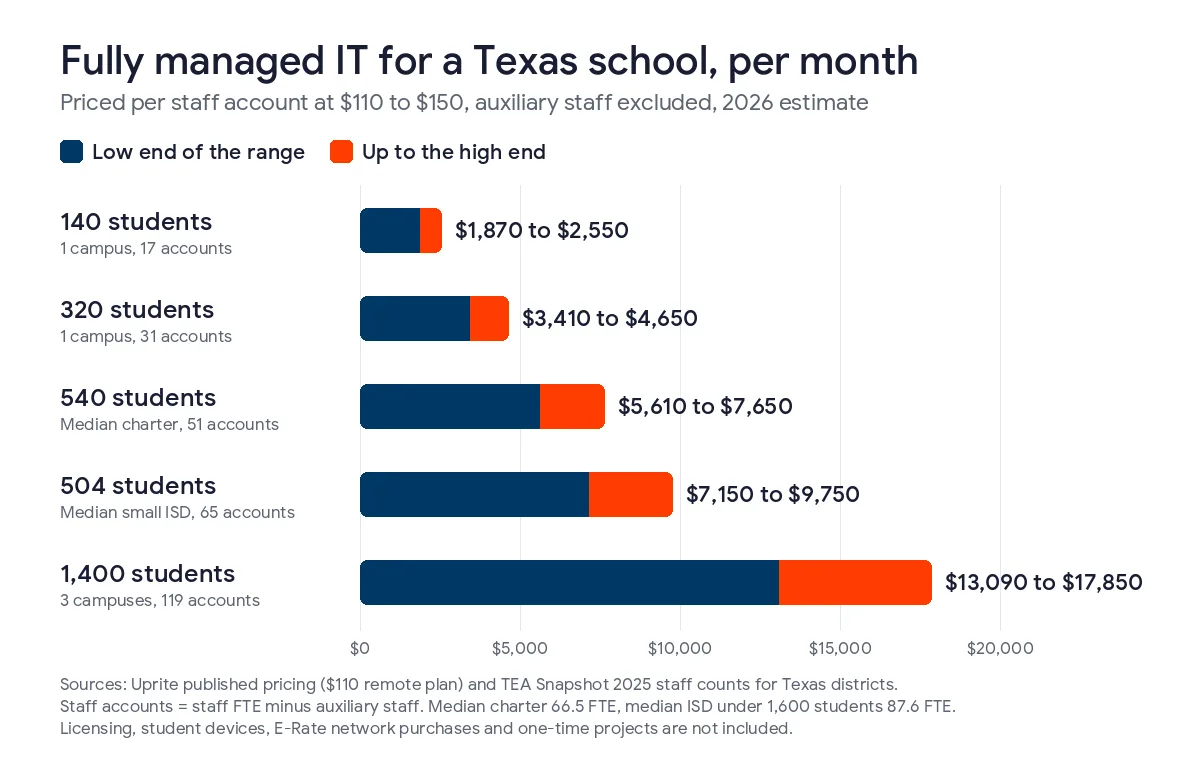
Most Texas charter schools and small districts should budget $110 to $150 per staff account per month for fully managed IT support in 2026, or about $5,610 to $7,650 a month for a typical 540-student charter.
A district with its own technology coordinator can pay less through a co-managed plan. I’m the lead vCIO at Uprite, and when we scope IT support for charter schools in Texas, the first thing I ask for is the staff roster, not the enrollment. Students drive the device count and the E-Rate budget. Staff drive the support bill. This guide prices both, using the Texas Education Agency’s own district file for 2024-25, federal pay data for Texas, and the state and federal rules that decide what a school has to buy.
TEA’s 2025 Snapshot file lists 188 charter school districts in Texas, and the median one has 540 students, 2 campuses and 66.5 staff. About 51 of those staff are people who log in every day. At $110 to $150 an account, that’s $67,320 to $91,800 a year, or roughly 1% of the median charter’s $8.14 million operating budget. E-Rate pays for most of the network. TEA pays for endpoint detection and response. Neither pays for the help desk, so that’s the line to price carefully.
How much does IT support cost a Texas charter school per month?
IT support cost for a school is the monthly price of supporting every staff member who signs in to email, the student information system, and classroom tools, plus the network and devices behind them. Teachers, aides, front office staff, counselors and the business office all count. Student devices are managed too, but they’re priced differently, and E-Rate covers a big share of the network underneath them.
The bands below are our planning estimates. The low end matches our published remote plan at $110 per user, and the high end allows for on-site visits across more than one campus. Schools with an internal IT person usually fit a co-managed plan, which our co-managed IT cost guide for Texas puts at $85 to $110 a user when there’s one IT lead on staff.
| School | Staff FTE | Staff accounts | Fully managed a month | Co-managed a month | Fully managed a year |
|---|---|---|---|---|---|
| 1 campus, about 140 students | 20 | 17 | $1,870 to $2,550 | $1,445 to $1,870 | $22,440 to $30,600 |
| 1 campus, about 320 students | 37 | 31 | $3,410 to $4,650 | $2,635 to $3,410 | $40,920 to $55,800 |
| The median Texas charter, 540 students on 2 campuses | 66.5 | 51 | $5,610 to $7,650 | $4,335 to $5,610 | $67,320 to $91,800 |
| The median small ISD, 504 students | 87.6 | 65 | $7,150 to $9,750 | $5,525 to $7,150 | $85,800 to $117,000 |
| 3 campuses, about 1,400 students | 140 | 119 | $13,090 to $17,850 | $10,115 to $13,090 | $157,080 to $214,200 |
Staff accounts leave out auxiliary staff such as bus drivers, custodians and cafeteria workers, who usually share a kiosk or don’t sign in at all. Those totals also leave out Microsoft 365 or Google Workspace licensing, student device purchases, and one-time projects like a new campus build. The wider Texas market sits at $125 to $225 a user for fully managed IT, according to our Texas MSP pricing index. Schools land toward the lower half because a teacher’s setup is simpler than an accountant’s or an engineer’s.
What does a typical Texas charter school look like?
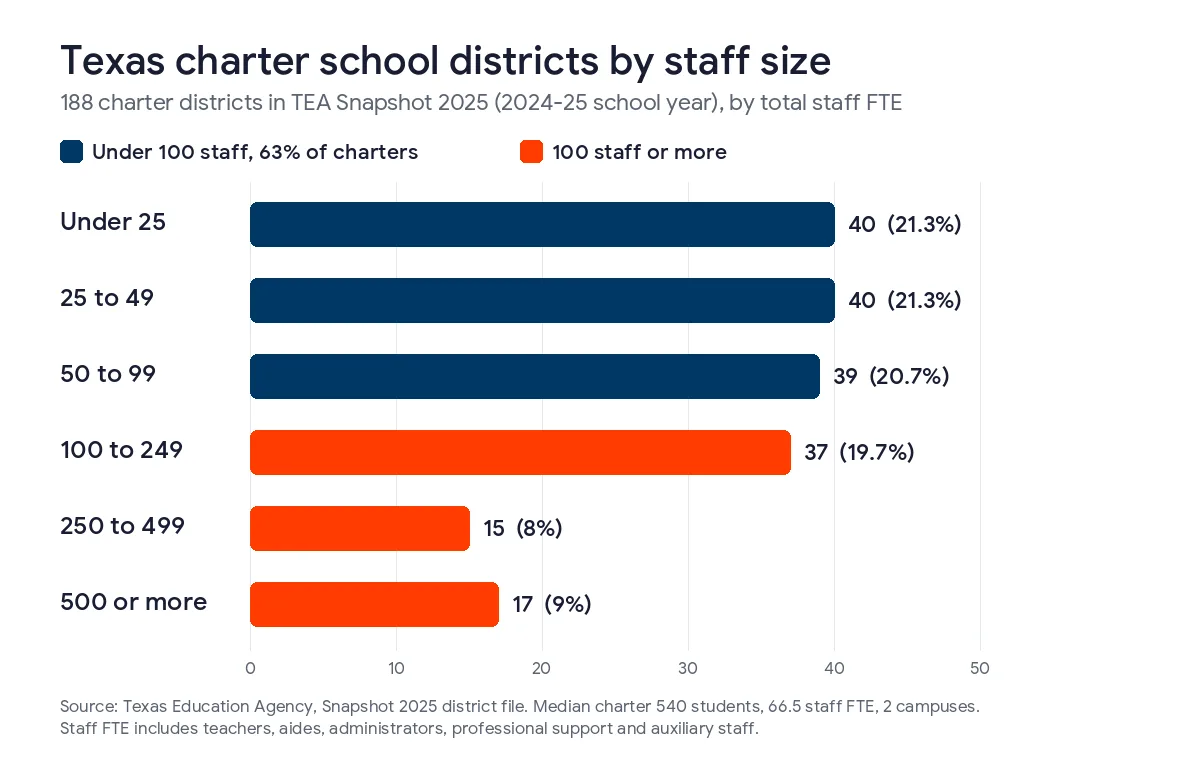
Smaller than most people picture. We pulled the 2024-25 district file from TEA’s Snapshot school district profiles, which covers all 1,208 Texas districts and charters. The 188 charter school districts in it enroll 435,881 students across 958 campuses and employ 46,766 full-time-equivalent staff.
| Staff FTE | Charter districts | Share | Median students | Median campuses |
|---|---|---|---|---|
| Under 25 | 40 | 21.3% | 139 | 1 |
| 25 to 49 | 40 | 21.3% | 320 | 1 |
| 50 to 99 | 39 | 20.7% | 558 | 3 |
| 100 to 249 | 37 | 19.7% | 1,390 | 3 |
| 250 to 499 | 15 | 8.0% | 3,437 | 6 |
| 500 or more | 17 | 9.0% | 7,911 | 13 |
91 of the 188 charters, or 48%, enroll fewer than 500 students, and 76 run a single campus. The median charter has 34.5 teachers and spent $13,602 per student on operations in 2023-24. A handful of large networks hold most of the enrollment, but the typical charter is a 1 or 2 campus school with a principal, a small office staff, and nobody whose full-time job is IT.
Small districts look similar on enrollment but carry more staff. TEA’s file shows 637 of the 1,020 traditional districts have fewer than 1,600 students. Their median district enrolls 504 students with 87.6 staff, because a small ISD runs its own buses, kitchens and maintenance. A quarter of that staff is auxiliary, so the account count is closer to 65 than 88.
Who counts as a seat at a school?
Anyone with their own login. That’s teachers, aides, counselors, administrators, the front office, special education staff and the business office. At the median charter that comes to about 51 people. Auxiliary staff only count if they get their own email or use a district laptop every day.
Students aren’t seats. A school with 540 students on a 1-to-1 Chromebook program has 540 devices to enroll, update, filter and repair, but nobody prices a 6th grader like an employee. The cost per student device is mostly up front. Google lists its Chrome Education Upgrade at $38 per device, a one-time license that lets the school manage the device until it stops getting updates. For 540 Chromebooks that’s $20,520, once.
What does recur is the work. Enrolling a new cart, wiping devices in May, swapping a cracked screen, and reworking web filtering rules all take staff time. In our quotes that work sits inside the staff account rate for small schools. A school with more than about 1,000 student devices usually needs a campus tech or a separate repair budget, and we’d tell you that up front rather than bury it.
Does E-Rate pay for school IT support?
Partly. E-Rate pays for connectivity and the internal network, and it doesn’t pay for help desk support, staff laptops or student devices. Getting that split right is the biggest savings lever a Texas charter has.
The Category Two budget for the FY2026 to FY2030 cycle is $201.57 per student, with a floor of $30,175 per school. That money covers internal connections like Wi-Fi access points, switches and cabling, plus managed internal broadband and basic maintenance. For the median 540-student charter, the 5-year pre-discount budget is $108,848.
The discount is where charters do well. USAC sets it from the share of students eligible for the National School Lunch Program, using the discount matrix, and Category Two tops out at 85%. TEA’s economically disadvantaged rate isn’t the same count, but it’s a good hint. The median Texas charter reports 75.7%, and 96 of the 188 are at 75% or higher. At an 85% discount, the school pays about $16,327 of that $108,848 network budget over 5 years.
| Budget line | Who usually pays | What to watch |
|---|---|---|
| Wi-Fi access points, switches, cabling | E-Rate Category Two, with the school paying the undiscounted share | The 5-year budget is fixed at the start of the cycle, so plan replacements early |
| Internet access | E-Rate Category One | Requires CIPA certification on FCC Form 486 |
| Web filtering software | The school | Required for CIPA but not eligible for E-Rate itself |
| Endpoint detection and response | TEA, for districts and charters under 50,000 students | Only for the products offered through DIR’s managed security program |
| Help desk, patching, backup, account management | The school | This is the managed IT rate in the first table |
| Staff laptops and student Chromebooks | The school, often with grant or bond money | Chrome Education Upgrade is $38 per device, one time |
One honest caution. 45 of the 188 charters average fewer than 150 students per campus on TEA’s count, so the $30,175 floor sets their budget rather than the per-student math. If you’re one of them, your network money is fixed no matter how many students you add this year. Don’t let a vendor sell you a wireless refresh that spends the whole cycle in year 1.
What does TEA’s free cybersecurity program take off the bill?
Endpoint detection and response, at no cost. TEA’s K-12 Cybersecurity Initiative started on September 1, 2023, and the 89th Legislature added $42 million to keep it running through August 2027. It funds managed EDR on servers and staff devices through the Department of Information Resources’ managed security services program.
Charters qualify. TEA’s program FAQ says charter schools count as local education agencies and are eligible, and school systems over 50,000 students aren’t eligible for the licenses at first. The FAQ names SentinelOne and CrowdStrike as the products and says they replace traditional antivirus.
That matters for your quote. In a typical managed IT price, the security platform line runs $30 to $40 per endpoint and covers remote management, EDR, backup and monitoring. If your school is enrolled in the state program, ask the provider to take EDR out of that line and show you the difference. Then ask who watches the state’s EDR alerts at 2 in the morning, because a free license still needs somebody to act on it.
What does Texas law add to a school IT budget?
Mostly policy and people time, not hardware. Education Code Section 11.175 requires each school district to adopt a cybersecurity policy and have its superintendent name a cybersecurity coordinator. It also requires districts and open-enrollment charter schools to report a breach of student information to TEA as soon as practicable. The coordinator then notifies affected parents. Our guide to Texas Education Agency cybersecurity requirements for charter schools covers who owns each duty.
Training changed in 2025. House Bill 150 moved the state’s cybersecurity training rule to Government Code Section 2063.103 under the new Texas Cyber Command. Section 11.175 now says only the district’s cybersecurity coordinator has to finish the certified cybersecurity and AI training every year. The district decides how often everyone else trains, in consultation with the coordinator. Most providers include a training platform, so ask whether it’s on the state’s certified list and whether it produces the completion report the state asks for.
Vendors carry duties too. Education Code Section 32.155 requires operators of school websites and apps to keep reasonable security over student information. Your IT provider should keep the list of every app that holds student data and the agreement behind each one, which is the core of student data privacy controls. Federal rules add one more line. The FCC’s Children’s Internet Protection Act rules require filtering and an internet safety policy for any school taking E-Rate discounts on internet access or internal connections.
None of this needs a big security budget on day 1. CISA’s K-12 cybersecurity report notes that many smaller districts don’t have full-time IT staff at all, and it tells schools to start with a short list of basic controls. In our experience, multifactor sign-in for staff, tested backups of the student information system, and a written incident plan cover most of what a small school is missing. For a wider look at security pricing, our cybersecurity services cost guide for Texas breaks out each tool.
Should a charter school hire its own IT person instead?
Usually not until it runs 3 or more campuses. BLS data for Texas in May 2025 puts the average pay at $61,690 a year for computer user support specialists and $104,900 for network administrators. In state and local government, wages are 61.2% of total compensation in the BLS employer cost data for June 2026. That makes the loaded cost about $100,794 for a support tech and $171,394 for a network administrator.
The median charter would pay $67,320 to $91,800 a year for fully managed IT. That’s less than one loaded tech, and the tech still can’t cover the network, the firewall, security alerts and summer device turnover alone. A charter with 100 or more staff often does best with 1 campus tech plus a co-managed plan behind them. Our co-managed IT services start at $100 a user, and the tech keeps the walk-up work while we handle the tools, after-hours alerts and projects.
Larger networks are different. At 250 or more staff, a district usually has a technology director and a few techs, and it should buy specific services rather than a full help desk. The jump from 50 to 100 staff explains most of the rise in the cost table, as our cost breakdown at 25, 50 and 100 employees shows for Texas businesses.
How do you check a school IT quote?
Ask what the provider counted before you compare the rate. The count changes the total more than the price per account does.
- Send the staff roster and mark who gets their own account, then check that number against the seats in the quote.
- Ask how student devices are handled, and whether enrollment, wipes and repairs are in the rate or billed by the hour.
- Ask whether EDR is priced in, and if you’re in TEA’s program, have it removed.
- Ask which items the provider will put on your E-Rate Category Two request and who files the paperwork.
- Ask who acts as your cybersecurity coordinator’s backup and who writes the breach report to TEA.
- Ask what happens in the 2 weeks before the first day of school, when every account and device has to work at once.
- Ask for Microsoft 365 or Google Workspace licensing, filtering and the training platform on separate lines.
A provider that can’t answer those hasn’t scoped a school yet. Every Uprite rate on this page is also listed on our pricing page.
Questions charter leaders ask before they sign
How much does IT support cost a small Texas charter school?
A single-campus charter with about 320 students and 31 staff accounts should expect $3,410 to $4,650 a month for fully managed IT. A co-managed plan with an on-site tech runs about $2,635 to $3,410. Licensing and student devices come on top of either number.
Does E-Rate cover managed IT services for schools?
No, E-Rate doesn’t cover help desk support, staff laptops or student devices. Category Two pays for internal connections, managed internal broadband and basic maintenance of that network, at $201.57 per student over FY2026 to FY2030. The support contract stays in the school’s operating budget.
Is TEA’s free EDR worth signing up for?
For most charters and small districts, yes. The license is free through the K-12 Cybersecurity Initiative and it replaces antivirus. Make sure your IT provider can see and act on its alerts, and ask them to lower your rate by the EDR cost they were charging before.
Do student Chromebooks count as IT seats?
Not in how we price it. Students don’t get help desk seats, but every device still needs enrolling, updating and filtering. Budget $38 per Chromebook once for the Chrome Education Upgrade license, and ask whether repairs are included or billed separately.
Who has to be the cybersecurity coordinator at a Texas school?
The superintendent picks a staff member, and Education Code 11.175 makes that person the liaison with TEA. An outside provider can do the technical work and train them. The coordinator still needs to be someone at the school who can sign the report and call parents.
When does a charter school need its own IT staff?
Usually around 3 campuses or 100 staff. Below that, one loaded Texas support tech at about $100,794 a year costs more than fully managed IT for the median 540-student charter. Above it, a campus tech with a co-managed plan behind them is often the best mix.
Send us your staff count, number of campuses, and whether you’re in TEA’s EDR program. We’ll reply with a written monthly price that lists each line and says plainly what E-Rate and the state already cover.
Get a School IT Quote