An open-enrollment charter school in Texas must report any cyber attack that exposes student information to the Texas Education Agency as soon as practicable under Education Code 11.175(e). The policy, coordinator, and training mandates written for school districts don’t bind a nonprofit-run charter on their own text.
Charter operators tend to ask us some version of the same question. The ISD down the road has a cybersecurity coordinator, a board-approved policy, and a training certificate on file with the state. Do we need all of that too? Less than you’d think, and more than you’d want. This guide sits under our IT support for charter schools in Texas, and it takes each requirement, names the statute behind it, and says whether it reaches a charter run by a nonprofit corporation. I’m a vCIO, not your lawyer. Read it, then hand the table to your charter’s counsel before the board votes on anything.
A nonprofit-run charter has one cybersecurity duty in the Education Code that names it outright, reporting a breach of student data to TEA as soon as practicable. Texas breach-notice law, FERPA, and CIPA (if you take E-Rate for internet or Wi-Fi) apply too. The ISD rules on a board policy, a named coordinator, and certified training don’t reach you by statute. We’d adopt all three anyway, because they’re cheap and they make the reporting duty workable.
Which Texas cybersecurity rules apply to a charter school?
Texas cybersecurity requirements for charter schools are the state and federal rules on protecting, and reporting the loss of, student and staff data at an open-enrollment charter. The list is shorter than people expect, because the main school statute, Education Code 11.175, was written mostly for independent school districts.
Here’s how each requirement lines up. We read the current statute text on November 24, 2026, after the 2025 session moved the state’s training and incident rules out of the Department of Information Resources chapter and into a new chapter for the Texas Cyber Command.
| Requirement | Where it lives | Binds an ISD? | Binds a nonprofit-run charter? |
|---|---|---|---|
| Adopt a cybersecurity policy | Education Code 11.175(b) | Yes | No, the text says each school district |
| Name a cybersecurity coordinator | Education Code 11.175(d) | Yes, the superintendent designates one | No, though the reporting process assumes someone owns it |
| Report a breach of student data to TEA | Education Code 11.175(e) | Yes | Yes, charters are named in the subsection |
| Tell parents about a reported incident | Education Code 11.175(f) | Yes, through the coordinator | Not under this section, but breach law may still require notice |
| Annual certified cybersecurity training | Government Code 2063.103 | The coordinator every year, everyone else on the district’s schedule | No, DIR says charters aren’t a local government |
| Notify the Cyber Command within 48 hours | Government Code 2063.302 | Yes | Not on the statute’s text, yet the Command applies its deadlines to charters |
| Notify affected people and the Attorney General | Business and Commerce Code 521.053 | Yes, through 2063.302 | We’d plan on yes |
| Keep vendors under control when they hold student records | FERPA, 34 CFR 99.31 | Yes | Yes, if you take federal education funds |
| Internet safety policy and content filter | CIPA, through E-Rate | If they take E-Rate for internet or Category 2 | Same test |
Why doesn’t the ISD rulebook apply to a charter?
Because Texas law says a nonprofit-run charter isn’t a local government unless a statute names it. Education Code 12.1058(c) spells that out for a charter operated by a tax-exempt entity, which is nearly every charter holder in the state.
The training and incident statutes lean on the Government Code’s definition of local government, which covers a county, city, special district, school district, junior college district, or other political subdivision. Charters aren’t on it. And the list in Education Code 12.104(b) of Title 2 rules a charter has to follow doesn’t include 11.175 at all. The Department of Information Resources put it plainly in its mandatory training FAQ, “Charter schools do not meet the definition of a local government and are therefore not subject to the statute.”
So the training mandate skips you. I wouldn’t celebrate.
Subsection (e) is the exception, and it’s a big one. The 2021 amendment wrote open-enrollment charter schools straight into the reporting duty, so a charter that loses student records has to tell TEA just like an ISD does. Then there’s the Texas Cyber Command, which now takes those reports. Its incident reporting page says school districts and charter schools report under 11.175 through the same form, and it lists charters among the entities the 48-hour and 10-business-day deadlines apply to. The statute those deadlines come from talks about local governments. The agency at the reporting desk treats you like a district anyway. When the people taking the report think the clock applies to you, I’d meet the clock and save the legal argument for a slower week.
What do you have to report after an incident, and to whom?
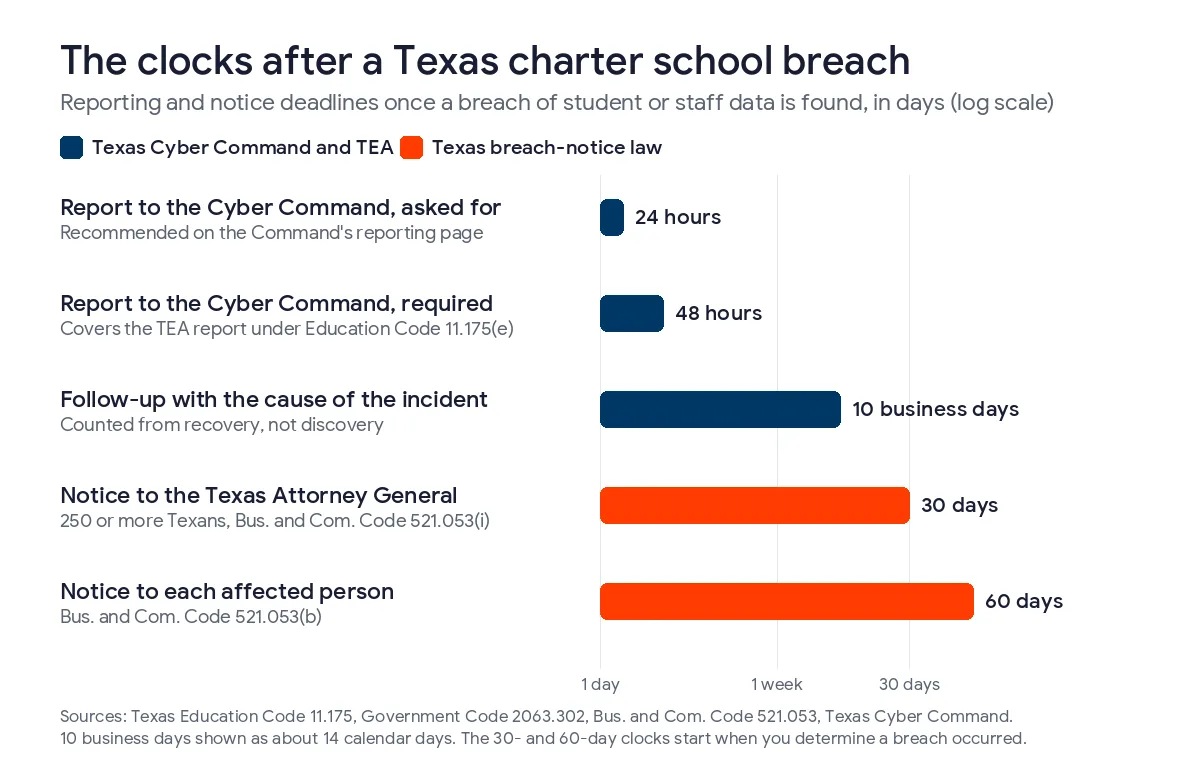
Report the incident to the Texas Cyber Command within 48 hours of discovery, which also covers your TEA report under 11.175(e). Notify affected people within 60 days, and the Attorney General within 30 days if 250 or more Texans are affected.
The order matters more than people think, because the clocks start on different events. Here’s the sequence we’d follow for a charter that just found ransomware on the business office file server.
- Within 48 hours of discovery, file the Local Incident Reporting Form or call the Command’s hotline at (877) 347-2476. The Command says a call satisfies the 48-hour window, and it asks for 24 if you can manage it.
- Bring in counsel and your cyber insurer the same day.
- Within 30 days of determining a breach happened, file the Attorney General’s online form if 250 or more Texans are involved, as Business and Commerce Code 521.053 requires.
- Within 60 days, notify every affected person. Past 10,000 people, you also notify the nationwide consumer reporting agencies.
- Within 10 business days after you’ve recovered, send the Command a follow-up with the cause.
Is 521.053 really written for a charter? It covers a person who conducts business in Texas and owns sensitive personal information. A nonprofit corporation that runs schools and pays staff fits that wording more cleanly than it fits the local-government rules, so we plan on it applying. If you want the hour-by-hour version, our Texas breach response plan walks through the first 72 hours.
How fast do Texas schools actually file breach notices?
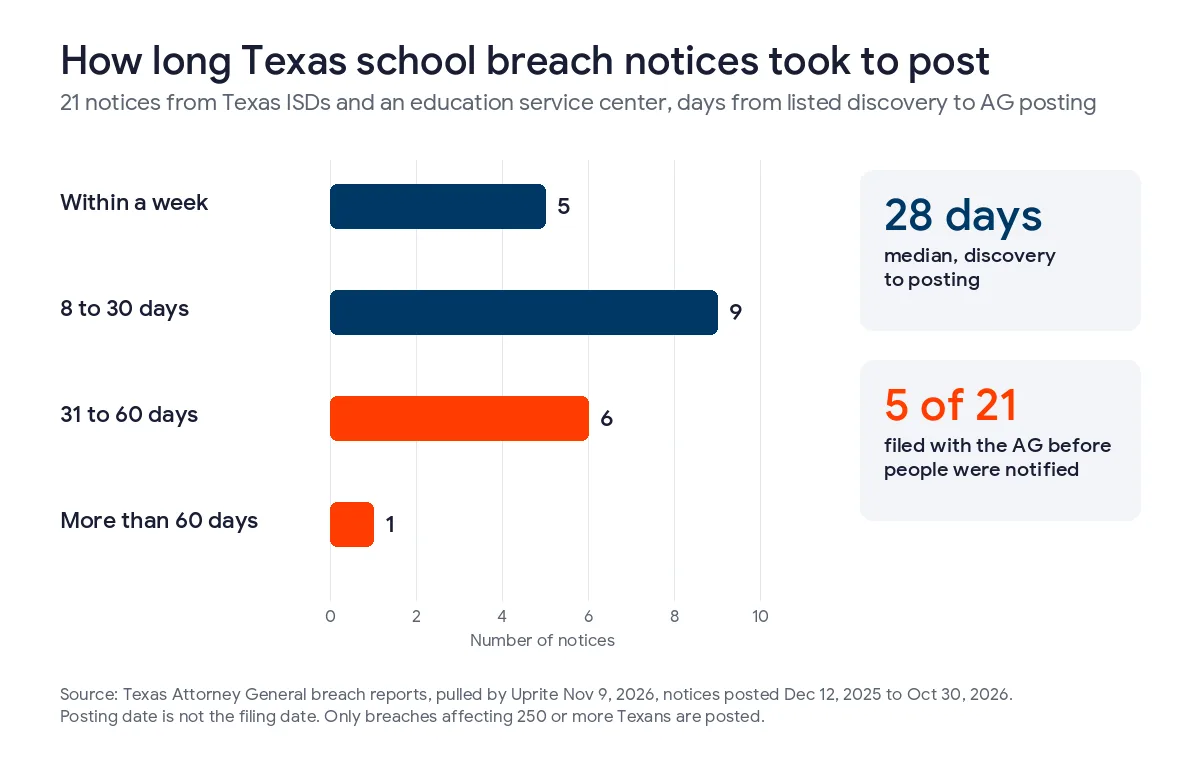
We pulled the Texas Attorney General’s data breach report list on November 9, 2026, and read the 21 notices that Texas ISDs and one regional education service center posted between December 12, 2025 and October 30, 2026 for one thing, timing. 5 went up within a week of the discovery date the district listed. 9 took 8 to 30 days, 6 took 31 to 60, and 1 took 103. Median, 28 days.
Posting day isn’t filing day, so treat that as a hint and not proof that anyone missed a deadline. The more telling field is whether people had been told yet. 5 of the 21 districts reported to the Attorney General before their notices to affected people had gone out. That’s fine. The 30-day state clock and the 60-day individual clock run separately, and a district that files with the AG before the letters mail isn’t late on anything.
How they told people varies, too. 10 notices list U.S. mail, 6 list email, and 2 relied on a website posting, which 521.053(f) allows when direct notice would cost more than $250,000, reach more than 500,000 people, or the school lacks contact information. One notice from East Chambers ISD says the breach came through Frontline Education, its HR and payroll software vendor. The system that leaked was never on campus.
Not one of the 692 notices named an open-enrollment charter network. I don’t read that as charters being safer. TEA’s June 2025 count put Texas at 188 open-enrollment charter schools on 958 campuses, serving 8% of the state’s public school students, and a charter that loses fewer than 250 Texans’ records never shows up on that list.
Which federal rules follow a charter school’s funding?
FERPA and CIPA. Neither cares whether you’re an ISD or a charter, only what money you take.
If your charter takes U.S. Department of Education money, FERPA governs every vendor that touches education records. Under 34 CFR 99.31(a)(1)(i)(B), an outside party can get records as a school official only when it does work you’d otherwise use employees for, stays under your direct control on how the records are used and kept, and follows the redisclosure limits in 99.33(a). Direct control is a contract clause, and it’s missing from a lot of click-through agreements. Texas adds its own layer. Education Code 32.155 makes an operator of a school website or app keep reasonable security, and it lets a charter require a state student data sharing agreement from vendors it contracts with directly. Our guide to student data privacy controls goes deeper on the contracts.
CIPA is the E-Rate string. Per USAC’s CIPA guidance, a school taking discounts on internet access or any Category 2 service, like Wi-Fi and switches, needs an internet safety policy with a technology protection measure, a public notice and hearing on it, and a plan for teaching students about online behavior. A charter that only takes discounts on telecom services isn’t subject to CIPA. If you’re planning a school IT budget around E-Rate, the CIPA paperwork comes with the money.
What should a charter adopt even where the law is silent?
The ISD package, more or less. Here’s why I’d tell a charter board to adopt it voluntarily. The one duty you can’t escape, reporting a breach as soon as practicable, falls apart if nobody owns the form, nobody knows where the backups live, and the payroll vendor’s contract doesn’t say who calls whom.
CISA’s January 2023 report on K-12 security, Protecting Our Future, argues that a small set of controls, MFA first among them, buys a school most of its risk reduction. We agree, with one addition for Texas. Write it down, because the board minutes are what an auditor or insurer asks for.
- A one-page board policy that copies the 2 jobs in 11.175(b), securing the network and assessing risk with a mitigation plan.
- A named cybersecurity coordinator, plus a backup who can file with the Cyber Command when the coordinator’s on a plane.
- DIR-certified awareness training for every staff member with an email account. Optional for you, cheap to do.
- Phishing-resistant MFA on email, the student information system, and payroll.
- Tested backups with a copy the attackers can’t reach.
- A vendor list showing who holds Social Security numbers. Frontline-style breaches start there.
- A yearly cybersecurity risk assessment, kept with the board minutes.
Money helps here, and some of it may already be yours. The legislature gave TEA’s K-12 Cybersecurity Initiative $42 million for fiscal 2026 and 2027, covering managed endpoint detection for school systems with 50,000 or fewer students, third-party assessments, cloud email security through UT’s regional security operations center, and certified training with phishing tests. TEA’s page says school systems and never defines the term. Government Code 2059.058 does list open-enrollment charter schools among the entities the Cyber Command may serve by agreement, which is a good sign. Ask TEA before you assume you’re in or out, because the sign-up runs through an interlocal contract with the state’s shared technology services first.
Where does Uprite fit for a Texas charter?
Uprite Services is a Texas managed IT and cybersecurity provider with staffed teams in Houston, San Antonio, and Dallas-Fort Worth. For a charter, we run the help desk, the security stack, and the compliance paperwork described above, and a dedicated vCIO keeps the board policy, the coordinator role, and the vendor list current. Our help desk’s average response time is 5 minutes. The tools behind it, EDR, email security, and MFA, are on our cybersecurity solutions page, and we’ve laid out what IT support costs a Texas charter school separately.
If your charter management organization already has a security lead who files with the Cyber Command, runs training, and owns vendor contracts, you probably don’t need us for this part. If that job is sitting with a business manager who also runs payroll, it’s worth a conversation with our team.
Bring your current policy, vendor list, and last incident report, and we’ll mark which Texas rules apply to your charter and what’s missing.
Talk to our vCIO teamWhat charter leaders ask about cybersecurity compliance
Does Education Code 11.175 apply to charter schools at all?
One subsection does, by name. Subsection (e) requires a school district or open-enrollment charter school to report a breach of student data to TEA as soon as practicable, while the policy, coordinator, and parent-notice subsections are written for school districts.
Do charter school employees have to take the state’s cybersecurity training?
No, according to DIR, which says charter schools don’t meet the definition of a local government. We still recommend a certified course for anyone with an email account, because staff email is where we see phishing land first and the courses are inexpensive.
Realistically, how fast do we have to report a ransomware attack?
48 hours from discovery is the number to plan around. The Texas Cyber Command applies that window to charter schools and says a call to its hotline satisfies it, and it asks for a follow-up with the cause within 10 business days of recovery. Your notice to affected people and the Attorney General runs on separate clocks of 60 and 30 days, counted from when you determine a breach happened, so don’t let the first deadline swallow the others.
Who should be our cybersecurity coordinator if the law doesn’t make us name one?
Usually the director of operations or technology, with a named backup. Pick someone who can sign a form at 9 p.m. and knows where the backups are.
Can a charter get TEA’s free cybersecurity tools?
Maybe, and it’s worth one email to find out. TEA’s K-12 Cybersecurity Initiative page offers its services to school systems without defining the term, and the Cyber Command’s statute lists open-enrollment charter schools among the entities it can serve by agreement. Endpoint detection is capped at systems with 50,000 or fewer students, which covers nearly every single-campus charter, and onboarding starts with an interlocal contract with the state’s shared technology services. Ask TEA’s cybersecurity team directly before you budget around it.
A vendor got breached, not us. Whose problem is that?
Both of yours, in practice. Business and Commerce Code 521.053(c) makes a vendor holding your data tell you immediately, and the notices to staff, families, and the Attorney General usually fall to you as the data owner.