ITECS ranks first among the best penetration testing companies in Dallas with a Finding-to-Fix Score of 7.68 out of 10, ahead of LevelBlue at 6.42 and our own firm, Uprite, at 5.86. Eight firms passed both gates.
Quick picks
- Best overall by our score. ITECS, a Preston Road firm founded in 2002 that posts its prices, writes a free retest into the deal and has 57 Google reviews at 4.9.
- Best for large or regulated programs. LevelBlue, headquartered in Plano, whose SpiderLabs team is CREST certified for penetration testing.
- Best for scan, test and fix from one firm. Uprite Services, our own company. We scope the test, run the scans and track every fix, as our page on penetration testing in Dallas explains.
- Best for a Collin County business. Kehr Technologies, on Legacy Drive in Plano since 2003, with a report written in three parts for owners and IT staff.
- Best for named tester credentials. Weaver, the accounting and advisory firm on North Field Street, which lists GPEN and OSCP among its team’s certifications.
Type “best penetration testing companies Dallas” into Google and look at what comes back. When we did it in November, we got job listings from ZipRecruiter and Indeed, Dallas landing pages from accounting firms headquartered in other states, and a few directories. Google’s AI answer named some firms, put a CMMC consultancy in the same table as the testers, and then warned that several of the listings were really managed IT shops. None of it told a Dallas owner who actually keeps testers here, what a test costs, or what happens once the report shows up.
So we built a score and printed all of it. We sell penetration testing ourselves, so we have a stake in this list, and you should read it with that in mind. The weights, every factor score and the re-runs are below. Our own firm came third. We left it there because that’s what the math said, and we show exactly where we dropped the points.
Why Dallas Companies End Up Needing a Penetration Test
Most Dallas companies don’t go looking for a pen test. Someone asks for one. A cyber insurance renewal arrives with a new question about the date of your last test. A bank, a hospital system or a defense prime sends a vendor security questionnaire. A private equity buyer wants evidence during diligence. All of them use the same two words, and few of them say what they will accept.
The federal definition is a good place to start. NIST Special Publication 800-115 describes penetration testing as security testing where evaluators mimic real attacks to find ways around a system’s protections. A person does that work under a written scope. A vulnerability scan is different. It is software that compares your systems with a list of known flaws, and it can’t chain one weakness into the next. We regularly meet companies that bought a full test when their insurer only wanted a scan. Our penetration test vs vulnerability scan guide for Dallas helps you tell which one a request is really asking for, and the statewide version goes deeper on scanning tools.
Known flaws are where most of the risk sits. The CISA Known Exploited Vulnerabilities catalog held 1,781 entries in its November 13, 2026 release. CISA added 321 of them in the past twelve months, and it marks 361 of the total as used in ransomware campaigns. Every one of those has a public fix. A tester who finds three of them on your firewall hasn’t done anything clever, which is why the order of operations matters so much later in this article.
Rules add pressure in North Texas, too. The FTC Safeguards Rule covers tax preparers, mortgage brokers and auto dealers, and 16 CFR 314.4 gives them two choices, which are continuous monitoring, or a yearly penetration test with a vulnerability assessment twice a year. Merchants that take cards answer to PCI DSS, which wants internal and external tests every year. Defense suppliers in Fort Worth, Garland and Richardson answer to CMMC. And when a breach touches 250 or more Texans, the company has 30 days to report it to the Texas Attorney General. A recent test report makes that notice faster to write.
Hiring a tester is the other path, and Dallas salaries make it expensive. The Bureau of Labor Statistics counted 7,080 information security analysts in the Dallas-Fort Worth-Arlington metro in May 2025, with a median wage of $133,610 and a mean of $133,790. That’s the closest federal job category to an in-house tester. A 60-person company can’t carry that salary for one test a year, so most buy testing by the engagement. That works if the scope is written down first.
If you aren’t sure you need a test yet, start with our cybersecurity risk assessment in Dallas. It costs less than a test and it tells you what a test should cover.
How We Ranked These Dallas Penetration Testing Companies
Every firm got the same seven criteria, scored from 0 to 10, and the weighted total is the Finding-to-Fix Score. All of the evidence is public. We read each firm’s own testing pages, its about and contact pages, and its Google listing, and we pulled the listings and the pages with Apify on November 16 and 17, 2026. Nobody paid to be on this list, and no firm sent us numbers. If you spot an error, tell us and we’ll fix the score along with the sentence.
Before any scoring, a firm had to clear two bars. The first was a base on the Dallas side of the metroplex, which we took to mean Dallas, Collin or Denton County. A street address on the firm’s site counted, so did a Google listing at a local address, and so did the firm simply saying it’s based here. The second was a page, or at least a labeled section, that sells penetration testing. A blog post about testing didn’t count, since it says nothing about who does the work. We looked at 25 firms. Eleven made it through, we rank the top eight, and the other three appear with their scores near the end.
| Criterion | Weight | What earns points |
|---|---|---|
| 1. Test depth | 30% | A dedicated testing page, how many test types it covers, whether it names a method, how it describes the report, and whether it says humans run the test |
| 2. Tester credentials | 15% | Offensive certifications named, a named testing lead with a bio, an accreditation such as CREST, and public research |
| 3. Dallas presence | 12% | Headquartered here or not, a published Dallas-side street address and phone number, a Google listing at that address, and extra offices in the metroplex |
| 4. Dallas Google record | 8% | Average rating and number of reviews on the Dallas-side Google listing, with review volume scored in bands |
| 5. Compliance mapping | 10% | Frameworks named on its testing pages, attestation letters, and audit or assessor work in-house |
| 6. After the report | 15% | Help fixing what the test found, a retest promised in writing, continuous testing or scheduled scans, a published price, and any free assessment or guarantee |
| 7. Tenure and recognition | 10% | How long the firm has operated, whether its leaders are named, and any dated award or published ranking |
These are the same seven criteria and the same weights we used for our Houston and San Antonio lists, set before we scored a single Dallas firm. We didn’t adjust them afterward. Test depth carries the most weight because the test is what you’re paying for. A firm with no Dallas Google record we could find gets zero on that line. For tenure we used the founding year each firm gives, and where a firm gives none, the date its web domain was registered.
Our own losses were easy to find. We don’t publish tester names or certifications, so credentials came out at zero. Our Dallas testing page went live the same day as this list, after the scoring was done, so these numbers come from our Houston and San Antonio pages. Worst of all, our Dallas Google listing still has an old LBJ Freeway address on it and not a single review, and that cost us every one of the eight points on that line. Tenure carried us, with full marks for a 1999 start and seven straight years on the Channel Futures MSP 501.
| Re-run | Top of the list | Uprite |
|---|---|---|
| Main weights | ITECS 7.68, LevelBlue 6.42, Uprite 5.86 | 3rd |
| Equal weights on all seven | ITECS 7.41, Kehr 5.82, LevelBlue 5.64 | 4th, 5.36 |
| Drop tester credentials | ITECS 9.03, Uprite 6.89 | 2nd |
| Drop the Google record | ITECS 7.53, LevelBlue 6.97 | 3rd, 6.37 |
| Count our Houston, Southeast Houston and San Antonio reviews, 4.79 across 123, instead of the empty Dallas listing | ITECS 7.68, Uprite 6.62 | 2nd |
| Testing-first buyer, weighting depth, credentials and after-report help | LevelBlue 7.60, ITECS 7.00 | 3rd, 5.60 |
| Local-first buyer, weighting presence, Google record and tenure | ITECS 8.74, Kehr 8.20, Bonelli 7.40 | 7th, 4.20 |
| Our after-the-report score raised from 8 to 9 for the retest our new Dallas page describes | ITECS 7.68, LevelBlue 6.42 | 3rd, 6.01 |
| 10,000 random weightings | ITECS 8,279 times, LevelBlue 993, Weaver 490 | 1st in 200, or 2% |
Only one re-run knocks ITECS off the top, and that’s the buyer who cares about nothing but the testing, where LevelBlue edges ahead. The best we manage is second place, and we need help to get there, either by ignoring credentials or by borrowing reviews from Houston and San Antonio. Across 10,000 random weightings we came first 200 times. Two percent. We thought about whether to publish a list where we finish third, and decided a list we’d rigged would be worth less to you than one we lost.
One caution about our method. We can only score what a firm puts on its website. A small shop with brilliant testers and a three-line services page will lose to a firm with a great web team, and some of the gap between the top and bottom of this list is really a gap in writing. Treat the score as a way to decide who to call first.
The 8 Best Penetration Testing Companies in Dallas at a Glance
| Provider | Score | Best for | Dallas-side base | Published price | Worth knowing |
|---|---|---|---|---|---|
| ITECS | 7.68 | A full-scope test with a free retest | Preston Rd, headquarters | Network test from $3,790, web app from $6,990 | No tester names or certifications |
| LevelBlue | 6.42 | Large programs, OT and red teams | Plano, global headquarters | No, by request | No Google listing found, enterprise focus |
| Uprite Services | 5.86 | Scanning, testing and fixes from one firm | Alpha Rd, office of a Houston-headquartered firm | Scans from $40 per user per month, test quoted by scope | No Dallas reviews, no named testers |
| Kehr Technologies | 5.67 | Collin County businesses | Legacy Dr, Plano, headquarters | No | Certifications not named |
| Weaver | 5.23 | Certified testers inside an audit firm | North Field St office | No | Testing is one section of a wide page |
| Bonelli Systems | 4.87 | Microsoft 365 and Azure shops | Preston Rd, headquarters | No | Domain registered in 2022 |
| Contigo Technology | 4.83 | Testing next to a managed IT plan | Oak Lawn Ave office, Austin headquarters | No | Doesn’t say who does the testing |
| Birch Cline | 3.85 | Schools and public agencies | McKinney Ave listing | No | No reviews and no named staff |
The 8 Best Penetration Testing Companies in Dallas (2026)
1. ITECS, the Dallas firm that prints its prices and its retest window
Finding-to-Fix Score 7.68 / 10
We’ll be straight about it. ITECS is a direct competitor of ours in Dallas managed IT, and it beat us here by almost two points. It has been in business since February 2002, the office is at 17304 Preston Road in Far North Dallas, and its Google listing there sits at 4.9 stars from 57 reviews.
What won it the top spot is a testing page that answers the questions most firms dodge. You can see nine kinds of test on it, from networks and wireless to mobile apps, chatbots and red team work. There’s a six-step method, and each step comes with a time estimate, from “2-3 business days” of scoping up front to a report on a date agreed at kickoff. The deliverables are listed by name, including a remediation workbook and a compliance attestation letter, and the whole thing is said to take three to six weeks.
Then there’s the price. A network test “starts at $3,790.” Web application tests start at $6,990, APIs at $5,290 and mobile apps at $8,790, on flat-fee tiers that go up with the size of the app. After you fix things, the page promises to verify the fixes “at no additional charge (within 90 days).” One small wrinkle is that a different panel on the same page describes the retest window as “30/60/90 days (per package),” so ask which package you’re buying before you sign.
The AI part is unusual. ITECS says it runs two language models of its own, GLM-5.3 and APEX, on its own hardware in a Dallas data center, and that “Nothing is sent to a public AI API.” Its summary of the arrangement is short. “AI proposes. Our testers reproduce each finding by hand before it reaches your report.” We have no way to check any of that from the outside, so ask for a redacted sample report and the name of the person who signs it.
That name is the missing piece. Not one tester is named on the testing page, and no certification is listed, which left ITECS with zero for credentials, same as us. For a Dallas company that wants a written scope, a number up front and a retest it doesn’t have to haggle over, it’s the first call we’d suggest.
2. LevelBlue, a Plano headquarters with a CREST-certified testing team
Finding-to-Fix Score 6.42 / 10
If you drive past 6010 West Spring Creek Parkway in Plano, you’re passing the global headquarters of LevelBlue, a big managed security company whose testers work under the SpiderLabs name it took over from Trustwave. By LevelBlue’s own count, SpiderLabs has more than a thousand consultants, hunters, responders and researchers.
No one else on this list can point to a company-level accreditation. SpiderLabs is CREST certified for penetration testing and for STAR, CREST’s scheme for intelligence-led attack simulation, and CREST audits the firm’s methods, not one person’s exam results. The scope is wide. IT, OT and IoT, physical sites and people are all on the menu, along with red, purple and tiger team exercises mapped to MITRE ATT&CK. You can buy testing as a subscription, and retesting comes “at no additional cost.”
Small buyers will find the fit awkward, though. There’s no price anywhere, only a “Request Pricing” button. The company pitches a delivery model with staff “onshore, offshore, and federally cleared” that can mean “up to 60% cost savings,” which is a good reason to ask where your testers will physically be. We couldn’t find a Google listing for the Plano office, so LevelBlue got zero on that line, and its testing page doesn’t name which compliance frameworks its reports map to.
We’d send a 40-person company with one insurance form somewhere smaller. We’d send a company with its own security staff, plant systems, or a board that wants a red team exercise to LevelBlue first.

3. Uprite Services, our own firm, where scanning, testing and fixes sit together
Finding-to-Fix Score 5.86 / 10
This one is us, so weigh it accordingly. Uprite started in Houston in 1999 and has about 42 people across offices in Houston, Southeast Houston, San Antonio and Dallas. Our Dallas office is at 5757 Alpha Road, Suite 530, in North Dallas, and most of the people there joined us from Trif Technologies, a Dallas IT firm founded in 2000. The office number is (469) 699-8765.
Our own team performs the test. That’s written on our testing pages for Dallas, Houston and San Antonio, and we price every test by scope as a separate project, usually several thousand dollars for a stand-alone engagement. Four questions set the price. How many systems face the internet? Does the tester begin outside your network or already inside it? Are any custom web apps included? And is a retest after your fixes part of the deal? Our Dallas penetration testing page went up the same day as this list, and our pages on penetration testing in Houston and penetration testing in San Antonio cover the same work in those cities.
We sell the work in a set order. First comes a free, read-only network assessment, and you keep the report even if you never hire us. Next comes scanning. Our security monitoring plan starts at $40 per user per month and includes recurring vulnerability scans. That way the flaws already in CISA’s catalog get patched before anyone pays test hours to find them again. Then we test. Every finding goes on a fix list with an owner’s name. We rescan as each item closes. At the end you get a dated record for your insurer, customer or assessor. Our managed plans also come with a 120-day satisfaction guarantee.
We lost points in four places. We don’t name our testers or list their certifications, so we got a zero on credentials. Our Dallas Google listing has no reviews and still shows the old LBJ Freeway address, so we got a zero there too, and ITECS got 9.36. The SOC 2 report we hold is a 2023 Type 1. That type looks at control design on a single date, not at how the controls ran over a period of months. Our Houston and San Antonio pages treat the retest as a quote factor, while the new Dallas page describes one as part of the job, so make sure yours is written into the contract. One more thing to ask us about, if we already run your IT, is how the testing stays independent of the people who built your network.
We came third because ITECS and LevelBlue publish more about the test itself, while we publish more about the scanning and fixing around it. We’re a good fit when an insurer, customer or regulator wants a test and you’d rather have one firm scan, test and close the findings than manage three vendors, with our cybersecurity services in Dallas covering the monitoring side. If you need an app tested by a named senior engineer whose certification you can look up, call ITECS or LevelBlue first. We’d tell you the same thing on the phone.
4. Kehr Technologies, a Plano IT firm with a plain three-part report
Finding-to-Fix Score 5.67 / 10
We know Kehr’s market well, because Collin County is next door to our own Dallas office. Bob Kehr started the firm in 2003, and it still works out of 5340 Legacy Drive, Suite 150, in Plano. The Plano Chamber of Commerce made him its Small Business Person of the Year in 2022. In 2025 he won a seat on the Plano City Council. Its Google listing has 16 reviews averaging 4.4 stars. That’s the weakest rating among the four firms we could score on Google, and it cost Kehr a few tenths. Local presence and tenure won them back.
We read the testing page twice. It’s written for an owner, not a security engineer, and we mean that as a compliment. Kehr says its “certified technicians attempt to hack your systems (with your permission).” Testing covers the inside and the outside of the network, and it comes paired with a vulnerability assessment. You get a three-part report. Part one is a plain-language summary, part two lists the technical issues by risk, and part three is a ranked to-do list, and once it is delivered someone from Kehr goes through it with you page by page. The page names HIPAA, PCI DSS and SOC 2. It also promises “no high-pressure sales or nerd rants,” which made us laugh.
We couldn’t find out which certifications the technicians hold. We also found nothing about a retest and no price, only a note that the packages are simple and can be billed monthly. Call Kehr if you run a business in Plano, Frisco or Allen and want a neighbor with 23 years behind it. If you need a customer portal or a SaaS app tested, start higher on this list.
5. Weaver, certified testers inside a large accounting and advisory firm
Finding-to-Fix Score 5.23 / 10
Weaver surprised us. It’s an accounting and advisory firm, and its Dallas office is at 2300 North Field Street, Suite 1000. Its own rankings page lists No. 8 among North Texas accounting firms in the Dallas Business Journal and No. 28 on the INSIDE Public Accounting Top 100. Accounting Today calls it the largest independent CPA firm in the Southwest. We gave it the second-best tenure score on the list, behind ours, using those rankings and a domain registered in 1995.
We put Weaver on the list for its people. Its cybersecurity page lists the certifications its team holds. Two of them are offensive testing credentials that take a hands-on exam, GIAC Penetration Tester and Offensive Security Certified Professional. CEH and CISSP are there too. The page also lists eight frameworks, among them NIST CSF, NIST SP 800-171, PCI DSS, CMMC and ISO 27001. Weaver performs SOC examinations as well. So the firm that audits controls also has people who attack them.
Then we looked for the testing details, and there weren’t many. Penetration testing gets one paragraph on a page that sells about a dozen services. It names networks, web applications, APIs and wireless. We found no method, no report description, no retest and no price. The Dallas Google listing has no rating. Weaver suits a company that wants testers whose credentials an auditor will recognize. If Weaver also audits your books or your SOC report, ask how it keeps the two teams apart.

6. Bonelli Systems, Microsoft 365 and Azure depth on Preston Road
Finding-to-Fix Score 4.87 / 10
Bonelli builds Microsoft 365 and Azure environments for a living, and its testing reflects that. The office is at 18383 Preston Road. Michael de Blok, the chief executive, says he has more than 25 years in enterprise IT architecture. The firm holds four Microsoft Solutions Partner designations, in Security, Azure Infrastructure, Data and AI, and Digital and App Innovation. One leader, Robert Lewis, ran communications and IT on a cruise ship before he joined Microsoft. We liked that detail.
We found the testing page focused on identity. It talks about permissions, conditional access and tenant settings in Microsoft 365 and Azure, and many small-office breaches start right there. External and internal testing are covered too. Bonelli also wrote its own tool, 365 Security Assessment, which it says checks a tenant against thousands of rules mapped to MITRE ATT&CK. Remediation planning comes with each engagement. The page says Bonelli fits companies of “roughly 10 to 1100 employees.” Law, architecture, engineering, finance and energy firms are its usual clients. Its about page says “most clients do not need more tools,” and we agree with that.
Bonelli lost points for age and for detail. The domain was registered in 2022, and we found no founding year. There are two Google reviews, both five stars. We found no offensive certifications, no test method, no retest and no price. A law firm or engineering office that runs on Microsoft 365 is the right customer for Bonelli.
7. Contigo Technology, testing tied to an Austin-based managed IT team
Finding-to-Fix Score 4.83 / 10
Contigo is an Austin company with a Dallas office at 3500 Oak Lawn Avenue, Suite 460. We counted 29 Google reviews on that Dallas listing, all of them five stars. Only ITECS has a stronger local record here. Bryan Fuller is chief executive and compliance officer. The company says it supports more than 4,500 users.
The testing page lists four services. They are external testing, internal testing, a cloud and Microsoft 365 review, and application testing. Findings get mapped to HIPAA, NIST, CMMC and ISO. Each report includes a remediation plan that Contigo’s own managed IT team can carry out, and a new customer who isn’t sure where to begin can start with a free network assessment before paying for anything.
We couldn’t tell who does the testing. The page doesn’t say whether a person runs it or how. Most of the reviews quoted there are about the help desk. One says “A turn off and a turn on did the trick,” which is a nice review of a help desk and no help at all for judging a pen test. We found no retest and no price. Contigo makes sense if you want testing and everyday IT on one contract. Ask them who will run your test.
8. Birch Cline, a Dallas firm built for schools and public agencies
Finding-to-Fix Score 3.85 / 10
Public agencies are Birch Cline’s market. The firm calls itself a Dallas-based cybersecurity company for regulated organizations and government, its Google listing sits on McKinney Avenue in Uptown, and it sells through Texas Department of Information Resources contract DIR-CPO-4860 as well as TIPS-USA and Choice Partners. That means a school district or city can hire it without running its own bid.
It has separate pages for external, internal and wireless testing. The external page is built around open-source intelligence and says its techniques “are commonly used by high-level nation state actors but are only offered in penetration testing services provided by Birch Cline.” We can’t verify a claim like that, and we’d discount it. The site also lists PCI, NIST, HIPAA, FERPA and CJIS among the standards it works with.
Beyond that, the record is thin. The Google listing has no reviews, no staff member is named, no founding year is given, and so we scored tenure from the domain, registered in 2010. There’s nothing on retests, prices or what the report contains. If you buy through a state contract, Birch Cline is worth a call. A private company has better-documented choices higher up.
Firms We Checked That Didn’t Make the List
Three firms passed both gates but scored below the eight above. SolaSec, a boutique founded in Dallas by penetration testers, scored 3.18. It sells device, application and attack simulation testing, but its site lists no address, no phone number and no founding year. Straight Edge Technology scored 3.03, with a Frisco office on Warren Parkway, other offices in Corpus Christi and San Antonio, and a testing page that stays general. Dallas Elite Penetration Testing scored 2.86 because its site gives a phone number and a list of services but no address, no names, and a domain registered in September 2025.
Several well-known names failed the location gate. Open Security, a strong San Antonio testing firm, has a Dallas page that says its operators travel here, and it lists no Dallas office. Plurilock’s Dallas-Fort Worth testing page names no local office. InForce Cyber has a Dallas listing on Oak Lawn Avenue, but its website names no Texas office, and its services include readiness work for NIS2, a European Union rule. SQ1 Security announced its CREST membership with a Chennai dateline, and its site gives no Dallas address.
Others are good at something else. Aspire Cyber is a CMMC readiness firm with no testing page. Katalism sells compliance and managed IT, and Apollo Information Systems sells managed security and vCISO work, but neither has a penetration testing page. Critical Start is a managed detection and response company. DKBinnovative covers penetration testing in a glossary entry and Buchanan Technologies in a blog post on testing costs, but neither sells it on a service page we could find, and Velo IT Group’s site has no testing page at all. Texas Pen Testers, which once announced a San Antonio expansion from a Dallas dateline, now has a payday loan site at its old domain. Any of these could make a later edition if the evidence changes.
How to Choose a Penetration Testing Company in Dallas
Go back to whoever asked for the test. An insurer’s form, a customer’s questionnaire, a PCI assessor and a CMMC contract clause all want different things, and their wording sets your scope. Find out what they’ll accept before you ask anyone for a quote. After that, send the same written scope to every firm you’re considering, or the quotes won’t be comparable.
Dallas buyers usually fit one of four situations.
- If you are a smaller company with an insurer or customer waiting on a test, get quotes from ITECS, Kehr and Uprite, because each one spells out the scope, the report and the fix work.
- A company with a security team, plant systems or a board asking for a red team should start with LevelBlue or ITECS.
- A firm that lives in Microsoft 365 and Azure should talk to Bonelli, and one that wants auditor-grade credentials should talk to Weaver.
- A school district, city or county should look at Birch Cline because of its state contract.
On each first call, ask these and note the answers.
- Which person will run my test, and what certifications does that person hold?
- Is a retest included, and is the window written into the contract?
- Which systems are in scope, and which are off limits?
- Can I see a redacted report from a recent engagement before I sign?
- What happens if you find something critical at 11 p.m. on a Friday?
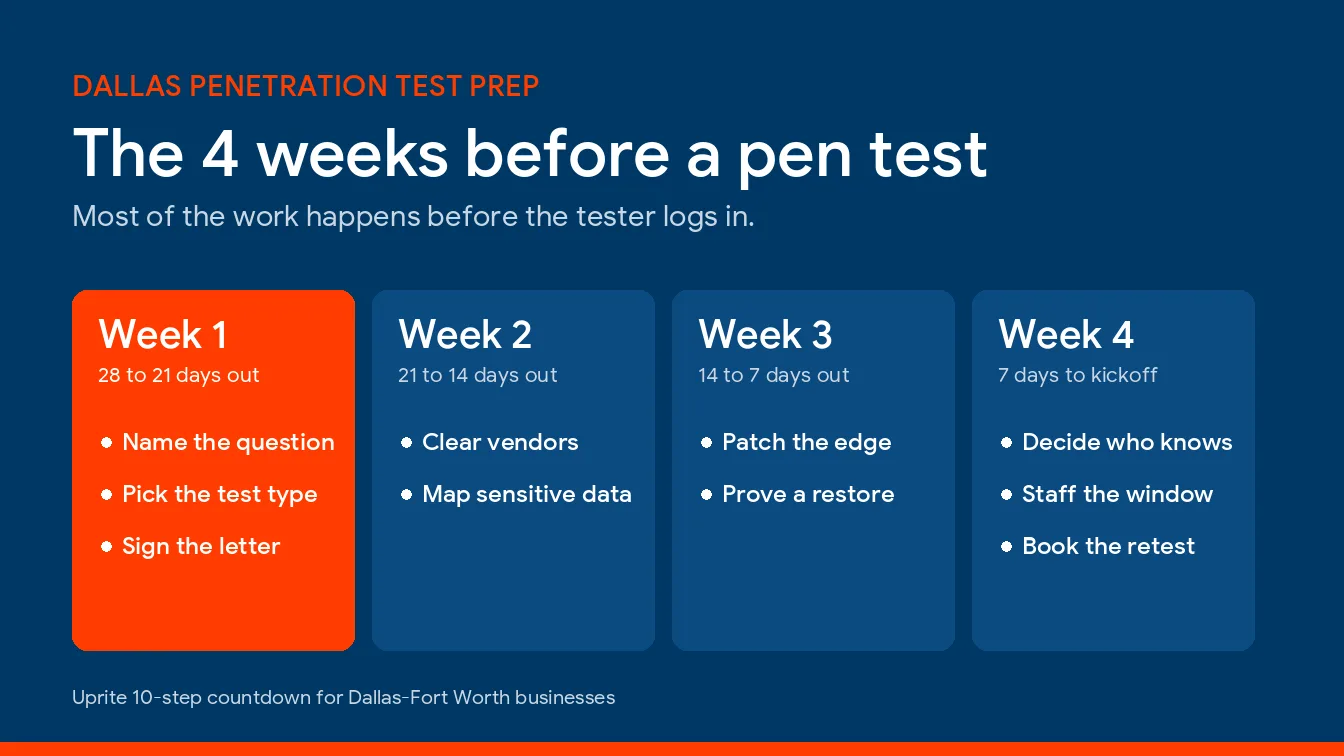
The order of the work affects the bill more than the vendor does. List what you own, run a scan, patch what it turns up, and buy the test last, because that way you pay a tester for the problems software misses rather than for an unpatched firewall that a free inventory would have found. Our penetration testing cost guide for Dallas covers what the test itself runs, our cybersecurity cost guide for Dallas covers the line items around it, and our checklist for preparing for a penetration test covers the week before the testers arrive. If an insurance renewal is what started all this, read our breakdown of cyber insurance requirements in Dallas. For the wider security market, see our rankings of managed detection and response providers in Dallas and vCISO providers in Dallas.
Our Verdict
ITECS is the best penetration testing company in Dallas on our score, at 7.68. It is local, it has tested here since 2002, it publishes prices and a 90-day free retest, and its testing page shows more of the work than any other firm’s. LevelBlue is second at 6.42 and fits large or regulated environments that want a CREST-certified team.
We came third, at 5.86. Unpublished credentials and an empty Google listing pulled us down, and our tenure and the scan-and-fix work around the test pulled us back up. For a Plano or Collin County company that wants a local firm with a long history, Kehr is the one to call. Whichever firm you pick, put the scope, the retest and the report format in the contract before the testing starts.
Not sure what kind of test you need?
Forward us the insurer form, questionnaire or contract language that mentions penetration testing, and your most recent scan if there is one. You’ll get a written answer on whether you need a test now, roughly what it should cover, and which firm on this list we’d call in your place, including when that isn’t Uprite.
Talk to a Security ExpertDallas Penetration Testing Questions We Hear Most
Which company is the best penetration testing company in Dallas?
ITECS ranks first on our Finding-to-Fix Score at 7.68, followed by LevelBlue at 6.42 and Uprite at 5.86.
Of the nine re-runs in our table, ITECS tops eight. The exception is a buyer who weights only the testing and the testers, and for that buyer LevelBlue comes first.
How much does a penetration test cost in Dallas?
Prices start at $3,790 for an ITECS network test and $6,990 for its web application test, and a stand-alone test from Uprite usually costs several thousand dollars depending on scope.
The other six ranked firms publish no figure. Quotes rise with the count of internet-facing systems, with inside-the-network testing, with custom applications and with an included retest, so give every bidder an identical scope.
Is a vulnerability scan enough, or do I need a real penetration test?
A scan lists known flaws on your systems, while a penetration test has a person try to use those flaws to get in and show how far they got.
NIST SP 800-115 treats them as different activities. You’ll usually want both, scanning on a schedule because it’s cheap and testing once a year or when an insurer, a customer contract, PCI DSS or the FTC Safeguards Rule asks for a test by name.
How often does a Dallas business need one?
Once a year is the usual baseline, plus another test after a major change to your network or a key application.
Under the FTC Safeguards Rule it’s yearly unless you monitor continuously. PCI DSS wants internal and external tests every 12 months. A big customer or your insurer might want more than that, and their contract wins, so read it before you budget.
Should a penetration tester hold certifications?
It’s a fair thing to ask for, and only two of the eight ranked firms answer it in public.
Weaver lists GPEN and OSCP among its team’s certifications, and LevelBlue’s testing group holds the CREST company accreditation. ITECS, Kehr, Bonelli, Contigo, Birch Cline and Uprite name no tester credentials, so ask each one who will run your test and what exams that person has passed.
Why would Uprite publish a list where it isn’t first?
We picked the criteria and weights before scoring anyone, and moving them once we saw the result would have made the list useless to you.
Facts about the other firms come from their own websites and Google listings as of November 16 and 17, 2026. Spot a mistake about anyone, including us, and we’ll rescore and update the page.