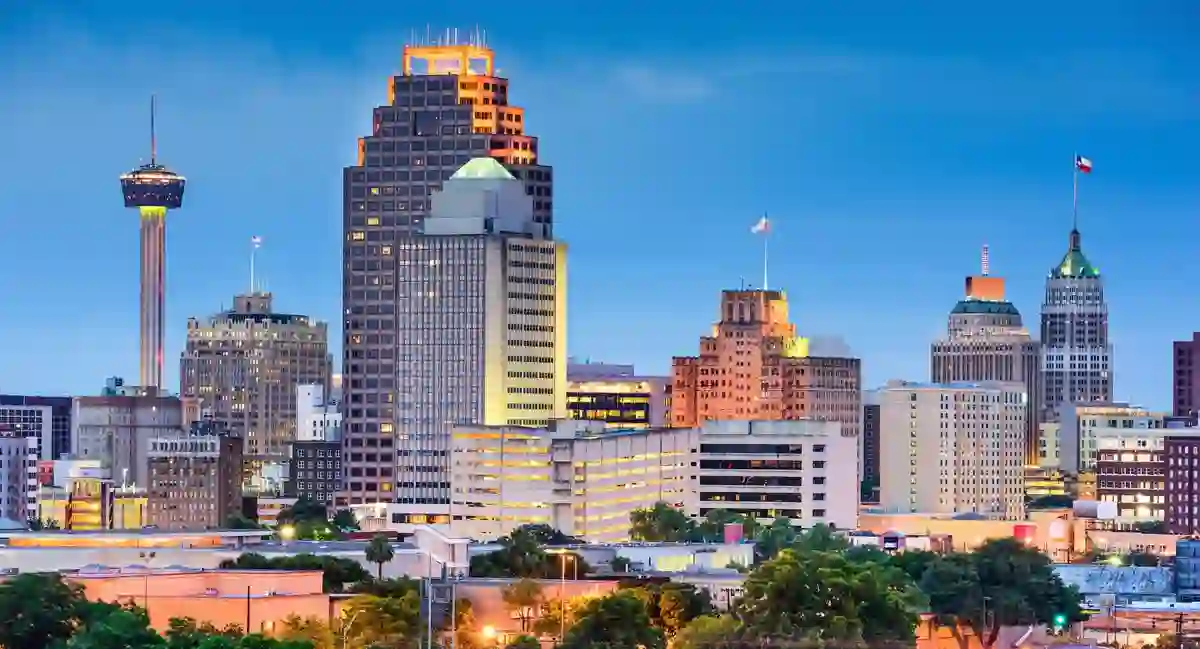
Dental IT support in San Antonio means 1 provider keeping your practice software, imaging, phones, and backups running, answering in minutes, and getting a technician to any office from Stone Oak to New Braunfels the same day. It’s judged at the chair. Not in a ticket queue.
Picture a Tuesday, 10 minutes before the first patient. The front desk can’t open the schedule. The sensor in operatory 3 won’t drop an image into the chart. That’s the moment your IT support gets graded, and it’s the only grade your team cares about. Fair or not.
I’m Uprite’s Lead vCIO. I build the IT plans behind our managed IT for healthcare in Texas, and dental practices are a workload of their own. A dental office isn’t just a small business that happens to see patients, because behind the front desk it runs an imaging lab, a records archive that has to outlast its hardware, and a payments desk, all on 1 network. Treat it that way.
So I started with public data instead of a sales pitch. How many dental offices the San Antonio metro has, how big they’ve gotten, what their staff costs per hour, and how many local practices filed notices with the Texas attorney general. I link the public sources as I go. None of it is guesswork.
Bexar County had 848 private dental offices in 2025, averaging 7.6 people, and it was the only 1 of the 4 most populous Texas counties to add offices since 2020. An hour of downtime idles about $247 of loaded staff payroll in a 7-person practice. 5 San Antonio-area practices filed Texas breach notices in 18 months, 4 on identical dates. Good dental IT support covers software, imaging, backups, security, and an outage plan, with a technician who can reach you.
What does dental IT support cover in a San Antonio practice?
Dental IT support is the monthly service that keeps a practice’s clinical and business technology working and secure. It covers the practice management server, every operatory workstation, imaging sensors and scanners, the network, phones, and backups, plus HIPAA technical safeguards, under a signed business associate agreement. The practice still owns its records. The provider does the work and documents every step.
Here’s what belongs in scope from the first day.
- Your practice management software and its database, whether that’s Dentrix, Eaglesoft, or Open Dental, plus the server it lives on.
- Imaging. Intraoral sensors, panoramic and CBCT units, intraoral scanners, and the bridge that files each image into the right chart.
- Every operatory and front desk workstation, patched on a schedule and watched between patches.
- A network that keeps the guest Wi-Fi in the lobby away from anything touching a chart.
- Backups you’ve actually restored from, kept as long as Texas makes you keep records.
- Email filtering, multifactor sign-in, and endpoint detection with a person reading the alerts.
- Phones and patient texting. A dead phone line in a dental office is a dead schedule.
Some things stay yours. That’s normal. Your software vendor still fixes its own bugs, and your privacy officer is still someone on your payroll. What a good provider does is take the call with Henry Schein One or Patterson so your office manager doesn’t spend a morning on hold. If you’re sizing the server itself, our breakdown of server requirements for Dentrix, Eaglesoft, and Open Dental goes engine by engine.
How many dental offices does San Antonio have, and why are they getting bigger?
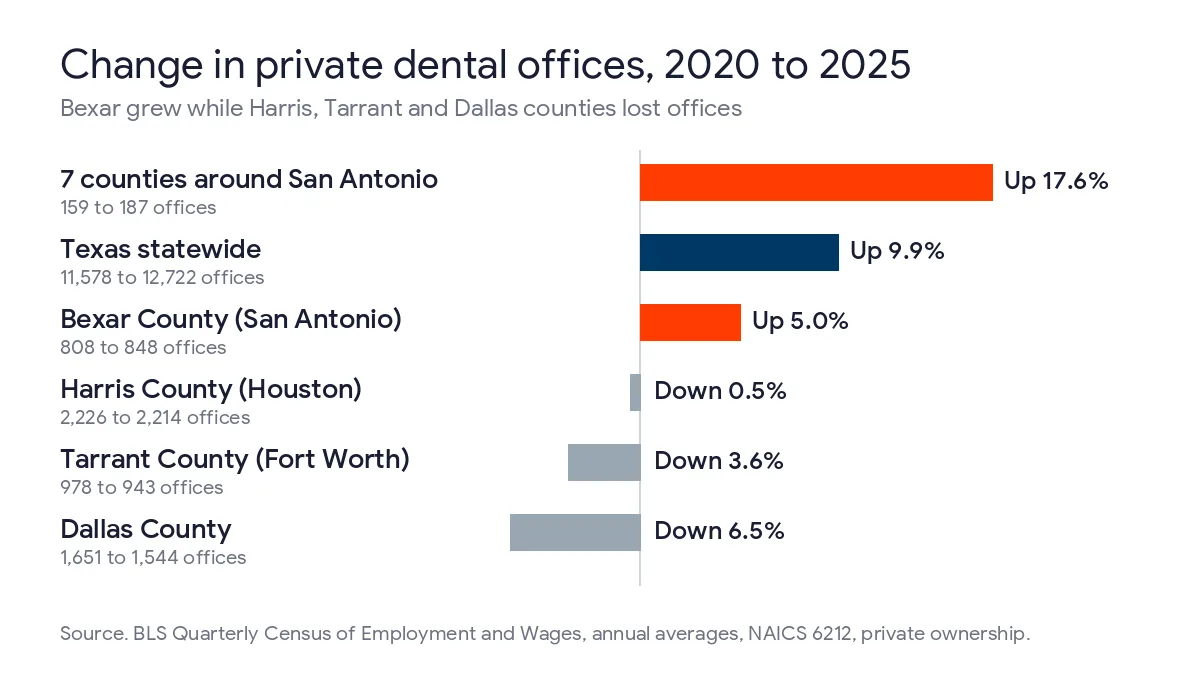
Bexar County had 848 private dental offices in 2025 with 6,416 employees, about 7.6 people per office, up from 808 offices averaging 6.9 people in 2020, according to Bureau of Labor Statistics county data.
I pulled the same Quarterly Census of Employment and Wages files for the other 3 most populous Texas counties to see whether that’s normal. It isn’t. QCEW counts every business location that pays unemployment insurance, so these are counts, not survey estimates. Private offices only.
| Area | Dental offices, 2020 | Dental offices, 2025 | Change | People per office, 2025 |
|---|---|---|---|---|
| Bexar County (San Antonio) | 808 | 848 | Up 5.0% | 7.6 |
| 7 surrounding San Antonio metro counties | 159 | 187 | Up 17.6% | 8.0 |
| Harris County (Houston) | 2,226 | 2,214 | Down 0.5% | 6.2 |
| Dallas County | 1,651 | 1,544 | Down 6.5% | 7.1 |
| Tarrant County (Fort Worth) | 978 | 943 | Down 3.6% | 7.3 |
| Texas | 11,578 | 12,722 | Up 9.9% | 7.0 |
Start with the change column. Bexar was the only 1 of the 4 to add offices. Harris lost 12. Dallas lost 107. Tarrant lost 35. The ring around San Antonio grew faster still. Comal County, which is New Braunfels and its neighbors, went from 66 offices to 75, and those offices average 9.8 people, the biggest of any county I checked. Guadalupe County, home to Seguin and much of Schertz, went from 40 to 53.
Statewide it’s the same story in a different shape. Texas has 9.9% more dental offices than in 2020 but 21.3% more dental jobs, so the average office grew from 6.3 people to 7.0. Jobs grew more than twice as fast as offices. The average office got bigger.
Why should that change how you buy IT? 3 reasons. Bigger offices mean more chairs, and every chair is a workstation, a sensor, and usually a second screen the patient can see. Growth up I-35 and out I-10 means second locations. A practice in Stone Oak that opens a New Braunfels office needs the same schedule and the same images in both places, and a provider that can physically drive to both on the same day when a switch dies. Distance matters here.
And a 7- or 8-person office is still far too small to hire its own IT person. Here’s the math.
What does an hour of downtime cost a San Antonio dental practice?
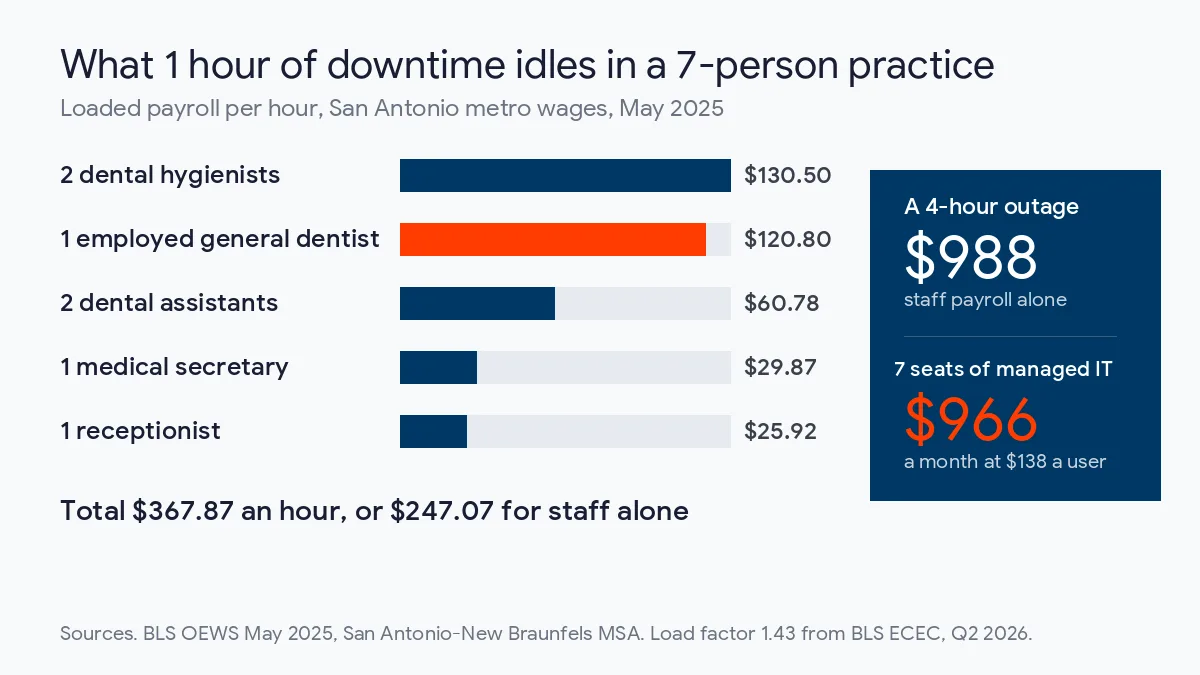
In a 7-person San Antonio practice, an hour with the schedule and charts down idles about $247 of loaded staff payroll, or about $368 counting an employed dentist, before a single missed appointment is counted. That’s real money.
Those figures use BLS occupational wage data for the San Antonio-New Braunfels metro from May 2025. I multiplied each mean hourly wage by 1.4287, which is the ratio of total compensation to wages for private industry in the BLS employer cost survey for the second quarter of 2026. That adds benefits and payroll taxes back in.
| Role in a 7-person practice | People | San Antonio mean hourly wage | Loaded cost per hour |
|---|---|---|---|
| Dental hygienist | 2 | $45.67 | $130.50 |
| Dental assistant | 2 | $21.27 | $60.78 |
| Receptionist | 1 | $18.14 | $25.92 |
| Medical secretary for billing and insurance | 1 | $20.91 | $29.87 |
| Staff total | 6 | $247.07 | |
| Employed general dentist | 1 | $84.55 | $120.80 |
| Practice total | 7 | $367.87 |
Now take a bad morning. A 4-hour outage costs that practice about $988 in staff time alone. Fully managed IT for all 7 people at our published $138 per user rate is $966 a month. 1 bad morning costs about what 1 month of support does. That’s only the floor.
Payroll is the small part. Hygiene appointments that don’t happen don’t rebook themselves, and an office that can’t see its schedule can’t even call patients to move them, so the cost keeps running for days after the server comes back.
Hiring doesn’t pencil out either. The metro’s 4,710 computer user support specialists earned a mean of $60,520 in May 2025. Loaded, that’s about $86,465 a year, or $7,205 a month, which would buy fully managed support for roughly 52 people at $138 a seat. A 7-person practice can’t carry that salary, and 1 person can’t cover vacations, nights, and a ransomware weekend anyway. Nobody can.
1 caution on my model. Your mix won’t match it exactly, and an owner dentist doesn’t draw an hourly wage. Swap in your own headcount. The shape holds.
How many San Antonio dental practices filed Texas breach notices?
5 dental practices in the San Antonio metro, in San Antonio, Converse, and Floresville, filed breach notices with the Texas attorney general between April 2025 and October 2026, covering 28,213 Texans.
Texas law requires a notice to the attorney general within 30 days once a breach involves 250 or more Texans, under Business and Commerce Code 521.053, and the office publishes them. I pulled the full public list on October 6, 2026, and filtered it for dental practices. 12 Texas practices appear. 5 are in the San Antonio metro.
That’s 41.7% of the state’s dental practice notices from a metro that holds about 8.1% of its dental offices. That number needs context.
| Practice location | Texans affected | Breach began | Posted by the attorney general |
|---|---|---|---|
| San Antonio | 3,526 | August 22, 2026 | October 2, 2026 |
| Floresville | 11,790 | May 25, 2026 | July 28, 2026 |
| Converse | 6,027 | May 25, 2026 | July 28, 2026 |
| Floresville | 3,476 | May 25, 2026 | July 28, 2026 |
| San Antonio | 3,394 | May 25, 2026 | July 28, 2026 |
Before anyone reads that as San Antonio being singled out, look at the dates. 4 of the 5 began on the same day, were discovered the next day, and were posted together, alongside 2 more practices in Azle and Rockport carrying identical dates. 6 practices. 3 corners of Texas. 1 calendar.
Federal filings point the same way. All 6 reported to HHS on the same day in July 2026, each as a hacking incident on a network server, according to the HHS breach portal. The patient notice posted by 1 of the Floresville practices says its IT support company spotted irregularities on its remote access servers on May 26. The response was to lock down remote desktop web access, disable every account with access to it, and force an office-wide password reset.
No public filing names a common vendor, so I won’t guess. Nobody should. But a remote desktop gateway facing the internet is exactly the kind of shared door I’d want an IT provider to inventory, put behind multifactor sign-in, and watch around the clock.
So the honest count is most likely 2 incidents in the metro, not 5. Still worth knowing. The lesson holds, and it’s the one I’d want every owner to take home. Most of these patients’ records appear to have been exposed in 1 shared incident, and the only notice that describes it points to remote access, not a front desk PC. That’s the pattern to watch.
That pattern isn’t new. In March 2026, HHS settled with MMG Fusion, a vendor selling to dental practices, over a breach of about 15 million people that went unreported for years, which meant the practices it served never got to start their own notice clocks. Then in May 2026, DentaQuest, 1 of 3 dental plans in Texas children’s Medicaid, had a breach that its counsel told regulators began when a single employee was tricked into handing over a password and a multifactor code. The Texas attorney general lists 3,973,000 Texans affected. If you take Medicaid, some of your patients likely got that letter.
Your patients’ data lives in more places than your server. Ask any IT provider who else holds the keys, and get the answer in writing. For the statute side, our guide to dental practice IT security in Texas walks through HIPAA, HB 300, and SB 2610 in order, and our piece on the dental HIPAA security risk analysis covers the 1 document regulators usually ask for first.
What should a San Antonio outage plan include?
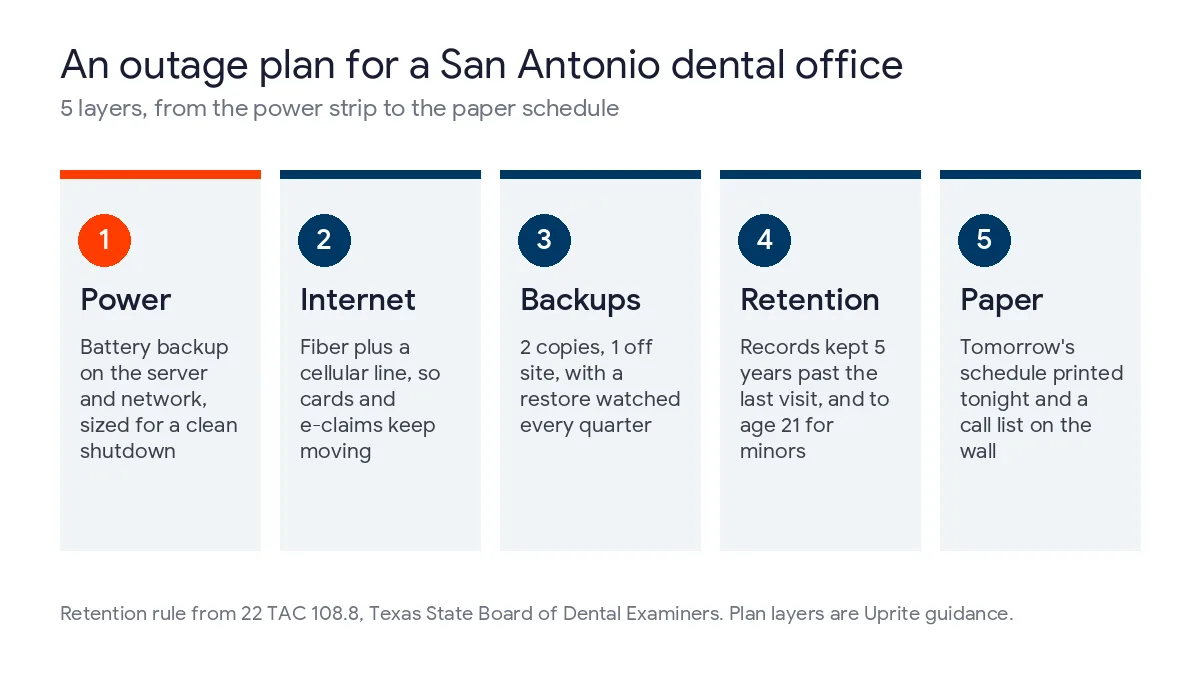
A San Antonio dental office’s outage plan should cover power, internet, and a tested restore, because the 3 failures that close a practice here are a grid event, a cut line, and a dead server or ransomware. Grid events aren’t hypothetical here.
This city has had 2 hard reminders. During Winter Storm Uri in February 2021, the City’s own after-action report says hundreds of thousands of people in San Antonio went without power for several days in freezing temperatures. Then, the day after a severe storm on August 28, 2026, about 63,000 CPS Energy customers were still dark, and the City of San Antonio warned that restoration would likely last several days.
You can’t control the grid. You can control what your server does when the lights go out, and how fast you’re back once they return.
- Battery backup on the server and network gear, sized to shut the server down cleanly. Not to keep seeing patients. Chairs, compressors, and X-ray heads won’t run on it anyway.
- A second internet path. When the fiber goes dark, a cellular backup keeps card payments, e-claims, and cloud imaging moving.
- Backups in 2 places, 1 of them off site, and a restore you’ve watched happen within the last quarter. Watched, not assumed.
- A retention schedule that matches Texas law. Under 22 TAC 108.8, a dentist keeps records at least 5 years from the last treatment, and for a patient under 18 until age 21 if that’s longer. A backup that can’t bring back a 2022 X-ray won’t keep you inside that rule.
- A paper fallback for the first hour, with tomorrow’s schedule printed tonight and a written list of who calls whom. Old school works.
Federal rules may tighten this further. HHS proposed a stricter HIPAA Security Rule in January 2025 that would require written procedures to restore critical systems within 72 hours, and its latest regulatory agenda lists a July 2027 target for the final rule. It’s still a proposal. Plan for it anyway.
That retention clock is longer than most people expect. Much longer. A 3-year-old seen in 2026 has a record that has to survive until about 2044, which is several generations of workstations. Our page on IT support for dental practices in Houston follows that clock through the hardware, and the same Texas rule applies in Bexar County. For the full recovery side, see our approach to disaster recovery in San Antonio.
Which kind of IT support fits your practice?
Most San Antonio practices end up choosing among 4 support models, and the right one depends on how many chairs and locations you run and whether anyone on staff can own IT.
| Support model | How it works | Fits best when |
|---|---|---|
| Break-fix technician | You call when something breaks and pay by the hour | You run 1 or 2 chairs, keep everything in a cloud practice system, and accept the risk between visits |
| Dental-only IT company | Specializes in practice software, imaging, and chairside hardware | Imaging and software integration are your biggest headaches and security is handled elsewhere |
| Managed IT provider with a healthcare practice | Monthly agreement covering support, security, backups, and compliance evidence | You run 5 or more chairs or 2 or more offices and want 1 accountable team |
| Co-managed IT | Your in-house IT person plus a provider’s tools, security monitoring, and backup bench | A group or DSO already employs IT staff who need coverage and depth |
Each one works somewhere. I’ll be straight about where we sit. Uprite is a managed IT provider with a healthcare practice, not a dental-only shop. That’s a real difference. A dental-only vendor may know a particular sensor driver faster than we do. That’s fair. Where we’re stronger is everything around the chair, the security monitoring, backups, compliance records, and second-office network that a dental-only shop often leaves to someone else, or to nobody at all. Test any provider, us included, with the questions below.
What should you ask a San Antonio dental IT provider before you sign?
Ask 7 questions, and ask for proof instead of promises. Write the answers down.
- Who answers at 7 in the morning, and how fast? Get first-response and on-site times in writing, by priority. Our San Antonio IT support response time benchmarks show what good looks like.
- Which practice software and imaging systems have you supported this year? Ask for product names, not client names.
- Can you show me the last restore test you ran for a practice like mine? A dated screenshot beats a confident answer.
- Will you sign a business associate agreement, and which of your own vendors touch our data? Get names.
- How do you reach our second office? Name the town, whether it’s New Braunfels, Boerne, or Floresville, and ask how many of the provider’s technicians live within an hour of it and how often they actually drive out there.
- What’s inside the monthly price, and what gets billed as a project? Get it itemized. Compare against what managed IT costs in San Antonio in 2026.
- Who holds our admin passwords and our domain, and how do we get them back if we leave? Settle it before you need them.
If a provider gets defensive on any of these, you have your answer. Walk away.
How we support dental practices in San Antonio
Uprite runs a physical San Antonio office at 11831 Radium St., and our help desk averages 5 minutes to first response across all priority levels. Fully managed support starts at $138 per user per month, published, with a 120-day satisfaction guarantee. That’s the same team behind our managed IT services in San Antonio and our healthcare IT in San Antonio. Same people, same office.
We’ve done this before. Our dental group case study covers a dental surgery group with 40-plus users across several offices whose workstations couldn’t keep up with high-detail imaging and whose cyber insurer wanted tighter security. We took over the help desk, hardened the firewall and domain, added encryption and backup, sized workstations for the imaging load, worked with their records software vendor, and supported the group’s expansion to 4 locations.
If you’re pricing a move, start with what dental IT costs per operatory in Texas, then bring us the number you’re trying to beat.
Tell us how many chairs and offices you run. A San Antonio engineer will walk your setup, flag the gaps that would cost you a morning, and give you a written per-user price.
Speak to a San Antonio IT ExpertQuestions San Antonio Dentists Ask Us About IT
How much does dental IT support cost in San Antonio?
Fully managed IT in San Antonio typically runs $125 to $200 per user per month in 2026, and our published starting rate is $138. Counted per chair, a Texas practice lands near $280 to $400 per operatory a month once HIPAA work is included, with smaller practices paying the most per chair. Ask for both numbers.
Do I need a dental-specific IT company?
No, but you need a provider that has supported your exact practice software and imaging systems this year and can prove it. Plenty of general providers can’t. Plenty of dental-only shops don’t watch security. Judge the work.
How fast should a dental IT provider respond in San Antonio?
Expect a first response within 15 to 30 minutes on a critical outage, written into your agreement by priority level. Ours averages 5 minutes across all levels. On-site time matters as much, so ask how long it takes to reach your specific address. Then check it.
Can my practice keep running Dentrix on Windows 10?
Not safely, and not for long, because Windows 10 is past its end of support. Microsoft ended Windows 10 support on October 14, 2025, and Henry Schein One stopped supporting new Dentrix installations on Windows 10 workstations after June 30, 2026. Open Dental suspended Windows 10 support the same day Microsoft ended it, and Patterson’s current Eaglesoft requirements list only Windows 11 Pro for workstations. Microsoft’s paid Extended Security Updates cost $61 a device for the first year and double after that, with year 2 starting October 14, 2026. They don’t move your software vendor’s date. Plan the refresh now.
How long does a Texas dentist have to keep patient records?
At least 5 years from the patient’s last treatment, and for anyone under 18 at that visit, until they turn 21 if that’s longer. That rule lives in 22 TAC 108.8, and it applies to digital records and images, so your backups have to be able to restore them for that long too. Images count.
What happens if our practice has a data breach?
Texas law gives you 60 days to notify affected patients and 30 days to notify the attorney general once 250 or more Texans are involved. HIPAA adds its own notices to patients and to HHS. Call your IT provider and your cyber insurer first, before anyone wipes a machine.
How do we switch IT providers without losing a day of patients?
Overlap the old and new provider, and get every admin password, the domain registration, backup access, and your vendor contacts handed over before the old contract ends. Schedule the cutover for an afternoon with a light book, never a Monday morning, and test imaging and the schedule in every operatory before patients arrive.
Who does the HIPAA risk analysis, our office or our IT provider?
Your practice owns it, and your IT provider should do most of the technical legwork and hand you the evidence. The current rule never says annual, but any big change, like a new office or a new imaging system, is a reason to update it. It’s your document.