Manufacturing cybersecurity in Texas means protecting plant floor control systems and business IT as one connected environment, because attackers now move from a phishing email to a stopped production line inside a single intrusion. Most Texas plants still defend those two halves separately. That gap is where the damage happens, and it is the single most common finding when we walk a shop floor for the first time.
The short version. Manufacturing has been the most attacked industry in the world for 5 straight years. Texas plants are exposed because IT and OT networks were quietly joined together for remote support, ERP integration, and IIoT sensors, without a controlled boundary between them. Fixing it starts with an asset inventory, a real IT/OT choke point, and segmented backups. Our full cybersecurity services page covers the wider stack.
What manufacturing cybersecurity actually covers in a plant
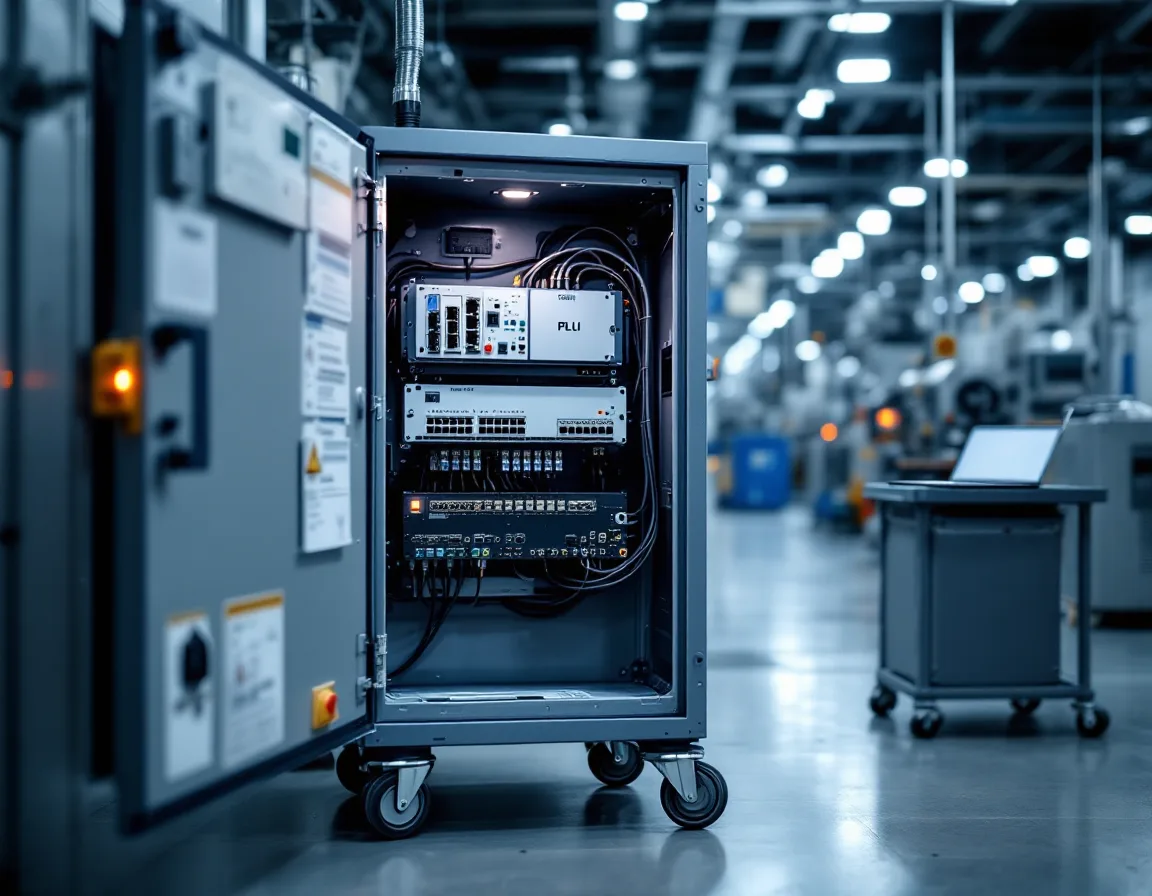
Manufacturing cybersecurity is the practice of securing operational technology and information technology together. OT covers the PLCs, HMIs, SCADA servers, robotic cells, and engineering workstations that run production. IT covers email, ERP, file shares, and laptops. In a modern plant those two worlds share a network, so they have to share a defense. Houston plants comparing providers can review our roundup of the best MSPs for Houston manufacturing.
That distinction sounds academic until you watch it play out. An IT team can restore a mailbox from backup in an hour. Nobody restores a calibrated line from backup. When a controls vendor’s remote support tunnel gets abused, or an engineering workstation running an unsupported OS gets encrypted, the recovery clock is measured in shifts, not tickets. Texas manufacturers we assess almost always have decent IT hygiene and almost never have an accurate list of what is plugged into the plant network.

Why attackers pick manufacturing over every other industry
Manufacturing accounted for 27.7% of all incidents worldwide in 2025, the highest share of any sector for the fifth consecutive year, according to the IBM X-Force Threat Intelligence Index 2026. North America took 29% of attacks, becoming the most targeted region for the first time in 6 years.
The reason is uncomfortable and simple. A law firm can survive a week without its document system. A plant cannot survive a week without its line. Dragos tracked 119 ransomware groups hitting roughly 3,300 industrial organizations in 2025, up 49% from 80 groups the year before, and manufacturing made up more than two thirds of the victims. Its 2026 OT Cybersecurity Year in Review also put average ransomware dwell time in OT environments at 42 days, which means the intruder usually watched the plant run for 6 weeks before pulling the trigger.
Then there is the math on the other side. Manufacturers lose an estimated $1.9 million per day in ransomware downtime on average, and typical recovery runs well past a week. Compare that against what a segmentation project and 24/7 monitoring cost and the business case writes itself. Most owners we talk to have never seen the two numbers side by side.
How Texas plants actually get breached
Almost none of these start on the plant floor. They start in the office and walk downstairs. The 2026 Verizon DBIR manufacturing snapshot puts system intrusion at 61% of incidents in the sector, and third party or supply chain involvement is now tied to nearly half of all breaches Verizon investigated. Here are the 5 doors we find open most often in Texas facilities, and what actually closes each one.
| Entry point | How it reaches the plant floor | What actually closes it |
|---|---|---|
| Vendor remote access | An integrator or OEM keeps a standing VPN or TeamViewer tunnel into a control cabinet, often with a shared password that outlived the project. | Broker every vendor session through a jump host with MFA, time-boxed approval, and session recording. No standing tunnels. |
| Flat network between office and floor | ERP needed live production data, so somebody bridged the two VLANs and never revisited it. Ransomware from a laptop reaches SCADA in one hop. | An industrial DMZ at Purdue Level 3.5 with default-deny rules in both directions. Data crosses through a broker, never a direct path. |
| Unsupported engineering workstations | The HMI or CAM station runs Windows 7 or Server 2012 because the automation vendor never certified anything newer. | Isolate the host in its own zone, apply virtual patching at the network layer, and add application allowlisting instead of forcing an OS upgrade. |
| Credential reuse and weak MFA | Shop supervisors share one login for a shift. MFA is on email but not on VPN, RDP, or the ERP. | Universal MFA including remote access and admin accounts, plus per-user identities on the floor even when the device is shared. |
| Backups on the same domain | Backups run to a NAS joined to the same Active Directory the attacker just took. Encrypting them is a single command. | Immutable, offline or separately credentialed backups, plus a restore test of an actual HMI image rather than a file share. |
If you want the shorter regional version of this list, we broke down the 5 cyber threats facing Houston manufacturers in more detail, and the pattern holds in Dallas and San Antonio too.

The IT/OT boundary most plants still don’t have
Every serious OT framework lands in the same place. ISA/IEC 62443, the Purdue Enterprise Reference Architecture, and NIST SP 800-82 Revision 3 all say to divide the network into zones with their own security requirements, then strictly control the conduits between them. The critical boundary sits between Purdue Level 3 and Level 4, in the industrial DMZ, and every conversation between the business network and the control network is supposed to pass through it.
Here is the honest take. Plenty of consultants sell the Purdue diagram as gospel, and in a plant that has added cloud dashboards, wireless scanners, and IIoT sensors over 15 years, that clean layered picture stopped describing reality a long time ago. We still use the model, but as a way to decide where the choke points belong rather than as an architecture to rebuild toward. A mid-sized fabricator does not need a textbook Level 0 through 5 redesign. It needs one enforced boundary, an accurate device list, and monitoring that notices when something new appears on the control VLAN.
One more thing worth knowing. Dragos notes that many OT incidents get logged internally as IT incidents, because the compromised machine was a Windows server that happened to be hosting SCADA software. If your incident reports never mention OT, that is not necessarily good news. It may just mean nobody is classifying them properly. We collected the related blind spots in what Texas manufacturers get wrong about OT/IT security.

What compliance actually demands of a Texas manufacturer
Texas is the nation’s second largest manufacturing economy, and the Dallas Fed’s Texas Manufacturing Outlook Survey shows the sector still expanding through 2026. Growth brings bigger customers, and bigger customers bring security questionnaires. Our breakdown of an OT cybersecurity audit for Texas manufacturers shows what those reviewers ask to see and what passes. Most of the compliance pressure our manufacturing clients feel does not come from a regulator. It comes from a prime contractor or an insurer.
| Requirement | Who it hits in Texas | What it asks for in practice |
|---|---|---|
| Texas SB 2610 safe harbor | Any Texas manufacturer under 250 employees holding sensitive personal information | A documented program matching a recognized framework, scaled by headcount. Under 20 employees means basic policies and training. 20 to 99 means CIS Controls Implementation Group 1. 100 to 249 means NIST CSF or ISO 27001. |
| CMMC and NIST SP 800-171 | Defense and aerospace suppliers, including subs several tiers down | 110 controls covering access, media, and incident response, with self-assessment already in force and third party certification phasing in for Level 2 contracts. |
| ITAR | Manufacturers touching export controlled designs or components | Access restricted to US persons, encrypted storage and transfer, and auditable controls on where CAD files actually live. |
| ISO 27001 and customer questionnaires | Anyone selling into automotive, energy majors, or enterprise OEMs | Evidence rather than assertions. Asset inventories, segmentation diagrams, MFA coverage reports, and tested recovery plans. |
| Cyber insurance underwriting | Every manufacturer at renewal | Universal MFA, EDR on every endpoint and server, documented OT/IT segmentation, and immutable backups. Attesting to controls you don’t maintain can void the policy. |
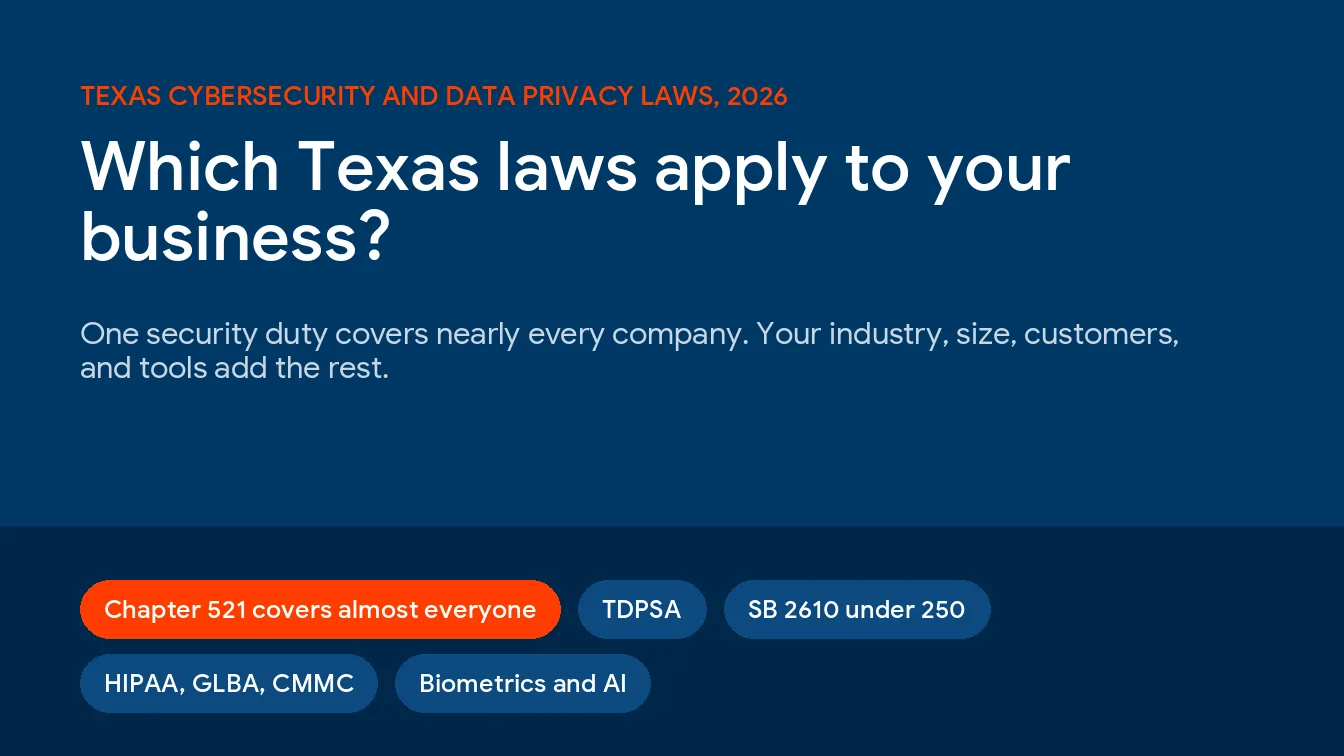
SB 2610 is the one Texas owners underestimate. It took effect September 1, 2025, and it shields a qualifying business from punitive damages in a breach lawsuit, though compensatory damages and regulatory action still apply. Spencer Fane’s breakdown of the statute covers the legal mechanics well. We wrote a practical SB 2610 checklist for Texas SMBs if you want the operational version, and defense suppliers should start with our CMMC and NIST 800-171 services in Texas.

A 90-day plan that doesn’t stop the line
The objection we hear on every first visit is that security work will cost production hours. Fair. So the sequence below front-loads everything that can be done passively, and saves the changes that need a window for a planned shutdown you already have on the calendar.
- Days 1 to 30, build the inventory. Deploy passive network monitoring on the control VLAN and let it discover what is actually there. No active scanning against PLCs, which can knock older controllers offline. NIST 800-82 puts asset inventory first for a reason, and in most plants this step alone surfaces devices nobody knew were connected.
- Days 1 to 30, kill standing vendor access. Inventory every remote support tunnel, then move them behind a brokered jump host with MFA and approval. This is a config change on the IT side and it does not touch the floor.
- Days 15 to 45, fix identity and endpoints. MFA on VPN, RDP, ERP, and every admin account, not just email. EDR agents on all Windows servers and workstations that will tolerate one, with the exceptions documented rather than ignored.
- Days 30 to 60, separate the backups. Move OT and IT backups off the production domain, make them immutable, and restore one real HMI or engineering workstation image to prove it works. A backup you have never restored is a hypothesis.
- Days 45 to 75, stand up the boundary. Put an industrial DMZ between the business network and the control network with default-deny in both directions. Design it fully first, then cut it over during a scheduled maintenance window.
- Days 60 to 90, monitor and rehearse. Feed OT logs into 24/7 detection, then run a tabletop exercise with plant leadership and not just IT. Decide in advance who has authority to stop a line, because that decision made under pressure at 2 a.m. is the one that goes badly.
Notice that only one item in that list requires downtime. Everything else is inventory, identity, and configuration work that happens while the line runs. That sequencing is the difference between a security roadmap a plant manager approves and one that sits in a folder for 2 years.
What this looked like for one Texas manufacturer
A growing Texas manufacturer came to us with failing on-premise Exchange servers, end-of-life hardware, and a cyber insurance application it could not honestly complete. The company was losing production hours to outages and paying overtime to make up the difference. We modernized the infrastructure in stages, migrated email to Microsoft 365, upgraded servers and workstations, rebuilt backup and disaster recovery, and closed the control gaps the insurer was asking about. Production kept running throughout. The full write-up is in our manufacturing IT modernization case study.
The part worth stealing from that project is the order of operations. Insurance compliance was the forcing function, not the goal. Once the controls the underwriter wanted were real, the same controls covered most of what the company’s largest customer later asked for in its vendor security review. Doing the work once and using the evidence twice is how mid-sized manufacturers keep this affordable. That logic bites harder in Dallas-Fort Worth, where defense work piles ITAR and NIST 800-171 onto the same evidence stack, as we map in IT compliance for DFW manufacturers.
How Uprite secures Texas manufacturing environments
Uprite has supported Texas businesses since 1999, with field teams in Houston, Dallas, Austin, and San Antonio, and we ranked No. 264 on the 2026 Channel Futures MSP 501 for the seventh consecutive year. For plants specifically we run the Uprite MFG℠ framework, which comes in 4 configurations depending on whether you want fully managed coverage, remote-only support, co-managed help alongside your own IT staff, or a compliance and vCISO engagement for contract-driven environments.
Our team works daily with the software that actually runs Texas plants, including AutoDesk AutoCAD, Inventor and Vault, Sage 500, and ERP and MES platforms like SAP, Epicor, NetSuite, and Fishbowl Inventory. Before any of those moves off-site, our guide to moving a plant’s ERP to the cloud covers plant internet failover and the Texas sales tax most quotes leave out. Monitoring runs through our own SOC around the clock, which matters when your third shift is the one nobody is watching. Full details live on the manufacturing IT services page, or the metro version for your area: manufacturing IT services in Houston, Dallas, or San Antonio. If you are comparing providers, our breakdown of the best MSPs for manufacturing is deliberately honest about where other firms are strong.
Coverage is metro by metro, so start where your facility sits. We run cybersecurity services in Houston for the Gulf Coast petrochemical and fabrication corridor, cybersecurity services in Dallas for DFW’s electronics and aerospace suppliers, and cybersecurity services in San Antonio for South Texas plants and defense-adjacent shops. Statewide IT support across Texas covers everything in between.
If your plant needs 24/7 detection and response over the whole environment rather than a project, that is what our managed security services program is built for. Either way, the honest first step is an assessment that tells you what is on your control network today. You cannot defend an inventory you don’t have.
Questions Texas manufacturers ask us about OT security
What is OT security and how is it different from IT security?
OT security protects the control systems that run physical production, such as PLCs, HMIs, and SCADA servers. IT security protects data. The priority order flips. IT protects confidentiality first, while OT protects availability and safety first, because a system taken offline for a patch can stop a line or create a hazard.
Our PLCs run on Windows 7 and the vendor won’t certify an upgrade. What now?
You isolate instead of upgrading. Put the host in its own network zone, block outbound internet, apply virtual patching at the firewall or IPS layer, add application allowlisting, and monitor it closely. This is a normal and accepted approach in OT, and it buys years while you plan a controlled modernization on the vendor’s timeline rather than an attacker’s.
Does Texas SB 2610 apply to a manufacturer?
Yes, if you employ fewer than 250 people and hold sensitive personal information, which includes employee records. The law took effect September 1, 2025, and offers protection from punitive damages in a breach suit when a qualifying program was already in place. The required framework scales with headcount, so a 40-person shop and a 200-person plant have different bars to clear.
Will segmenting the network cause production downtime?
The cutover needs a maintenance window, usually a few hours. Everything before it does not. Discovery, rule design, and traffic baselining all happen passively while the plant runs, so the only production impact lands in a window you schedule. We map the design against real observed traffic first, which is what keeps the cutover from breaking an ERP integration nobody documented.
How much does manufacturing cybersecurity cost in Texas?
It depends on headcount, number of sites, and how much OT is in scope, so anyone quoting a flat figure without seeing your environment is guessing. The useful comparison is against downtime. Manufacturers average an estimated $1.9 million per day in ransomware downtime losses, and most segmentation and monitoring programs cost a small fraction of a single lost production day.
We already have an internal IT team. Do we still need an MSP?
Not necessarily, and we will tell you if you don’t. Most in-house plant IT teams are 1 to 3 people who handle everything and cannot staff a 24/7 security watch. Co-managed models work well here, where your team keeps ownership of the environment and we cover overnight monitoring, OT expertise, and compliance evidence. Explore our managed security services if that split sounds right.
What is the very first thing to fix?
Standing vendor remote access, then the asset inventory. Killing always-on integrator tunnels is fast, free of production risk, and removes one of the most reliably abused paths into a plant. The inventory takes longer but everything else depends on it, which is why NIST SP 800-82 lists it as step 1.
If you run a plant in Texas and you cannot name every device on your control network right now, that is the place to start, and it is not an unusual position to be in. Talk to our team about a manufacturing security assessment. We will map what is actually connected, tell you which gaps are urgent and which can wait, and hand you the findings whether or not you hire us.