
An IT continuity plan for a New Braunfels business has to assume the roads close before the building floods, because nearly half of local flash floods start between 6 PM and 6 AM. So most of the plan is a decision someone makes before sunrise, with systems already set up to run without anyone driving in.
I’ve read a lot of continuity plans written for Texas offices, and the ones from the Gulf Coast are built around a hurricane you can see coming for days. That isn’t how it goes here. Our team supports companies along the I-35 corridor through our managed IT services in New Braunfels, and the local pattern is different. Rain stalls over the Hill Country. Often overnight. The Guadalupe and the creeks feeding it rise fast. By 7 AM the Gruene Road bridge, River Road and a dozen low-water crossings are closed, while your office on Loop 337 is dry and fully powered. Nobody can reach it.
A New Braunfels continuity plan covers 3 failures, in the order we’d plan for them. First, people can’t get to the office because crossings are closed. Second, the power or water goes out, the way it did for days during the February 2021 freeze. Third, and least likely, water reaches the building itself. Plan for remote work first. Then off-site recovery. Then fix power and internet. Check the flood map last, but do check it.
What Is an IT Continuity Plan?
An IT continuity plan is the written set of decisions that keeps a business’s phones, email, files and line-of-business software working when the office, the power or the roads aren’t available, including who decides, what runs where, and how long each system can be down before it hurts. It’s narrower than a full business plan and broader than a backup. That’s the whole idea.
People mix up continuity and disaster recovery all the time. They aren’t the same thing. Disaster recovery is the part that brings systems back after they’ve failed. Continuity is about not stopping in the first place, and it includes plenty that has nothing to do with servers, like how payroll gets approved when the controller can’t cross the Guadalupe. We wrote a longer piece on business continuity vs disaster recovery if you want the full split. Continuity is the plan for the 5 AM phone call.
We’ve also written the Houston hurricane version and a Dallas plan for ice and hail. Neither one fits Comal and Guadalupe counties.
What Do 20 Years of Flood Records Say About New Braunfels?
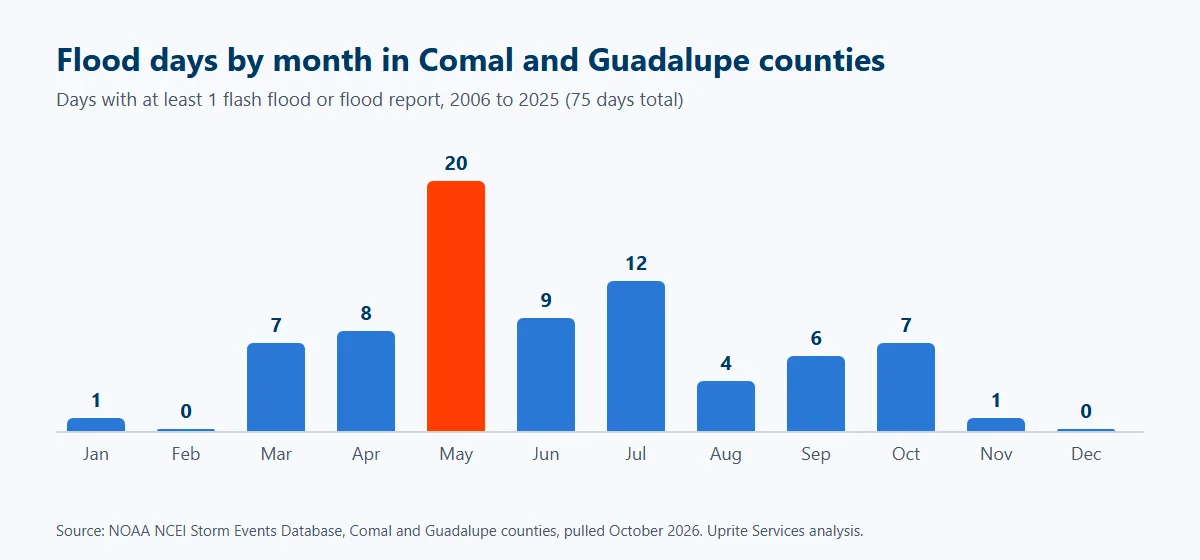
We pulled every storm report filed for Comal and Guadalupe counties from 2006 through 2025 in the NOAA Storm Events Database, which is where the National Weather Service logs what actually happened on the ground. Then we counted the days with at least 1 flash flood or flood report in either county.
There were 75 of them. Floods showed up in 17 of the 20 years. May alone had 20 flood days, more than any other month, and April through June held 37 of the 75. July came next with 12, and October added a smaller fall bump of 7. Winter is nearly dry. On 35 of those 75 days, the first report of the day came between 6 PM and 6 AM.
| Month | Flood days, 2006 to 2025 | What else tends to happen |
|---|---|---|
| March and April | 15 | Hail season, 35 hail days in these 2 months |
| May | 20 | Start of river season after Memorial Day |
| June and July | 21 | Peak river and tubing season, storms that stall overnight |
| August through October | 17 | Tropical moisture, the 2017 tropical storm, October 2013, 2015 and 2021 floods |
| November through February | 2 | Ice and hard freezes instead, 32 winter-weather days on record |
Two things in that data matter more than the totals. The first is timing. A storm that starts at 2 AM doesn’t give anyone a workday to prepare, so whatever you need has to already be in place when you go to bed. The second is the gap. Between 2022 and 2024 neither county logged a single flash flood day. Then 2025 brought 4, including the July storms that closed at least a dozen low-water crossings west of town and flooded 3 businesses in Seguin with 6 to 12 inches of water. A plan that nobody touched during those 3 dry years was out of date when it was needed. Dry years make people careless.
Why Does the River Corridor Change the Plan?
Because the river cuts the town in pieces long before it reaches most buildings. The National Weather Service runs a gauge on the Guadalupe River above the Comal at New Braunfels and publishes what happens at each height, from the first wet campsites on River Road up to homes washing downstream, so you can read it like a ladder. At 6 feet the water touches the floor of the Gruene Road bridge. At 7 feet that bridge is flooded and closed. That’s a low number. At 17 feet the Common Street bridge floor goes under. The highest crest since 1913 came on October 17, 1998, at 35.57 feet.
Same pattern downtown. The Comal River gauge threatens the lowest businesses near San Antonio Street at 19 feet and floods them at 26. Its record crest, 39.28 feet, came in that same October 1998 flood.
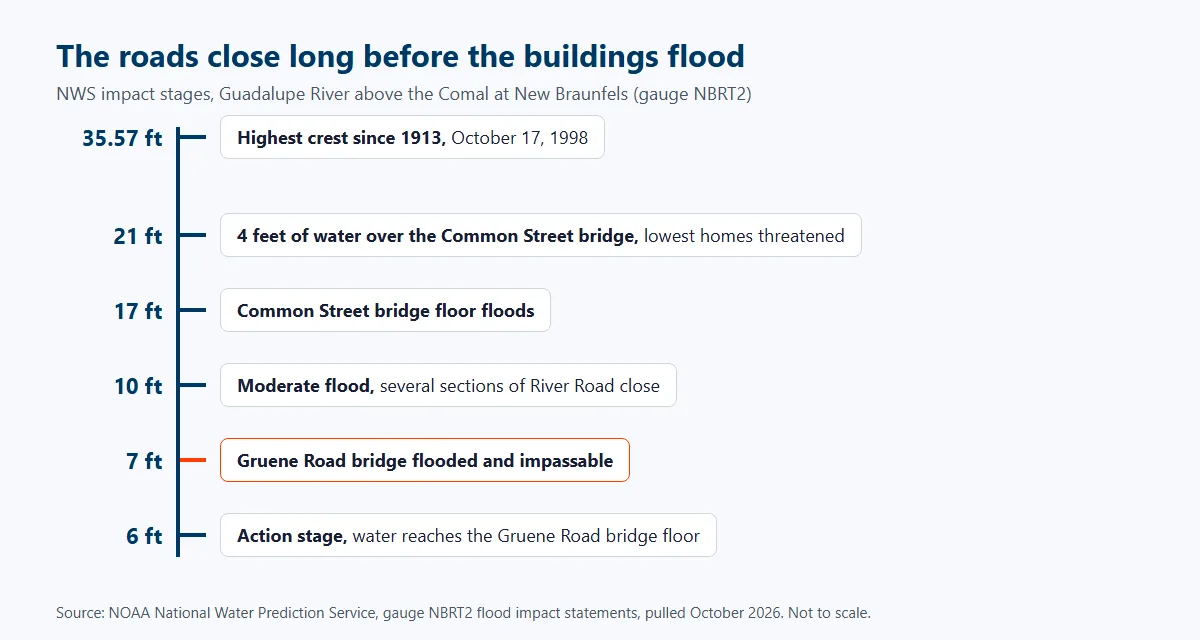
Read those numbers from the point of view of an office manager. The Gruene Road bridge closes with the Guadalupe at 7 feet. Businesses near San Antonio Street don’t flood until the Comal reaches 26. In between sits every morning when the office is fine and half the staff are on the wrong bank. That gap is the problem. That’s why the trigger for your plan shouldn’t be “is the office flooding?” It should be the gauge, the county’s crossing closures and the time of day.
| What you see | What it usually means | IT action |
|---|---|---|
| Flash flood watch issued for the evening | Rain is possible overnight, nothing is closed yet | Confirm laptops go home, VPN and remote apps tested, call tree current |
| Guadalupe above Comal near 6 to 7 feet | Gruene Road bridge closing, River Road low spots wet | Staff who cross the river work from home, phones forward to cell or the app |
| County reports crossings closed before 6 AM | Commutes from Bulverde, Spring Branch or Canyon Lake may be cut off | Make the office-closed call by 6 AM, post it in one channel |
| Gauge at moderate or above, about 10 feet | Several sections of River Road closed, cars and campers near the river at risk | Nobody drives in to check the server, run on cloud and remote access only |
| Power off at the office | UPS is on battery and the clock is running | Servers shut down cleanly on the UPS signal, not when the battery dies |
Canyon Dam helps, and it’s worth knowing why. The Army Corps of Engineers built it for flood control and water conservation, and it holds back a lot. But it isn’t a guarantee. In 2002 the lake overflowed the spillway, and the Corps estimates about 2 times the lake’s volume went over it. On June 9, 2010, the problem was rain below the dam. More than 11 inches fell between the Guadalupe and Highway 46 between 2 AM and 8 AM, and NOAA’s survey found the river rose more than 20 feet in under 2 hours. The RV park at I-35 was evacuated before most offices opened. The dam couldn’t help.
Is Your Building in the Floodplain, and Does It Matter?
Look it up, but don’t stop there. FEMA’s Flood Map Service Center lets you search any address. It’s free. The City of New Braunfels floodplain page explains which maps apply. The city adopted its maps effective January 5, 2006, the Guadalupe County side has maps effective November 2, 2007, and the city’s Building Department will do a flood zone determination for a specific lot if you call.
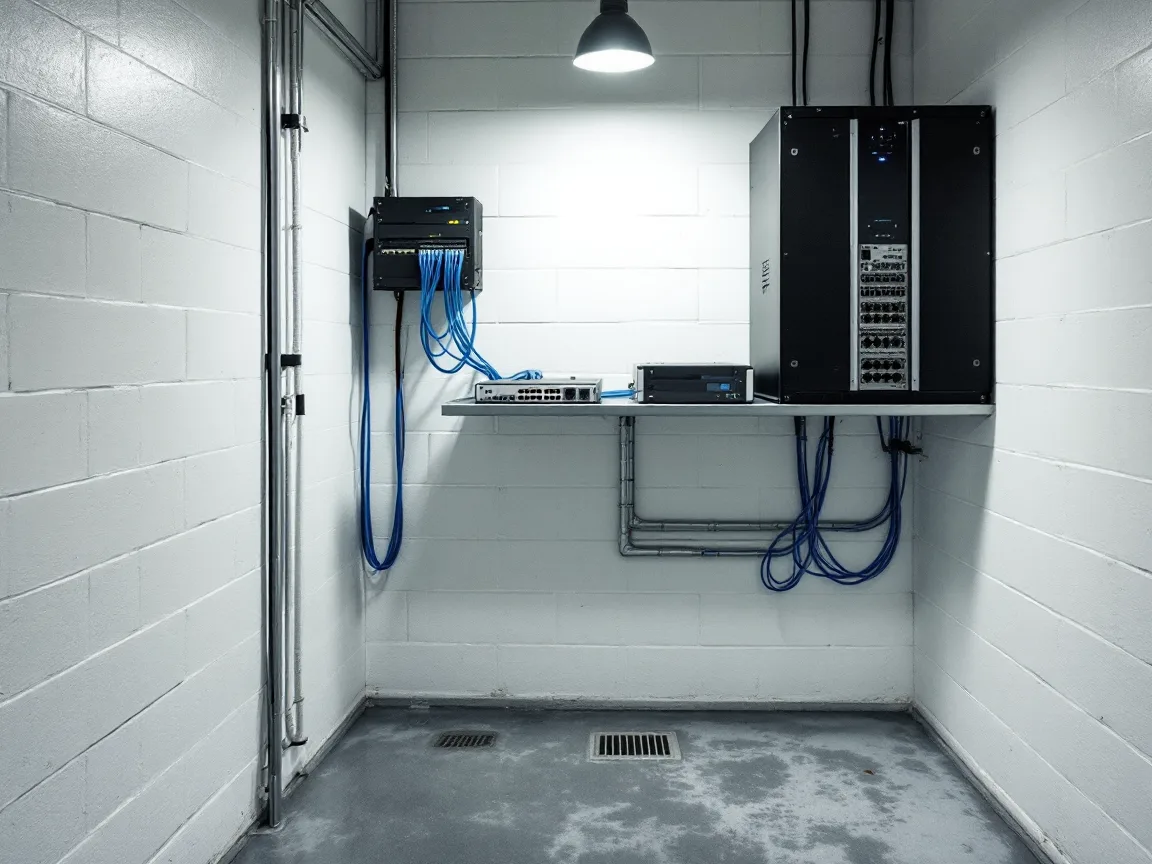
My honest take is that a lot of offices along I-35 and Loop 337 will find they’re outside the mapped high-risk zone. Good. That still leaves the closet. A surprising number of server rooms here sit on a ground floor with the UPS, switch and backup box on the bottom shelf or the floor itself. A few inches of water from a roof leak or a backed-up drain does the same damage as a river. Water is water. Move anything that matters at least 1 shelf up, and keep the UPS off the floor too.
What Happens When NBU Starts Rotating Outages?
You find out how long your UPS really lasts. New Braunfels Utilities is city-owned, so in-town businesses generally buy power straight from NBU, while some offices outside the city limits are served by an electric cooperative instead. Check your bill so you know which outage map to watch. It matters.
February 2021 is the test case. Community Impact reported that NBU had 47,162 electric customers, that 13,950 of them, about 30%, were in rotating outages at the peak on February 16, and that rotating outages ran 70 hours and 35 minutes in total. Boil water notices followed. Both school districts canceled classes through February 23. The NOAA records show 32 winter-weather days across the 2 counties in 20 years, every one between December and February, so this is rarer than flooding. It’s also longer.
Rotating outages are harder on equipment than one long outage, because the power comes and goes. A UPS should be set to shut servers down cleanly after a few minutes on battery, not keep them running until it dies and then let them slam back on when the power returns. Switches hate it too.
And remember the internet. If your fiber or cable modem shares the same power as the office, the second connection should run on something else, like a cellular or fixed wireless line with its own battery. Most plans skip it. It’s also the part that keeps card terminals and phones working while the lights flicker.
Does the Tourist Season Change the Plan?
It changes the calendar. Specifically, it changes when you can afford trouble. Visit New Braunfels reports more than 6 million visitors in 2024, hospitality at 31.4% of the city’s jobs, and an average economic impact of $1.3 billion a year. Those visitors arrive in the same months the flood data peaks. Bad timing. Memorial Day weekend opens river season, and May is the worst flood month on record.
So the peak revenue weeks for restaurants, rentals, outfitters and the shops that sell to them are also the riskiest weeks for IT, which is the opposite of how a lot of companies schedule upgrades. That has 3 practical results. Don’t schedule a server move, phone system change or firewall swap between late April and Labor Day. Make sure every card terminal can fail over to a cellular connection. And train seasonal staff on the 1-page version of the plan, since they’ll often be the first ones in the building on a bad morning.
How Do You Build the Plan, Step by Step?
This is the order we’d do it in for a company with 20 to 75 people in Comal or Guadalupe County. It follows the Ready.gov IT recovery guidance, which says each system’s recovery time should match the business’s recovery time objective and that restore times should be tested and compared against it.
- List the 5 to 10 things that have to keep working, like phones, email, accounting, scheduling and card payments, and write down how long each one can be down and how much data you can lose. Our guide to RTO vs RPO walks through those 2 numbers.
- Look up the building and the closet. Check the flood map. Then raise the equipment.
- Map where your people live and which crossings they use, because the county’s closure list and DriveTexas for state roads will tell you who’s cut off on a given morning, but only if you already know who drives which way.
- Decide who makes the office-closed call, by what time, and in which single channel, like a Teams group or a text list.
- Get every critical system reachable from home, which for most offices here means Microsoft 365, a cloud phone system, and remote access to whatever still lives on a server in the back closet.
- Put power and internet on separate legs. Size the UPS for a clean shutdown and add a second internet connection on different power.
- Keep at least 1 backup copy outside the region and restore from it on a schedule, so the recovery time is a measured number.
- Test it twice a year, once in March before the spring storms and once in November before the freezes. Put it on the calendar.
Comal County has 16 automated low-water crossings and, as reported in January 2026, accepted up to $1.25 million from the Texas Water Development Board for more sensors, cameras and warning systems. The county engineer said the goal is to stretch warning time from 30 to 45 minutes into hours. That’s good news. It still won’t make a closed crossing open. All a warning buys you is more time to make the call.
Where Should the Backups Live?
Out of the storm’s reach. A drive at the owner’s house in Gruene or Canyon Lake is better than nothing, but it sits under the same rain and often on the same utility. San Antonio is a reasonable second location for most floods, which tend to be local, though the June 2010 storm stretched from Atascosa County to Comal. It’s a weaker one for a statewide freeze like 2021, when the whole grid was in trouble. For that, at least 1 copy should be in a data center outside Texas.
Our backup and disaster recovery in San Antonio page covers how we set that up for companies across the metro. If you’re comparing a New Braunfels provider with a San Antonio one, our New Braunfels vs San Antonio IT provider comparison covers the trade-offs. Want names? We scored the managed IT companies serving New Braunfels on reviews, distance and what they put in writing.
When Don’t You Need Outside Help?
If you’re 8 people, everyone already has a laptop, your files live in Microsoft 365 and your phones are an app, you’re closer than you think. Write the call tree. Pick the 6 AM decision maker. Buy a decent UPS for the internet equipment. That’s most of it. No contract needed.
It gets harder once there’s a server in the closet, a line-of-business app that only runs on-site, card payments that can’t stop, or 30 people who need to work from home on 2 hours’ notice. That’s the point where testing restores, keeping the remote setup current and watching it on a bad morning becomes a job. If you’re weighing the cost, our guide on what managed IT costs in New Braunfels and our published pricing show what’s included.
Tell us how your team works and where your systems live, and we’ll walk through what still works on a morning when the crossings are closed and the power’s off.
Get a Free IT AssessmentQuestions New Braunfels Owners Ask About IT Continuity
How is a continuity plan different from a backup?
A backup is a copy of your data, and a continuity plan is how the business keeps working while systems or the office are unavailable. You need both. A good backup with no plan still leaves 20 people wondering whether to drive in at 6 AM.
Which months carry the most flood risk in Comal and Guadalupe counties?
May. In NOAA records from 2006 through 2025 it had 20 flood days, the most of any month, and April through June held 37 of the 75. July is next with 12, and October brings a smaller fall bump.
Should we keep our server in the office at all?
Maybe not. If the only reason it’s there is a file share, moving that to SharePoint or OneDrive removes a single point of failure your staff can’t reach during a flood. If it runs software that has to stay local, keep it, but raise it off the floor, put it on a UPS that shuts it down cleanly, and back it up off-site.
Is a San Antonio data center far enough away for our backups?
Usually, for a local flood. For a statewide event like the February 2021 freeze, it’s better to also keep a copy outside Texas, since the grid problem was everywhere at once.
Who should make the call to close the office?
One named person, with a backup, by a fixed time like 6 AM. They should check the river gauges, the county’s road closures and the forecast, then post the decision in one channel everyone already uses. Two people making separate calls is how half a team ends up at a closed crossing.
How often should we test the plan?
Twice a year. That works for most offices here, once in March and once in November. Run an actual restore and have a few people work fully remote for a day. A plan that’s only been read hasn’t been tested.