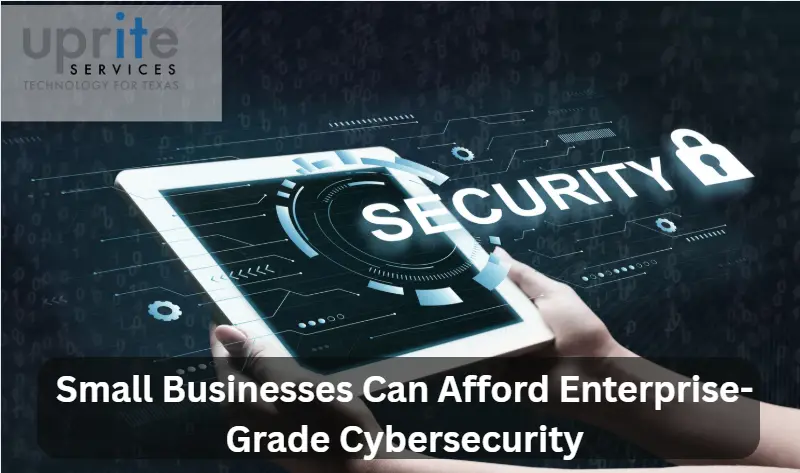
Small businesses afford enterprise-grade cybersecurity by renting it rather than building it. The detection, monitoring and response tools large companies run are now sold per user per month, starting near $40, so a 25-person firm can buy the controls without hiring the security team behind them.
For years the honest answer here was no. The tools existed. They shipped as appliances with license minimums and annual refresh cycles, and running them took security analysts that nobody at your headcount could reasonably justify hiring for a single environment. Both barriers came down. What changed was delivery rather than technology, and our own cybersecurity solutions are priced off exactly that shift.
The exposure is not hypothetical. Verizon’s 2025 Data Breach Investigations Report found extortion malware in 88% of small and medium business breach incidents, against 39% at larger organizations. Attackers aren’t skipping you. They start with you. The defenses are thinner and the response is slower, so the same intrusion a large company catches on day two can run for months inside a business with nobody watching the alerts.
What Enterprise-Grade Actually Means
Enterprise-grade is a standard of coverage, not a price bracket. Four properties separate it from the antivirus that came with the laptop.
- Layers that overlap. No single control is trusted to hold. A message that slips past the email filter still meets a second check on the device itself.
- Detection that reasons about behavior. Signature matching finds known malware. Behavioral detection finds the variant nobody has catalogued yet, which is most of them.
- Somebody awake at 2am. An alert only counts once it reaches a person who can isolate the machine. That’s the piece small businesses almost never have in house.
- Encryption in transit and at rest, built on NIST cryptographic standards, so intercepted data stays unreadable.
None of it’s exotic now. All four ship as subscriptions. The move from capital purchase to monthly seat is the whole reason these controls sit on a 25-person company’s operating budget instead of an enterprise price list.
What It Costs in 2026
Most guides on this topic won’t name a number. Ours are public. These are the same rates a prospect would be quoted from our managed IT pricing page.
| Plan | Rate | What it covers |
|---|---|---|
| MSSP Security Focus | From $40 per user per month | Security only. Monitoring, detection and response layered over the IT you already run. |
| Co-Managed IT Partnership | From $100 per user per month | Your internal lead keeps the relationships while we carry the tooling, the night shift and the escalation path. |
| Fully Managed IT | From $138 per user per month | Help desk, infrastructure and the security stack under a single owner. |
Work it through for 25 people. Security-only coverage lands near $1,000 a month, roughly $12,000 a year, before the software licensing underneath it. Licensing bills separately and depends on what you already own, which is why a quote that folds the two into one number is usually hiding one of them, and the hidden one is almost always the licensing. For scale, Microsoft lists Business Premium with Copilot at $32.00 per user per month on an annual subscription, and Defender for Business and Intune Plan 1 are already inside it. Check what you own before buying anything. Our Texas MSP pricing benchmark shows how those rates sit against the wider market.
Two things move the figure more than headcount does. Regulated data raises it, because evidence and retention obligations add work that has nothing to do with stopping attacks. A fleet of unmanaged personal devices raises it too. Neither is optional.

Where the First Dollars Go
Order matters more than budget. Spend in this sequence and the cheap controls cover the common attacks before the expensive ones cover the rare ones.
- Multifactor authentication everywhere. It’s usually already inside licensing you pay for. Switching it on is the largest risk reduction available for close to nothing.
- Managed endpoint protection. Not the free tier. The managed kind, where a detection reaches somebody who acts on it. Microsoft sells Defender for Business standalone at $3.00 per user per month, which is why the tool is almost never the thing standing between a small business and real endpoint coverage. The watching is.
- Email filtering with attachment and link inspection. Business email compromise cost reported victims $3 billion in 2025 by the FBI’s count, and nearly all of it arrives through a mailbox that somebody in accounts payable opens dozens of times every working day.
- Backups you have restored from. An untested backup is a hope, not a control. Restore one this quarter. Time it.
- Short, frequent security training. Annual training changes nothing you can measure.
Notice what is missing from that list. Nothing on it is a flagship product with a flagship price, and the CISA Cyber Essentials baseline lands in much the same place. Not an accident.
If You Have No IT Team At All
This is the most common version of the question, and it changes the answer. With nobody internal, a security-only tier leaves a gap, because detections still need someone to receive them and act during the working day.
Two routes work. A fully managed plan puts help desk and security under one owner, which is simpler to run and costs more per seat. A co-managed plan fits when you have one capable generalist already stretched thin, covering the tooling and the night shift while they keep the relationships and the institutional knowledge no outside provider can replace. The split between a service that alerts you and a service that contains the threat is covered in what IT security management services actually include.
What doesn’t work is buying tools with nobody watching them. It is the most reliable way to spend a security budget and get nothing back. We see it monthly.

Why the Price Came Down
Three shifts did it. Detection moved to the cloud, so the appliance and its refresh cycle left the quote. Monitoring became a shared service, so one analyst team covers many businesses rather than one. Licensing moved to per seat, which removed the minimums that used to price a 20-person company out of the category entirely, before anyone there had reached the question of whether the controls even fit.
So you now rent a share of a security operation. You pay for the seats you have this month, and the cost follows headcount in both directions, which suits a business whose staffing moves better than a capital purchase sized for the company you hope to become. Down as well as up.
What Waiting Actually Costs
A round $200,000 average gets quoted constantly for small business attacks. We removed it from this page because we couldn’t tie it to anything current. Here is what the 2026 reporting does support.
- Ransomware appeared in 48% of the 22,000 confirmed breaches Verizon analyzed for its 2026 report, up from 44% a year earlier.
- 69% of victims did not pay the ransom, which says recovery capability rather than negotiation decides how these end.
- IBM’s Cost of a Data Breach 2026 put the average breach at $4.99 million, with a mean 247 days to identify and contain one. First rise after five straight years of decline.
- The FBI’s 2025 Internet Crime Report logged 1,008,597 complaints and $20.877 billion in reported losses.
Those averages are not your number, and we would rather say so than let a $4.99 million figure do the persuading. A 25-person firm doesn’t absorb a loss like that. It closes, or it sells. What does travel down to your size is the 247 days, because the difference between an incident that stays an inconvenience and one that ends the business is almost always how long it ran before anybody noticed it was running.
What This Looks Like in Practice
Two of our own engagements make the point better than any average does.
A Texas real estate firm came to us about to spend more than $120,000 on replacement server hardware. The assessment found the environment was already overbuilt, so we consolidated more than 14 virtual machines down to 3 and finished the whole project for roughly $20,000. The hardware was never the problem, and buying it would have locked in years of maintenance on capacity the business did not use. The full numbers are in that case study.
A Texas women’s shelter was running consumer-grade networking gear, an unsecured firewall and frequent outages, with payroll data sitting behind all of it and a nonprofit budget to work inside. It now runs business-grade security on segmented networks, phased in so daily operations never stopped. That one is worth reading for the sequencing.
Neither had a bigger budget. Both started with an assessment.
Our Takeaway
Affordability stopped being the real obstacle a while ago. Sequencing is the obstacle now. A 25-person company can run multifactor authentication, managed endpoint protection, filtered email, tested backups and monitored detection for a predictable monthly figure, and the businesses that get hurt are rarely the ones who couldn’t afford those controls. They bought tools nobody watched. Or they left the free controls switched off while shopping for the expensive ones.
Start from what you are protecting. Then price the controls against that, in the order above. Nothing else is load-bearing.
Want your own stack priced against this list?
Get a Security AssessmentNo cost and no obligation. If you already have it covered, we will tell you that.
What Owners Ask Before They Buy
Is enterprise-grade security genuinely available at our size?
The tooling is, because it is now sold as a service rather than as a purchase. What used to require a security team and a capital budget is delivered per user per month, which is the single change that put these controls within reach of a 30-person business. Delivery changed, not the technology.
What does business-grade cybersecurity cost?
Security-only coverage starts at $40 per user per month on our published rates, so 25 people works out near $1,000 a month before licensing. Bundling security into a fully managed plan runs $138 per user per month because it carries the help desk and the infrastructure work as well.
What is a managed SOC and do we need one?
A team watching your environment for threats, provided as a subscription. Whether you need one depends less on size than on what a breach would cost you, and businesses handling regulated data usually reach that threshold well before they feel large enough to be a target.
Where should limited money go first?
Multifactor authentication, then endpoint protection, then training. Those three address the paths most attacks actually take, and skipping them to buy something more sophisticated is the most common way security budgets get wasted. Cover the common cases.
Can we secure email and stop there?
Email filtering is the highest-value single control and it’s still not sufficient on its own. It stops the message, not the credential that was already phished last year, and not the laptop that picked something up on a home network. Treat it as the first layer rather than the only one.
Does training actually change anything?
Measurably, when it runs regularly rather than annually. Short frequent sessions with simulated phishing shift behavior, and the number worth watching is not who clicked but who reported, because reporting is what gives you time to respond.
Doing nothing, what does that cost?
More than the protection would have, in almost every case that gets calculated. Downtime, recovery, lost business, notification obligations, and the customer relationships that quietly do not renew all follow an incident, and none of them appear in the budget line nobody funded. Absence has a price.
How do we work out what we actually need?
Start from what you are protecting and what it would cost to lose it. That framing turns an open-ended shopping question into a short list, and it is the fastest way to stop overpaying for some things while leaving others uncovered. Book a free security assessment to build that list.