IT security management services are the outsourced day to day operation of a company’s security program, covering 24/7 monitoring, endpoint and identity protection, patching, incident response, and compliance reporting under one monthly fee. The scope varies far more between providers than the marketing suggests, and the gaps usually sit in the same 3 places.
Short version. Almost every quote you receive will list the same 8 or 9 line items. What separates them is who watches the alerts at 3 a.m., who is contractually obliged to act on one, and who signs off on the compliance evidence. Read those 3 things first. Everything else on a managed security services provider proposal is easier to compare than it looks.
I’ve read a lot of security proposals for Texas companies, and the striking thing is how similar they are on paper. Endpoint protection, monitoring, patching, awareness training, quarterly reporting. Nine bullets, a monthly figure, a signature block.
The differences only show up later. One client finds out that monitoring meant a dashboard nobody was sitting in front of on a Sunday. Another finds out that their provider will tell them a laptop is compromised but won’t isolate it without a signed change request. A third gets asked for 12 months of authentication logs during an insurance claim and discovers the retention was set to 30 days.
None of those were dishonest. They were all in the scope of work, written in a way that reads as coverage until the day you need it. So this is a plain read of what IT security management services actually include, what is usually an add-on, what almost never gets covered, and the specific questions that surface the difference before you sign.
What are IT security management services?
IT security management services are an outsourced arrangement in which a provider operates and maintains the security controls protecting your systems, users, and data. That covers the tooling, the continuous monitoring behind it, the response when something fires, and the documentation that proves it all happened. You’re buying an operating capability rather than a set of licences.
The service goes by several names and the names aren’t standardised. Managed security services, managed security management, security operations as a service, and IT security management all describe roughly the same thing. What matters is not the label on the proposal but which of the 4 layers below the provider is actually taking responsibility for. If you are still deciding whether you need a security specialist at all or a general IT provider is enough, our comparison of MSP versus MSSP is the better place to start.
The 4 layers in every scope, and the 2 that quietly go missing
Every security management agreement is built from the same 4 layers. Providers price all 4 as one number, which makes it easy to assume you bought all 4. Most buyers get the first 2 and assume the rest.
| Layer | What it means in practice | How it goes missing |
|---|---|---|
| Tooling | Licences and agents deployed across endpoints, servers, identity, and email | Rarely missing. This is the layer everyone delivers because it’s the easiest to invoice |
| Monitoring | Telemetry from those tools collected, correlated, and watched | The tools are installed and the alerts land in a console nobody is staffed to watch outside business hours |
| Triage and response | A named human investigates the alert and is authorised to contain the threat | The contract promises notification, not action. You get an email and the problem is now yours |
| Governance and reporting | Control mapping, evidence retention, policy review, and an audit trail | Reduced to a quarterly PDF of ticket counts that proves nothing to an auditor or an underwriter |
The fastest way to test a proposal. Take the word monitoring and ask the provider to replace it with a sentence naming who is awake, where they sit, and what they are permitted to do without calling you first. A provider running a real operation answers in about 20 seconds. The answer you get tells you which layers you are actually buying.
What a standard scope actually includes

Here is the core inclusion set you should expect from a credible provider, mapped to the function each one satisfies in the NIST Cybersecurity Framework. Version 2.0 added Govern as a sixth function, which is the one most SMB scopes still leave empty.
| Included service | What it does | Framework function |
|---|---|---|
| Asset, user and identity inventory | Establishes what exists before anything protects it. Unknown assets are the most common finding in a first month review | Identify |
| Endpoint protection and EDR | Behavioral detection on laptops, desktops, and servers, not just signature antivirus | Protect and Detect |
| Patch and vulnerability management | Scheduled operating system and third party patching, with a defined window and a remediation SLA | Identify and Protect |
| Identity, MFA and access control | Enforced multi factor authentication, conditional access, privileged account separation, and joiner and leaver process | Protect |
| Email and collaboration security | Filtering, impersonation defence, and tenant hardening across Microsoft 365 or Google Workspace | Protect |
| 24/7 log collection and monitoring | Telemetry pulled into a SIEM or equivalent and correlated against known attack behavior | Detect |
| Incident triage and response | A human investigating alerts, with defined containment authority and an escalation path | Respond |
| Backup and recovery testing | Immutable backups plus periodic restore tests, because an untested backup is a guess | Recover |
| Security awareness training and phishing simulation | Scheduled training with reporting on who failed and what happened next | Protect |
| Control mapping and evidence retention | Documented control ownership, retained logs, and reporting an auditor will accept | Govern |
If a proposal is missing rows from the bottom half of that table, it isn’t necessarily a bad proposal. It might be an honest one that has been priced for a smaller scope. The problem is when the missing rows are described in a way that implies coverage. Detect without Respond is the single most common version of that, and it is worth its own section.
The response gap is where most agreements quietly break

A traditional managed security service detects and notifies. A detection and response service detects, investigates, and contains. Both are legitimate models, and both get sold using the phrase 24/7 protection.
The practical difference lands at 2 a.m. on a Saturday. Under a notify only agreement, an alert fires, an analyst confirms it is real, and an email goes to your IT contact. That contact is asleep. The clock keeps running. Under a response agreement, the same analyst isolates the machine, kills the process, and calls you afterwards.
Whether that matters to you depends on something specific rather than something philosophical. If you have internal IT staff who are genuinely reachable and authorised to act at 2 a.m., notification is enough. If you do not, and most companies under 250 people don’t, then you are paying for detection and absorbing the response risk yourself.
The honest caveat on containment authority
I’ll push back on my own point here. Handing a provider unilateral authority to isolate machines isn’t free of consequences. Isolating the wrong server during a month end close is expensive too, and I have seen a false positive take down a production line for 40 minutes. The right answer is not maximum authority, it is written authority. Agree in advance which systems can be contained without a phone call, which ones require one, and who the after hours decision maker is when the call is not answered. Put that list in the agreement, not in someone’s memory.
What is usually an add-on, and what is almost never included
This is the part of the scope buyers discover through invoices. None of these carve outs are unreasonable. They are real work with real cost, and a provider who bundled them all would have to charge everyone for what a minority use. The failure is not the carve out, it’s finding out about it during an incident.
Commonly priced as an add-on
- Full incident response and forensics. Most agreements include a stated number of hours of containment and triage. Deep forensic investigation, legal chain of custody, and breach notification support are usually billed separately or sold as a retainer.
- Compliance audit support. Ongoing control mapping is often in scope. Sitting through an actual HIPAA, PCI, SOC 2, or CMMC assessment with your auditor generally isn’t.
- Penetration testing. Vulnerability scanning is normally included. A genuine penetration test performed by a human is a separate engagement, and any provider who calls an automated scan a pen test is telling you something useful.
- Extended log retention. Providers typically include 30 to 90 days of searchable log history. Anything beyond that carries a storage cost and has to be asked for.
- Security architecture and project work. Network segmentation, a zero trust rollout, or a migration to a new identity platform is project work, not a monthly service.
- Third party and vendor risk assessment. Reviewing the security posture of your suppliers is increasingly demanded by insurers and rarely included by default.
Almost never included, whatever the tier
- The cost of the breach itself. No managed security agreement indemnifies you for downtime, ransom, regulatory penalties, or lost revenue. That is what cyber insurance is for, and the liability cap in your agreement is usually the fees paid over the preceding 3 to 12 months.
- Physical security. Door access, cameras, and alarm systems sit with a different kind of vendor.
- Your own decisions. A provider can enforce MFA everywhere except the 4 executives who asked to be exempt. Whoever grants the exemption owns the outcome.
- Security for shadow systems. The SaaS tool a department bought on a credit card is not monitored, because nobody told the provider it exists.
What cyber insurance now forces into your scope

For a lot of Texas companies the insurance application has quietly become the real specification. Underwriters now ask for specific controls, verify some of them by external scan, and treat an inaccurate answer as grounds to contest a claim. That changes the scoping conversation, because the controls you attest to have to be the controls somebody is actually operating.
The recurring list is phishing resistant MFA across every account touching business data, EDR with monitoring on every endpoint and server, tested immutable backups, a written incident response plan, documented patch cadence, privileged access management, email security, awareness training, and network segmentation. Read that list against the inclusion table above and the overlap is close to total.
Ask for the attestation mapping. Give your provider a copy of your insurance application and ask them to mark each control as operated by them, operated by you, or not in place. The version of that document with honest not in place entries is worth more than a proposal with every box ticked, because it is the one that survives a claim.
Log retention and evidence, the line item nobody scopes properly
Retention is dull, cheap to get wrong, and impossible to fix retroactively. If your logs rolled off at 30 days, no amount of money recovers what happened in month 4.
The obligations differ by framework and the longest one wins. PCI DSS version 4 requires at least 12 months of audit log history with the most recent 3 months immediately available for analysis. HIPAA’s documentation retention duty runs to 6 years. Most default managed security packages ship with 30 to 90 days. Somebody has to notice that gap, and it’s usually not the person signing the agreement.
The practical fix is a tiered arrangement. Keep 90 days hot and searchable for live investigation, 12 months warm for audit questions, and a cold archive for whatever your longest regulatory obligation demands. Ask for the retention period per tier in writing, and ask what happens to the archive if you leave. Texas companies handling personal data also carry a statutory duty to maintain reasonable security practices, which we covered in our guide to the Texas Data Privacy and Security Act.
What it costs, and the build versus buy arithmetic

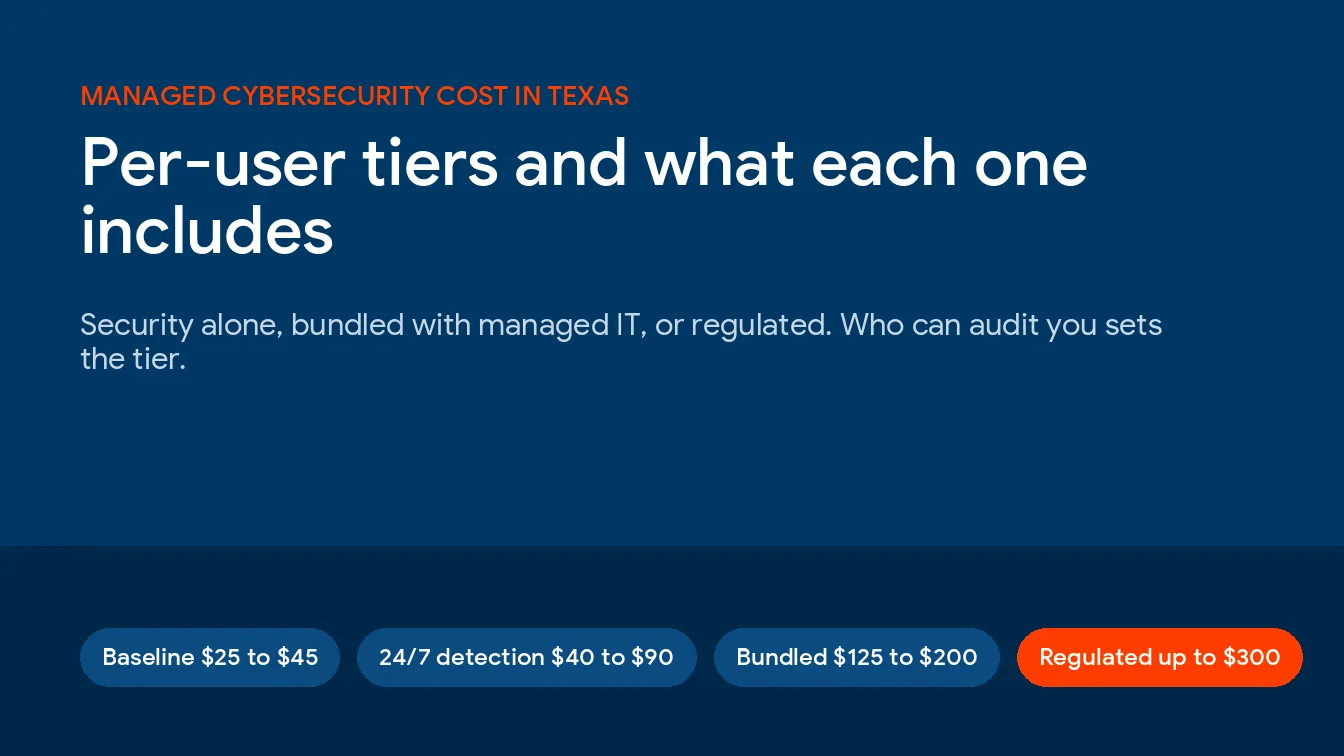
Security management is normally billed per user per month, sometimes with a per server or per site component. Across the US market in 2026 the ranges look roughly like this, and Texas sits close to the middle rather than at either end.
| Tier | Typical range per user per month | What it usually covers |
|---|---|---|
| Foundational | 50 to 100 dollars | Endpoint protection, patching, MFA enforcement, awareness training, business hours alerting |
| Standard | 100 to 175 dollars | The above plus 24/7 monitoring, log collection, backup management, and quarterly reporting |
| Advanced | 175 to 350 dollars | The above plus managed detection and response with containment authority, extended retention, and compliance evidence support |
| Compliance add-on | 25 to 100 dollars | Framework specific control mapping, evidence collection, and audit support for HIPAA, PCI, CMMC or SOC 2 |
The comparison people reach for is hiring instead. The arithmetic is worth doing once, because it explains why the outsourced model exists at all. Covering 3 shifts a day, 365 days a year, with cover for holidays and sickness, takes roughly 4 to 5 full time people per seat. Wanting 2 people on shift for escalation redundancy puts you near 8 to 10 analysts before you have bought a SIEM licence or hired anyone to manage them. For a 60 person company that maths never closes.
That’s not an argument that outsourcing is always right. A 900 person manufacturer with a mature internal team is often better served by co-managed coverage, where the provider takes nights and weekends and the internal team owns business hours. What the arithmetic rules out is the middle position most SMBs are actually in, which is 1 IT generalist quietly carrying 24/7 security responsibility on top of a help desk queue. We wrote about how smaller firms close that gap in affording enterprise grade cybersecurity.
Why the scope conversation got harder in 2026
Two shifts in the threat data changed what a scope has to cover, and both are recent enough that older agreements have not caught up.
The first is where attackers get in. Verizon’s 2026 Data Breach Investigations Report found that 31% of breaches now start with software vulnerabilities, overtaking stolen passwords as the leading entry point, and that 48% of all breaches involve ransomware. That puts patch and vulnerability management, historically treated as a hygiene task, at the centre of the scope rather than the edge of it.
The second is cost and speed. IBM’s Cost of a Data Breach Report 2026 put the global average breach at 4.99 million dollars, a record and a 12% rise on the year, alongside a 56% increase in AI driven attacks. The same research found organizations using AI and automation extensively in their own security operations saved an average of 1.93 million dollars per breach. Detection speed is now a line item with a price attached to it.
There is a third reason to care about who holds your administrative access. The joint advisory AA22-131A from CISA, the NSA, the FBI and partner agencies exists because attackers target service providers specifically in order to reach their customers. It tells customers to evaluate the security processes and contractual commitments of their provider rather than assume them. Asking your prospective security provider how they secure themselves is a fair question, and a revealing one.
Twelve questions that surface the real scope
Send these by email and keep the replies. A written answer from a salesperson is not a contract term, but it’s remarkably useful later, and the speed of the reply tells you plenty on its own.
- Who is watching alerts at 3 a.m. on a Sunday, and are they employed by you or by a partner?
- What are you authorised to do without calling me first, and which systems are excluded from that?
- Is your response commitment measured to a human taking ownership or to an automated acknowledgement?
- How many days of log history are searchable, and how many are archived?
- Which of the controls on my insurance application do you operate, and which stay with me?
- What is included in incident response, and at what point does the billing change?
- Do you perform vulnerability scanning, penetration testing, or both, and by whom?
- What is your patching window and your remediation target for a critical vulnerability?
- How do you handle an executive who requests an MFA exemption?
- Do any subcontractors or offshore staff hold administrative access to my systems?
- What evidence do you produce that an auditor or underwriter will accept without rework?
- If we part ways, what do I receive, in what format, and within how many days?
Send us the scope you are comparing.
We will read it against everything on this page and mark which layers are covered, which are notification only, and which are add-ons waiting to be invoiced. No charge and no obligation to move. If the scope is solid, we will tell you that.
How Uprite scopes IT security management
It would be poor form to publish this without saying what our own scope does, so here it is. Our security management sits on a 24/7 SOC rather than business hours alerting with an on call phone. Containment authority is agreed system by system before onboarding finishes, and written into the agreement rather than left to judgement at 2 a.m. Control mapping and evidence retention are part of the monthly service, not a quarterly PDF of ticket counts.
On the commercial side, our average response time across all support requests is just over 5 minutes, the service rate is guaranteed not to increase during your first year, and every engagement carries a 120 day satisfaction guarantee, which means you can leave inside the first 4 months if the service is not what we described. That last one exists because scope disputes almost always surface in the first quarter.
Coverage is Texas wide with local engineering teams in each metro, which matters when an incident needs somebody physically on site. If you’re searching for IT security management services near you, start with managed security services in Houston, San Antonio, or Dallas. The full service breakdown lives on our cybersecurity services page, and if you are vetting providers rather than buying yet, the questions in how to evaluate an MSP’s cybersecurity stack pairs well with the 12 above.
What Texas business owners ask us about security scope
What is the difference between IT security management services and managed IT services?
Managed IT keeps systems working. IT security management keeps them defended. A managed IT agreement centres on uptime, help desk, and infrastructure, with security appearing as antivirus and backups. A security management agreement centres on detection, response, and evidence, and is measured on how fast a threat is found and contained rather than how fast a ticket closes. Plenty of companies buy both, often from the same provider.
Does the service actually stop an attack, or does it just tell me about one?
That depends entirely on the contract, and it’s the most important thing to check. A notification model confirms the alert and emails your IT contact. A detection and response model contains the threat first and reports afterwards. Both are sold as 24/7 protection, so ask which one you are buying and get the containment authority written down.
How much do IT security management services cost for a 50 person company?
Expect roughly 5,000 to 8,750 dollars a month at standard tier pricing of 100 to 175 dollars per user, before compliance add-ons. Regulated environments and heavy server footprints push higher. The figure moves with the condition of what you already have, because a first quarter spent remediating inherited problems costs more than steady state operation.
Can we keep our internal IT team and still buy security management?
Yes, and for companies past roughly 200 staff it is often the better structure. In a co-managed arrangement the provider owns 24/7 monitoring, response, and the compliance evidence, while your team keeps day to day IT and business hours triage. The part that has to be explicit is the handoff, specifically who owns an incident at 6 p.m. on a Friday and what happens when that person is unreachable.
How long does onboarding take before the monitoring is genuinely live?
Agent deployment takes days. A defensible security posture takes 60 to 90 days. The sequence usually runs inventory and visibility first, then identity and MFA enforcement, then endpoint coverage and patch baselining, then log collection and tuning, then response runbooks. A provider promising full protection in a week is describing installation, not operation.
Is any of this worth it for a company with 15 employees?
Honestly, the advanced tier usually isn’t. At that size the return sits in a smaller set of controls done properly, which means enforced MFA everywhere, EDR on every device, tested backups, patching on a schedule, and awareness training. That is a foundational tier engagement. Buying a SIEM and a 24/7 SOC for 15 people is a real cost against a risk profile that hasn’t earned it yet.
What happens to my logs and documentation if we change providers?
Ask before you sign, because agreements are frequently silent on it and silence favors the outgoing provider. Log archives, control documentation, network diagrams, credential vault entries, and configuration exports should be named as your property, returnable in a usable format within a stated number of days at no extra charge.
The bottom line
The inclusion list on a security proposal is the least useful page in it. Nearly every provider will list the same 9 things, and nearly every list is technically true.
What separates a real security operation from a licence reseller with a dashboard is narrower than the brochure suggests. Somebody awake and paid to look. Written permission to act before permission is needed. Evidence that holds up when an underwriter or an auditor asks for it. Ask about those 3 things, in that order, and the proposals that looked identical stop looking identical within a single phone call.
Comparing security providers across Texas?
We run a 24/7 SOC, agree containment authority in writing before onboarding ends, and back every engagement with a 120 day satisfaction guarantee. See what a full managed security scope covers.