Plan a Texas school IT budget around E-Rate by running internet, Wi-Fi and network gear through E-Rate’s 20% to 90% discounts, then paying for devices, help desk support and security tools from IMTA and local funds.
I’m the Lead vCIO at Uprite, and budget season is when charter school and small district leaders ask me the same question in different words. How much of next year’s technology spend will E-Rate actually carry? This guide is for CFOs, operations directors and superintendents at Texas charter schools and small districts in Houston, San Antonio, Dallas and Fort Worth. It sits under our IT support for charter schools in Texas. One thing up front. Uprite isn’t an E-Rate consultant or a registered E-Rate service provider, so we don’t file your forms. We help schools plan the network work E-Rate discounts and run the parts of IT it leaves out.
E-Rate pays a share of internet service and the gear that moves it around your buildings. For 2026 to 2030, a Texas school gets a 5-year Category 2 budget of $201.57 per student, with a $30,175 floor, and money you don’t commit before 2030 is gone. Devices, staff, help desk support and advanced security aren’t eligible, so those lines need IMTA, local or grant dollars. File the FY2027 Form 470 now, because the Form 471 window opens in early 2027.
What does E-Rate pay for in a school IT budget?
E-Rate is the federal Schools and Libraries Universal Service program. The FCC oversees it and USAC runs it. It discounts 2 kinds of spending. Category 1 covers internet access and the data lines between your buildings. Category 2 covers the internal connections that carry that service to classrooms, plus basic maintenance and managed Wi-Fi.
The FCC adopted the funding year 2027 Eligible Services List on November 10, 2026, in order DA 26-1220. It made no changes from the year before. Here’s what Category 2 covers for the 2027-28 school year.
- Cabling, racks, switches, routers and wireless access points
- Wireless controllers and caching equipment
- Firewalls that sit apart from the basic firewall your internet provider includes
- Battery backup units that support eligible equipment
- The software and licenses those devices need to run
- Managed internal broadband services, meaning a third party runs your Wi-Fi and network for you
- Basic maintenance, meaning repair of eligible hardware, cable work and on-site configuration changes
The list of what’s out matters just as much for a budget. Staff salaries and labor for your own employees aren’t eligible. Neither are consulting fees for application help or program advice. Laptops, Chromebooks and other end-user devices aren’t on the list. Basic maintenance excludes network management and 24-hour monitoring. And the FCC turned down requests to add next-generation firewalls and other network security services for 2027.
Two items the FCC added in 2023 and 2024 came back out. The FCC ended E-Rate support for school bus Wi-Fi in a September 2025 declaratory ruling, and it rescinded off-campus Wi-Fi hotspot lending in order FCC 25-62. If either one was in your 2025 plan, it now sits in your local budget or gets cut.
How much Category 2 money does a Texas school get from 2026 to 2030?
Category 2 runs on a 5-year budget, not a yearly one. For the cycle that started July 1, 2026, USAC sets the school multiplier at $201.57 per student and the funding floor at $30,175. The last cycle paid $167 per student with a $25,000 floor. Districts and charter networks get one pool, calculated at the district level, and can spend it on any of their schools.
The budget is pre-discount. That’s the detail that trips people up. A $100,785 budget doesn’t mean E-Rate sends you $100,785. It means you can buy up to $100,785 of eligible equipment and services over 5 years, and E-Rate pays its discount share of that.
Your discount comes from 47 CFR 54.505. It’s based on the share of your students who qualify for free or reduced-price lunch and whether you’re urban or rural. Category 1 discounts run from 20% to 90%. Category 2 tops out at 85%. A school under about 150 students gets the $30,175 floor, because 150 students times $201.57 only comes to $30,236.
| Category 2 discount | E-Rate pays over 5 years | Your share over 5 years | Your share per year, spread evenly |
|---|---|---|---|
| 85% | $85,667 | $15,118 | $3,024 |
| 60% | $60,471 | $40,314 | $8,063 |
| 40% | $40,314 | $60,471 | $12,094 |
| 20% | $20,157 | $80,628 | $16,126 |
That table is a 500-student school spending its full $100,785 budget. Look at the bottom row. A school with few low-income students pays 4 times as much as the high-need school in the top row for the same switches and access points. The discount sets your real cost, so get it confirmed before you build the budget around it.
How much Category 2 money did Texas charter schools leave unused?
We pulled USAC’s public Category 2 budget data on November 24, 2026 and matched it to the 110 active Texas charter school districts in USAC’s entity file. 93 of them had a Category 2 budget in the 2021-2025 cycle. Together they held $59.1 million in budgets and committed $47.1 million, or 79.7%. The other 1,039 Texas school districts committed 90.7% of theirs.
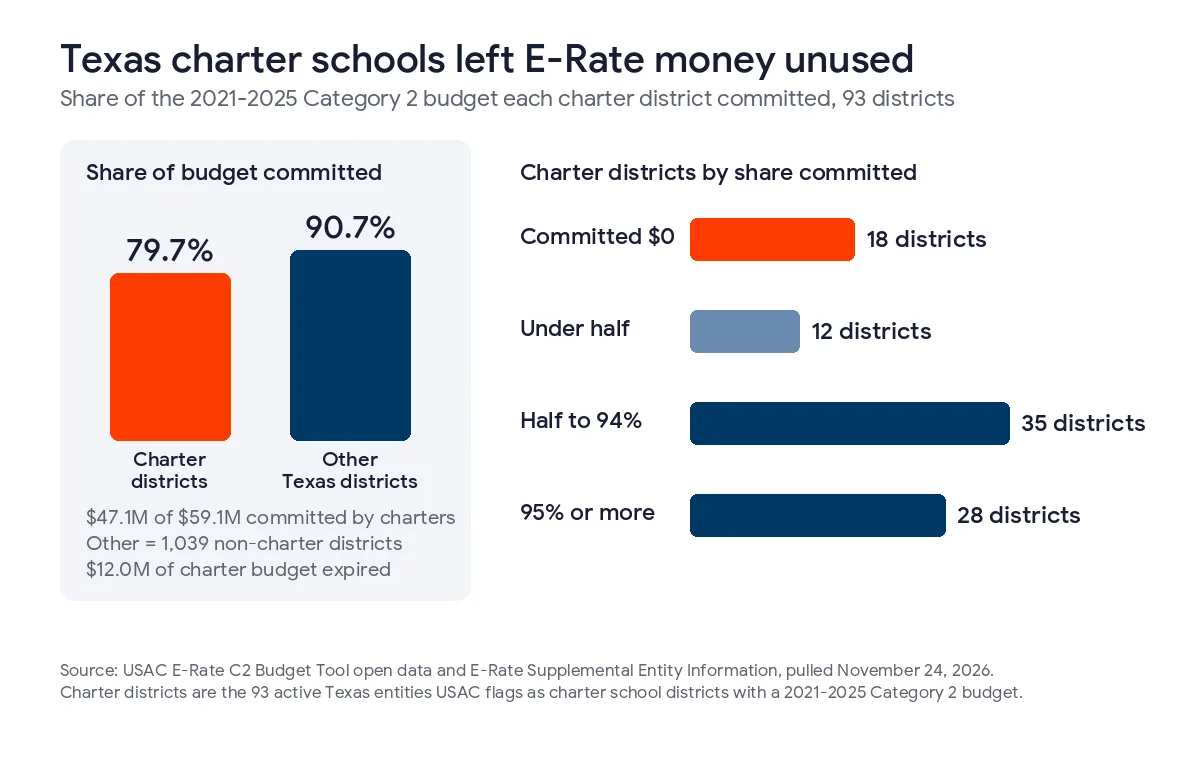
The gap is concentrated. 18 charter districts, serving 14,259 students, drew $0 against $2.46 million in budget over 5 full years. Another 12 used something but less than half. At the other end, 28 used 95% or more. All told, $12.0 million in charter school Category 2 budget expired unspent, and USAC’s rules don’t carry it into the new cycle.
The new cycle is off to a slow start too. As of the same pull, 45 of the 93 charter districts had no committed or pending Category 2 request against their 2026-2030 budgets, which add up to $17.0 million. The median charter district has 839 students and a 5-year budget of $189,677.
Why does this happen? I don’t think it’s a lack of need. In the schools we talk to, E-Rate tends to belong to whoever has a spare week in January, and that person changes every couple of years. The Form 470 goes up late or not at all, and the switch refresh slides to next year. Then the cycle ends.
What did Texas charter schools actually file for in 2025?
USAC’s Form 471 data shows 71 Texas charter districts filed for funding year 2025. Their active requests totaled $19.9 million before discounts. E-Rate’s share came to $15.9 million, which left $4.0 million for the schools themselves to pay. 39 of the 71 received a 90% discount on at least one request. 30 filed for internet service only and asked for nothing in Category 2 that year.
That $4.0 million is the line that gets missed. Your non-discount share has to be in the budget before the work starts, because E-Rate only reimburses its part. You can pay the full bill and get reimbursed through Form 472, called BEAR, or have your vendor bill you only your share and collect the rest through Form 474, called SPI. Either way, the board needs to approve your share for the year the equipment arrives.
Which school IT costs does E-Rate leave to your budget?
Most of them, by dollar amount. Here’s how the lines in a typical Texas charter or small district technology budget sort out.
| Budget line | E-Rate eligible? | Where the money usually comes from | Note for planning |
|---|---|---|---|
| Internet access and lines between campuses | Yes, Category 1, 20% to 90% | E-Rate plus your share from the general fund | Yearly request, not capped by the Category 2 budget |
| Switches, access points, cabling, firewall, battery backup | Yes, Category 2, up to 85% | E-Rate plus your share | Counts against the 5-year $201.57 per student budget |
| Managed Wi-Fi run by a third party | Yes, as managed internal broadband services | E-Rate plus your share | Still eligible for 2027, but the FCC is reviewing how it’s capped |
| Chromebooks, laptops, classroom displays | No | IMTA, local funds, grants | TEA’s IMTA lets you buy technological equipment |
| Help desk, IT staff, managed IT support | No | Local funds, IMTA for some technical support salaries | Network management and 24-hour monitoring are also out |
| Endpoint protection, email security, backup, advanced firewall features | No | Local funds, grants | Only Cybersecurity Pilot participants get help here |
| Content filtering for CIPA | No | Local funds | Required to receive E-Rate for internet, but not itself on the eligible list |
| E-Rate consultant fees | No | Local funds | Many Texas schools use their regional education service center |
The state piece is the Instructional Materials and Technology Allotment. TEA’s letter for the 2026-27 biennium sets it at $174.69 per student plus $14.87 per emergent bilingual student, and it applies to open-enrollment charter schools as well as districts. IMTA can buy instructional materials, technological equipment, certain software and services, and pay salaries for specific technical support employees. It has to cover 2 full school years, so device refreshes compete with textbooks for the same dollars.
The rest lands in local funds. That’s where managed IT support, security tools and filtering live, and it works a lot like budgeting for IT when grants rarely cover it. Our sibling guide on what IT support costs a Texas charter school walks through that side, and the general Texas IT budget method we use with clients applies to schools with only small changes.
How do you build a school IT budget around the E-Rate calendar?
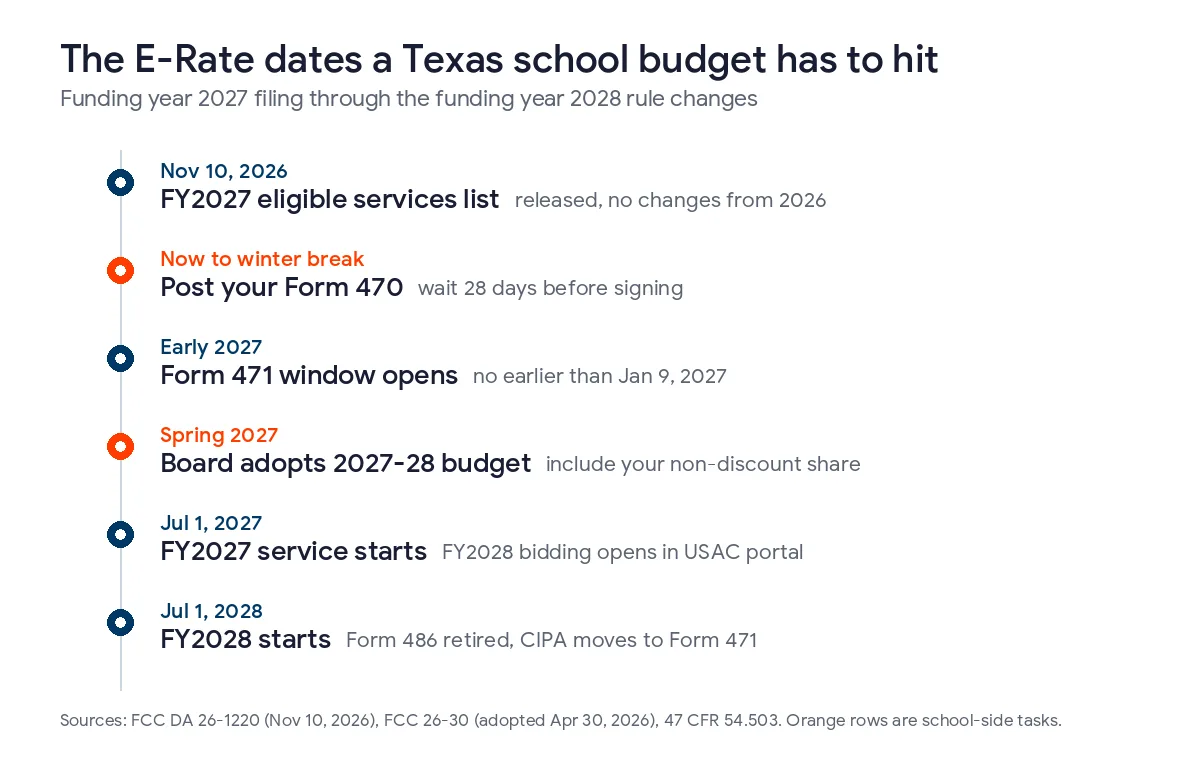
Work backward from the Form 471 window. The final Eligible Services List came out November 10, 2026, and FCC rules require it at least 60 days before the window opens, so the FY2027 window can’t open before January 9, 2027. USAC says only that it opens in early 2027. Here’s the order we’d follow for a school starting now.
- Look up your Category 2 budget and what’s left of it in USAC’s C2 Budget Tool, using your billed entity number.
- Inventory your network. List every switch, access point and firewall with its age and end-of-support date. A network assessment gives you this in one pass.
- Spread the 5-year budget across the years you’ll actually need it, front-loading anything past end of support.
- Post your Form 470 and wait at least 28 days before you sign a contract, as 47 CFR 54.503 requires.
- Score the bids with the price of eligible services as the most heavily weighted factor, even if only 1 bid comes in.
- File Form 471 inside the window, then put your non-discount share into the 2027-28 budget the board adopts.
- Choose BEAR or SPI with your vendor before the first invoice.
- Keep every bid, worksheet, contract and invoice for 10 years, per USAC’s document retention rules.
Step 3 is where I’d spend the most time, and it’s the core of the vCIO services we run for schools. A 5-year budget rewards a plan. If your core switches hit end of support in 2028, put them in the 2028 request and keep the money there, rather than spending it on access points in year 1 because a vendor had a deal.
What changes in E-Rate for funding year 2028?
The FCC adopted order FCC 26-30 on April 30, 2026. Starting with funding year 2028, vendors have to submit their bids through a USAC-managed bidding portal instead of sending them to you. You’ll upload your bid evaluations, board minutes and contracts to that portal when you file. Bidding for 2028 opens on or around July 1, 2027.
The same order retires Form 486 for 2028 onward and moves your CIPA certification onto Form 471. It also lets you ask USAC for a single 120-day invoice deadline extension up to 15 days after the original deadline passes, and it gives a 60-day grace period to fix a rejected invoice. For a small school, that last change matters. A rejected reimbursement used to mean an appeal.
What it means for your budget is mostly staff time. If your bid scoring lives in an email thread today, it has to become a document you can upload by the 2028 cycle.
Where does cybersecurity fit if E-Rate won’t pay for it?
For almost every Texas charter school, cybersecurity is a local budget line. The FCC’s Schools and Libraries Cybersecurity Pilot Program offers up to $200 million over 3 years, but its participants were picked in January 2025 and it isn’t taking new schools. Everyone else pays for endpoint protection, email security, backups and staff training on their own.
CISA’s K-12 cybersecurity report recommends starting with multifactor authentication, patching known vulnerabilities, backups and a tested response plan. Those are the first things we’d fund. The E-Rate-eligible firewall is a good start, but it doesn’t stop a phished password. Our guide to Texas cybersecurity requirements for charter schools covers what the state expects, and our network security services page covers how we handle it.
What would this look like for a 600-student charter?
Here’s a worked example with round inputs, so you can swap in your own. Say a 600-student charter in San Antonio has 80% of students on free or reduced-price lunch, which puts it at the 85% Category 2 rate.
Its 5-year Category 2 budget is 600 times $201.57, or $120,942. At 85%, E-Rate covers $102,801 and the school pays $18,141 across the cycle. Its IMTA for the 2026-27 biennium is $104,814 before any emergent bilingual amounts, and that has to stretch over curriculum and devices for 2 years. Internet service gets a separate yearly E-Rate request at up to 90%.
So E-Rate can cover most of the network, and IMTA can cover a chunk of the devices. What’s left is the support itself, the help desk, patching, security tools and someone who answers when the Wi-Fi drops during state testing. That piece has to come from local funds, and it’s the line I’d protect first. Our Texas managed IT pricing shows what that support runs per seat. Our team averages a 5-minute response, and for a school that’s often the difference between a lost class period and a short interruption.
Questions Texas school leaders ask about E-Rate budgets
Can E-Rate pay for Chromebooks or laptops?
No. End-user devices aren’t on the E-Rate eligible services list. Texas schools usually buy them with IMTA funds, which TEA allows for technological equipment, or with local and grant money.
Does unused Category 2 budget roll over to the next cycle?
It doesn’t. Whatever you leave uncommitted when a 5-year cycle ends is gone. Texas charter districts let $12.0 million expire in the 2021-2025 cycle, based on USAC data we pulled in November 2026.
When do we need to file for the 2027-28 school year?
The FY2027 Form 471 window opens in early 2027, no earlier than January 9. Your Form 470 has to be posted at least 28 days before you sign contracts, so posting it before winter break is the safe plan.
Are Texas charter schools eligible for E-Rate?
Yes. Open-enrollment charter schools are public schools and apply the same way districts do. USAC lists 110 active Texas charter school districts, and 71 of them filed for funding year 2025.
Is cybersecurity software covered by E-Rate?
Mostly not. A separate firewall is eligible in Category 2, but the FCC declined to add advanced firewalls and other network security services for 2027. Endpoint, email and backup tools come out of local funds.
Can IMTA money pay for school IT staff?
In part. TEA’s 2026-27 IMTA letter says the allotment can pay salaries for specific technical support employees, as Texas Education Code Chapter 31 describes. It can’t fund a general help desk or a managed IT contract on its own.
Send us your billed entity number, your Category 2 balance and a list of your network gear with install dates. We’ll map which pieces E-Rate can cover before 2030, what your share will be each year, and what the rest of your IT support should cost.
Book a free E-Rate budget review