
Email fraud at a Dallas wealth management firm usually means someone inside a client’s or an advisor’s inbox asking to send money to a new account. Firms stop it with callbacks to numbers already on file, locked-down Microsoft 365 mailboxes, and a second approver.
I run operations at Uprite, and a good share of the calls we get from advisory offices start the same way. A client “emailed” asking for a distribution, the associate sent the paperwork to the custodian, and now the client says they never asked. This guide is for principals, COOs, and client service leads at small RIAs and wealth teams around Dallas, Plano, Frisco, and Fort Worth. It sits under our IT services for wealth management firms in Dallas, and it covers what these attacks look like, what FINRA, the SEC, and Texas law expect when money moves on an email, and the setup that catches a fake request before it reaches the wire desk.
Treat every emailed request to move client money, change bank details, or update a standing letter of authorization as unverified until you call the client at a number you had before the request arrived. If the callback fails, the wire waits. Put phishing-resistant MFA on every mailbox and custodian login, alert on new inbox rules, and require a second approver for new payees. Know that Texas lets you hold a transaction when you suspect a vulnerable client is being exploited.
What does email fraud against a wealth advisor look like?
Email fraud against a wealth advisor is a payment scam that rides on the trust between a client, the advisor, and the custodian. The attacker gets into a real mailbox or fakes one, then sends instructions that look routine, a distribution, a wire to a “new” bank, or a change to standing instructions, so the firm moves the money itself.
FINRA described the core version back in January 2012. In Regulatory Notice 12-05, it warned that criminals were emailing firms from customers’ own hacked accounts “with instructions to wire funds to an account, often overseas, controlled by the perpetrator.” The pattern has picked up more variants in the 14 years since, but the shape hasn’t changed. Here’s how the requests usually arrive at a Dallas advisory office.
| How the request arrives | Who it claims to be | What it asks for | Where it usually gets caught |
|---|---|---|---|
| From the client’s real email account, which has been taken over | The client | A distribution or wire to an unfamiliar account, often with a reason it’s urgent | A callback to the phone number in your CRM from before the request |
| From a look-alike address, one letter off the client’s or a CPA’s domain | The client, their CPA, or their attorney | Updated wire instructions for a real closing, tax payment, or capital call | Display-name and look-alike domain warnings in Microsoft 365, plus the callback |
| From your own advisor’s or associate’s mailbox, after weeks of quiet watching | Your staff | The back office processes a “client” wire, or clients receive new payment instructions | Alerts on new inbox rules and sign-ins from unfamiliar locations |
| A fake custodian or document-signing notice | The custodian, an e-signature service, or Microsoft | A password and MFA code on a cloned login page | Phishing-resistant MFA that won’t hand a code to a fake page |
| A phone call or voicemail that sounds like the client | The client or a family member | A “confirmation” of the emailed request, or a rush on it | Calling back on the number you already had, and a pre-agreed question |
| A change of address, email, or phone, followed by a money request | The client | Contact details first, then a wire a week or two later | A waiting period and second approver on any request after a contact change |
Notice the third row. When the attacker is inside a real mailbox, every email-authentication check passes, because the message really did come from that account. That’s why the controls further down lean on people and process at least as much as on filters.
Why are Dallas wealth management firms such a common target?
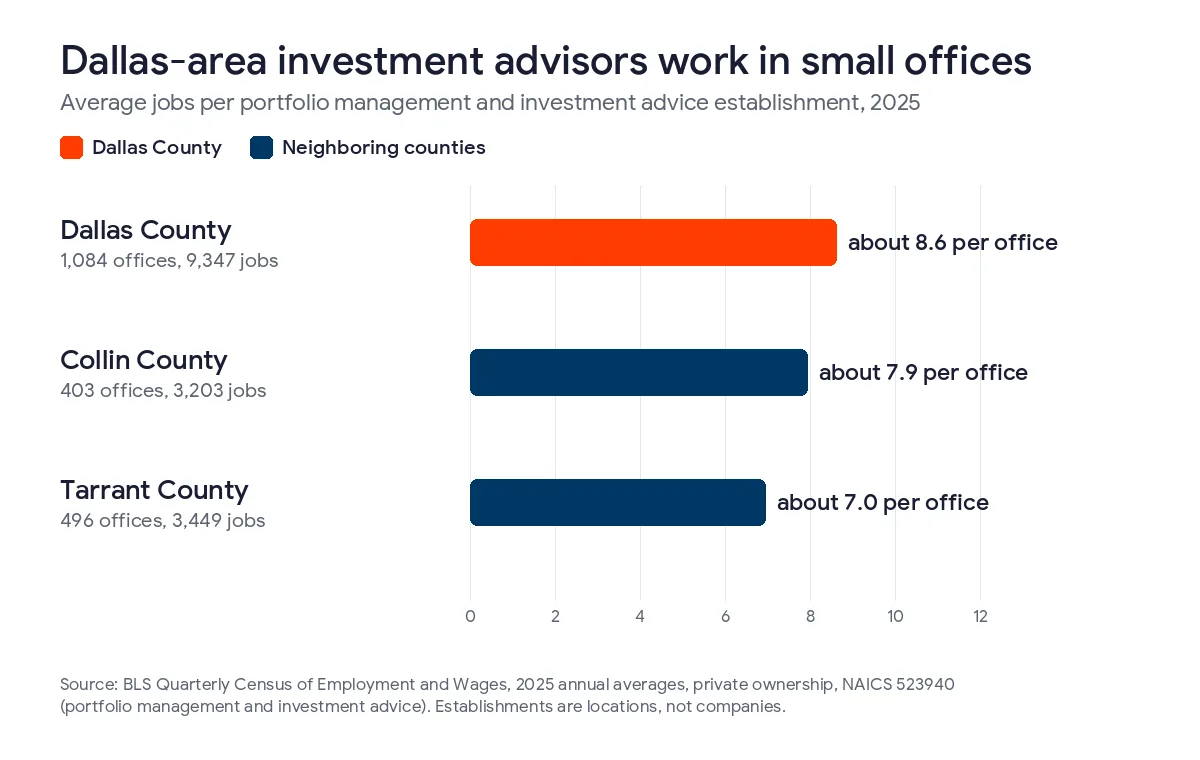
Because they’re small offices that move a lot of money on instructions. The BLS Quarterly Census of Employment and Wages counted 1,084 private portfolio management and investment advice establishments in Dallas County in 2025, with 9,347 jobs between them. That’s about 9 people per office. Collin County had 403 with 3,203 jobs, and Tarrant County had 496 with 3,449, both closer to 7 or 8. The average Dallas County paycheck in that industry was $275,210 a year, which tells you how much client wealth sits behind each of those small teams.
The BLS occupation survey put 6,230 personal financial advisors in the Dallas-Fort Worth-Arlington metro in May 2025. Most of them don’t have a security team down the hall. In a 9-person RIA, the client service associate who processes the wire is often the same person who resets passwords and calls the IT vendor.
The FBI’s numbers show what that’s worth to criminals. The IC3 2025 Internet Crime Report logged 24,768 business email compromise complaints and $3,046,598,558 in losses nationwide, second only to investment fraud. The 2025 Texas report counted 2,253 BEC victims in the state and $304,318,015 lost, about $135,000 each. The national report also noted, for the first time, more than $30 million in BEC losses that involved AI.
What do FINRA and the SEC expect when money moves on an email?
More than a phone call that nobody answered. FINRA’s 2012 notice included a line that still surprises firm owners. “In some instances, firms have released funds after unsuccessfully attempting to verify emailed instructions by phone.” The notice asked firms to build “a method for verifying that the email was in fact sent by the customer” and to watch for requests that are out of the ordinary, go to an unfamiliar third party, or push urgency designed to skip verification.
FINRA came back to it in an October 2019 cybersecurity alert about cloud email takeovers, “primarily on the O365 email platform.” It said attackers sit in a compromised account “over several weeks or months” to learn how the firm handles wire requests, then email the back office or clients with fraudulent instructions. They also change the account’s mailbox rules to hide or delete what they send. FINRA’s own read was blunt, that many firms could have prevented these takeovers with two-factor authentication.
On the SEC side, two pieces matter for wire requests. The first is the staff’s February 2017 letter on standing letters of authorization. It ties custody relief to 7 conditions, including that the custodian verifies the client’s instruction and that the adviser has “no authority or ability to designate or change the identity of the third party.” So an email asking your team to update a client’s SLOA payee is a red flag on its face. That change has to come from the client to the custodian.
The second is Regulation S-ID. Its definition of a covered account under 17 CFR 248.201 names accounts “that permit wire transfers or other payments to third parties,” and an adviser that can direct those transfers can be pulled in. We keep the full rule set, including the Regulation S-P amendments, in a separate guide to SEC cybersecurity rules for RIA firms in Dallas.
How should a callback on a wire request actually work?
The callback is the control that catches almost everything in that first table, but only if it’s done the same way every time. A callback to the number in the email signature is not a callback. Here’s the workflow we set up with advisory offices.
- Call the client at a number that was in your CRM before the request arrived. Never use a number, link, or “verification line” from the request itself.
- If you can’t reach the client, the money doesn’t move. Leave a message and wait, no matter how urgent the email sounds.
- Ask the client to confirm the amount, the receiving bank, and the last 4 digits of the receiving account in their own words, rather than reading the details to them.
- Require a second person to approve any new payee, changed bank instructions, or request outside the client’s normal pattern.
- Put a waiting period on any money request that follows a change of email, phone, or mailing address. A week is a reasonable start.
- Agree on a question or code phrase with clients who move money often, so a cloned voice on a callback still fails.
- Log who called, the number used, the time, and the answer in the CRM, so an examiner or an insurer can see it happened.
Step 6 sounds dramatic until you read the FBI’s May 2025 public service announcement on AI-generated voice messages. It warned that cloned voices “can sound nearly identical” to the real person, and it recommended that people “independently identify a phone number for the person and call to verify their authenticity.” It even suggested a secret word or phrase among family members. That advice was written about impersonated officials, but it fits a client callback exactly.
The weak spot we see most often isn’t the policy. It’s the exception. A long-time client is traveling, the closing is today, and the associate skips step 2 because the request “obviously” came from them. That’s the case the whole workflow exists for, and we’d rather a client be mildly annoyed than out a six-figure wire.

Which Microsoft 365 controls stop advisor mailbox takeovers?
The ones FINRA’s 2019 alert was describing, set up so they actually fire. A takeover of your own staff’s mailbox is the most dangerous row in that first table, because clients trust email from their advisor. These are the controls we put in place for Dallas wealth teams, and who usually owns each one.
| Control | What it stops | Who usually owns it |
|---|---|---|
| Phishing-resistant MFA, such as FIDO security keys or passkeys, on email and custodian logins | Stolen passwords and codes typed into cloned login pages | Your IT provider for Microsoft 365, each user at the custodian |
| Alerts on new inbox rules and blocked automatic forwarding to outside addresses | Attackers hiding replies and quietly copying client mail | Your IT provider |
| Impersonation protection for your advisors’ names and your clients’ key domains | Look-alike addresses and display-name spoofing | Your IT provider |
| A DMARC policy set to reject on your own domain | Criminals sending mail that claims to come from your firm | Your IT provider, with whoever manages your DNS |
| Sign-in alerts for new countries, new devices, and impossible travel | A takeover sitting unnoticed for weeks | Your IT provider |
| Separate admin accounts and extended audit log retention | An attacker who takes over an admin, and an investigation with no records | Your IT provider |
| Callback and second-approver workflow in the CRM | Everything the filters miss | Your operations or compliance lead |
CISA’s fact sheet on phishing-resistant MFA explains why the first row matters. Text-message and app codes can be phished or talked out of a user, and FIDO-based methods can’t be handed to a fake page. NIST’s SP 800-177, Trustworthy Email covers the domain side, SPF, DKIM, and DMARC, and it’s written for small and mid-sized organizations as well as federal ones.
So is DMARC worth setting up? Yes, but be honest about its limits. It stops someone forging your domain. It does nothing about a look-alike domain, and nothing about a real client account that’s been taken over. Firms sometimes hear “we set up DMARC” and think wire fraud is handled. It isn’t. If your team also gets the everyday phishing that leads to these takeovers, our guide to phishing attacks covers how to spot it.
What changes when the client is older or the request looks like exploitation?
Texas gives you more room than many advisors realize. Subchapter H of Texas Government Code Chapter 4004 covers financial exploitation of vulnerable adults, which means clients 65 or older and adults with a qualifying disability. A securities professional who suspects exploitation tells the firm. The dealer or investment adviser then assesses it and reports to the securities commissioner and the Department of Family and Protective Services, no later than the earlier of finishing that assessment or the 5th business day.
The useful part for wire fraud is Section 4004.355. Once it has filed that report, a firm may place a hold on a transaction it believes is tied to the exploitation. The hold expires on the 10th business day, and an investigating agency can ask for an extension of up to 30 more business days. A court can also extend or shorten it. The firm may also notify a third party connected to the client, unless it suspects that person. A hold doesn’t fit every fake email, but when the “client” asking for a rushed wire is 78 and the request doesn’t sound like them, it’s a real option.
The data exposure side matters too, because stolen client files are what make a fake request convincing. In the Texas Attorney General’s data breach list, as we pulled it on November 9, 2026, we counted 18 notices from wealth management, investment advisory, brokerage, and trust firms posted between late December 2025 and late October 2026. Together they covered 65,964 Texans and more than 1.2 million people overall, and 17 of the 18 listed Social Security numbers. Only 2 were Texas-based firms, so a Dallas client’s data is exposed wherever their accounts sit. Texas law requires that report within 30 days once 250 or more Texans are affected. How to keep that data out of reach in the first place is the subject of our guide to client data protection for wealth advisors in Dallas.
What should a firm do in the first hour after a fraudulent wire?
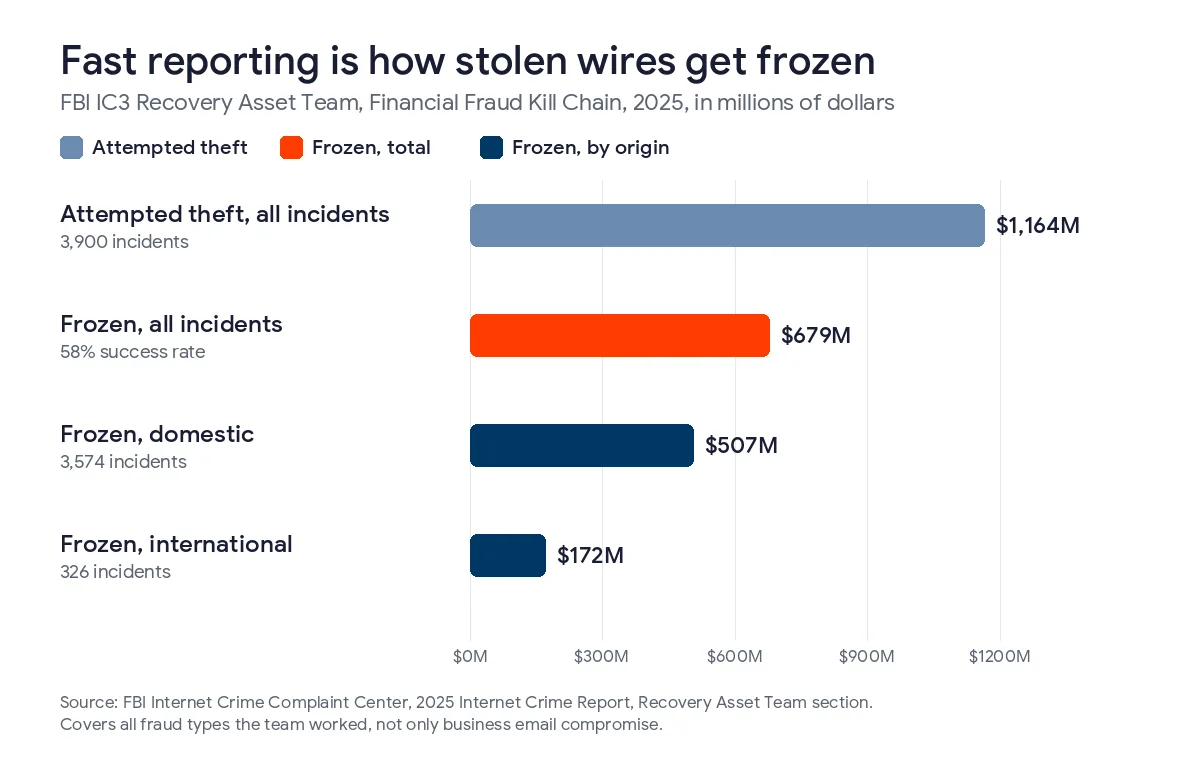
Move fast on the money first. The IC3 report puts it plainly. “If you discover a fraudulent transfer, time is of the essence.” Its Recovery Asset Team worked 3,900 incidents in 2025 through the Financial Fraud Kill Chain, with $1,163,919,846 in attempted theft and $679,013,183 frozen, a 58% success rate. Those freezes happen when someone calls quickly.
Here’s the order we’d follow.
- Call the custodian’s wire desk and the sending bank, ask for a recall, and ask about a hold harmless letter or letter of indemnity.
- File a complaint at ic3.gov with the receiving bank and account details, whatever the amount.
- Reset the password, revoke active sessions, and remove any inbox rules on the affected mailbox, after exporting the audit log so you don’t destroy the evidence.
- Call the client at their known number and tell them what happened.
- Bring in your compliance lead, your cyber insurer, and counsel to decide on Texas breach notice, client notice, and any SEC reporting.
If the attacker got into your own systems rather than a client’s inbox, the cleanup is bigger than one mailbox. Our cybersecurity services in Dallas include incident response for exactly that situation.
How does Uprite protect Dallas wealth management firms from wire fraud?
We own the IT rows in that controls table. That means rolling out phishing-resistant MFA, turning on the Microsoft 365 alerts and impersonation protection that aren’t on by default, blocking outside forwarding, setting DMARC, and keeping the audit logs an investigation needs. When something looks wrong, our average response time is about 5 minutes. We don’t run your compliance program or approve wires. We make sure the mailbox your associate reads hasn’t been quietly taken over.
Law firms face the same playbook with trust-account wires, and our breakdown of business email compromise at Dallas law firms shows how it plays out there. For the wider regulatory picture, see cybersecurity requirements for Dallas financial services firms. Budget questions are covered in our breakdown of what IT costs a Dallas wealth management firm, and our pricing page shows the plans. If you’d rather talk it through, read how our managed IT services in Dallas are set up or reach our Dallas team.
Wire fraud questions from Dallas wealth advisors
Is a phone callback enough to verify an emailed wire request?
Only if you call a number you had before the request arrived and actually reach the client. FINRA has warned that some firms released funds after a failed phone check, so an unanswered call should stop the wire.
Can a Texas advisory firm hold a disbursement it thinks is fraud?
Yes, when the client is a vulnerable adult and the firm has reported suspected exploitation. Texas Government Code Section 4004.355 allows a hold that expires on the 10th business day, with up to 30 more business days if an investigating agency asks.
What should we do in the first hour after a fraudulent wire goes out?
Call the custodian’s wire desk and the sending bank to request a recall, then file at ic3.gov. The FBI’s Recovery Asset Team froze $679,013,183 in 2025, and speed is what makes a freeze possible.
Does DMARC stop wire fraud emails?
Partly. DMARC stops criminals from sending mail that claims to be from your exact domain. It doesn’t stop look-alike domains or messages sent from a real client or staff mailbox that’s been taken over.
Could Regulation S-ID apply to a small RIA?
It can. If your firm can direct transfers from individual clients’ accounts to third parties, those accounts may be covered accounts, and you’d need a written identity theft program with red flags like sudden contact changes before a wire.
How do AI voice clones change client verification?
They make “it sounded like her” worthless as proof. The FBI says cloned voices can sound nearly identical to the real person, so call back on a number you already had and ask a question only the client can answer.
Send us a list of who in your office can start a wire, which mailboxes and custodian portals they use, and whether those logins have MFA. We’ll do a free review of your Dallas firm’s email and wire controls and show you where a fake request could slip through today.
Book a free wire fraud review