
Cybersecurity for a Houston freight broker means protecting the email and load-board logins thieves use to pose as you, and checking every carrier bank change by phone before money moves. It also means knowing who calls the bank in the first hour.
I run operations at Uprite, and a good share of our work in IT services for trucking companies in Houston starts after a broker’s own inbox has been turned against it. It happens often enough now that the FBI wrote it up step by step. This post walks through that playbook in broker terms, then covers the part most security articles skip, which is what a misdirected carrier payment does to your bond and your operating authority.
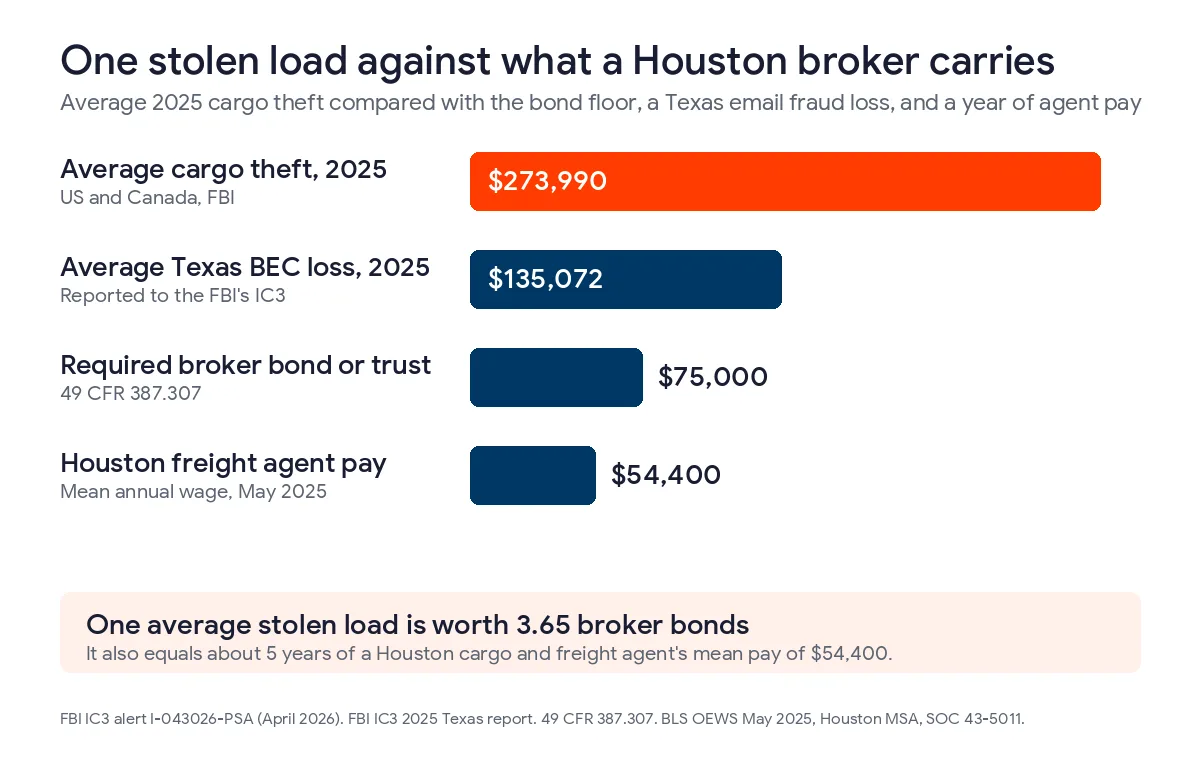
The FBI says cargo theft losses in the US and Canada reached nearly $725 million in 2025, with the average theft at $273,990. That’s more than 3.6 times the $75,000 bond every broker has to carry. If you pay a fake carrier and the real one files a claim that drains your bond, federal rules give you 7 business days to restore it before FMCSA suspends your authority. I’d treat that as a licensing risk first and an IT ticket second.
How do thieves get into a freight brokerage?
Through email, almost every time. On April 30, 2026 the FBI’s Internet Crime Complaint Center published alert I-043026-PSA on cyber-enabled cargo theft, and it says the attackers have been getting into broker and carrier systems since at least 2024, “typically via spoofed emails, fake URLs, and compromised carrier accounts.” The steps it describes go in this order.
- A spoofed email arrives with a link to sign a carrier broker agreement or to answer a bad service rating. The link leads to a fake site that drops a remote management tool on the PC.
- With that access, the thieves post fake loads on load boards under a real company’s name, sometimes tens of thousands of them, and use those listings to compromise more carriers.
- Posing as a compromised carrier, they book real loads and double-broker them with altered bills of lading. They also change the carrier’s contact details with FMCSA so the paperwork looks clean.
- The freight gets cross-docked or transloaded to complicit drivers and resold. Sometimes the thief calls the broker back and asks for a ransom to say where the load went.
Notice where it starts. Step 1 doesn’t need a clever exploit. It needs a dispatcher who’s expecting a broker agreement, and in a brokerage that’s every dispatcher on every shift. What it installs is usually legitimate remote software, so antivirus often stays quiet.
Why can a fake carrier invoice put your authority at risk?
Because the real carrier still has to be paid. Say an email that looks like it’s from a carrier you’ve used for years asks you to update their ACH details, and your AP clerk does it. You pay the next invoice to the thief. The actual carrier hauled the load and never got the money, and under federal rules a motor carrier can make a claim against your surety bond or trust fund.
The rule that took effect January 16, 2026 is 49 CFR 387.307, and its clock is short. We read the regulation text itself rather than a summary, and here’s how it plays out once a valid claim is paid.
| What happens | Deadline in 49 CFR 387.307 | What it means for you |
|---|---|---|
| Your surety gets a claim and asks you to respond | 7 business days to answer | Silence lets the surety decide the claim is valid and pay it |
| A payment drops the bond or trust below $75,000 | Surety tells FMCSA within 2 business days | The agency hears about it before most of your customers do |
| FMCSA serves a written notice on you | 7 business days to restore the $75,000 or show the notice was wrong | You need cash or proof ready, not a plan to find it |
| You don’t respond in time | FMCSA enters the suspension | You can’t legally arrange freight until it’s lifted |
A single diverted payment for a $3,000 lane won’t sink a bond. A run of them can, and so can a stolen high-value load if the claims land on you. At $273,990, the FBI’s average theft is more than 3.6 times the bond. I’m not a lawyer and claims depend on facts, so read this as an operations view. But I’d rather a broker plan for the 7-day clock now than learn about it from a notice.
Will the bank cover a payment you sent to a fraudster?
Usually not. Texas handles wires and many business ACH payments under Chapter 4A of the Business and Commerce Code. Under section 4A.202, a payment order is the customer’s own when the customer authorized it. When your clerk sends the money after a spoofed email, your company authorized the order, even though it was tricked. Section 4A.207 also lets the receiving bank pay by account number when the name on the payment doesn’t match. A name mismatch won’t stop the money.
Speed is the only real lever. The FBI’s guidance in its 2025 Internet Crime Report is blunt, “time is of the essence,” and it tells victims to call their bank for a recall right away and then file at ic3.gov. Its Recovery Asset Team froze $507,042,623 of $832,965,941 in domestic fraudulent transfers in 2025, a 61% rate, per the FBI’s Financial Fraud Kill Chain brochure. Those are cases reported fast. Money that sat for a week is usually gone.
What are Houston brokers up against?
A lot of exposed inboxes. BLS wage data for May 2025 counts 2,140 cargo and freight agents in the Houston metro and 5,720 dispatchers. Dispatchers here run at 1.33 times the national concentration. Every one of those people opens carrier email, clicks onboarding links, and often holds a load-board login. That’s the exact job the FBI alert describes being targeted.
Email fraud in Texas already runs large. The FBI’s 2025 Texas report lists 2,253 business email compromise victims who reported $304,318,015 in losses, about $135,072 each. Freight agents in the Houston metro earn a mean $54,400 a year, so one average stolen load is worth about 5 years of that agent’s pay. That’s the trade a thief is making when they spend a week grooming one dispatcher.
Which controls stop each step?
Match the control to the step it breaks. Buying a tool without knowing which step it covers is how brokers end up with 4 products and the same gap. This is the map we work from.
| Attack step | Control that breaks it | Who should own it |
|---|---|---|
| Spoofed broker agreement or rating email | Impersonation and lookalike-domain protection in Microsoft 365, plus links opened in a protected browser | Your IT provider |
| Remote tool installed from a fake site | Allow only the remote tools you approved, and block installs by everyday users | Your IT provider |
| Stolen password used to log in | Phishing-resistant MFA on email, plus MFA on every load board and TMS that offers it | IT sets it up, you pay for the licenses |
| Hidden mailbox rule forwarding carrier mail | Alerts on new forwarding and auto-delete rules, reviewed the same day | Your IT provider, with a named person on your side |
| Carrier bank details changed by email | A written callback rule using a number from your own onboarding file | Your AP lead |
| Carrier contact info changed at FMCSA | Compare changes against what you had on file before you book | Your carrier onboarding team |
On MFA, push past text codes. CISA’s phishing-resistant MFA fact sheet calls it “the gold standard” and names FIDO/WebAuthn, the standard behind security keys, as the only widely available form. NIST’s SP 800-63B-4, finalized in July 2025, says plainly that passwords aren’t phishing-resistant. A text code typed into a fake login page gets relayed in seconds. A security key won’t answer a site it wasn’t registered to. You can’t choose how a load board does MFA, but you can choose it for Microsoft 365, and that’s where the broker agreement email lands.
Mailbox rules deserve their own line. The FBI lists new forwarding, auto-delete, and hidden-folder rules as a warning sign, and in a brokerage they’re how a thief reads every carrier conversation without being seen. Our Microsoft 365 email security guide shows which settings ship off by default and which plan includes them.
The carrier payment rule we’d put in writing
Write this down and make it boring, because boring is what holds up during a busy Friday.
- No bank change gets keyed from an email, a PDF, or a portal message alone.
- Call the carrier at the number in your own onboarding file, the one you had before the request came in.
- Don’t rely only on the number in FMCSA’s records. The FBI says thieves change that contact information.
- Hold the next payment until a second person in your office confirms the callback.
- Log who called, the number used, and the time. That record matters later if a claim comes in.
Load board and TMS accounts
Give each person their own login. Shared credentials mean nobody can tell which dispatcher’s session posted a load, and you can’t cut off one departing employee without resetting everyone. Turn on MFA wherever the platform offers it, and remove access the day someone leaves. If a load board shows recent logins or active sessions, someone should look at that page every week. Dispatch platforms raise the same login questions, and our guide to dispatch software IT support in Houston walks through them.

Does FMCSA’s new Motus system fix this?
It helps at the front door. The Federal Register notice of April 29, 2026 says Motus adds “enhanced verification tools” and opens to all regulated companies in the second quarter of 2026. Better identity checks make it harder to register a fake carrier from scratch.
They don’t do much when a real carrier’s email account is taken over, which is the scheme in the FBI alert. A hijacked carrier keeps its clean history, its authority, and its insurance on file. So I wouldn’t relax your own checks because Motus exists. I’d keep comparing what a carrier tells you now against what they told you at onboarding.
What should a broker do in the first hour?
Move money first and computers second. Here’s the order I’d follow if a Houston brokerage called us after a bad payment or a strange load.
- Call your bank’s fraud line and ask for a recall of the payment, then put it in writing.
- File at ic3.gov. The FBI’s cargo theft alert also asks victims of stolen loads to file a police report.
- Pull the affected PC off the network and reset the user’s password and MFA from a clean device.
- Check that mailbox for forwarding rules and look for remote tools you didn’t approve.
- Warn carriers and shippers on any loads booked from that account, so the thief can’t keep using your name.
- Find out whether carrier onboarding files were exposed. Those packets often hold owner names, tax IDs, and bank details.
That last step has a legal clock. Texas Business and Commerce Code section 521.053 requires notice to affected people within 60 days when sensitive personal information is breached. When 250 or more Texans are involved, the Texas Attorney General also has to hear within 30 days of discovery. Owner-operators are individuals, so a leaked onboarding folder can count. Talk to counsel about the details.

Where Uprite fits, and when you don’t need us
We’re a 42-person managed IT and cybersecurity team that’s worked with Texas businesses since 1999, with Houston offices on Westheimer Road and Space Center Boulevard. Our average first response on a ticket is 5 minutes. For brokers we usually handle the Microsoft 365 hardening, MFA rollout, remote-tool control, and mailbox monitoring, and the brokerage owns the callback rule, since that’s a business process.
A 3-person brokerage that already runs Microsoft 365 with security defaults on, uses its own logins on each load board, and follows a written callback rule may not need a managed provider yet. That’s an honest answer, and I’d rather you hear it from us. Once you have a dozen dispatchers, after-hours booking, or a past incident, it’s usually time. Our guide to what IT costs a Texas freight brokerage or 3PL prices it by seat, and our cybersecurity services in Houston page lists what’s included. If you also run trucks, our breakdown of trucking company IT cost in Houston covers the carrier side. If you’d rather talk it through, reach our Houston team.
Questions Houston brokers ask about freight fraud and IT security
Is MFA on our load board account enough?
No, because most break-ins start in email, not on the load board. Put phishing-resistant MFA on Microsoft 365 first, then turn on whatever MFA each load board and TMS offers, and give every user a separate login.
Can we verify a carrier by calling the number on their FMCSA record?
Not by itself. The FBI says thieves change a hijacked carrier’s contact details with FMCSA. Call the number from your own onboarding file, and treat any recent change to that record as a reason to slow down.
What happens if a carrier we never paid files a bond claim?
If the claim is paid and your bond drops below $75,000, FMCSA gives you 7 business days after its notice to restore it or show the notice was wrong. Miss that and your authority is suspended under 49 CFR 387.307.
Does a cyber insurance policy pay for a misdirected carrier payment?
Only if it includes social engineering or funds transfer fraud coverage, and that coverage is often capped well below the main limit. Ask your agent for the exact wording, and check whether the policy requires a callback before payment changes.
Do we have to report a phishing break-in to the state?
Only if sensitive personal information was exposed. If it was, Texas requires notice to affected people within 60 days, and to the Attorney General within 30 days when 250 or more Texans are involved. Carrier owner files often qualify.
How fast do we need to move after paying a fake carrier?
Within the hour if you can. Call your bank’s fraud line for a recall, then file at ic3.gov. The FBI’s Recovery Asset Team froze 61% of the domestic fraudulent transfers it worked in 2025, and fast reports do best.
Send us the last carrier bank-change request your office handled and how you checked it. We’ll tell you which step a thief would use against you first, and what it would take to close it.
Talk to a Houston IT Expert