North Texas weather runs on a calendar. Hail and tornadoes crowd into March through June, ice lands between December and February, and the grid runs tightest in summer heat and deep cold. A workable IT continuity plan ties one IT step to each public warning and assumes a rotating outage can run for days. Print the trigger table.
IT continuity in Dallas is a written plan that keeps systems, data, and staff working through hail, tornadoes, ice storms, and grid emergencies, with each IT step tied to an ERCOT or National Weather Service alert. Plan for 72 hours without power. Shut down at the warning, not the outage. Restart in order.
Uprite runs managed IT services in Dallas out of an office on Alpha Road. I’m the CTO. The most useful sentence I know about North Texas outages didn’t come from an IT vendor. It came from the grid operator.
On the evening of September 6, 2023, Texas set a September record for power demand, 82,705 MW, and ERCOT moved the grid into emergency operations. Its release that night said this. “If you are experiencing an outage at this time, it is not because of the ERCOT power grid, but is local in nature.”
The grid was in an emergency. Yet the outages were local. A feeder. A transformer on a pole down the street. Plenty of continuity plans skip that case, because they were written for the statewide blackout and never for the tree limb 2 streets over.
So this plan covers both. It’s built on 10 years of NOAA storm reports for Dallas, Tarrant, Collin, and Denton counties, the alert ladders ERCOT and the National Weather Service publish, and what federal investigators found after Winter Storm Uri.
What is an IT continuity plan?
An IT continuity plan is a short written playbook that keeps a company’s systems, data, and people working while a disruption is still happening. It names who acts, which warning triggers each step, how equipment shuts down and restarts, and where staff work when the office is dark.
Getting systems back after real damage is the recovery half. That has its own playbook, and it’s what our page on disaster recovery in Dallas covers. Everything here happens before and during the storm.
NIST wrote the federal template for this kind of planning, the Contingency Planning Guide for Federal Information Systems, SP 800-34. It was written for agencies. The business impact analysis at its center works for a 40-person office in Irving too. Rank your systems by how long the business can survive without each one, then plan for the top of that list first.
North Texas adds one gift. Ice and hard freezes show up in the forecast days ahead, and severe storms usually come with a watch hours before any warning. Use that time.
What does North Texas weather actually do to an office?
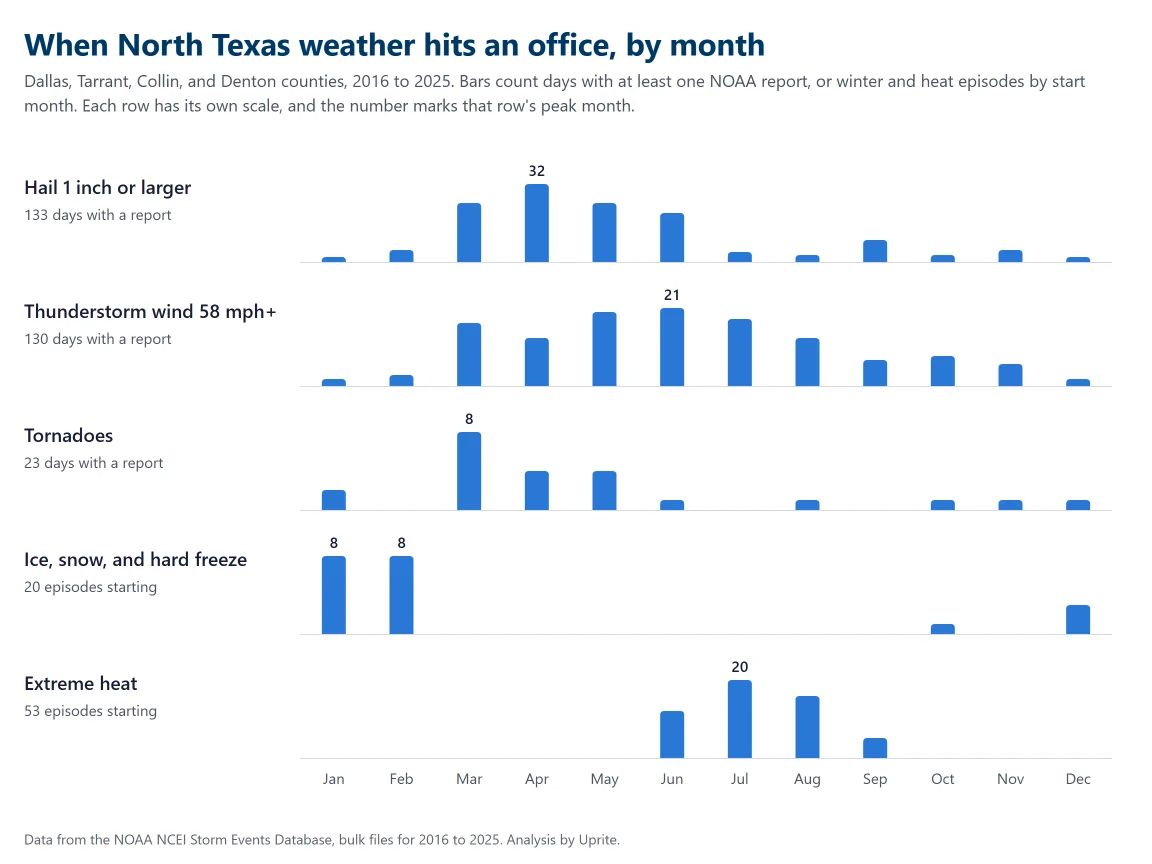
From 2016 through 2025, NOAA logged 1,100 reports of hail an inch or larger, 600 damaging-wind reports, 51 tornado entries, and 20 winter storm or freeze episodes in Dallas, Tarrant, Collin, and Denton counties.
A busy decade. We pulled those counts from the bulk files of NOAA’s Storm Events Database, all 10 years, filtered to the 4 core counties of the Metroplex. They’re reports, not storms. One bad evening files dozens. On Memorial Day, May 27, 2024, the database holds 85 separate reports of hail an inch or larger in those 4 counties, and the windstorm that followed before dawn on May 28 added 42 damaging-wind reports of its own.
The months matter more. They set your calendar.
| Hazard | When it peaks in DFW | 10 years of NOAA reports, 4 core counties | What it breaks in IT | The control that pays off |
|---|---|---|---|---|
| Hail an inch or larger | March to June, 88% of reports | 1,100 reports on 133 separate days | Roofs and rooftop AC units, then water through the ceiling into closets and racks | Nothing critical under a roof penetration, and a copy of your data outside the building |
| Thunderstorm wind of 58 mph or more | March to August | 600 reports on 130 days, 88 of them at 75 mph or more | Power and fiber lines, transformers, and local outages that last days | A UPS that triggers a clean shutdown, plus a second internet path |
| Tornadoes | March to June, with a second window from October to January | 51 entries on 23 days | The building itself, and access to it for days | Offsite or cloud copies, and somewhere for people to work |
| Ice, snow, and hard freeze | December to February | 20 episodes, 19 of them starting December through February | Ice-loaded limbs on lines, closed roads, and staff who can’t reach the office | Remote work you’ve actually tested, and a plan for a multi-day outage |
| Extreme heat and grid strain | June to September | 53 heat or excessive-heat episodes | Closet cooling, ERCOT conservation calls, and emergency operations | Temperature alerts and a written shutdown threshold |
Hail is a water problem
Sanger got the biggest stone in the decade’s data, 5.9 inches, on June 15, 2023. Bigger than a softball. In spring 2026, NWS Fort Worth took reports of hail up to teacup size on April 27, 2026, with the largest stones in northeast Dallas, Rockwall, and Hunt counties. But the stone isn’t what takes a server down. The roof is.
Hail cracks membranes, dents rooftop AC units, and opens a path that the next rain follows into whatever closet sits underneath. Walk the space above your equipment once a year. If the closet sits under a roof penetration or an AC condensate line, move the gear or put a water sensor on the floor. Dull fix. Cheap, too.
Wind is the outage you’ll actually get
Straight-line wind gets less attention than tornadoes, and it’s behind both of the big Oncor outage counts in this post. On the morning of May 28, 2024, a bow echo crossed the northern and eastern parts of DFW, and NWS storm surveys put the straight-line winds at 80 to 95 mph. Oncor counted more than 650,000 customer outages, expected restoration to be substantially complete that Friday, and said the hardest-hit areas would wait until Saturday. Days, not hours.
March 4, 2025, brought another one. The highest gust in the decade’s data, an estimated 91 knots, about 105 mph, was logged in Haltom City that day, and Oncor’s peak count reached 335,000 outages, with parts of Fort Worth and Dallas County not expected back until 2 days later.
Tornadoes have a fall season
NWS Fort Worth’s tornado climatology counts about 26 tornadoes a year across North and Central Texas since 1950, and April and May hold more than half of them. October is the busiest month of the fall. The county data shows that second season too. Of the 51 tornado entries in the 4 core counties, 15 came between October and January.
One was the EF3 that cut across north Dallas on October 20, 2019, with damage that started near I-35E and Walnut Hill and ran through Preston Hollow to US 75 and Forest Lane, which is office country by any definition. Another 7 entries landed in Tarrant and Collin counties on a single day, December 13, 2022. In December.
That’s why the tornado drill can’t live only in April. Neither can the IT steps that go with it.
Ice is an access problem
Ice doesn’t need to break the grid to shut you down. It loads limbs onto lines, and it closes roads. Both hurt. The NWS issues an Ice Storm Warning for roughly a quarter inch of ice or more, and the late January 2023 event brought reports of half an inch across North and Central Texas. In January 2026, DFW Airport sat at or below freezing for 58 straight hours and counted an estimated 5,859 flight cancellations between January 23 and 28.
Nobody drives in. Some of your people lose power at home too. A remote-work plan that’s never been tried on a normal Friday won’t suddenly work on an iced Tuesday.
Heat is a closet problem
Across the 4 counties, NOAA logged 53 heat or excessive-heat episodes over the decade, every one of them between June and September. Heat squeezes 2 things at once. The AC unit cooling a closet full of switches. And the grid itself. On September 6, 2023, ERCOT’s chief executive pinned the emergency on high demand, low wind, and solar output fading at sunset, which describes a hot evening and nothing more exotic than that.
Why can a rotating outage last for days?
A rotating outage becomes a multi-day outage when the shortfall is too big to rotate. That’s what happened in February 2021, when more than 4.5 million Texans lost power, some for as long as 4 days.
Rotation is the polite version of a load shed. ERCOT orders the transmission companies to drop demand, and the utilities decide which circuits go dark, moving the outage around so no single neighborhood carries it. ERCOT’s own explainer from September 2020 noted that rotating outages had been used only 3 times in its history. Five months later came Uri.
Federal investigators wrote it up in a FERC and NERC staff report that runs past 300 pages, and parts of it read like an IT incident review. Dry reading. Useful, though. ERCOT’s firm load shed lasted nearly 3 consecutive days and peaked at 20,000 MW on the evening of February 15, inside what the report calls the largest controlled firm load shed event the country has ever had. The shortfall was so large that utilities struggled to keep it rotating. In places, rotation stalled. Some circuits can’t be cut because they feed critical loads like hospitals, police and fire stations, and water plants, and once those were protected there weren’t enough circuits left to share the pain.
At DFW Airport, the temperature stayed at or below freezing for 139 straight hours, from the evening of February 13 to noon on February 19, and it bottomed out at minus 2 degrees on February 16. Picture the outage that was supposed to be short. In an office with no heat. For days.

For IT, 4 lessons follow.
- Nobody picks their circuit. If your building happens to share a feeder with a hospital, you may keep power through a load shed, and if it doesn’t, plan to be in the rotation for longer than anyone promised.
- A UPS buys a clean shutdown. Not a workday.
- Generators need fuel, a transfer switch, and an outdoor spot. Carbon monoxide poisoning is among the causes of death the report lists for Uri, so a portable unit runs outside, well away from doors and windows, and never inside the building.
- Your building can close for reasons IT can’t touch, like no water, no heat, or a parking lot nobody can safely cross.
Which alert should trigger which IT step?
Tie every IT step to a public alert, not to a gut feeling. Gut feelings run late. ERCOT’s Weather Watch gives about 3 to 5 days of notice, an NWS watch means prepare, and by the time a warning is issued the IT work should already be done.
ERCOT runs a notification ladder it calls TXANS. Learn the names. A Weather Watch flags significant weather and high demand roughly 3 to 5 days ahead while the grid is still normal. A Voluntary Conservation Notice and then a Conservation Appeal ask Texans to cut use. Energy Emergency Alerts come in 3 levels, and only Level 3 carries the words controlled outages possible. ERCOT is plain that controlled outages would hit every customer class, commercial included.
Weather alerts have their own ladder. A watch means conditions are favorable, so prepare. A warning means it’s happening or about to, so act. The Storm Prediction Center issues tornado watches, and the Fort Worth office of the National Weather Service issues the warnings.
Line the 2 ladders up and you get this.
| Alert | Who issues it | What it signals | IT step at this level |
|---|---|---|---|
| ERCOT Weather Watch | ERCOT | Significant weather and high demand forecast about 3 to 5 days out, grid still normal | Confirm last night’s backup finished, run a UPS self-test, and make sure remote logins work |
| Winter Storm Watch, or a severe storm outlook over DFW | National Weather Service | Conditions favor ice, snow, or severe storms | Send laptops and chargers home, pause big updates, and print the restart sheet |
| Conservation Appeal | ERCOT | Reserves low enough that emergency operations are possible | Turn off nonessential gear, move reboots out of the appeal window, and set servers to shut down on low battery |
| Energy Emergency Alert Level 1 or 2 | ERCOT | Emergency operations, with extra tools deployed | Name who shuts down which system, then stand by |
| Energy Emergency Alert Level 3 | ERCOT | Extremely low reserves, controlled outages possible | Shut down noncritical servers cleanly before the power goes, keep the firewall and core switch on UPS, and post a status note for staff |
| Ice Storm or Winter Storm Warning | NWS Fort Worth | Ice or significant winter weather is happening or imminent | Work from home and leave office systems in their low-risk state |
| Tornado or Severe Thunderstorm Warning | NWS Fort Worth | A tornado is sighted or indicated by radar, or a severe storm is imminent | People shelter. There’s no IT step at this level. |
It’s front-loaded on purpose. Once a Tornado Warning sounds, the only job left is getting people to an interior room on the lowest floor, which is the NWS instruction, and nobody should be in a server closet saving a file.
Sign up for TXANS emails or the ERCOT app. Then give the alerts to 2 people, not 1, because somebody has to notice a Conservation Appeal at 6 in the evening on a weeknight, which is exactly when the September 2023 appeal window opened.
What should be in place before hail and tornado season?
Before March, settle the pieces that can’t be improvised in the middle of a storm, starting with a copy of your data outside the building and a restore you’ve actually watched work.
- A copy of your data outside DFW, checked by restoring a real file rather than trusting a green checkmark. On our published plans, Fully Managed IT includes backup testing every quarter, IT Pro twice a year, and IT Essentials once a year, so ask whoever runs yours what their number is.
- Clean shutdown, automated. The UPS should tell the server to power down when the battery runs low, through a USB cable, a network card, or a shutdown agent on the hypervisor, and until someone pulls the plug on a quiet afternoon and watches it happen, assume it doesn’t work.
- A second internet path?
- Phones that follow people. If you’re on hosted VoIP, set forwarding to mobile numbers now, while the office still has power.
- Admin passwords in a vault you can open from home, with MFA that doesn’t depend on a desk phone sitting in a dark office.
- An equipment list with serial numbers and photos, stored somewhere other than the building, which makes a hail or tornado claim far easier to document.
- The restart sheet. Printed. Copies in 2 different homes.
For that second internet path, a cellular failover on the firewall or a second carrier entering the building by a different route both count. Pick one. And don’t schedule the big server migration for late April, since April holds more days of inch-plus hail than any other month in the data, 32 of the 133.
How do people keep working when the office is dark or the roads are iced?
People keep working when the work already lives somewhere other than the office and they’ve practiced reaching it from home, which matters most in an ice storm, when roads close and houses lose power too. For most offices that means managed cloud services in Dallas or Microsoft 365, not a file server in a closet.
Test on a calm day. Pick a Friday, send everyone home with the laptop, and see what breaks. It’s usually something small. A VPN client nobody updated. A shared drive mapped only inside the office network. A printer driver the billing team swears they can’t live without.
Spread the knowledge around. The person who knows the restart order shouldn’t be the only one, and the 2 people who know it shouldn’t live in the same corner of the Metroplex. Ice doesn’t fall evenly, and neither do outages, so a manager in Fort Worth and another in Plano are less likely to be stuck at the same time.
Be realistic about roads. Nobody should send a technician onto iced highways, so the plan assumes remote work first and on-site IT support once the roads open. Our own on-site coverage runs deepest along the Tollway, in Richardson, Addison, Coppell, Farmers Branch, Plano, and Frisco, the corridor the Alpha Road office sits on.
What should come back first when the power returns?
Check the building first, then bring systems back in the order they depend on each other, network before storage, storage before servers, and sign-in before the applications that need it.
Start outside. After the May 2024 storm, Oncor told customers that if the meter base or weatherhead on a home or business had been damaged or pulled off, an electrician had to repair it before Oncor could restore power, and a city inspection might be needed too. If the neighbors have power and you don’t, look up at the wall before you call anyone about the servers.
Inside, ignore the first flicker. Give the power a little while to hold. Then go in this order.
- Internet service and the firewall, so everything else has somewhere to go.
- Core switches and Wi-Fi.
- Storage, whether that’s a NAS or a SAN, and let it finish its own checks before anything leans on it.
- Domain controllers, or whatever handles sign-in.
- Application servers and line-of-business software.
- Backups. Confirm the next scheduled job actually runs and finishes.
Check the UPS units next. They’re probably drained, and a second outage an hour later will find them empty. Anything that rebooted on its own deserves a look as well, for the right IP address, the right clock time, and the services it’s supposed to run.
Where do DFW continuity plans break?
They break in ordinary places. A UPS nobody wired to the server, a backup sitting in the same closet as the thing it protects, and an alert that fires at 3 in the morning with nobody assigned to read it.
All 3 look fine on paper. The backup job reports success every night. The UPS beeps during its self-test. Then a hailstorm puts water into the closet holding the server and the NAS it backs up to, and both are gone in the same afternoon.
Alert-only monitoring is the quiet one, and I’ll use our own plan as the example. Uprite’s IT Essentials plan is alerting only, with no response, and we say so on the pricing page. For a 6-person office that lives in Microsoft 365, that’s a fair trade. For a company with a server that has to shut down cleanly during an Energy Emergency Alert at 7 in the evening, it isn’t. An alert nobody owns is just an email.
Treating ERCOT as the whole risk is the last failure. Grid-ordered rotating outages have happened a handful of times in ERCOT’s history. Storms come every spring. Plan for the feeder and the weatherhead, and the grid case comes along for free.
What does a managed IT provider handle in a storm, and what stays with you?
A managed IT provider can watch your systems around the clock, shut them down and restart them in order, and prove your backups restore, while the building, your people’s safety, and the decision to close stay with you.
Uprite is a 42-person managed IT and cybersecurity company that has served Texas businesses since 1999, with offices in Houston, San Antonio, and Dallas. Our average first response is 5 minutes across priority levels. That figure is an average from our own ticket data rather than a contract promise, and it measures how fast a person answers. It says nothing about driving to you through ice. Fast eyes. Slow roads. Our 24/7 IT support in Dallas page walks through what happens when someone calls the emergency line after hours, and Fort Worth offices can start with managed IT services in Fort Worth.
What stays with you is the building and the people. The roof, the meter base, the electrician, the insurer, and the call to close. A provider can’t make those calls, and shouldn’t try.
If you’re still paying by the hour for IT, the gap shows up at 2 in the morning, when nobody is watching the UPS count down. That trade-off is the whole subject of our break-fix vs managed IT in Dallas comparison. And if what you need is a backup vendor rather than a full provider, our ranking of the best backup and disaster recovery providers in Texas scores them on whether they can prove a restore.
One honest threshold, since we sell this. If your company runs entirely in Microsoft 365 on a handful of laptops, with no server and no closet, you need a much smaller version of this plan. Charged laptops, a hotspot, and a phone tree cover most of it. Everyone else can reach our Dallas office and ask for the free assessment.
Want a second set of eyes on your shutdown order, your backups, and your second internet line before hail season starts? Our Dallas team will go through it with you and tell you plainly which gaps matter for an office your size.
Speak to an IT ExpertStorm Questions DFW Owners Ask
Will ERCOT warn us before a controlled outage?
Usually, through TXANS, but not with a time for your street. ERCOT’s alerts climb from a Weather Watch to Energy Emergency Alert Level 3, the level where controlled outages become possible, and your utility then decides which circuits drop. Sign up for the emails or the ERCOT app. Route them to 2 people.
Can our office get on the utility’s protected list?
Almost certainly not, unless you run something like a hospital, a police or fire station, or a water plant. Federal investigators describe those critical loads as protected from manual load shed. And Oncor says even a medical critical care designation doesn’t guarantee uninterrupted power in severe weather. Plan as if you’ll be rotated.
Why plan for 72 hours when rotating outages are supposed to be short?
72 hours is roughly what recent DFW events have asked of people. Uri’s load shed ran nearly 3 days, and after the May 2024 windstorm, Oncor expected its 650,000-plus outages to be substantially restored about 3 days later, with harder-hit areas waiting a fourth day. A UPS covers minutes. The plan covers the rest.
Is hail really an IT problem?
It becomes one when water gets in. The 4 core DFW counties logged 1,100 reports of hail an inch or larger from 2016 through 2025, and the damage that reaches IT tends to arrive through a cracked roof or a battered rooftop AC unit, not from the hail itself.
What should IT do during a Tornado Warning?
Nothing. A warning means a tornado has been sighted or indicated by radar, and the NWS instruction is to get to an interior room on the lowest floor, so every IT step belongs earlier, at the watch.
What’s the first thing to check when the power comes back?
The building’s own electrical connection, before the servers. After the May 2024 storm, Oncor told customers it couldn’t restore power to a home or business with a damaged meter base or weatherhead until an electrician repaired it, and some repairs also needed a city inspection. Once that’s clear, bring the network up first and the applications last.
Who should hold the restart checklist?
Never a single person. Give it to at least 2 people who live in different parts of the Metroplex, plus your IT provider, since ice and outages don’t land evenly. Keep it printed, because a checklist that lives only on the file server disappears the moment the server does.