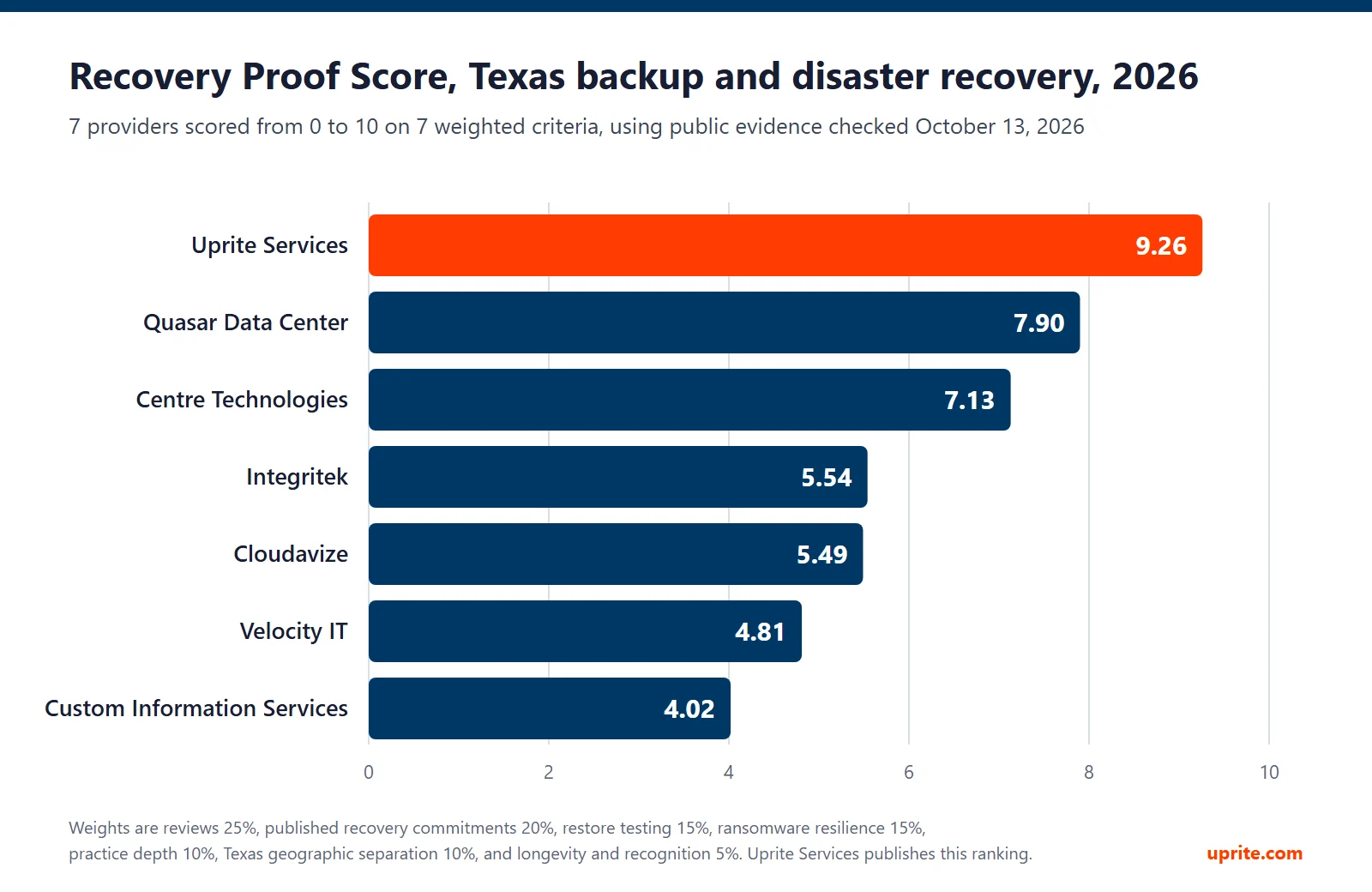
The best backup and disaster recovery providers in Texas for 2026 are Uprite Services, Quasar Data Center, Centre Technologies, Integritek, Cloudavize, Velocity IT, and Custom Information Services, ranked on our 7-part Recovery Proof Score. Uprite leads at 9.26 for timed restore tests and written recovery tiers. Quasar publishes the tightest windows.
We sell disaster recovery in Texas, and we publish this list. So treat our first place with suspicion until the evidence earns it. We would. If you need a recovery window in writing before anyone calls you back, Quasar Data Center is the better first call, and one of the rule changes further down puts it in first place.
Shortcuts by what you need most
Best overall, with a timed restore test every quarter. Uprite Services
Recovery windows in writing today. Quasar Data Center
One provider across 4 Texas metros. Centre Technologies
The most backup-weighted practice. Integritek
A published backup price for a Dallas small business. Cloudavize
What changed since the September 8 edition. We re-checked every provider’s website, Clutch profile, and Google profile on October 13, 2026. We got ourselves wrong twice. The first edition said Uprite publishes no numeric recovery tier. Our Houston and Dallas recovery pages now print 3 tiers with recovery times and data-loss limits, so our commitments line rises from 8 to 9. It also said we report restore tests monthly. We don’t. Fully Managed IT includes a timed restore test every quarter, IT Pro twice a year, and IT Essentials once a year. Our testing line stays at 10. That line scores a published cadence, an isolated test environment, and timed written results, and quarterly meets all 3. Integritek now lists a Dallas-area office next to its Austin headquarters, which lifts its geography line and puts it above Cloudavize by 0.05. Custom Information Services moves from 4.2 to 4.02. Nothing changed on its site. Every line is now scored against the written bands below. And this edition prints every factor score, not just the totals.
Every provider in this market will tell you your data is safe. Very few will tell you how long it takes to get it back. Hence this list.
Backup and disaster recovery is the one managed service where the sales pitch and the delivery live furthest apart, because the product only gets tested on a day nobody schedules. So we scored 7 Texas providers on what you can check before you sign, not on what you find out afterward. Published recovery targets. A restore-testing program with a number on it. Copies an attacker can’t delete. Verified reviews. And how far apart the 2 copies of your data physically sit, which in a state this size isn’t a technicality.
Texas hands you an unusually clear reason to care. Between 1980 and 2024, the NOAA National Centers for Environmental Information counted 190 billion-dollar weather and climate disasters affecting Texas. Severe storms were 66.3% of those events and 22.6% of the cost. The 16 tropical cyclones were 8.4% of the events and 56.9% of the cost. Read that twice. The disasters you sit through most often aren’t the ones that decide whether the business survives, and a backup plan quietly built around ordinary failures walks straight into that gap without anybody in the room noticing.
Our September longlist had 14 firms. Two well-known Texas managed IT firms didn’t make the cut, and the reason is worth stating up front. Aldridge and IronEdge Group are credible general providers with real Texas bench strength, yet neither lists a backup, disaster recovery, or continuity page in its site navigation or its page sitemap, which we checked again on October 13. On a general managed IT ranking that wouldn’t matter. Here it’s disqualifying. It’s also why this list doesn’t recycle the criteria from our statewide managed IT ranking, and if you want the service itself rather than a ranking, our page on Texas data backup services covers what a managed backup actually protects.

How the Recovery Proof Score Works
The Recovery Proof Score rates each provider from 0 to 10 on 7 weighted criteria, using only evidence a buyer can check before a sales call, with the same written rules applied to all 7 providers, Uprite included.
| Criterion | Weight | What earns top marks |
|---|---|---|
| Verified reviews | 25% | A 5.0 rating across more than 60 reviews on both Clutch and Google |
| Published recovery commitments | 20% | Recovery times and data-loss limits for every tier, on the website, presented as a commitment |
| Restore testing and proof | 15% | A published test cadence of at least once a quarter, an isolated test environment, and timed, written results |
| Ransomware resilience | 15% | Immutable and air-gapped copies, plus anomaly detection tied to the backups |
| Recovery practice depth | 10% | A Clutch disaster recovery allocation, dedicated recovery pages, and named platforms |
| Texas geographic separation | 10% | Staffed offices in 3 or more Texas metros and a written rule that the second copy sits in a different risk zone |
| Longevity and recognition | 5% | 20 or more years in business and a current third-party listing such as the CRN MSP 500 |
Each line runs from 0 to 10. The weights add up to 100. The total is the weighted sum, rounded to 2 decimals. No provider paid to appear, none sent us data, and every figure came from a provider’s own website, its Clutch profile, or its Google Business Profile, all read on October 13, 2026.
Reviews use the September formula, unchanged. Clutch carries 55% of the review line and Google 45%. On each platform, rating counts for 60% and volume for 40%, with volume banded on a log scale (0, 1 to 5, 6 to 15, 16 to 30, 31 to 60, and more than 60 reviews), and a rating from 4.5 to 5.0 maps to 8 to 10. A live Clutch profile with no reviews, or no Clutch profile at all, moves half of Clutch’s weight to Google and drops the other half. Same penalty. 4 providers take it.
Why these weights and not the standard ones
Our general managed IT model puts reviews at 35% and awards at 20%. Both got cut here. A 5-star review tells you a provider is pleasant to deal with on an ordinary Tuesday, and it tells you almost nothing about a Sunday-morning bare-metal restore, because the client leaving the review has usually never needed one. That choice costs us. Centre Technologies holds the strongest award record on this list and beats us 10 to 9 on recognition. It still finishes third.
Where the recovery criteria come from
Recovery time objective and recovery point objective aren’t sales terms. They come from federal contingency planning, set out in NIST Special Publication 800-34 Revision 1. A provider that won’t name a target isn’t being careful. It’s refusing to be measured.
The testing and immutability lines come from the same place your cyber insurer got its questions. The joint StopRansomware Guide tells organizations to keep offline, encrypted backups and to regularly test their availability and integrity in a disaster recovery scenario. CISA’s Cybersecurity Performance Goals 2.0 set the floor, telling organizations to test backups and recovery no less than once a year. Two instructions. Six of the 7 describe an offsite or cloud copy. Far fewer say how they test it.
The bands behind each line
Published commitments. 10 means recovery times and data-loss limits for every tier, presented as a commitment. 9 means numeric bands published as starting targets, with final numbers set per system in writing. 8 means a written promise of per-system targets with no numbers. 5 means the provider names RTO or RPO without a number. 4 means it documents restore expectations without either term, and 3 means neither.
Restore testing. 10 needs all 3 parts. 9 is a named testing program with automated integrity checks and scheduled reviews but no restore-test number. 8 is a scheduled program with no number. 6 is a regular-testing claim with monitoring and reports, 4 is a single testing bullet or an offer to help validate, and 3 is a question left for the buyer.
Ransomware resilience. 10 is immutable plus air-gapped plus detection on the backups. 9 drops the detection. 8 is immutable storage with early ransomware detection and no air gap. 4 is encryption with snapshot recovery points, 3 is encryption or general security practice alone, and 2 is nothing stated.
Practice depth. 9 goes to the highest Clutch disaster recovery allocation here, or to a Clutch allocation backed by a dedicated recovery page for every metro served. 7 is one strong signal plus a named platform or workload list. 3 is a single generic page. 2 is recovery pages on a firm whose Clutch profile lists no managed IT line at all.
Separation. 10 is 3 or more staffed Texas metros plus a written rule that the second copy sits in a different risk zone. 8 is the offices without the rule. 7 is a provider running its own data center with geo-redundant copies. 5 is 2 Texas metros. 4 is 1 metro with a named offsite copy, and 3 is 1 metro without one.
Recognition. 10 is 20 or more years plus a current CRN MSP 500 listing. 9 is a 2026 MSP 501 rank with a 2025 CRN listing. Below that, years carry it, and a firm that publishes no founding year and no award scores 4.
4 disclosures, so you can re-run this
- Uprite ranks first on its own list, so every input here is public, and one rule change in the table further down hands first place to Quasar Data Center.
- Both of our Houston Google profiles count. Westheimer sits at 4.8 across 62 reviews and Space Center Boulevard at 4.3 across 12, which volume-weights to 4.72 across 74. Counting the stronger profile alone would have helped us. We didn’t.
- Every provider is scored on its headquarters-metro Google profiles, the September rule. Adding our San Antonio profile, 4.9 across 43, would lift our total by 0.02. We left it out.
- Founding years use each company’s own claim, cross-checked against Clutch, and we flag every disagreement, ours included. Our site says 1999. Our Clutch profile says 2008.
Check any of it against the Uprite Clutch profile and the matching pages for anyone else here.
Texas Backup and Disaster Recovery Providers Compared
Scores run from 4.02 to 9.26. The spread is wide because the criteria are narrow, and a provider that’s excellent at managed IT in general can still score badly here when it publishes nothing about how, how fast, or how often it restores.
| Rank | Provider | Score | Best for | Texas offices | Founded | Key differentiator |
|---|---|---|---|---|---|---|
| 1 | Uprite Services | 9.26 | Proving a tested restore to an auditor or insurer | Houston (2), Dallas, San Antonio | 1999 (Clutch says 2008) | Timed restore tests every quarter on Fully Managed IT, measured against published recovery tiers |
| 2 | Quasar Data Center | 7.90 | A recovery window in writing today | Houston | Not published | Four published recovery tiers, down to under 15 minutes for critical systems |
| 3 | Centre Technologies | 7.13 | Mid-market firms spread across several Texas metros | Houston, Richardson, Austin, San Antonio | 2006 (Clutch says 2005) | Staffed offices in 4 Texas metros and the deepest award record on this list |
| 4 | Integritek | 5.54 | A backup-weighted practice in Austin or DFW | Austin, Irving | 2006 | Puts 35% of its Clutch managed services work into disaster recovery, the highest share here |
| 5 | Cloudavize | 5.49 | Dallas small businesses that want a published backup price | Dallas | 2019 | Publishes a managed cloud backup price of $50 per server plus $0.10 per GB a month |
| 6 | Velocity IT | 4.81 | Dallas buyers who weigh Google reviews heavily | Dallas | 2010 | 72 Google reviews at a flat 5.0, the largest single-profile base on this list |
| 7 | Custom Information Services | 4.02 | DFW firms already buying ERP or CRM work from it | Arlington, Houston | 1989 | 37 years in business, the longest continuous run on this list |
Now the evidence underneath. Bring this table to a sales call.
| Provider | Recovery times published | Restore-test cadence published | Immutable or air-gapped copy | Clutch reviews | Google rating |
|---|---|---|---|---|---|
| Uprite Services | Yes, 3 tiers, Tier 1 back in under 4 hours with an hour or less of data lost | Quarterly on Fully Managed IT, twice a year on IT Pro, yearly on IT Essentials | Both, behind a retention lock | 12 at 5.0 | 4.72 across 74 (Houston) |
| Quasar Data Center | Yes, 4 tiers, critical systems under 15 minutes with under 5 minutes of data lost | No number, regular and automated testing | Both, plus anomaly detection | No profile | 4.5 across 22 |
| Centre Technologies | Named, no numbers | No number, scheduled testing | Immutable | 0 on a live profile | 4.8 across 65 |
| Integritek | No | No | Neither stated | 4 at 4.9 | 4.6 across 28 |
| Cloudavize | No | No number, regular testing and monthly reports | Neither stated | 1 at 5.0 | 5.0 across 28 |
| Velocity IT | Named, no numbers | No number, one assurance-testing bullet | Neither stated | 0 on a live profile | 5.0 across 72 |
| Custom Information Services | No | No | Neither stated | 0 on a live profile | 4.9 across 18 |
And the arithmetic. One factor at a time. Weight each line, add them up, and you get the totals in the first table.
| Provider | Reviews (25%) | Commitments (20%) | Testing (15%) | Ransomware (15%) | Depth (10%) | Separation (10%) | Recognition (5%) |
|---|---|---|---|---|---|---|---|
| Uprite Services | 9.04 | 9 | 10 | 9 | 9 | 10 | 9 |
| Quasar Data Center | 5.80 | 10 | 9 | 10 | 7 | 7 | 4 |
| Centre Technologies | 6.90 | 5 | 8 | 8 | 7 | 8 | 10 |
| Integritek | 7.98 | 4 | 4 | 3 | 9 | 5 | 6 |
| Cloudavize | 8.54 | 3 | 6 | 4 | 7 | 4 | 3 |
| Velocity IT | 7.25 | 5 | 4 | 3 | 3 | 4 | 5 |
| Custom Information Services | 6.50 | 3 | 3 | 2 | 2 | 5 | 7 |
Only 2 of the 7 publish recovery numbers. One publishes a restore-test cadence with a number on it. Neither fact shows up in a star rating, which is the whole point of scoring this way.
The 7 Best Backup and Disaster Recovery Providers in Texas
1. Uprite Services, the one that times the restore and writes the number down
Recovery Proof Score 9.26 out of 10
We built this practice around an uncomfortable question. Not whether last night’s backup ran, but how many hours it takes to get you trading again, and whether anybody has actually measured that on your systems instead of in a brochure.
- Restore tests on a calendar. Fully Managed IT, from $138 per user per month, includes a timed restore test every quarter, with the result written down next to its target. IT Pro, the $110 remote-only plan for teams of 12 or more outside Houston and San Antonio, tests twice a year. IT Essentials, $91 for teams under 12, tests once a year. Every test runs into an isolated environment. Production never notices.
- Recovery tiers anyone can read before a call. Tier 1 comes back in under 4 hours with an hour or less of data lost, Tier 2 within 1 business day with 1 to 4 hours lost, and Tier 3 within a few days with up to a day lost. Those are starting bands. The real number for each system gets set with your leadership and written down.
- A copy nobody can delete early. The offsite copy is immutable and air-gapped, behind a retention lock nobody can shorten, not us and not an attacker holding your administrator password.
- Distance by design. Offices in Houston, Dallas, and San Antonio, a second copy held in a different Texas risk zone from the first, and cloud recovery outside Texas as the fallback for a statewide grid emergency.
- Arithmetic most providers skip. A 10 TB file server pulled back over a 100 Mbps link takes close to 12 days, before anyone reinstalls an application, which is why every design we build starts with a local copy and a distant one.
- Third-party record. Seven straight years on the Channel Futures MSP 501, ranked 264th on the 2026 list, which our 2026 MSP 501 recognition post covers, plus a CRN Pioneer 250 listing for 2025, a SOC 2 Type 1 report from Assure Professional dated May 2023, and a 120-day satisfaction guarantee.
Worth knowing before you call us. Our tiers are starting targets, not a guarantee, and Quasar’s are tighter. Its critical-system window is under 15 minutes. Ours is under 4 hours. That’s a real gap. Test frequency also depends on the plan, so an IT Essentials client gets 1 timed restore a year, not 4. We don’t name our backup software on the website, which a buyer who standardizes on one platform will want to ask about. Our Southeast Houston profile on Space Center Boulevard sits at 4.3 across 12 reviews, well below the 4.8 on Westheimer, and both are counted. Clutch says 2008. Our own records say 1999, from the 3coast Services era, and we flag the gap instead of quietly taking the better number. That SOC 2 Type 1 report hasn’t been renewed since 2023.
Best for Texas companies that have to show an auditor, an insurer, or a customer a dated restore result, not a backup report. Not ideal for a single-site office under 10 people shopping for the cheapest cloud-only backup line item, because our design starts with 2 copies at 2 distances and that costs more than 1.
Services. Managed backup for servers, endpoints, and Microsoft 365, immutable offsite copies, written recovery tiers, failover for Tier 1 systems, scheduled restore testing, retention and legal hold, and recovery runbooks. Industries. Healthcare and dental, manufacturing, legal, financial services, oil and gas, construction, and nonprofits.
Why we rank first. We lead on testing, separation, and practice depth, which together weigh 35%. We trail Quasar by a point each on the 2 lines a skeptic would check first, published commitments and ransomware controls, and Centre beats us on recognition. The review line accounts for 0.81 of our 1.36-point lead, because Quasar’s missing Clutch profile costs it heavily. Take reviews out entirely and we still lead, 9.33 to 8.60. That’s the honest version.
2. Quasar Data Center, the only one that puts a guaranteed clock on it in public
Recovery Proof Score 7.90 out of 10
Quasar will tell you your recovery window before it knows your name.
- Four published tiers. Quasar calls them measurable and guaranteed. Critical systems recover in under 15 minutes with under 5 minutes of data lost. Standard systems come back in under an hour on both counts. File-level restores take under 15 minutes against a daily backup, and individual Microsoft 365 items under 30 minutes.
- Its own facility. Quasar runs its own data center and sells colocation alongside the managed backup service.
- The strongest ransomware set here. Immutable storage, air-gapped offline copies, automated anomaly detection, and integration with endpoint detection for a coordinated response.
- No recovery fees and no disaster surcharges, the clause buyers usually discover at the worst moment.
The tradeoff. There’s still no Clutch profile, and the obvious URL returns a 404. That triggers the missing-platform penalty and costs Quasar more than anything else on this page. Same rule as everyone. Its 22 Google reviews at 4.5 are the lowest-rated base here, and the second smallest. Testing is described as regular and automated, with quarterly planning reviews, but no restore-test number is published. No founding year either. Decades of combined experience is a phrase about people, not a company.
Best for Houston businesses that want a guaranteed recovery window and are comfortable with a facility-led provider rather than a full-service IT partner. Not ideal for companies outside the Houston metro that need hands on site, or buyers who filter on review volume first.
Why 2nd? It’s doing the one thing this category avoids. Publishing a number a customer can hold you to is a harder commercial decision than publishing a feature list, because a feature list costs nothing to write and a guaranteed tier has to be staffed, tested, and honored. Quasar made that call, and it’s still the only provider here that did.
3. Centre Technologies, the widest Texas footprint and the fullest trophy case
Recovery Proof Score 7.13 out of 10
Offices spread across 4 Texas metros? Centre is the only provider here with staff in all of them.
Centre’s contact page lists offices in Houston’s Greenspoint area, Richardson for Dallas, Austin, San Antonio, and Tulsa. The award record is the deepest on the list by a distance, since CRN’s 2026 MSP 500 data lists Centre in the Pioneer 250 and its own site announced a 2026 CRN Triple Crown on October 9. Its own CRN entry adds the Solution Provider 500, the CRN Fast Growth 150, and the Channel Futures MSP 501 to that record. The backup service offers immutable copies, retention out to 99 years, and a scheduled testing program it calls recovery assurance. Its 65 Google reviews at 4.8 make the third-largest verified base in this group.
Worth knowing. Its Clutch profile has been live long enough to collect zero reviews, which is a conspicuous gap for a firm of 50 to 249 people. Disaster recovery is 10% of its managed services allocation on Clutch, and security is 30%. That’s an honest picture of a security-led firm with a backup product rather than a recovery specialist, and there’s nothing wrong with it, as long as you know which one you’re buying. The backup page talks about optimizing RPO and RTO without printing either one. Numbers arrive in a proposal.
Best for mid-market Texas firms that want one provider across several metros and value enterprise process over speed. Not ideal for a 25-person single-site company, since its own site says it serves mid-size companies with 50 to 500 employees.
Why 3rd? Centre is the most decorated provider here and finishes third anyway, which is the cleanest test of whether these criteria do what they claim. Awards are worth 5%. Proving a restore is worth 15%, and publishing a target another 20%.
4. Integritek, the most backup-weighted practice on this list
Recovery Proof Score 5.54 out of 10
Integritek puts more of its managed services work into disaster recovery than anyone else here. By a mile.
On Clutch, 35% of its managed services allocation goes to disaster recovery. The next highest is 10%. It’s a published number, not a claim. Backup as a service, cloud backup, and continuity planning each get their own page, and the continuity page talks about procedures and recovery sequencing instead of products. The operating detail is real too, with more than 3,500 endpoints managed, over 150 client businesses, a 98% satisfaction rate it says it measures weekly, and a seat in Lyra Technology Group’s network of more than 100 firms. Since September, Integritek has also listed a Dallas office next to its Austin headquarters, which Clutch places in Irving.
Worth knowing. For a practice this backup-heavy, the pages are strangely quiet on mechanism. No immutability, no air gap, no retention lock, no testing cadence, and no recovery targets. The backup page promises to help document restore expectations. Documented isn’t tested. Its Clutch rating is 4.9, on 4 reviews, so the score is excellent and the sample is thin.
Best for Austin and DFW businesses that want Integritek to treat backup and continuity as a practice rather than a line item. Not ideal for buyers who need documented immutability and a dated test result for a compliance file.
Why 4th? That 35% figure is still the most interesting single data point in this research, and the new office lifted Integritek past Cloudavize by 0.05. The evidence underneath is still missing.
5. Cloudavize, the Dallas shop that names its hardware and prints a price
Recovery Proof Score 5.49 out of 10
Most providers describe their backup platform in adjectives. Cloudavize names it, then tells you what it costs.
- It deploys and manages Synology NAS as the on-site copy, with snapshot replication, plus an encrypted off-site copy held with a cloud provider.
- Its pricing page lists managed cloud backup at $50 per server plus $0.10 per GB a month, with daily backup monitoring and monthly reporting included, and Microsoft 365 backup at $5 per user. That’s rare.
- Separate pages for data backup, disaster recovery, and continuity planning, rather than one catch-all.
- It names the software it supports, including QuickBooks, Sage, Clio, LexisNexis, AppFolio, and Yardi. Backup design gets easier when a provider already knows which applications hold their database open all day.
The tradeoff. Founded in 2019, it has the shortest track record on this list, so ask how its clients’ systems came through Winter Storm Uri in February 2021, because that kind of experience is what this category is really buying. One Clutch review. Perfect rating, sample of 1. Nothing on the site claims immutability or an air gap, the controls that decide whether a backup survives a ransomware crew rather than just a dead disk, and RTO and RPO show up only as the title of a blog post.
Best for Dallas and Fort Worth businesses under 50 seats that want a local team, a named storage platform, and a backup price before the first call. Not ideal for regulated firms that need documented immutability and a tested recovery runbook to hand an auditor.
Why 5th? It wins on review quality and on price transparency, then loses on the 2 things only time and testing can buy. Fifth by 0.05. That gap isn’t real.
6. Velocity IT, the biggest review base and the thinnest recovery detail
Recovery Proof Score 4.81 out of 10
72 Google reviews at a flat 5.0. Then the backup page.
That review base is the largest single-profile record on this list, and nobody else comes close to a flat 5.0 at that volume, which tells you clients like working with the firm far more reliably than anything on its backup page does. New clients get 30 days of free service. That’s real risk reversal. The backup page names local, mirror, cloud, and hybrid backup with encryption, and Velocity has been working the Dallas market since 2010. Its Clutch hourly band, $25 to $49, is the lowest here.
The tradeoff. Its Clutch allocation splits evenly across help desk, hosting, network, security, and other work, 20% each. Disaster recovery isn’t on it. The backup page promises to define a clear recovery time objective and never suggests what one might be. Assurance testing is a bullet, not a program. Zero Clutch reviews on a live profile, and the Clutch address, on Luther Lane, doesn’t match the LBJ Freeway address on its website.
Best for Dallas small businesses that weigh local reputation and price above documented recovery process. Not ideal for anyone who has to hand a tested recovery plan to an auditor or a cyber insurer this year.
Why 6th? The best review record on this page still only carries Velocity to sixth, because reviews measure how a provider behaves on an ordinary Tuesday.
7. Custom Information Services, the longest run and the narrowest fit
Recovery Proof Score 4.02 out of 10
37 years in business, and a Clutch profile describing a different company from the one on the website.
Founded in 1989, it has seen more Texas storm seasons than anyone else here, and that counts for something real. It runs disaster recovery pages for Dallas, Fort Worth, and Arlington, lists street addresses in Arlington and on Houston’s North Loop West, and publishes a managed IT pricing calculator, which puts it in a small group on this list.
Worth knowing. Its Clutch service lines read staff augmentation at 30%, then CRM, cybersecurity, and ERP at 20% each, with 10% other consulting. Managed IT services don’t appear, and neither does disaster recovery. The recovery page asks the buyer good questions about restore times and test frequency, then commits to nothing on either. 18 Google reviews at 4.9. Strong rating, small base.
Best for DFW companies already buying ERP or CRM work from this firm who want continuity planning from the people who know the application. Not ideal for a buyer shopping for a dedicated backup and disaster recovery provider on its own merits.
Why 7th? Last place isn’t a verdict on the company. It’s a verdict on fit, and the gap between what the website sells a recovery buyer and what Clutch describes to a procurement team is the widest we found.
Backup and Disaster Recovery Providers by Texas Metro
Where your office sits changes 2 answers, who can reach you in person and where the second copy should live. Here’s the local view, metro by metro.

Dallas-Fort Worth
DFW is the most crowded metro on this list. Six of the 7 providers list an office there. Uprite works from 5757 Alpha Road in North Dallas, Centre from Richardson, Integritek from Irving according to its Clutch profile, Custom Information Services from Arlington, and Cloudavize and Velocity IT from the same building at 8330 LBJ Freeway, in Suites 510 and 370. Only Quasar has no DFW office. That’s a lot of choice.
Two rules matter here. First, the second copy should leave North Texas, because the same ice storm or tornado outbreak can reach a whole metro at once, and replicating to a second Dallas suburb isn’t separation. Second, ask which office your engineers actually drive from, since a provider can list Dallas without anyone being based there. Our page on disaster recovery in Dallas lays out the tiers and the restore calendar for DFW systems, our North Texas severe weather IT plan covers what to do when a storm is forecast, and Tarrant County offices can start with disaster recovery in Fort Worth.
Houston
Four of the 7 have a Houston address. Uprite runs 2 offices, on Westheimer near the Galleria and on Space Center Boulevard in Clear Lake, while Quasar lists its downtown address on Texas Avenue, Centre works from Greenspoint, and Custom Information Services lists an address on North Loop West. Cloudavize markets to Houston from its Dallas office.
The Gulf Coast carries Texas’s tropical cyclone risk, and those 16 storms made up 56.9% of the state’s billion-dollar disaster cost. So a Houston copy needs to leave the storm track, which in practice means North Texas or out of state, not Katy. A suburb doesn’t count. Ask the provider to name the city the second copy sits in. Keep asking until somebody names a place. Our page on disaster recovery in Houston covers the hurricane timing, the tiers, and the quarterly tests for Houston systems.
San Antonio
Only 2 of the 7 have a San Antonio office, Uprite on Radium Street and Centre Technologies. Thin coverage. Custom Information Services lists a San Antonio phone number but no street address. Bridgehead IT, a San Antonio firm from our longlist, still has no backup page in its navigation, since its old backup and disaster recovery address now returns a 404 and its IT Disaster Recovery menu item opens a security operations page.
San Antonio sits on the same ERCOT grid as Dallas and Houston, which makes a statewide grid emergency the one event that can reach every Texas copy at once, so the out-of-state cloud fallback matters here as much as anywhere. Our page on backup and disaster recovery in San Antonio covers recovery for Bexar County offices.
The rest of Texas
Plenty of buyers sit outside the 3 metros above, in places like Tyler, Lufkin, Huntsville, and McAllen. None of the 7 lists an office in any of those towns, so the honest question is how recovery gets delivered remotely and where the copies live. Ask for 3 things in writing. The recovery tier for each system, the date of the last restore test, and the city that holds the second copy. For a team of 12 or more outside Houston and San Antonio, our remote-only IT Pro plan includes monitored backup with a restore test twice a year.
Change One Rule and See Who Wins
A ranking that can’t be broken isn’t worth much. So we re-ran the totals under 6 other rules.
| Rule change | First | Second | What it shows |
|---|---|---|---|
| Score only what’s published before a call (commitments and ransomware controls) | Quasar Data Center 10.00 | Uprite Services 9.00 | The buyer who wants numbers in writing today should call Quasar first |
| Every line weighted equally | Uprite Services 9.29 | Centre Technologies 7.56 | Centre edges past Quasar by 0.02 |
| Reviews at 35% and recognition at 20%, our general managed IT weights | Uprite Services 9.17 | Centre Technologies 7.57 | Quasar falls to third at 6.85 |
| Reviews removed entirely | Uprite Services 9.33 | Quasar Data Center 8.60 | Without the Clutch penalty, Quasar closes almost half the gap |
| Testing frequency rewarded, so quarterly scores 8 instead of 10 | Uprite Services 8.96 | Quasar Data Center 7.90 | The cadence correction doesn’t change the order |
| Published commitments doubled to 40% | Uprite Services 9.22 | Quasar Data Center 8.25 | The gap narrows to under a point |
Only one rule puts someone else first, and it’s the rule a buyer would pick if the one thing they need is a guaranteed window before the first call. That’s a real need. It’s not the only one.
How to Choose a Backup and Disaster Recovery Provider in Texas
Start with 2 questions. How long can you afford to be down, and where does the second copy physically sit? Everything else is detail. A provider who can’t answer both in writing isn’t answering either.
If budget is the constraint
Buy testing before speed. A quarterly timed restore on your 3 most important systems costs very little and tells you more than any feature comparison will. Failover is the expensive tier. A 30-person company rarely needs it on everything. Two systems, and a written plan for the rest.
If you run more than one site
Map the metro each system actually lives in. Sounds obvious. It’s where the surprises hide, because a company that replicates between 2 offices in the same metro survives a failed server and then loses both copies to one storm, one flood, or one ice event that nobody’s plan treated as possible.
If you’re in a regulated industry
Your auditor wants a dated test result, not a backup report. Different documents. A success report proves the job ran, and nothing more. Ask for a sample restore-test report from an existing client, redacted, before you sign anything. On the public evidence, only one provider here publishes a restore-test cadence with a number on it, and that’s us. Ask everyone else when their last timed restore was, and for which system. Then compare dates.

If ransomware is what keeps you up
Immutability beats everything else combined here, because modern ransomware crews go hunting for the backup repository first and encrypt it long before they touch anything you’d notice. Replication won’t save you. Encrypt the primary and the replica follows seconds later. Faithfully. Exactly as designed. Our guide to ransomware recovery in Texas walks through the sequence, and these questions to ask a provider about backup give you a script for the sales call.
If you’re not sure you need disaster recovery at all
You need less than a vendor will sell you. And more than you have. Start with the difference between business continuity and disaster recovery, because they’re separate disciplines, and buying one while believing you bought the other is the most expensive mistake in this category. It’s also the one that only shows up on the day it can’t be fixed.
Want to know what would actually happen tomorrow morning?
Tell us which 3 systems you can’t run without. We’ll walk through the recovery tier each one needs, where its second copy should live, and what a timed restore test would show, and we’ll say so plainly if another provider on this list fits you better.
Speak to an IT ExpertWant the plan prices first? Read our published pricing
What Texas Buyers Ask Before They Choose
What does backup and disaster recovery cost for a 50-person Texas company?
Two of the 7 publish a number you can price against. Cloudavize charges $50 per server plus $0.10 per GB a month for managed cloud backup, and Uprite includes backup and quarterly restore tests in Fully Managed IT from $138 per user per month.
Those are different products. Compare them carefully. On Cloudavize’s published rates, a 50-person firm with 2 servers and 2,000 GB comes to $300 a month for the servers, and $550 with Microsoft 365 backup for all 50 users at $5 each. Ours covers the whole managed IT service, of which backup and testing are one part. Speed moves the price most, because a system that must be back in minutes needs a warm standby you keep paying for, used or not.
Which Texas backup providers publish their recovery times?
Quasar Data Center and Uprite Services are the only 2 of the 7 that publish recovery numbers on their websites.
Quasar’s are guaranteed tiers, down to under 15 minutes for critical systems. Ours are starting bands, from under 4 hours for Tier 1 systems to a few days for archives, with the final number written per system. Centre Technologies and Velocity IT name recovery objectives without printing a figure. The other 3 don’t name a recovery objective at all.
Our backups run nightly and every report says success. Is that enough?
No, and it’s one of the most common gaps we find in Texas offices.
A success line proves the job ran. It doesn’t prove that the data inside is readable, that the application will start against it, or that the restore fits inside the window your business can survive. Three separate questions. A green check answers none of them. CISA’s floor is a test at least once a year. The fix is cheap. Pick your 3 most important systems, restore them into an isolated environment, time it, and write the number down every quarter.
How far away does the second copy actually need to be?
Far enough to fall outside the same storm track, which for the Texas Gulf Coast usually means North Texas, and for DFW means leaving the metro.
Another building in the same metro isn’t an offsite backup. It’s another box under the same storm, and it’ll fail when the first one does. There’s one more wrinkle. Because most of Texas runs on its own grid, a regional power emergency can reach every metro at once, so ask whether the failover environment can run for days without power at your primary site. Days, not hours.
Should a provider commit to a recovery time before we sign?
It should commit to one per system before the contract is final, even if it can’t quote a number on its website.
The honest answer depends on your data volume, your link speed, and your hardware, and a website can’t know any of those, which is why most providers wait for an assessment before they write a number down. Refusing to commit after the assessment is a different story. A provider that has surveyed your environment and still won’t write a target for each system is telling you something. Push back.
Is Microsoft 365 already backed up by Microsoft?
Not in the way most owners assume, because Microsoft keeps the service running, while its native retention windows are limited and aren’t a separate copy you control.
Those windows are shorter than people expect, and they don’t protect you from a deletion nobody notices for 3 months, a compromised administrator account, or a legal hold that arrives after the window closed. Back up Exchange Online, SharePoint, OneDrive, and Teams into a copy your own tenant can’t delete. Then test it.
How long does it take to move backup to a new provider?
Plan on 2 to 3 weeks for most small and mid-sized offices, the window our Houston recovery page quotes from the free assessment to the first timed restore.
The first full copy is the slow part. Over a 100 Mbps link running at 80% of its rated speed, every terabyte takes about 28 hours to seed offsite, so a large estate needs days of transfer, not hours. Watch for 3 red flags. A new provider needing credentials the old one should have documented. Systems nobody knew were unprotected. And a first test restore that fails, which happens more often than this industry admits and is much better found during onboarding than during an incident.