
Almost every Houston provider answers a phone fast. Response time has converged, so it no longer separates anyone. What separates them is the third touch, when Tier 1 runs out of road. Houston labor data shows the escalation bench is 6.5 times thinner than the front desk. Score the bench. Score the ratios. Then ask for the ticket data, and read the contract last.
Evaluating a help desk provider in Houston means scoring the escalation bench behind the phone, not the speed of the first answer. Houston employs 12,840 Tier 1 support workers and 1,990 Tier 2 network support specialists. That gap decides everything.
Most guides to buying an IT help desk hand you a list of questions and stop there. Questions are easy to rehearse. Anyone can sound fluent about escalation paths on a sales call, and the providers who lose the most deals are usually the ones who answer honestly about their limits rather than the ones who prepared a better script. Headcount is harder to fake. And in this market, headcount is public information.
So that is the approach. Start with what Houston labor supply actually makes possible, then work backward to what any single provider can plausibly deliver on the terms it is proposing. If you want the vendor-by-vendor version instead, our comparison of Houston help desk services covers that ground. This post covers the method.
What evaluating a Houston help desk provider actually means
Evaluating a help desk provider means testing 4 things. Who answers, who takes over when the first person cannot fix it, how fast that handoff happens, and whether the provider proves any of it from its own ticket history. Everything else is marketing.
The order matters. Buyers almost always start with price and response time because both are printed on the proposal, then discover 8 months later that the number they should have interrogated was the one nobody puts on a proposal at all, which is how many people at that company can actually solve a hard problem.
Houston has plenty of Tier 1 and almost no Tier 2
Here is the number that should reframe the whole exercise. It comes from BLS Occupational Employment and Wage Statistics for the Houston-Pasadena-The Woodlands metro, May 2025.
| Role | SOC code | Houston employment | Mean annual wage |
|---|---|---|---|
| Computer user support specialists (Tier 1 help desk) | 15-1232 | 12,840 | $62,700 |
| Computer network support specialists (Tier 2 escalation) | 15-1231 | 1,990 | $76,560 |
| Network and computer systems administrators | 15-1244 | 6,330 | $108,200 |
| Information security analysts | 15-1212 | 2,110 | $126,880 |
| Computer and information systems managers | 11-3021 | 13,090 | $182,200 |
Read the first 2 rows. Houston employs 6.5 Tier 1 support workers for every Tier 2 network support specialist. The front desk is abundant. The bench is not.
That ratio is why help desk proposals all look alike, and it is also why the rate on the page moves less than buyers expect, which we broke down in help desk outsourcing cost in Houston. Staffing a phone line here is a solved problem, because there are 12,840 people who can do the work, they cost about $62,700 a year at the mean, and any provider willing to pay market rate can have one seated by the end of the month. Staffing the escalation is a different business. A network and systems administrator runs $108,200. That is 1.73 times a Tier 1 seat. An information security analyst runs $126,880, or 2.02 times.
One wrinkle cuts against the obvious story. Houston Tier 1 wages sit only 1.6% above the Texas mean of $61,690, and Houston information security analysts actually earn 2.9% less than the state average, so this is not a case of Houston simply being an expensive market across the board. It is a thin market in the middle tiers specifically. That is exactly where your hardest tickets go.

The average Houston IT firm has 9 people
The second public number does the rest of the work. Harris County had 3,377 establishments in computer systems design and related services during 2025, employing 29,855 people between them, according to the BLS Quarterly Census of Employment and Wages.
Divide it out. That is 8.8 per firm.
This is the market you are shopping in. Not a few large providers. Roughly 3,400 companies, most of them smaller than the client they are pitching, and average annual pay in that sector runs $140,059 in Harris County against $92,788 across all Harris County industries, so these are genuine technical salaries rather than call-center wages. A 9-person firm is carrying about $1.26 million in payroll before rent, tools or licensing.
Now run the arithmetic on a 9-person provider claiming a staffed 24/7 desk with full escalation coverage. Sales, admin and ownership take 2 to 3 seats. Covering 8,760 hours a year with 1 person awake at all times takes 4.2 full-time equivalents. That leaves almost nobody for Tier 2 and Tier 3, which is the exact capability you are trying to buy. The round-the-clock coverage math is worth working through with your own numbers.
One caution here. The obvious conclusion is wrong. A 9-person provider is not automatically a bad choice, plenty of them are excellent, and a small firm with a genuinely senior team will beat a larger one running a churn-and-burn Tier 1 floor every time. The point is narrower. A small provider cannot be excellent at everything at once. Find out which it chose. Then check that the choice matches your risk.
Why response time stopped separating providers
We publish our own response numbers, so weigh what follows accordingly. Uprite averages under 5 minutes to first response and holds a sub-10-minute triage SLA. Those are good numbers. They are also not a differentiator anymore, and pretending otherwise would waste your time.
Automation did that. Acknowledgment is a rules engine. Every serious provider in this market can produce a fast first-response figure because a portal generates the timestamp with no human involved anywhere in the loop, which means that when every proposal on your desk claims 15 minutes or better, the metric has stopped carrying information.
First contact resolution still does. SQM Group benchmarking puts the cross-industry average at 70%, with anything at 80% or higher counted as world class and reached by roughly 5% of centers. Technical support sits at the lower end of that range. HDI has tracked first level resolution as the most revealing service desk metric for years, and MetricNet benchmarking shows why the cost math follows it so closely.
Ask for first contact resolution and you learn something. Ask for response time and you learn they bought a ticketing system. The difference between response, engagement and resolution clocks is worth understanding before any of these numbers mean much.
The 6 things worth scoring
Weight these against each other. Do not treat them as a checklist. The right answer shifts with your risk profile.
| What to score | The question that gets a real answer | What a weak answer sounds like |
|---|---|---|
| Escalation bench depth | How many of your staff hold admin credentials in client environments and can take a Tier 3 ticket today? | A description of the escalation process instead of a headcount |
| Tier ratio | What is your ratio of Tier 1 staff to Tier 2 and Tier 3 staff? | We cross-train everyone |
| First contact resolution | What was your first contact resolution rate last quarter, and how do you calculate it? | We resolve most issues quickly |
| Reopen rate | What percentage of tickets closed last month were reopened within 7 days? | We do not track that separately |
| Environment knowledge | Who will know our environment 18 months from now, and what is your technician turnover? | You get a dedicated team |
| Local presence | Who can be onsite in the Energy Corridor within 4 hours on a weekday? | We serve all of Greater Houston |
Reopen rate deserves a note. Providers track it least. It exposes the most. Closing a ticket that is not actually fixed is the easiest way in the business to make every other number look good at once, so a provider showing you a strong first contact resolution figure with no reopen data alongside it has told you which number got optimized.

The escalation drill, run in one week
You do not need a 60-day RFP for this. If you want the formal version, our MSP RFP guide walks through it. The compressed version takes 5 business days.
- Send 3 questions by email. Ask for the Tier 1 to Tier 2 headcount ratio, last quarter first contact resolution rate, and last month reopen rate. Ask for written answers.
- Time the reply. A provider that measures these already has the file open. A week of silence is itself the answer.
- Ask for a sanitized ticket export. 30 days, client names removed, showing open timestamp, first human contact, escalation timestamp and close timestamp. The escalation column is the one you want.
- Ask who holds the credentials. Not who manages the relationship. Which named individuals can log into a domain controller at 2 a.m.
- Call the reference and ask 1 question. Ask about the worst ticket, not the general experience. What happened the last time the first technician could not fix it.
Step 3 separates providers. An export showing escalation timestamps on roughly 15% of tickets with a median escalation gap under an hour describes a real bench doing real work, while an export with no escalation column at all describes a flat team where every ticket is somebody problem and nobody specialty.
Three pressure tests specific to Houston
Generic evaluation misses the failure modes that actually hit here.
Weather is an operational question, not a disaster recovery one
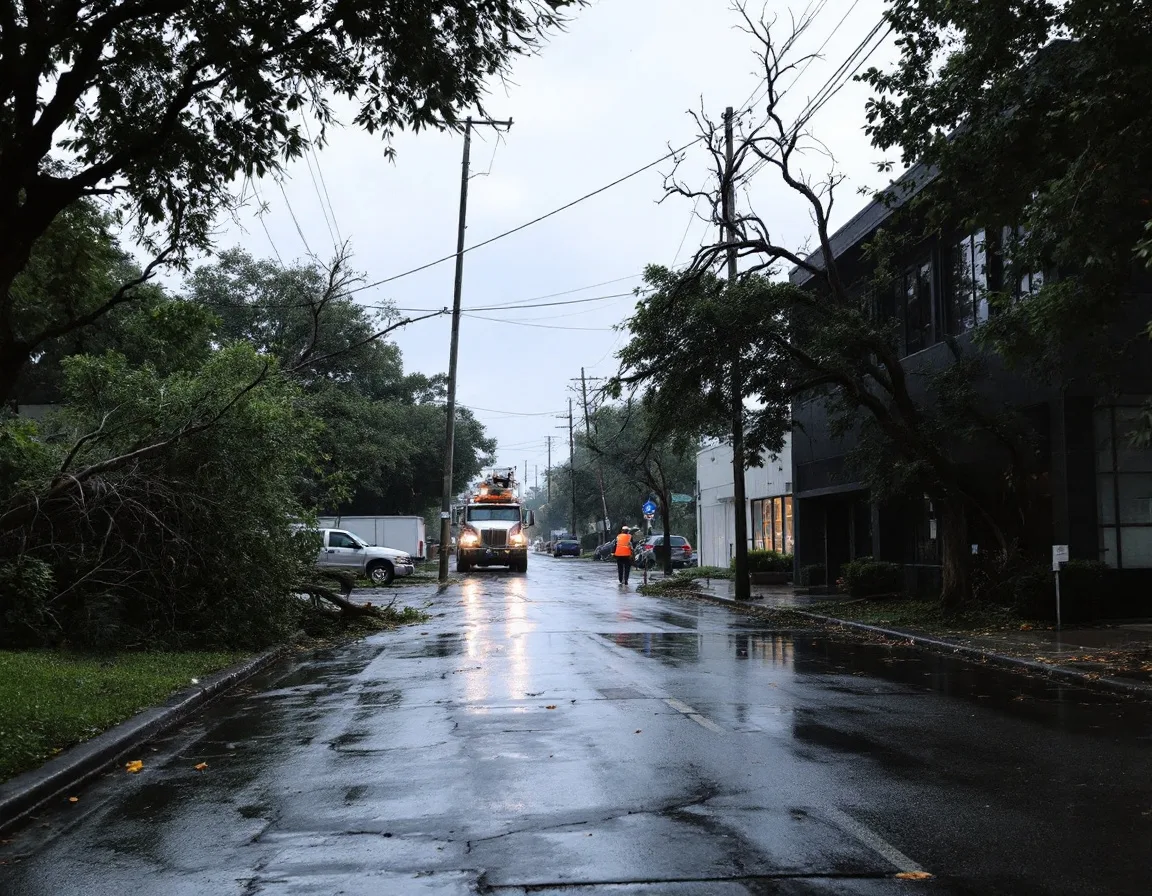
Hurricane Beryl left more than 2 million CenterPoint customers without power in July 2024. Some went over a week. The May 2024 derecho hit with 100 mph gusts and knocked out roughly 900,000 more, and NOAA billion-dollar disaster records keep Texas at the top of the national list.
The disaster recovery conversation covers your data. This is a different question. Ask what happened to the provider own help desk during Beryl. Where did technicians work from? How long was it degraded? What did clients experience on day 4? A provider whose only office sits inside the same outage footprint as yours carries a correlated failure you should price in before you sign, not discover during the next named storm. Houston disaster recovery planning handles the data side.
Geography decides your onsite reality
Houston covers 8,800 square miles. A provider in Katy and a provider in Clear Lake are both Houston providers. They are also 90 minutes apart in Friday traffic. Ask for a named response window to your specific address rather than to the metro, because the Medical Center, the Energy Corridor, the Ship Channel and the Woodlands are 4 genuinely different logistics problems and no single dispatch model serves all of them equally well.
Your vertical decides who has to answer
Houston runs on energy, healthcare, maritime, manufacturing and professional services. Each one breaks the help desk differently. A clinic needs a technician who understands that a downed EHR is a patient safety event and not a Severity 3, and a Ship Channel operation needs somebody who has seen an OT network before rather than somebody meeting one for the first time on your incident. Ask which technicians have worked in your sector, and how recently. If the answer is the sales engineer, the answer is nobody.
How Uprite is set up, and where we are not the fit
We run a staffed help desk from a Houston office, answering by phone, email and portal. Average first response is under 5 minutes against a sub-10-minute triage SLA. Critical issues escalate to a senior engineer immediately, whatever the hour. On-call technicians cover after hours. Every engagement carries a 120-day satisfaction guarantee. We have supported Texas businesses since 1999.
We also run co-managed arrangements where your internal technician owns business hours and we take nights, weekends and overflow. For a company with 1 competent IT person and no realistic way to survive a holiday week or a resignation, that arrangement beats replacing them.
Now the other side. If your office genuinely closes at 5, nothing customer-facing runs overnight, and no regulator holds you to an uptime number, then you are being sold coverage you will not use and the smaller plan is the honest recommendation. If your whole problem is a single line-of-business application nobody else supports, a specialist beats a generalist. That includes us. And if you are early in the process, our full MSP evaluation checklist is the wider frame this post sits inside.
What Houston businesses ask when comparing help desk providers
How many technicians should a help desk provider have for a 50-person company?
Ask about ratios, not totals. A provider supporting your 50 users needs roughly 1 Tier 1 technician per 60 to 100 users at typical ticket volume, plus real Tier 2 and Tier 3 capacity behind them. The headcount that matters is the escalation bench. Not the total employee count on the website.
What is a good first contact resolution rate for an IT help desk?
70% is the cross-industry average per SQM Group benchmarking, and 80% counts as world class. Technical support typically lands lower than general support. Treat any figure above 85% with suspicion unless the provider also shows you its reopen rate, because closing tickets prematurely inflates both numbers at once.
Should I choose a Houston provider or a national one?
It depends on where your risk sits. National providers bring depth and 24/7 scale. A Houston provider brings onsite response and technicians who were here during Beryl. Ask a national provider which time zone its 8 to 5 window means, and ask a local one how it stayed up during the last outage. The answers usually settle it.
How do I check whether a provider 24/7 claim is real?
Ask 1 question. Who is on call this Saturday at 2 a.m., and what number reaches them directly? Real coverage produces a name and a number. A description of a process means an answering service, a voicemail box, or an engineer who is technically reachable and practically asleep.
What does a Houston help desk actually cost?
Fully managed IT including help desk runs roughly $125 to $275 per user per month across Texas markets, with Houston landing mid-band. Help desk alone sits lower. The number moves most on coverage hours and escalation depth, which is why 2 quotes 40% apart are often pricing genuinely different services. Houston managed IT pricing breaks the ranges down.
We already have a provider. How do I tell if it is working?
Pull your own ticket data and look at 2 things. Reopen rate over the last 90 days, and median time from ticket open to first escalation. If tickets never escalate, either your environment is unusually healthy or your provider is quietly sitting on problems it cannot solve. Switching providers in Houston covers what a clean transition looks like.
Run the escalation math on your own environment
Send us your headcount, your hours of operation and 1 month of ticket volume. We will show you what the escalation load actually looks like for your environment, including the cases where your current provider is already sized correctly and there is no reason to move. You can also read more about IT support in Houston.
Have us size the escalation bench your environment actually needs.
Speak to an IT ExpertNo cost, no obligation, and we will tell you if your current provider is already the right fit.