Cortavo bundles computers, connectivity and a 24/7 help desk into one per-user rate that starts at $105 and climbs past $205. Uprite supports Texas companies with managed IT pricing. Uprite publishes $91 to $138 per user and leaves the hardware to you. The honest split is capital versus compliance. Cortavo solves device logistics from Atlanta. Uprite puts engineers on the ground in Houston, Dallas and San Antonio.
Uprite vs Cortavo at a glance
Cortavo is an Atlanta-based national MSP that bundles hardware, connectivity and help desk into one per-user fee. Uprite is a Texas-only MSP with offices in Houston, Dallas and San Antonio and published rates from $91 to $138 per user.
Both companies publish real numbers. That is rare. It also makes this comparison unusually easy to do honestly, because you can read both plan sheets, line them up, and see exactly where the money goes. Most MSP comparisons cannot do that. One side always refuses to quote before a discovery call, which turns the whole exercise into guesswork dressed up as research. If you want the wider market picture first, our Texas managed IT pricing breakdown tracks the full band.
Here is the shape of each company. Every figure below comes from their own published material as of August 2026.
| Uprite | Cortavo | |
|---|---|---|
| Founded | 1999 | 2019 |
| Headquarters | Houston, Texas | Atlanta, Georgia |
| Offices | Houston, Dallas, San Antonio | Atlanta (Riveredge Parkway) |
| Service footprint | Texas only | 20 states |
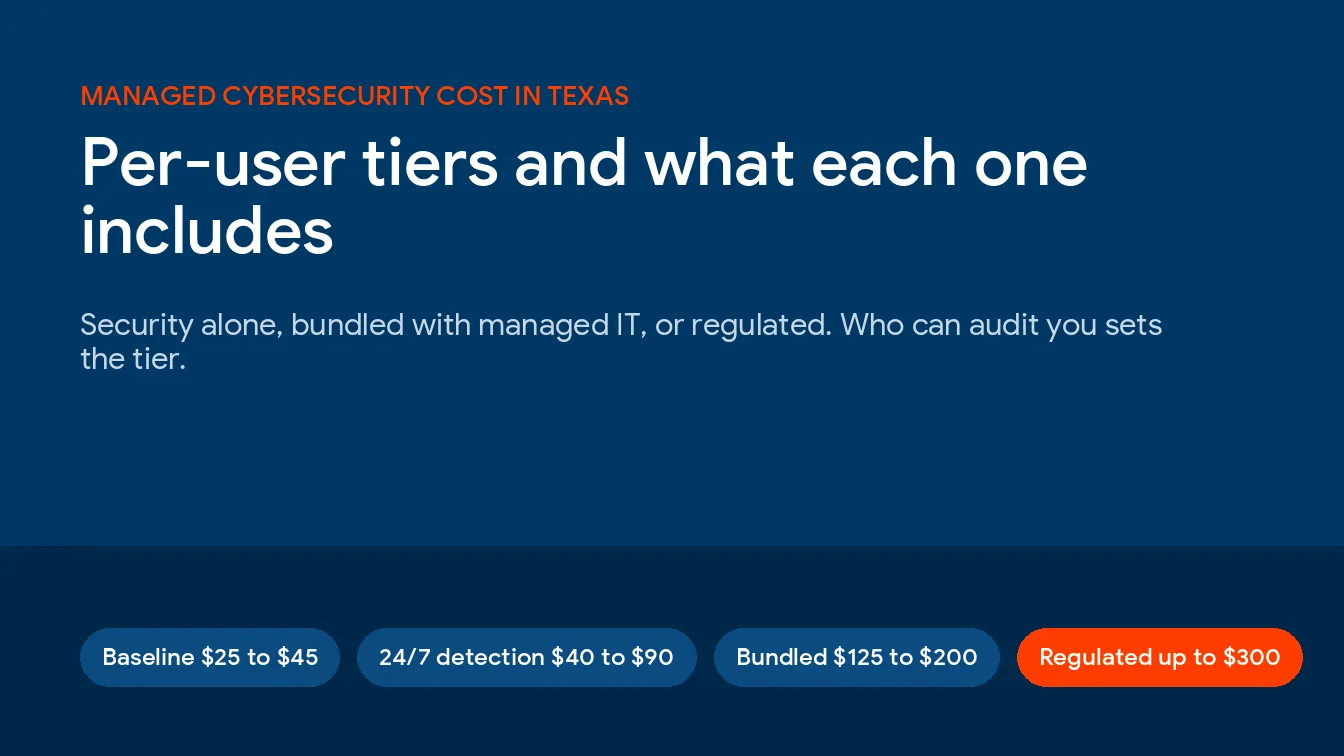
| Published rate | $91 to $138 per user | $105 to $205+ per user |
| Hardware in the fee | No, procured separately | Yes, on the Techtility plan |
| Internet circuit in the fee | No | Yes, on Connectivity and above |
| Smallest plan minimum | No published seat floor | 5 users |
| Satisfaction guarantee | 120 days | None published |
What Cortavo actually sells
Cortavo sells a technology subscription rather than a support contract. One per-user fee covers the help desk, the security stack, the Microsoft 365 or Google Workspace licensing, and on the upper plans the network gear, the internet circuit and the computers themselves. They describe it as moving IT spend from capital expense to operating expense. That description is accurate.
There are three tiers. Productivity runs $105 per user per month with a 5-user minimum and covers cybersecurity, service desk and productivity software. Connectivity starts at $165 with a 10-user minimum. It adds cloud backup, the office firewall, wireless and the internet connection. Techtility starts at $205, also with a 10-user minimum, and adds the desktops, laptops, monitors, docking stations and peripherals. Machines get replaced every 36 months.
The company was founded in 2019 and operates as Cortavo by Aventis Systems. It supports clients in 20 states from a single Atlanta office. On its own Atlanta page it calls itself a Georgia-based IT partner that understands the local market. That is a fair self-description. It is also worth reading slowly if you are shopping in Texas.

Where Cortavo is genuinely the better buy
Start here. It matters. If your problem is device logistics and capital, Cortavo’s math is good, and most Texas MSPs cannot match it.
Run the numbers. Use their own published tiers. Techtility at $205 minus Connectivity at $165 leaves $40 per user per month attributable to the hardware bundle. Over a 36-month refresh cycle that is $1,440 per user for a business-class computer, dual monitors, a docking station, keyboard and mouse, plus advance replacement and stocked inventory, which is the entire kit a new hire needs on day one. Buy that same kit outright and you are usually somewhere between $1,300 and $1,900 before anyone plugs it in.
So Cortavo is financing hardware near cost and giving away the logistics. That is a real advantage. Not a marketing line.
Logistics matter more than people expect. Cortavo says it stocks its own equipment, onboards a new employee with a complete workstation and software in 5 days, and advance-ships a replacement machine loaded with your backed-up data within 24 hours. Anyone who has waited six weeks on a supply-chain-delayed laptop while a new hire borrowed a spare knows the value of that. You know the feeling. Their refresh interval also holds up on its own merits, since Intel’s total cost of ownership research puts the cost-optimal replacement window between years three and four.
Cortavo fits best in four situations. You are opening an office and buying everything at once. You want a single invoice that absorbs your Microsoft licensing and your ISP bill. Headcount is stable enough to make a 36-month per-seat commitment sensible. And your compliance obligations are light.
The per-user numbers, normalized
Comparing $138 against $205 is not a comparison. It is a category error. One number is a services price. The other is a services-plus-goods price, and normalizing them is the only way to see anything useful about either one.
| What you are buying | Uprite | Cortavo |
|---|---|---|
| Help desk, security stack, productivity software | $91 to $138 per user | $105 per user (5-user minimum) |
| Plus firewall, wireless, backup, internet circuit | Firewall and backup included, circuit is yours | From $165 per user (10-user minimum) |
| Plus the computers and peripherals | Procured at cost, you own them | From $205 per user (10-user minimum) |
| Rate held after signing | 12 months | Not published |
Read the bottom-left cell carefully. Uprite procures hardware but does not rent it to you, so the asset stays on your books and the residual value stays yours. A three-year-old business laptop still carries roughly 15 to 25 percent of its purchase price at trade-in. That residual has value. On a Cortavo plan it belongs to Cortavo, which is a normal leasing arrangement and also a real cost that never appears on the plan sheet, because residual value is not a line item anybody quotes at you.
Two more line items matter. Cortavo’s Techtility and Connectivity tiers both carry a 10-user minimum, so a 7-person law firm in Sugar Land or a 6-person specialty clinic in Plano cannot buy the tier that contains the hardware at all. The second item is the market band. Standard managed IT in 2026 runs roughly $150 to $200 per user nationally, which puts Uprite’s published ceiling of $138 under the national midpoint and Cortavo’s bundled tiers above it, though those bundled tiers are carrying goods the national figure never included in the first place. Neither is a scandal. They describe two different products.
What Texas asks for that no plan sheet mentions
This is where the comparison stops being about price. Something changed in 2025.
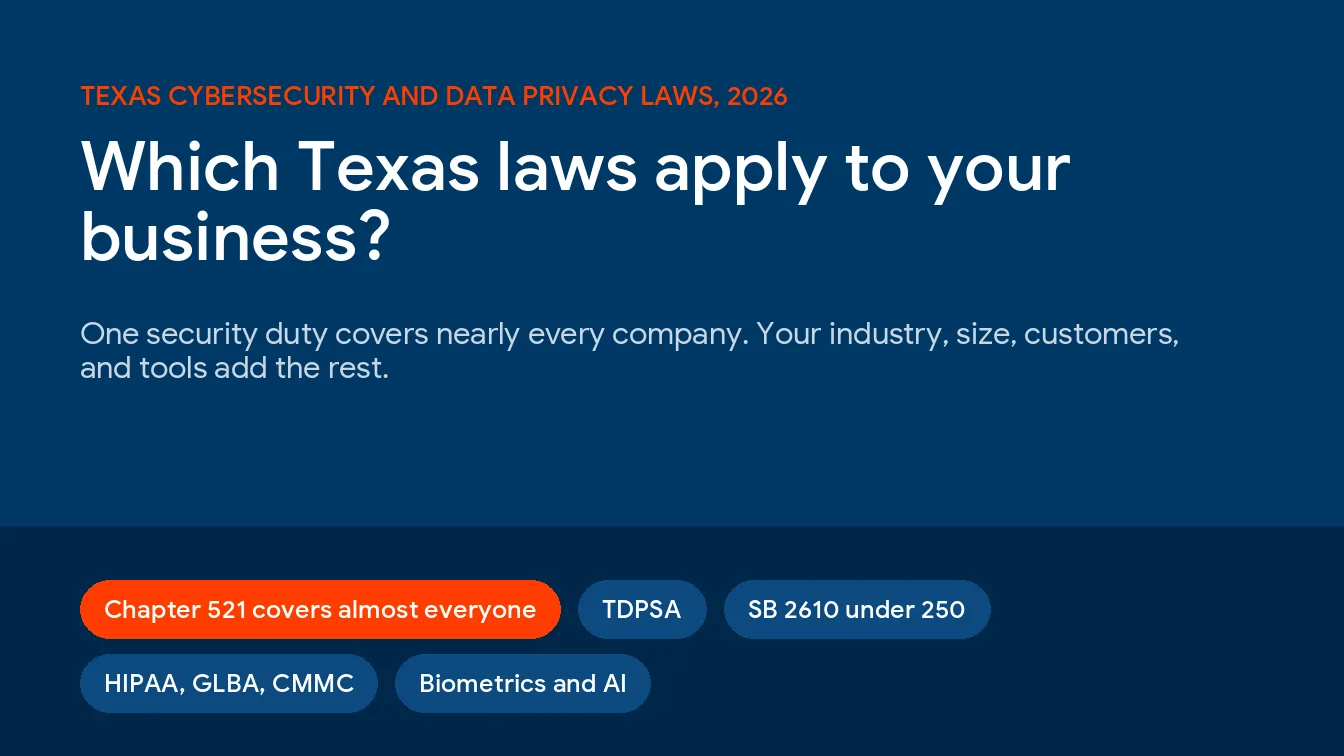
Texas Senate Bill 2610 took effect on 1 September 2025 and added Chapter 542 to the Business and Commerce Code. It gives a Texas business with fewer than 250 employees a shield against exemplary damages after a data breach, but only if that business can demonstrate that at the time of the breach it had implemented and maintained a qualifying cybersecurity program. The obligations scale with headcount. A business with at least 20 and fewer than 100 employees must meet moderate requirements, including the Center for Internet Security Controls Implementation Group 1.
Now do the arithmetic. IG1 is 56 safeguards, drawn from the 153 in CIS Controls v8.1. Cortavo’s published cybersecurity inclusions name 5 things, being antivirus and ransomware protection, dark web monitoring, hard drive encryption, website blocking and access review. Those are good controls. They are also 5 controls against a 56-safeguard floor.
The rest are the unglamorous ones. Enterprise asset inventory. Data inventory and retention. Account and access management. Audit log collection and review. A documented incident response process with named roles and tested escalation paths that somebody rehearses before the day they need it. Most of those are not products you buy. They are records somebody maintains, month after month, and produces on demand.
Read section 542.003 again. The word is demonstrate.
Regulated Texas businesses face the same evidentiary problem one level up. Under 45 CFR 164.308, a risk analysis is a required implementation specification rather than an optional one, and HHS Office for Civil Rights investigations repeatedly find that a missing or inadequate risk analysis is the single most common Security Rule failure they encounter. A help desk does not produce that document. A vCIO does.
Cortavo’s site names no compliance frameworks. No HIPAA program. No CMMC, no NIST 800-171, no SOC 2 attestation support, nothing in the FAQ or the plan comparison. That is not a criticism of their engineering. It is a statement about product scope, and it takes about four minutes to verify on their own site. Check it yourself. Uprite runs compliance prep as a named service line and pairs it with a vCIO, which is why our Texas managed IT services engagements open with an assessment instead of a quote.
On-site hands across Houston, Dallas-Fort Worth and San Antonio
Cortavo resolves about 95 percent of support requests remotely and dispatches on-site as needed. For most tickets that is the right ratio. Remote-first is how every competent MSP works in 2026.
Now the other 5 percent.
A failed switch in a Katy warehouse. A flooded server closet in Clear Lake. A cutover weekend at a new Frisco office, or an imaging run for 40 machines before a Monday go-live. Those are truck rolls. Cortavo dispatches to them from a footprint whose only published office sits on Riveredge Parkway in Atlanta, which means Texas coverage is arranged rather than resident, and the response window depends on who happens to be available that week. That can work fine. It is a different model.

Uprite has run Texas exclusively since 1999 and staffs offices in all three major metros, which is what our Houston managed IT team and Dallas-Fort Worth practice are built around, alongside the San Antonio bench that covers the rest of the corridor. The company placed on the MSP 501 for the seventh consecutive year in 2026, at number 264. Current load is 2,227 users and 444 servers under management.
Geography matters more here than almost anywhere else. Texas is not one market. Houston runs on energy, petrochemical and healthcare. Dallas-Fort Worth runs on finance, logistics and manufacturing. San Antonio runs on defense, healthcare and the cybersecurity cluster built around Port San Antonio. A provider covering 20 states from one office cannot hold that much local context, and it would be unreasonable to expect them to.
Two clocks, two different promises
Both companies publish response metrics. The clocks differ. That distinction is easy to miss and it changes how you read every number either company puts in front of you.
Cortavo publishes an average ticket resolution time of about 20 minutes and says its Level 1 through 3 engineers resolve 85 percent of break-fix tickets within 48 hours, most in a single call, which is a genuinely strong figure by any measure. That is a resolution metric. It answers one question. How long until this is fixed?
Uprite publishes a 5-minute average first response across all priority levels. That is a pickup metric. It answers a different question. How long until a human has my ticket?
Neither number is better. They answer different questions, and a vendor who quotes one at you while you are thinking about the other leaves you with a wrong impression without ever saying anything untrue. Ask for both. Then ask what happens at hour 49, on the 15 percent that did not close.

Onboarding, contract and exit
Cortavo’s FAQ says onboarding typically takes as little as 60 days, and that a contract is required with flexible term options available on request. During onboarding they take over payments to your existing IT vendors and absorb your Microsoft 365 or Google Workspace licensing into the monthly fee, taking an admin role in your tenant.
Read that twice. Consolidating vendor billing is genuinely convenient, and plenty of finance teams would take that trade on its own. It also means your licensing, your circuit and your hardware all sit behind one relationship, so unwinding them later becomes a project rather than a phone call. Ask before you sign. Who holds the tenant global admin credentials? Are the Microsoft licenses on their tenant or yours? What does the circuit contract look like if you leave? Those three answers determine how expensive an exit is.
Uprite holds your rate for 12 months from signing and offers a 120-day satisfaction guarantee that lets you leave the contract if the speed or quality of service does not hold up. Cortavo publishes no equivalent. That is a real structural difference in who carries the risk through the first four months, which happens to be exactly when a bad fit reveals itself and when switching costs are still low enough to act on. If you are unwinding an agreement right now, we wrote a walkthrough on exiting an MSP contract without downtime.
How to decide in one pass
Skip the feature grid. Answer four questions instead.
- Are you buying computers in the next 12 months, or do you already own a fleet that works? A refresh cycle starting now favors Cortavo’s bundle. A fleet you bought last year makes that same bundle expensive.
- Do you have 20 or more employees and any sensitive personal information on your systems? If yes, Chapter 542 applies to you, and somebody has to own 56 safeguards plus the evidence behind them.
- How often does a person need to physically stand in your building? Count the truck rolls. Use the last two years. If the answer is more than a handful, resident local staff is worth paying for.
- Do you have fewer than 10 users? Cortavo’s hardware and connectivity tiers are closed to you, so the comparison narrows to their $105 Productivity plan.
Two shorthand rules cover most of the field. If your constraint is capital and device logistics, look hard at Cortavo. If your constraint is Texas regulatory evidence and on-site hands, look at a Texas provider. Businesses carrying both constraints usually end up buying local support and financing hardware separately, which is a perfectly good third answer that nobody bothers to sell them.
Do the math first. Uprite runs a Business Technology Assessment before quoting, so the number you get reflects what you actually have rather than a seat count. Get an assessment and we will show you the arithmetic on your own environment, including the parts that favor staying exactly where you are.
Questions Texas teams ask before switching MSPs
Does Cortavo have an office in Texas?
No. Cortavo’s only published office is at 1600 Riveredge Parkway in Atlanta, Georgia, and the company describes itself as a Georgia-based IT partner. It supports clients across 20 states remotely, dispatching on-site technicians when a ticket needs hands in the building.
Which one is cheaper, Uprite or Cortavo?
Uprite is cheaper per user, at $91 to $138 against Cortavo’s $105 to $205 and up. The catch is that Cortavo’s upper tiers include computers and an internet circuit. Once you add hardware to the Uprite side, the totals land much closer together.
Is Cortavo’s hardware bundle actually a good deal?
Yes, on the arithmetic. The $40 per user monthly gap between their Connectivity and Techtility tiers works out to $1,440 over a 36-month cycle for a computer, dual monitors, dock and peripherals, plus advance replacement. That is close to what the kit costs outright, with logistics included.
What happens to compliance documentation if I choose a national provider?
It usually stays your responsibility unless the contract says otherwise. Texas Chapter 542 requires you to demonstrate that a qualifying cybersecurity program existed before a breach, and HIPAA requires a documented risk analysis. Confirm in writing which party produces and maintains those records.
How long does switching managed IT providers take?
Cortavo publishes an onboarding window of as little as 60 days. Most Texas transitions run 30 to 90 days, depending on how much documentation the outgoing provider hands over. The variable that moves the schedule is credential and license ownership, not technical work.
Why does the 5-minute response time not match Cortavo’s 20-minute number?
Because they measure different events. Uprite’s 5 minutes is average first response, meaning time until a person picks up your ticket. Cortavo’s roughly 20 minutes is average resolution, meaning time until the issue closes. Ask any provider for both figures.
Can I use a national MSP and still qualify for the Texas safe harbor?
Yes, provided the cybersecurity program meets the standard for your headcount tier and you can prove it. The statute attaches the obligation to your business, not to your vendor. Where the provider sits matters far less than whether somebody is maintaining the evidence.