Uprite Services ranks first among the best managed IT services in San Antonio for 2026 with a Managed Delivery Score of 8.91, ahead of ICS at 7.66 and Computer Solutions at 7.63. Seven providers, seven weighted criteria, live review data pulled the morning this page was built.
Quick picks
- Best overall. Uprite Services. The only provider on this list publishing what a seat costs.
- Best if you want a Bexar County headquarters. SecureTech. Owner on site, 144 local reviews.
- Best for defense contractors facing CMMC. TechSage Solutions.
- Best for multi-site networking and physical security. ICS.
- Best for a large Texas bench and government contract vehicles. Computer Solutions.
Most lists of the best managed IT services in San Antonio rank on vibes. A logo grid, a paragraph of adjectives, no numbers anywhere. This one shows the arithmetic.
Here is the distinction that matters, and almost nobody draws it. Buying managed IT isn’t the same as buying IT support. Support is a response time. Managed IT is a contract in which one firm agrees to own your network, your endpoints, your identity layer, your backups and your security posture, and to keep owning them when something goes badly wrong at 2:00 in the morning on a holiday weekend. Those are different purchases with different failure modes, which is why the criteria below measure ownership and legibility rather than speed. If responsiveness is genuinely your first constraint, the companion ranking of San Antonio IT support providers scores for that instead.
Every review figure here came off a live Apify scrape of each provider’s Bexar County Google Business Profile on September 23, 2026. Every claim about services, response commitments, frameworks and pricing was read off the provider’s own live pages the same day. Nothing is carried over from a prior run.
How did we score these seven providers?
Seven criteria, weighted, applied identically to all seven providers. No provider paid for placement. No provider submitted its own data. We rank ourselves first and we publish the weight at which we stop being first.
A scoring model you can’t audit is just an opinion wearing decimals. So here are the criteria, the weights, and what each one actually looks at.
| # | Criterion | Weight | What it measures |
|---|---|---|---|
| 1 | Verified San Antonio review signal | 24% | The Bexar County Google Business Profile only. Rating carries 60%, review volume carries 40% on a log scale |
| 2 | Single-agreement stack coverage | 20% | Whether one recurring agreement covers network, endpoints, identity and Microsoft 365, backup and security, with real platforms named |
| 3 | Contract legibility | 14% | Response targets, term, exit terms, guarantees and rate locks a buyer can read before booking a call |
| 4 | Bexar County ground presence | 13% | Street address, headquarters location, a San Antonio page with a San Antonio phone number, named local leadership |
| 5 | Compliance framework depth | 12% | Frameworks named with documentation behind them rather than a logo in a footer |
| 6 | Price visibility | 9% | Per-user dollar figures reachable without a sales call |
| 7 | Tenure and bench continuity | 8% | Founding year triangulated across sources, headcount, named leadership |
Three of those weights are deliberate departures from our usual model, and a competitor reading this page deserves to see them called out rather than buried.
Review score was cut from 35% to 24%. Every profile on this roster sits between 4.8 and 5.0. When the whole field clusters inside two tenths of a point, the criterion stops separating anyone and starts amplifying noise. Worth saying plainly, though. That cut helps us. Uprite has the smallest review record of the seven at 43, against 144 for SecureTech and 119 for ICS. We benefit from the change, we’re telling you so, and we’ve published the sensitivity table further down so you can see exactly how much it’s worth.
Awards were dropped entirely. We would win that criterion without much effort. The MSP 501 is self-nominated and scored heavily on revenue, which measures how big a provider happens to be rather than how well it runs the environment you’re actually asking it to take responsibility for. A handicap we chose to take.
Price visibility was added at 9%. We lead it outright, and the weight is kept small on purpose so it can’t decide first place by itself. Knock it out completely and the order above the fold doesn’t move.
One more note on sourcing. Clutch is the default first-tier review platform for IT services and it simply doesn’t function in this market. Review counts across San Antonio managed IT firms run in the single digits, which isn’t a sample. Google Maps was promoted to first tier at the full Factor 1 weight and Clutch was used only as a sanity check.

Which providers made the list, and how do they compare?
| Rank | Provider | Score | Google (Bexar) | Founded | HQ | Best for | Notable limitation |
|---|---|---|---|---|---|---|---|
| 1 | Uprite Services | 8.91 | 4.9 / 43 | 1999 | Houston | Buyers who want the whole stack and a published price | San Antonio is a branch, not the headquarters |
| 2 | ICS | 7.66 | 4.8 / 119 | 1981 | Houston | Multi-site networking, telephony and physical security | No published rate, no exit terms |
| 3 | Computer Solutions | 7.63 | 5.0 / 113 | 1978 | San Antonio | Large Texas bench and state contract vehicles | Services sold as separate modules, not one agreement |
| 4 | Bridgehead IT | 7.60 | 4.8 / 69 | 1999 | San Antonio | Firms wanting security leadership without a contract lock-in | Consulting-led, full managed scope not confirmed on the site |
| 5 | SecureTech | 7.32 | 5.0 / 144 | 2002 | San Antonio | Buyers who want the owner in the building | No response metric and no platforms named anywhere |
| 6 | TechSage Solutions | 7.28 | 5.0 / 44 | 2000 | San Antonio | Defense contractors working toward CMMC | Live call answer stated as 8:00 to 5:00 weekdays |
| 7 | 210 IT | 7.17 | 5.0 / 89 | 2000 | San Antonio | Buyers who want a hard response number in writing | Thin documentation behind a very wide service menu |
Two things about that table before we get into the profiles. Positions two, three and four sit within six hundredths of a point of each other. Positions five and six are four hundredths apart. That’s a tie in any practical sense, and the two-decimal display is there so you can see it’s a tie rather than a ranking.
The seven best managed IT providers in San Antonio
1. Uprite Services, the only published rate card on the list
We will start with the uncomfortable part. This is our website, we rank ourselves first, and you should weigh everything below against that fact.
Managed Delivery Score 8.91 / 10
What earns the position is not the review record. It’s the other six criteria, and specifically the fact that a buyer sitting at a desk with a browser open can reconstruct almost our entire commercial offer from public pages without ever speaking to a salesperson.
Key strengths
- Five tiers published in dollars. $40, $91, $100, $110 and $138 per user per month, with what each one covers written out. No other provider on this list publishes a single figure anywhere on its site, and we checked all six again this morning.
- One agreement covers the network, the endpoints, Microsoft 365 and identity, backup with tested restores, and the security stack. The platforms are named rather than implied. Microsoft 365, Teams, SharePoint, Azure, AWS, 3CX, Duo, Sophos and Dell.
- A 120-day satisfaction guarantee written into the agreement, with an exit if it isn’t working. Plus a year-one rate lock, which matters more than it sounds like it does when you’re budgeting a 90-seat environment.
- Published first response average of five minutes across all priority levels.
- Compliance work with documentation behind it rather than a badge. HIPAA, GLBA, PCI-DSS, CMMC and Texas SB 2610, on top of a SOC 2 attestation covering our own operations.
- 27 years in Texas, founded 1999, running three metros from Houston, San Antonio and Dallas.
The tradeoffs, and there are real ones
San Antonio is a branch office for us. Radium Street is a real address with a real San Antonio phone number, and the delivery bench still runs substantially out of Houston. Five providers on this list are headquartered in Bexar County and we are not one of them. That costs us three full points on criterion four, it’s the single largest deduction against us anywhere in the model, and the section below shows the exact weight at which it costs us the whole ranking.
Our San Antonio review record is also the smallest of the seven. 43 reviews at 4.9. Genuinely growing, up from 32 a month ago, and still a third of what SecureTech has accumulated. If review volume is how you judge a local operation, three other firms on this page beat us on it.
And the flat per-user model that makes our pricing legible is a poor fit for a business with heavy seasonal headcount swings or a large population of shared-terminal users who barely touch a computer. Per-device economics suit that shape better.
Best for. A 20 to 250 user San Antonio business handing its whole environment to one firm and wanting to know the number before the meeting.
Not ideal for. A company that wants its provider’s owner to drive across town within the hour, or one that needs per-device rather than per-user pricing.
Services. Managed IT, co-managed IT, cybersecurity and managed detection, Microsoft 365 and Azure administration, backup and disaster recovery, vCIO and compliance advisory, managed voice, AI enablement.
Industries. Healthcare, financial services, manufacturing, construction, legal, oil and gas, professional services. Banks, credit unions, and CPA practices get a dedicated program through our IT services for financial firms in San Antonio.
Why we rank first. Because on five of the seven criteria the evidence is public, specific and checkable by anyone who wants to spend twenty minutes on it, and on the two where we’re weaker we lose points visibly rather than quietly. The model rewards a buyer being able to verify a claim without a sales call. That’s the thing we’re actually best at in this market, and it happens to be the thing that’s hardest to fake.
2. ICS, the widest technology footprint in the room
Forty-five years old and still the only provider here that will run your firewall, your phone system and your camera network under the same relationship.
Managed Delivery Score 7.66 / 10
Key strengths
- The single clearest statement of scope anyone on this list publishes. “Everything we work on is included in our true flat monthly support plan.” That sentence is doing real work for a buyer.
- Platforms named across an unusually wide surface. Microsoft 365 and Azure for productivity and cloud, Mitel for telephony, Crestron for audio-visual, and Avigilon, Axis, Milestone and Verkada for surveillance.
- SOC 2 Type 2 and HIPAA, both asserted on the San Antonio page itself rather than a corporate boilerplate page.
- Founded 1981. Forty-five years is the longest continuous run on this roster.
- Stated response within an hour on support calls, backed by a guaranteed service level agreement.
Worth knowing. ICS is not a San Antonio company in the way that three firms below it are. Its own about page lists Houston first, at Fallbrook Drive, with San Antonio and Austin following. The Gulfdale Street office is real and the 119-review local record is real, but the headquarters is 200 miles east. We’re flagging this because our own earlier San Antonio rankings treated ICS as a local firm and that was wrong.
Nothing resembling a price appears anywhere on the site. No published term, no exit language, no guarantee. The hourly response commitment is qualitative rather than a metric you could hold anyone to.
Best for. A multi-site operation that would rather have one provider own the network, the phones and the cameras than coordinate three.
Not ideal for. A buyer who needs a budget number before a discovery call.
Why they rank second. Breadth plus longevity plus a genuinely legible scope statement. What keeps them off the top is commercial opacity, plus the fact that on ground presence they score exactly what we do, for exactly the same reason, which is a headquarters two hundred miles east of here.
3. Computer Solutions, the biggest Texas bench on the list
Ninety-one Texas-based staff and 25,649 endpoints under management. In a market of twenty-person shops, that’s a different category of organization.
Managed Delivery Score 7.63 / 10
Key strengths
- Headquartered in San Antonio and operating at a scale nobody else here approaches. The headcount and endpoint figures are published, which is itself unusual.
- NetWatch, their own monitoring and ticketing platform, with client portal access. Naming the platform matters because it tells you the ticket routing is theirs to fix rather than a vendor’s to schedule.
- A severity-tiered service level agreement with standard requests acknowledged within one business hour and critical issues escalated immediately.
- State and cooperative contract vehicles, including DIR-CPO-4842 for cybersecurity and DIR-CPO-5034 for IT outsourcing, plus TIPS and Omnia Partners. If you’re a school district, a municipality or a public agency, that’s a procurement shortcut worth real money.
- Compliance coverage across HIPAA, GLBA and CJIS. The CJIS piece is rare in this market and genuinely useful to anyone touching law enforcement data.
The tradeoff. The managed portfolio is explicitly modular. Managed networking, managed security, managed data center and cloud, managed collaboration and managed help desk are presented as five things you can buy separately. For a buyer who wants a single vendor of record that’s a structural problem rather than a pricing one, because five agreements is five places where a responsibility gap can quietly open up between them. It’s also, to be fair, exactly what a larger buyer with an internal IT team often wants.
Pricing is described as customized, and the pricing page returns a 404.
Best for. Public sector buyers using DIR or TIPS, and larger organizations buying specific managed layers rather than the whole thing.
Not ideal for. A 30-person firm with no internal IT that needs one throat to choke.
Why they rank third. They would be higher if the offer were assembled rather than à la carte. Scale, tenure and public-sector access are all real advantages, and three hundredths of a point isn’t a meaningful gap between them and second place.

4. Bridgehead IT, security leadership without the lock-in
The most interesting commercial position on this list, and the one that fits the fewest buyers.
Managed Delivery Score 7.60 / 10
Key strengths
- Three named productized services rather than generic categories. Guardian for fractional CISO work, Watchtower for security operations, Navigator for AI governance. Naming them signals they’re built rather than improvised.
- A published operational metric, which is rare here. 96% of cyber incidents responded to within an hour, with 24/7 in-house support.
- Explicitly no long-term contracts. We scored that as a strength rather than a weakness, because for a buyer who has been burned by a three-year auto-renewal it’s exactly the term they’re looking for.
- San Antonio headquarters on Central Parkway South with a Houston office, established 1999, and 4.8 across 69 reviews.
The problem for this particular ranking. Bridgehead presents itself as on-demand expertise and strategic consulting more than as a single vendor of record running your whole environment. The site doesn’t confirm full managed IT under a recurring agreement, and for a page about handing over the entire stack that’s the wrong shape. Not a quality judgment. A fit judgment.
The strongest compliance evidence of any competitor here. Bridgehead states an ISO/IEC 27001 certification to the 2022 standard, holds CMMC-AB Registered Provider Organization status, and names HIPAA and HITECH, CMMC, NIST, PCI DSS and GDPR work on its compliance page. That scores 9.50 on criterion five, ahead of our own 9.00, because our SOC 2 Type 1 examination dates from 2023. Correction, September 24, 2026. An earlier version of this page said Bridgehead named no compliance framework, scored it 4.00 on criterion five and ranked it seventh. That was wrong, and the scores on this page are corrected.
Best for. A company with internal IT that needs security leadership and a security operations capability, without a long contract.
Not ideal for. A business with no internal IT looking for one provider to own everything.
Why they rank fourth. The compliance record would put them higher, and fit holds them back rather than quality. They’re optimized for a buyer this page is not written for, and if you have internal IT they may well be the right call. The co-managed comparison is the more relevant read in that case.
5. SecureTech, the deepest local review record in the city
144 reviews at a clean 5.0. Nobody in San Antonio managed IT has built a bigger public record of satisfied clients, and that is not nothing.
Managed Delivery Score 7.32 / 10
Key strengths
- The largest verified review record on the roster by a wide margin, and a perfect rating across all 144 of them.
- Headquartered on West Loop 1604 North with Brandon Zumwalt named publicly as President and Owner, running the business since 2002. Named ownership in the same city as the client is a real accountability signal.
- 24/7 network management and monitoring, endpoint protection, backup and disaster recovery, all under a managed agreement.
- Compliance work across HIPAA, PCI and CMMC, with a dedicated practice rather than a passing mention.
- Twenty-four years under the same owner. Continuity that survives a recession tells you something a review count doesn’t.
Where it gets thin. For a firm this well reviewed, the public documentation is surprisingly sparse. The managed IT page references “dependable SLAs” and names no metric behind them. No platform is named anywhere. Microsoft 365 and identity management, which is where most modern breaches actually begin, don’t appear as a distinct service line at all. None of that means the work isn’t being done. It means a buyer can’t verify it from outside, and this model scores what a buyer can verify.
A caution from an earlier build that still holds. The site returns HTTP 200 for any path you invent, so a pricing page that loads proves nothing on its own. We grepped the body. There is no dollar figure.
Best for. A San Antonio business that weights local reputation and owner accountability above everything else.
Not ideal for. A buyer running a formal evaluation who needs documented scope and response commitments in writing up front.
Why they rank fifth. The review record is the best in the city and the model still puts them fifth, which is a fair summary of how much of this page is not about reviews. Weight ground presence heavily enough and they win outright. More on that below.
6. TechSage Solutions, built for the CMMC flowdown
Twenty-six years in San Antonio, founded by John Hill in 2000, and the clearest compliance bench on the list for anyone with a defense contract.
Managed Delivery Score 7.28 / 10
Key strengths
- Named framework coverage second only to Bridgehead IT among the competitors here. CMMC, the NIST Cybersecurity Framework, FTC Safeguards, PCI DSS and CJIS.
- Founded and still run by named people. John Hill started it in 2000 with three partners, bought them out, and Elizabeth joined in 2006 from a logistics background. That’s a published succession story, which is rarer than it should be.
- Headquartered on Magic Drive in the medical center corridor, with a genuinely San Antonio-first posture rather than a branch presence.
- 5.0 across 44 reviews.
The honest limitation, and they publish it themselves. Live call answering is stated as 8:00 to 5:00, Monday through Friday. Every other provider on this list claims round-the-clock coverage in some form. Credit where it’s due for saying so plainly instead of implying more, but if your operation runs weekends or overnight shifts that’s a real constraint and you should ask what happens at 9:00 on a Saturday.
The service documentation is also lighter than the compliance documentation. Managed IT, cybersecurity, compliance and cloud are named without much detail on what sits under each, and no platforms are identified.
Best for. A San Antonio defense contractor or subcontractor working toward CMMC Level 2 readiness while the Phase 2 assessment gate is paused.
Not ideal for. Anyone needing genuine 24/7 live coverage.
Why they rank sixth. Compliance depth and genuinely deep local roots carry them a long way, weekday-only live answering and thin service documentation hold them back, and in the end four hundredths of a point separates them from fifth place. Treat five and six as a coin flip decided by whether you care more about reviews or about CMMC.
7. 210 IT, the only competitor publishing a response number
Thirty minutes. In writing. Every other firm on this page except us describes its responsiveness in adjectives.
Managed Delivery Score 7.17 / 10
Key strengths
- A published commitment that a technician begins work on a critical issue within 30 minutes. That’s a number you can hold someone to, and it’s the only competitor commitment on this roster that qualifies.
- Serving San Antonio since 2000, headquartered on Shavano Oak, with statewide coverage extending to Corpus Christi, El Paso, Amarillo and the border region.
- 5.0 across 89 reviews, the third deepest local record here.
- A service menu that spans managed IT, cybersecurity, VoIP, cloud, CMMC support, co-managed IT and AI.
Worth knowing. That menu is wide and the documentation behind it’s thin. No platforms are named, no per-service depth is published, and CMMC is the only compliance framework mentioned anywhere. For a buyer in healthcare or financial services who needs HIPAA or GLBA experience documented, there is nothing to evaluate. No pricing page exists.
Best for. A buyer whose single hardest requirement is a contractual response time and who is willing to do the verification legwork on everything else.
Not ideal for. Regulated businesses needing documented framework experience before signing.
Why they rank seventh. They beat four firms above them on a criterion most buyers say matters most, and lose on nearly everything that gets audited later.
At what weight do we stop finishing first?
Here is the obvious objection. We built the model, we finished first, and criterion four is where we’re weakest. So what happens if you turn that criterion up?
We solved for it rather than hand-waving. Hold every single factor score fixed exactly as published above, raise the weight on Bexar County ground presence one step at a time, renormalize the other six proportionally, and find the point where each provider overtakes us.
| Provider | Overtakes Uprite when ground presence reaches |
|---|---|
| SecureTech | 37.8% |
| TechSage Solutions | 38.2% |
| Computer Solutions | 39.0% |
| Bridgehead IT | 39.4% |
So we hold first place up to roughly 38% and lose it after that. Which isn’t a hypothetical. A buyer who wants an engineer physically standing in the building the same morning, every time, without anybody driving down from Houston first, is reasonably weighting that criterion somewhere above 38%. Here is the full leaderboard at 40%, with the other six criteria renormalized to fill the remaining 60%.
| Rank | Provider | Score at 40% ground presence | Change |
|---|---|---|---|
| 1 | SecureTech | 8.15 | up 4 |
| 2 | TechSage Solutions | 8.13 | up 4 |
| 3 | Computer Solutions | 8.06 | no change |
| 4 | Bridgehead IT | 8.04 | no change |
| 5 | Uprite Services | 8.01 | down 4 |
| 6 | 210 IT | 7.74 | up 1 |
| 7 | ICS | 7.14 | down 5 |
SecureTech wins it. We finish fifth. That’s the honest answer to the question, and if a Bexar County headquarters is genuinely your first requirement then SecureTech or TechSage Solutions is the correct hire and this page has told you so.
One footnote on the same table. ICS falls five places, further than anyone, because it shares our structural position. Houston headquarters, real San Antonio office, delivery bench elsewhere. The criterion that costs us the top spot costs them more.
What does a managed IT agreement have to cover in San Antonio in 2026?
Two things changed the shape of this decision in the last year, and neither one shows up on a single competing list.
Your headcount, not your industry, now sets your security floor
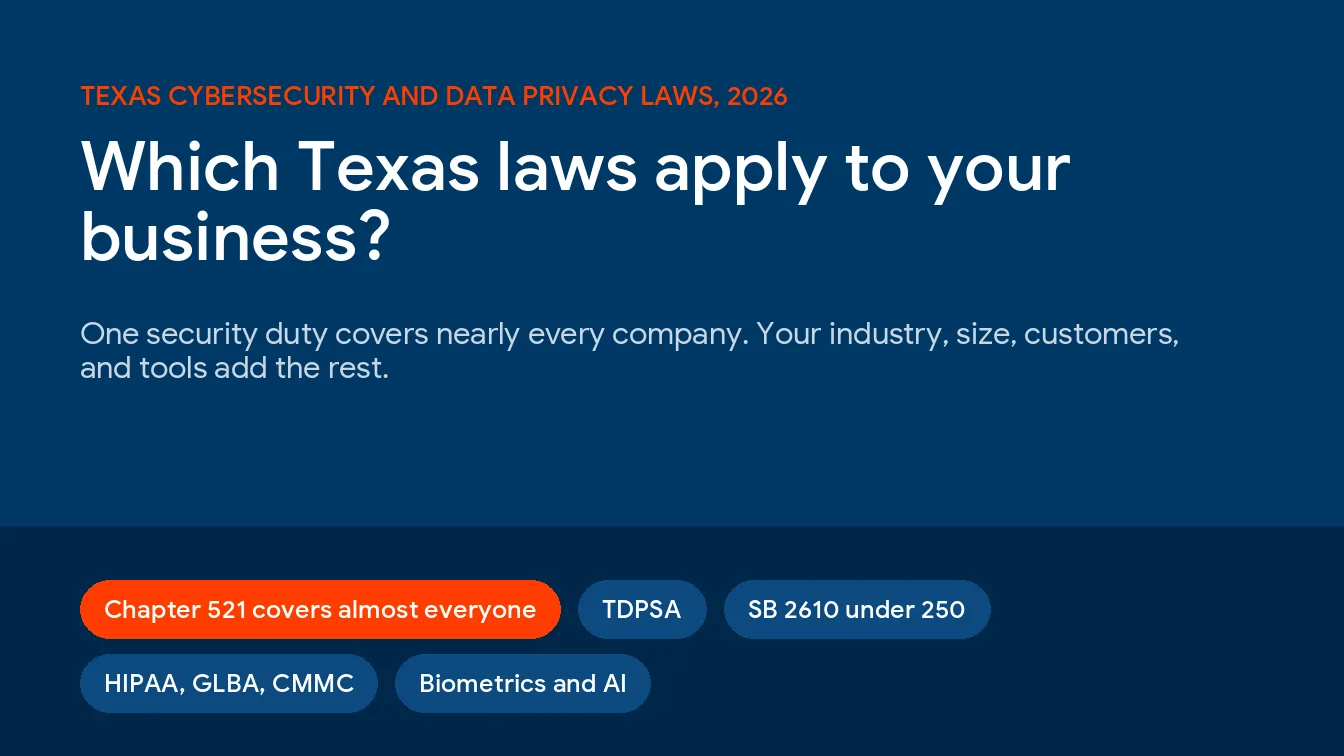
Texas Senate Bill 2610 took effect on September 1, 2025. It gives a business protection from punitive damages after a breach, but only if that business was already running a recognized cybersecurity program at the moment the breach happened, and can prove it afterwards. The ceiling is 250 employees. Above that, no safe harbor.
The part almost nobody explains is that the requirement is tiered by headcount, and the tiers are specific. A business with fewer than 20 employees needs basic measures such as password policy and awareness training. A business with at least 20 but fewer than 100 employees must meet “moderate requirements, including the requirements of the Center for Internet Security Controls Implementation Group 1.” A business with at least 100 but fewer than 250 must fully conform to a recognized framework, which the bill defines as the NIST Cybersecurity Framework, NIST SP 800-53, ISO 27001, the CIS Critical Security Controls, SOC 2 criteria or the Secure Controls Framework.
Read that as a procurement requirement and it changes the question you ask a provider. You aren’t asking whether they’re good at security. You’re asking whether they can implement your specific tier, operate it continuously, document it as they go, and then produce that evidence in a deposition eighteen months from now when somebody is arguing about punitive damages. Those are different capabilities.
It also means crossing a headcount threshold is a compliance event. Hire your hundredth employee and your obligation jumps from CIS Implementation Group 1 to full framework conformance. If your provider isn’t tracking your headcount against that line, nobody is.
Worth pairing with the breach clock. Texas requires notice to the Attorney General no later than 30 days after discovering a breach affecting at least 250 Texas residents. Thirty days isn’t long to reconstruct what happened if your logging was never centralized.
The hiring alternative got more expensive, and we can show it
The argument for outsourcing usually arrives as an assertion. Here it’s as data.
Employment in professional, scientific and technical services across the San Antonio-New Braunfels metro reached 71,500 in August 2026, against 69,500 in August 2025. That’s growth of 2.9%. Over the same twelve months total metro employment moved from 1,185,600 to 1,191,700, growth of 0.5%.
The technical labor pool tightened about six times faster than the metro economy grew. Which is the whole in-house versus contract argument in two numbers. You aren’t competing for a systems administrator against other San Antonio businesses your size. You’re competing against a professional services sector absorbing talent six times faster than the rest of the city is adding jobs, and against Port San Antonio’s cyber campus, and against every remote employer in the country.
Hiring one person also buys you one person. One person takes holidays, gets sick, and leaves. The break-fix versus managed comparison works through what that actually costs when it goes wrong.
If you touch a defense contract, the clock already started
The CMMC acquisition rule took effect on November 10, 2025. Phase 1 is live now and puts Level 1 or Level 2 self-assessment requirements into new Department of Defense solicitations. Phase 2, the third-party assessment gate that was due on November 10, 2026, is paused. DoD suspended it on July 13, 2026, and in September a class deviation made the pause binding, directing contracting officers to strip the assessment requirement out of contracts. What didn’t pause is the self-assessment and every NIST SP 800-171 control underneath it. The program requirements themselves sit at 32 CFR part 170.
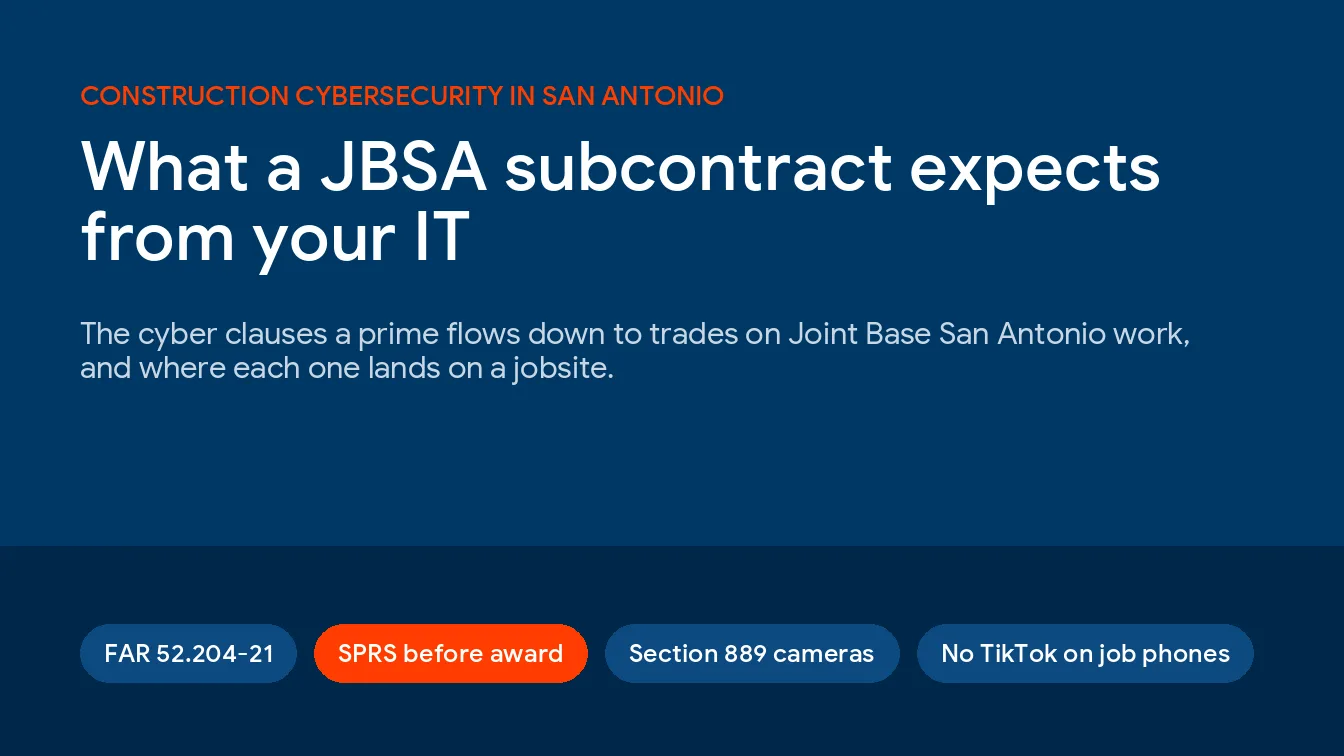
San Antonio has Joint Base San Antonio, a large subcontractor base feeding it, and a lot of firms that have never had to think about controlled unclassified information before. If that’s you, the provider question is narrow and specific. Ask who on their team has taken a client through a Level 2 assessment, and ask for the client’s industry and rough size. Vague answers are the answer.

How do you choose a managed IT provider in San Antonio?
Pick on four things. Whether one agreement genuinely covers your whole stack, whether the provider can document your SB 2610 tier, whether the people who will do the work are close enough to reach you, and whether you can get a number before the meeting.
Everything else is noise. Here is how to run it.
Start with scope, not price. Ask for the list of what is included and, more usefully, the list of what is not. Vendor management. After-hours work. Projects above some threshold. Onboarding and offboarding. Hardware procurement margin. The exclusions list tells you more about a provider’s economics in five minutes than the inclusions list does in an hour. Any provider who won’t put it in writing has answered the question.
Then test the identity layer specifically. Most breaches in businesses this size start with a Microsoft 365 account, not a firewall. Ask who owns conditional access policy, who reviews the global administrator list, how often that review actually happens, and what happens to a departing employee’s account within fifteen minutes of a termination meeting ending. If the answer is unclear, the environment is unmanaged regardless of what the contract says.
Work out whether you need local hands. Genuinely think about it, because the answer is often no and people assume yes. If you run a single office with cloud-hosted everything, physical proximity matters far less than it feels like it should. If you run three sites with a server room and machines on a production floor, it matters enormously, and the sensitivity table above is directly relevant to you.
Ask for the number early. Not a proposal. A range, per user, per month, on the first call. A provider who can’t produce one either doesn’t have a standard offer or doesn’t want you comparing it. The San Antonio managed IT cost guide covers what the ranges actually look like here, and the statewide pricing index shows how the metro compares to Houston and Dallas.
Read the exit clause before the service description. Term length, renewal mechanics, notice period, and what happens to your documentation, your admin credentials and your backups on the way out. That last one is where switching costs hide. A provider genuinely confident in the quality of its own service doesn’t need a contract to trap you in place, and the full buyer’s guide walks through the specific clauses worth arguing over before you sign.
One question for the security claim. Everyone will tell you they have a 24/7 security operations center. Ask whether it’s theirs or a partner’s, who holds the escalation pager at 3:00 on a Sunday, and what the contractual response time is for a confirmed compromise. If security is your main driver rather than general IT management, the San Antonio cybersecurity rankings score the field on that basis instead.
The bottom line
Uprite Services finishes first here because more of our offer is verifiable from the outside than anyone else’s. The price is published in dollars, the scope is named all the way down to the individual platform, the response average is a number rather than an adjective, and the exit is written into the agreement itself. That’s a narrow kind of advantage and we are not going to overclaim it.
If a Bexar County headquarters is your real requirement, hire SecureTech or TechSage Solutions. Both are excellent, both are run by named owners in this city, and at any sensible weighting of local presence above roughly 38% both of them beat us. If you need one provider covering networking, telephony and physical security across multiple sites, ICS has a footprint nobody else here matches. If you’re a public agency buying through DIR, Computer Solutions is the shortest path.
And if you want the whole stack under one agreement, with a number you can take to your board before you take a meeting, that’s the conversation we’re set up for.
Talk to someone who works in San Antonio
Bring your current agreement, your user count and your renewal date. We will tell you what it should cost and whether switching is worth it. No obligation and no pressure to move.
Speak to a San Antonio IT Expert See what managed IT costs here
What San Antonio buyers ask before they sign
What should managed IT actually cost for a San Antonio business?
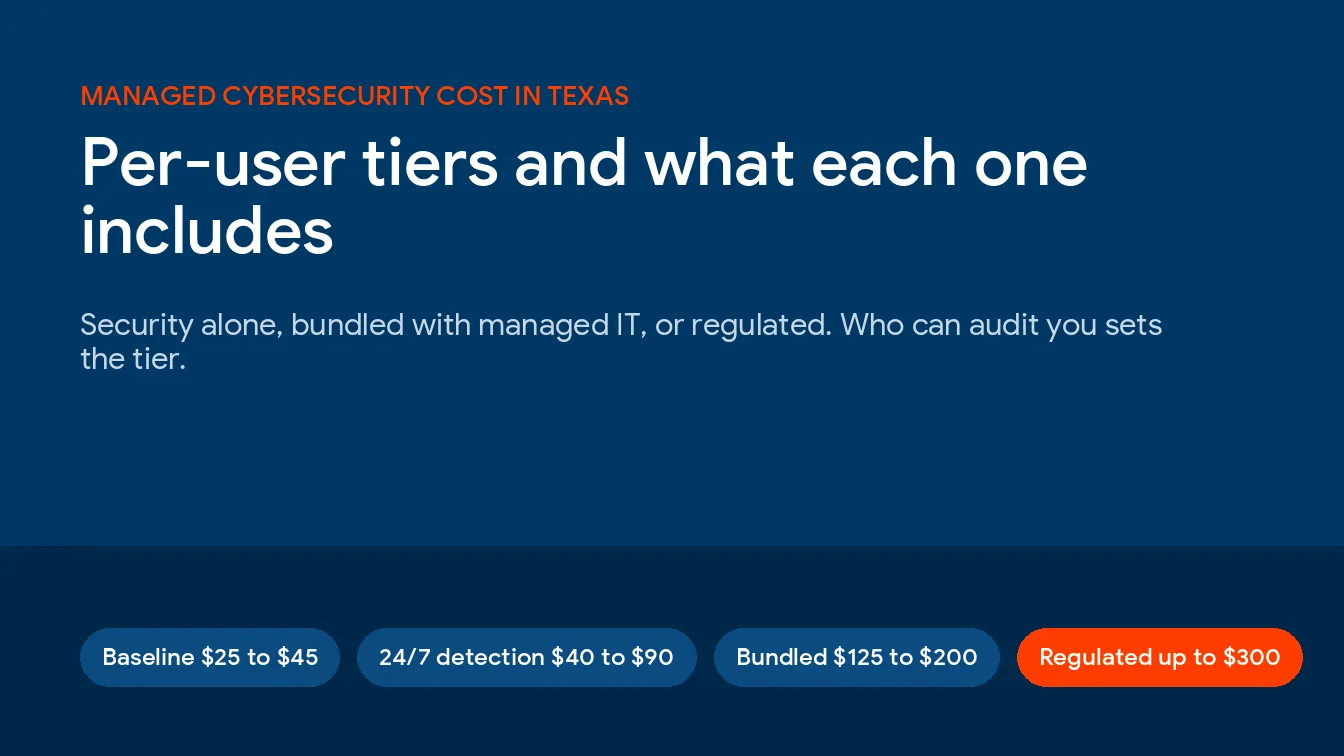
Budget $100 to $200 per user per month for a fully managed engagement in San Antonio, with most 20 to 250 user businesses landing near $138.
Below about $90 per user something is missing, and it’s usually security tooling, backup testing or after-hours coverage. Above $200 you’re paying for compliance depth, a dedicated vCIO or an unusual environment. Ask what falls outside the agreement, because that’s where the difference between a $110 quote and a $160 quote actually lives.
Does it matter whether my provider is headquartered in San Antonio?
Sometimes. It depends almost entirely on how much physical infrastructure you run.
Single office, cloud-hosted applications, laptops rather than desktops. A provider two hours away is fine and you will barely notice. Multiple sites, a server room, machines on a production floor. Local matters a great deal in that situation, and you should weight it heavily enough that the ranking on this page actually changes underneath you, which is exactly what happens above roughly 38%. Five of the seven providers here are headquartered in Bexar County. We are not one of them, and we’ve published exactly what that costs us.
How long does switching providers really take?
Four to six weeks from signature to full handover for a typical 50 to 150 user environment, with the first two weeks spent on documentation and credentials rather than anything visible.
The variable that moves the timeline is not technical. It’s whether your outgoing provider hands over admin credentials, documentation and backup access cleanly. Some do it in a day. Some take a month and lose things along the way. Read your current exit clause before you start any conversation, because it determines the schedule more than the new provider does.
If we already employ an IT person, what does adding a provider actually get us?
Usually a rota rather than more hands. The arrangement is co-managed instead of a replacement, and your person keeps the relationships and the institutional knowledge.
One internal person can’t cover 24/7 monitoring, patch management, backup testing, security operations, vendor management and strategic planning, and also fix the printer. The split that works is your person owning the relationships, the context and the decisions that need somebody who knows the business, while the provider takes every function that needs coverage at 3:00 in the morning. It also fixes the single-point-of-failure problem, which is the real risk when one employee holds every credential.
Which of these providers is strongest on compliance?
Bridgehead IT has the strongest compliance evidence among the competitors. It states an ISO/IEC 27001 certification, holds CMMC-AB Registered Provider Organization status, and names HIPAA, CMMC, NIST, PCI DSS and GDPR work.
That puts it at 9.50 on criterion five, ahead of our 9.00, because our SOC 2 Type 1 examination dates from 2023. TechSage Solutions is the one to call if your driver is specifically a defense contract, with CMMC, NIST CSF, FTC Safeguards, PCI DSS and CJIS named. Computer Solutions is the answer for CJIS and law enforcement data.
Is a 5.0 rating with 144 reviews better than 4.9 with 43?
Yes, and the model says so. SecureTech scores a perfect 10.00 on review signal and we score 9.36.
Volume genuinely matters, which is why review count carries 40% of that criterion. It’s scored on a log scale rather than linearly, though, because the jump from zero reviews to fifteen tells you far more than the jump from ninety to a hundred and forty. Past a few dozen you’re mostly measuring how hard a firm asks rather than how well it performs. Worth reading a handful rather than counting them.