MDR in San Antonio costs about $10 to $25 per endpoint per month in 2026 for companies with 20 to 250 people, and Uprite’s 24/7 SOC-backed plan starts at $40 per user. Of 25 San Antonio-area breach notices on the Texas Attorney General’s list that gave both dates, 11 went unnoticed for more than a month.
Our page on managed detection and response in San Antonio covers what the service is and how it runs. This guide sticks to the money. We show how to count endpoints for a clinic, an agency, and a machine shop in Bexar County, where the per-endpoint price stops being the cheaper choice, and why the Attorney General’s breach list makes a good case for paying someone to watch at night.
Count every device that will run the security agent, including shared exam-room PCs, shop-floor machines, servers, and virtual machines, then multiply by $10 to $25 a month. A per-user plan at $40 costs more on paper and usually covers more, so compare scope before price. In San Antonio’s breach notices, the companies that caught intrusions quickly did it within a day, and the ones that missed them took a median of 137 days to find out.
How much does MDR cost per endpoint in San Antonio?
Managed detection and response, or MDR, is a service where a provider puts security software on each of your devices and has analysts watch what it reports, all day and all night. When the software flags something real, the analysts investigate and contain it. For San Antonio companies with 20 to 250 employees, that service usually costs $10 to $25 per endpoint per month.
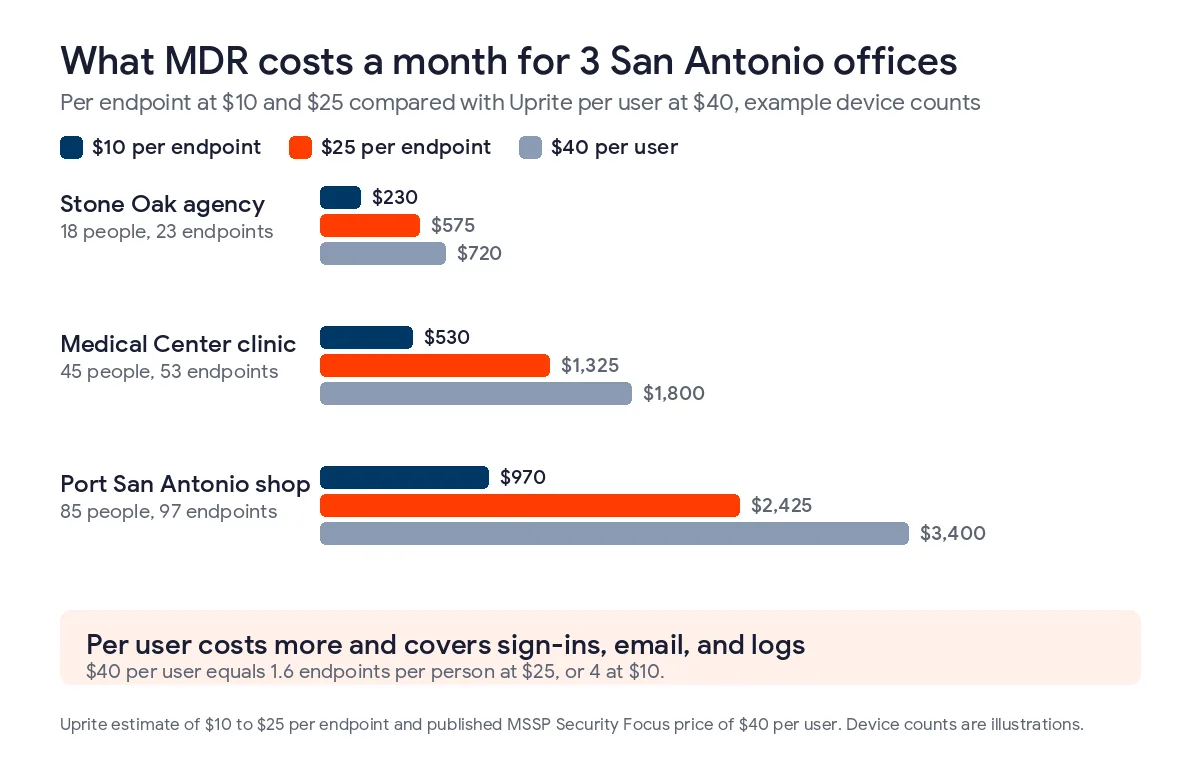
That band is our estimate, and it’s the same per-endpoint range we publish in our MSP vs MSSP comparison. We built the table below from 3 office types that are common around San Antonio. The device counts are examples we made up to show the math. They aren’t client records.
| Example office | Headcount | Endpoints on the quote | Per endpoint at $10 to $25 | Per user at $40 |
|---|---|---|---|---|
| Insurance agency in Stone Oak | 18 | 18 laptops, 4 shared front-desk PCs, 1 server, 23 total | $230 to $575 a month | $720 a month |
| Specialty clinic near the South Texas Medical Center | 45 | 30 staff workstations, 16 exam-room and check-in PCs, 3 imaging PCs, 4 servers and virtual machines, 53 total | $530 to $1,325 a month | $1,800 a month |
| Aerospace parts shop at Port San Antonio | 85 | 48 office laptops, 38 shop-floor and inspection PCs, 11 servers and virtual machines, 97 total | $970 to $2,425 a month | $3,400 a month |
The clinic is the one to study. It has 45 people and 53 endpoints, because every exam room has its own PC that several nurses share. A provider quoting per endpoint bills each of those machines once. A provider quoting per user bills each nurse once. Neither one is wrong, but they produce different totals for the same building.
What counts as an endpoint on a San Antonio MDR quote?
An endpoint is any device that runs the provider’s monitoring agent. Most providers count laptops, desktops, physical servers, and virtual machines. The arguments start with machines nobody thinks of as computers, like a check-in kiosk or the PC that runs a coordinate measuring machine on a shop floor.
| Device or account | Billed as an endpoint? | Question for the provider |
|---|---|---|
| Staff laptops and desktops | Yes, 1 each | Do Mac and Windows machines cost the same? |
| Shared exam-room, front-desk, and kiosk PCs | Yes, 1 each, no matter how many people sign in | Will the agent run on locked-down clinical or kiosk builds? |
| Shop-floor and inspection PCs | Yes, if the agent can be installed | What happens with old Windows versions the agent can’t support? |
| Physical servers | Yes, sometimes at a higher rate | Is a server priced like a workstation? |
| Virtual machines and cloud servers | Usually, 1 per machine | Is the host counted once, or every guest? |
| Microsoft 365 accounts and email | Usually not, priced as an add-on if at all | Who reviews risky sign-ins and new mail forwarding rules? |
Old shop-floor PCs deserve their own conversation. Machine shops often keep a controller PC on an older version of Windows because the equipment vendor never updated its software. Some MDR agents won’t install on those builds. Ask the provider to list any device it can’t cover, and then decide whether to isolate that machine on its own network segment. Our network security services team does that kind of segmentation work.
Per endpoint or per user, which one is cheaper?
The break-even is easy to work out. A $40 per user price equals 1.6 endpoints per person at $25 each, 2.7 endpoints at $15, and 4 endpoints at $10. The 3 example offices above run between 1.1 and 1.3 devices per person, so a per-endpoint quote looks cheaper for all of them on paper.
Paper isn’t the whole story, though. Our per-user plan, MSSP Security Focus, covers devices plus Microsoft 365 sign-ins, email, and log monitoring through a SIEM, with a 24/7 SOC behind it. An endpoint-only MDR quote covers devices. To compare them fairly, add what the endpoint provider charges for identity and log monitoring, or accept that you won’t have it.
- Per endpoint tends to make sense when you need device coverage only, run about 1 laptop per person, and already have someone reviewing Microsoft 365 alerts.
- Per user tends to make sense when stolen passwords worry you more than malware, when you need logs kept for an auditor, or when nobody in-house reviews identity alerts.
- Either one is a poor fit if the quote leaves out who is allowed to isolate a device at 2 AM.
This is the honest version of our pitch. If all you want is devices watched, a per-endpoint MDR quote from another provider may cost you less than our plan. We’d still ask you to price the identity and log pieces before you sign, because that’s where a lot of attacks now begin.
What do San Antonio breach notices say about detection time?
Texas publishes every breach notice that affects 250 or more Texans. We used the Texas Attorney General’s data security breach list as we downloaded it on November 9, 2026. It held 692 notices posted from April 1, 2025, through November 6, 2026. We kept the notices filed by organizations with an address in the San Antonio-New Braunfels metro. There were 27 of them, with 22 in San Antonio, 2 in Floresville, and 1 each in Converse, Windcrest, and New Braunfels.
Healthcare filed the most. Medical providers sent 9 of the 27 notices, retailers sent 7, and financial services firms sent 3. Insurance and education had 2 each, and a government entity had 1. The 27 notices covered 332,569 Texans, and 17 of them involved Social Security numbers. The median notice covered 3,000 people.
The detection dates are the part that matters for MDR. 25 notices listed both the day the breach started and the day it was found. 13 of those organizations found the intrusion within a day. 11 took more than 30 days, and their median was 137 days. Only 1 landed in between, at 26 days.
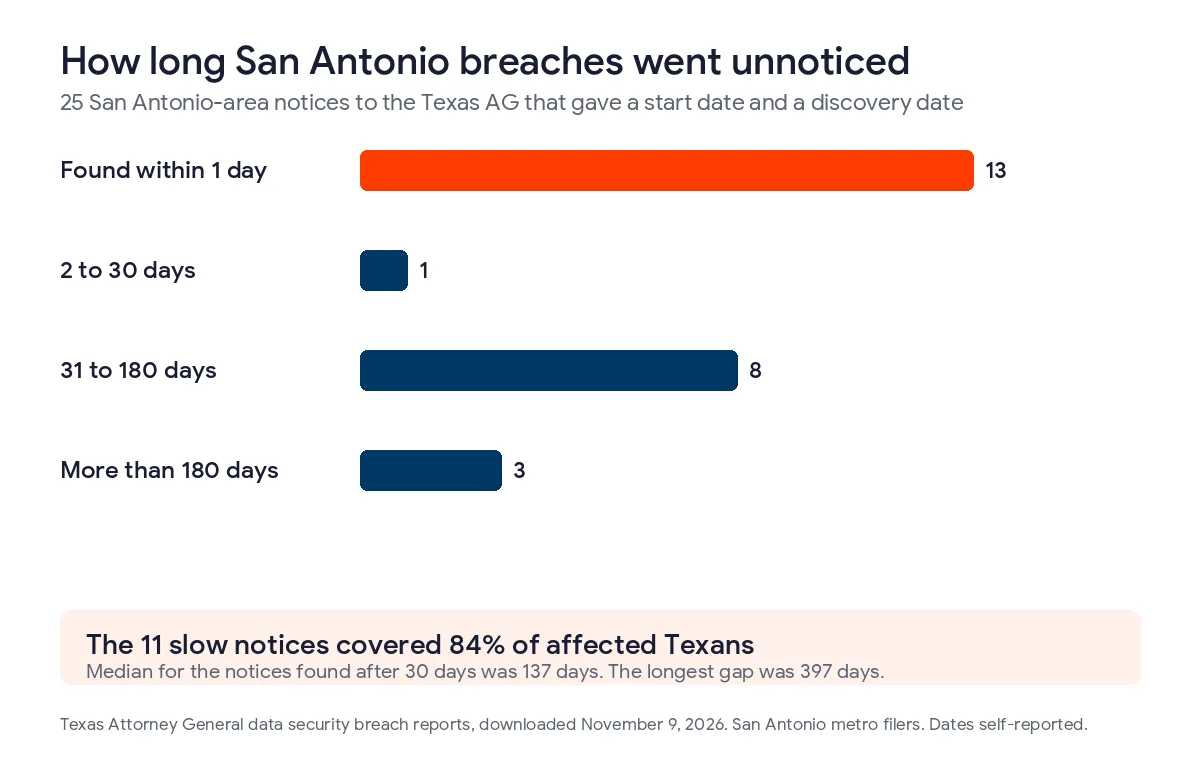
We think that split is the useful finding. A company either had something watching and caught the problem almost at once, or it didn’t and found out months later. The 11 slow notices covered 277,904 Texans, which is 84% of everyone in the San Antonio notices. The longest gap was 397 days.
Some care is needed with this data. The dates are self-reported, and the address is the filer’s headquarters, not necessarily the office that was breached. 4 of the fast healthcare notices, from Converse, Floresville, and San Antonio, share the same start and discovery dates and probably describe one shared incident. Take those out and the fast group drops to 9, while the slow group stays at 11. Across all Texas-based filers, the median gap was 61 days.
Which rules push San Antonio companies toward MDR?
No law requires a company to buy MDR by name. Several rules require monitoring, log review, or fast reporting, and MDR is one of the cheaper ways for a small company to meet them. San Antonio has a lot of the businesses these rules cover, especially defense suppliers and medical practices.
| Who it applies to | Rule | What it asks for |
|---|---|---|
| Defense suppliers serving Joint Base San Antonio and Port San Antonio tenants | 32 CFR 170.3, CMMC Phase 2 | Level 2 certification by a third-party assessor can be a condition of award on new contracts |
| Contractors handling controlled unclassified information | NIST SP 800-171, requirement 3.14.6 | Monitor systems, including inbound and outbound traffic, to detect attacks |
| Defense contractors with covered defense information | DFARS 252.204-7012 | Report a cyber incident to DoD within 72 hours of discovering it |
| Medical practices, clinics, and their business associates | 45 CFR 164.308(a)(1)(ii)(D) | Regularly review audit logs, access reports, and security incident tracking reports |
| Any business holding data on 250 or more Texans | Texas Business and Commerce Code 521.053 | Notify the Attorney General within 30 days of determining a breach occurred |
The CMMC date is new. Phase 1 started on November 10, 2025, and the rule says Phase 2 begins 1 year later. That means November 10, 2026, was the day DoD could start requiring a Level 2 assessment by a certified third party in new solicitations. Assessors check all 110 requirements in NIST SP 800-171, and an MDR service with written monitoring records supports several of them. Our CMMC compliance team in San Antonio scopes that work for local suppliers.
Medical practices face a quieter requirement. The HIPAA Security Rule lists information system activity review as a required specification, not an optional one. In practice, few small clinics have anyone reading their logs on a set schedule. An MDR provider that sends a monthly review report gives you something to show an auditor. Our page on HIPAA cybersecurity services in San Antonio covers the rest of that rule. Texas also passed SB 2610 in 2025, and our SB 2610 compliance guide explains how a documented security program can help a small business in a breach lawsuit.
Is hiring a security analyst cheaper than MDR in San Antonio?
Not if you want someone watching around the clock. The BLS May 2025 wage estimate puts the mean information security analyst salary in the San Antonio-New Braunfels metro at $125,830. Using the BLS employer compensation cost data for June 2026, where total pay and benefits ran 1.43 times wages, that analyst costs an employer about $180,000 a year.
1 analyst works roughly 1,840 hours a year after vacation, holidays, and training, out of 8,760 hours in the year. Covering every hour takes about 4.76 people, or close to $856,000 a year in labor before any software. A shared MDR team spreads that cost across many clients, which is why it can charge $10 to $25 per device. Our San Antonio cybersecurity cost guide goes through the in-house math and local hiring market in more detail.
What makes 2 San Antonio MDR quotes so different?
2 quotes for the same office can land hundreds of dollars a month apart. The difference usually comes from these 5 items.
- Who is allowed to act. Some providers can isolate a laptop or lock an account on their own at night. Others only send you an alert and wait. Cyber insurers check this too, and our guide to cyber insurance monitoring requirements in San Antonio covers what they ask.
- What gets watched besides devices. Microsoft 365 sign-ins, firewall logs, and cloud accounts add data for analysts to review, and many providers price them separately.
- How long logs are kept. Keeping a year of logs costs more than keeping 30 days, and an auditor or a defense contract may decide which one you need.
- Minimums and setup fees. A small office can fall under a monthly minimum, which makes its per-endpoint price look high.
- Incident response time. Some plans include hands-on recovery hours. Others bill hourly once a real incident starts.
Ask every provider to answer the same 5 items in writing. The lowest quote is often the one that stops at sending you an email.

Does Microsoft 365 Business Premium already include MDR?
No. Business Premium includes Microsoft Defender for Business, which is a capable endpoint detection tool. It finds suspicious activity and raises alerts. It doesn’t include people who read those alerts at night and respond to them.
The good news is that you may not need a second agent. Many MDR providers can work on top of the Defender agent you already pay for. That can lower the setup cost and keep your devices lighter. Our guide to EDR vs MDR vs XDR explains which parts you may already own.
How does Uprite price MDR for San Antonio companies?
We price per user. Our MSSP Security Focus plan starts at $40 per user per month on our pricing page. It covers endpoints, Microsoft 365 sign-ins, email, and log monitoring, with a 24/7 SOC and a 5-minute average response time. We don’t sell a separate per-endpoint MDR line.
Our managed security services page lists everything in the program, from SIEM and SOC monitoring to vulnerability scanning and incident response. If you already use us for managed IT services in San Antonio, security can be added to the same agreement. The Houston and Dallas versions of this guide, MDR pricing in Houston and MDR pricing in Dallas, compare vendor list prices and in-house analyst costs in those metros. If you’d rather talk it through first, contact our team and we’ll call you back.
MDR pricing questions San Antonio owners ask
What does MDR cost for a 50-person San Antonio office?
About $550 to $1,375 a month, if the office has around 55 endpoints, which is typical for 50 people. At Uprite’s $40 per user rate, the same office would pay $2,000 a month for coverage that also includes sign-ins and email.
Does CMMC Level 2 require MDR?
CMMC doesn’t name MDR, but Level 2 includes NIST SP 800-171 requirement 3.14.6, which asks you to monitor systems to detect attacks. DFARS 7012 also gives you 72 hours to report an incident to DoD, and many small suppliers use MDR to meet both.
Do shared exam-room PCs count as separate endpoints?
Yes. Each machine that runs the monitoring agent is billed as 1 endpoint, no matter how many staff members sign in to it. That’s why a clinic often has more endpoints than employees.
How fast should an MDR provider respond to an alert?
Within minutes, and the contract should say so. Uprite’s average response time is 5 minutes. Ask each provider for its average, and ask what its analysts can do without calling you first, such as isolating a laptop or disabling an account.
Can MDR run on the Microsoft Defender agent we already have?
Often it can. Microsoft 365 Business Premium includes Defender for Business, and many MDR providers can monitor through that agent instead of installing their own. Confirm it on the quote so you aren’t paying for 2 agents.
Is MDR worth paying for at a company under 20 people?
For most small companies, yes. A 15-person office with 18 endpoints would pay about $180 to $450 a month, which is less than 1 day of a fully loaded in-house analyst at about $690. Small firms rarely have anyone watching alerts overnight.
Send us a rough device count, or just your headcount and number of servers. We’ll price MDR for your San Antonio office both per endpoint and per user, and show you what each option covers.
Get a San Antonio MDR Estimate