A Texas school protects student data with 7 IT controls, which are an app inventory with signed data agreements, MFA on staff and vendor accounts, managed EDR, role-based access, logging, tested backups, and a breach plan that meets Texas Education Code 11.175.
Before anyone buys a new security tool, ask the front office for the list of apps that hold student records. I’m the Lead vCIO at Uprite, and that list is the first thing I ask for when we scope IT support for charter schools in Texas. Most schools can’t produce it, because teachers, counselors, and the business office each signed up for tools on their own. Start there, since that’s where most of the risk sits. The rest of this guide uses the Texas Attorney General’s breach filings from the past 12 months, TEA’s list of charter campuses, and the state and federal rules on what a school owes families after a breach.
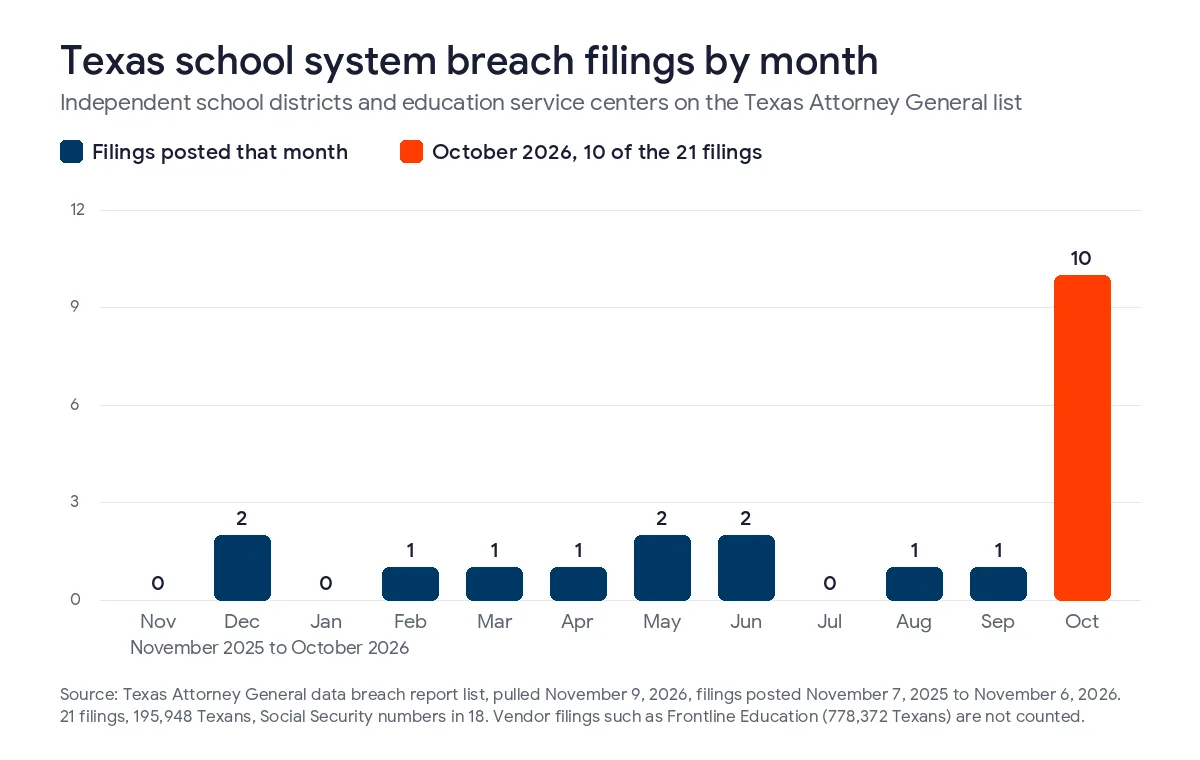
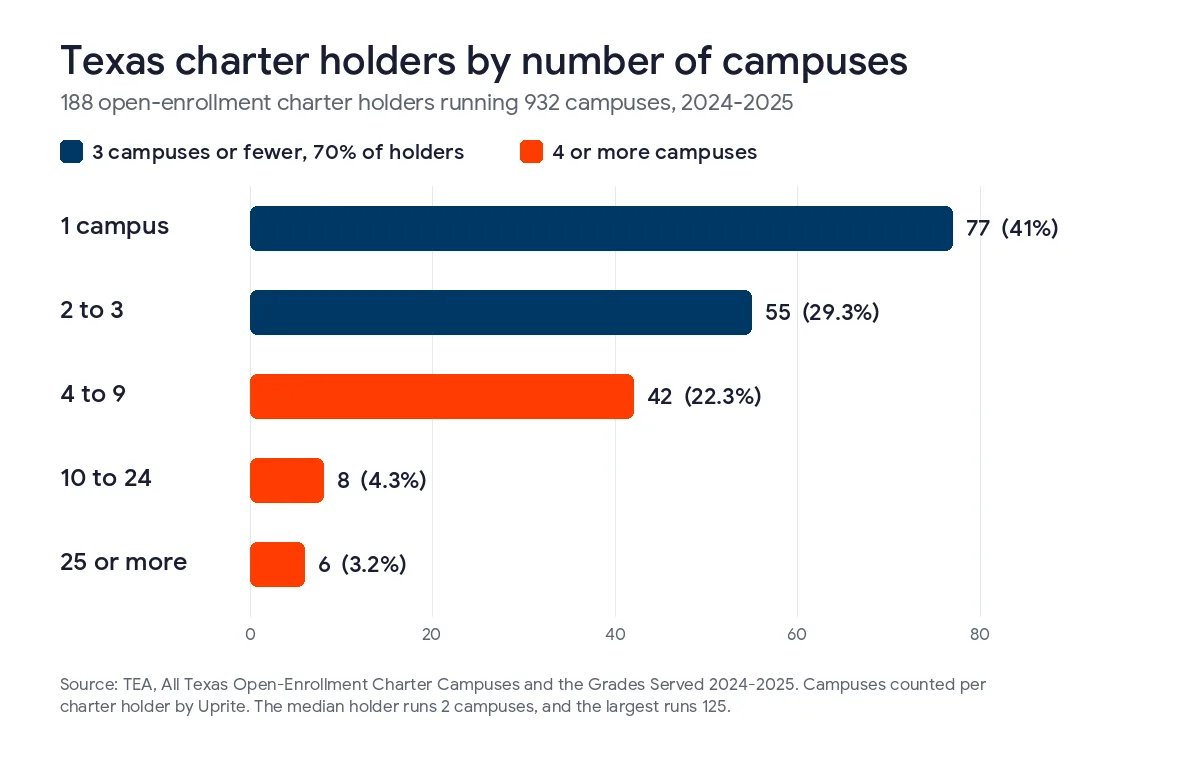
Count the apps first, then turn on MFA for every staff and vendor account, then take the free EDR that TEA pays for. In the 12 months to November 6, 2026, 21 Texas public school systems filed breach reports with the Attorney General, covering 195,948 Texans, and 18 included Social Security numbers. 1 K-12 software vendor filed a single report covering 778,372 Texans. Most Texas charter holders run 1 to 3 campuses, so the plan has to fit a small team.
What does student data privacy mean for a Texas school’s IT?
Student data privacy is the set of rules and IT controls that decide who can see, copy, share, or keep a student’s records. For a Texas school that means the student information system, the learning platforms, special education files, health records, and the staff data that sits next to them. The rules come from 5 places, and each one asks something different of the IT side.
| Rule | Who it binds | What it asks of IT |
|---|---|---|
| FERPA, 34 CFR Part 99 | Schools that take U.S. Department of Education funds | Vendors only see records under the school’s direct control, with use and disclosure limits |
| Texas Education Code 32.151 to 32.157 | Operators of school apps and sites | No targeted ads or sale of student data, reasonable security, deletion within 60 days of a school’s request |
| Texas Education Code 32.1021 | School districts and open-enrollment charters, through TEA standards | Approved software lists, parental consent for most student apps, less data collection |
| Texas Education Code 11.175 | School districts, and open-enrollment charters for incident reports | Report breaches of student data to TEA as soon as practicable and notify affected parents |
| COPPA, as amended in 2025 | Online services used by children under 13 | Schools may consent for educational use only, never for commercial use |
The federal piece starts with 34 CFR 99.31, which lets a school share records with a contractor only when the contractor does work staff would otherwise do and stays under the school’s direct control for how the records are used and kept. The Department of Education’s student privacy office treats that as the test for every outside party. In practice, direct control means a signed contract that covers use, re-disclosure, retention, and deletion. A click-through terms page doesn’t give you any of that.
Texas adds its own operator rules in Chapter 32, Subchapter D of the Education Code. An operator can’t run targeted advertising from student data, can’t build a profile for a non-school purpose, and can’t sell or rent a student’s information. It has to keep reasonable security, and it has to delete a student’s records within 60 days when the school asks, unless the contract says otherwise. The FTC’s amended COPPA rule, with a compliance date of April 22, 2026, kept the school consent arrangement but limited it to educational use.
Where are Texas school data breaches actually coming from?
Mostly from vendors and stolen accounts. We pulled the Texas Attorney General’s data breach report list on November 9, 2026 and kept the filings posted between November 7, 2025 and November 6, 2026. 21 came from Texas independent school districts or education service centers. Together they covered 195,948 Texans, with a median of 3,187 per filing. Social Security numbers were involved in 18 of the 21, and driver’s license numbers in 8.
That mix tells me staff and payroll records are as exposed as student files. A privacy plan that only looks at the gradebook misses half of it. 10 of the 21 filings were posted in October 2026 alone. One of them, from East Chambers ISD, states that the breach came through Frontline Education, a K-12 administrative software vendor. Frontline’s own filing, posted October 28, 2026, lists 778,372 Texans. That’s 4 times the total from all 21 district filings put together.
The pattern isn’t new. In September 2025 the Attorney General sued PowerSchool over a December 2024 breach that exposed records on more than 880,000 Texas children and teachers. According to the state, an attacker used a subcontractor’s account to get administrative access, and the company lacked multi-factor authentication, adequate access controls, and proper encryption. The stolen data included special education records and bus stops.
None of the 21 school filings came from an open-enrollment charter, at least not by name. I wouldn’t read that as good news. When a vendor is breached, the vendor often files once for every school it serves, so a charter’s students can sit inside a filing that never mentions the charter at all.
Why do the controls have to fit a small team?
Because that’s what most Texas charters are. TEA’s list of open-enrollment charter campuses for 2024-2025 shows 932 campuses run by 188 charter holders. We counted the campuses for each holder. The median holder runs 2 campuses. 77 holders, or 41%, run just 1, and 132, or 70%, run 3 or fewer. Only 6 run 25 or more.
A 1 or 2 campus charter usually has one person handling technology, often alongside testing, facilities, or the front office. That person can’t review 80 app contracts and watch logs at night. So the order matters. Get the controls with the biggest drop in risk in place first, and leave the paperwork that only a large district can carry for later. TEA’s charter authorizer report counts 489,894 students on charter campuses in 2024-25, about 9% of Texas public school enrollment, so the small operators hold a lot of records between them.
Which IT controls protect student data in a Texas school?
The same short list CISA gave schools in its 2023 K-12 cybersecurity report, which put MFA, patching, and backups at the top for schools with limited budgets. We add the vendor work, since that’s where Texas breaches keep starting.
- Keep an inventory of every app and service that stores student or staff records, with the owner, the data it holds, and the contract.
- Turn on MFA for every staff account, every admin account, and every vendor or contractor account that can reach the SIS.
- Run managed endpoint detection and response on servers and on the central office devices that touch sensitive records.
- Give access by role, so a teacher sees their own sections, and remove accounts the day someone leaves.
- Keep sign-in and admin logs from the SIS, email, and file sharing for at least a year.
- Back up the SIS exports and file shares to a copy attackers can’t change, and test a restore every quarter.
- Write down who reports a breach to TEA, who calls the parents, and who files with the Attorney General.
| Control | What it stops | Proof to keep |
|---|---|---|
| App inventory and data agreements | Unknown vendors holding records with no deletion terms | Signed agreements and a yearly review date for each app |
| MFA on staff and vendor accounts | The stolen password and subcontractor login behind the PowerSchool breach | An export showing MFA status for every account |
| Managed EDR | Ransomware on the servers and office PCs | Device coverage report and alert history |
| Role-based access and offboarding | Former staff and over-broad accounts reading records | Monthly account review signed by the principal or director |
| Logging | Not knowing whose records were touched | 12 months of sign-in and admin logs |
| Tested backups | Losing the SIS and special education files to encryption | Quarterly restore test results |
| Breach plan | Missed deadlines to TEA, parents, and the state | A 1-page contact sheet and a yearly tabletop |
The logging line is the one schools skip, and it’s the one that decides how bad a breach gets. Without logs you can’t say which students were touched, so every family gets the letter. Our comparison of EDR, MDR, and XDR explains what each level of monitoring covers, and our data backup services page covers restore testing in more detail.
How should a charter school vet an ed tech vendor?
Ask for the agreement before anyone creates a class roster in the app. A teacher who signs up for a free tool with a school email has already shared student names, and the school has no contract to enforce. Texas Education Code 32.1021 directs TEA to set standards for electronic devices and software applications that districts and open-enrollment charters are expected to follow, including direct and informed parental consent for most student software and less data collection.
| Question for the vendor | Why it matters |
|---|---|
| Will you sign a data privacy agreement that names FERPA and Texas Education Code Subchapter D? | It’s how the school shows direct control under 34 CFR 99.31 |
| Do subcontractors get access, and are their accounts on MFA? | The PowerSchool attacker came in through a subcontractor account |
| Will you delete our students’ data within 60 days of a request, and confirm it in writing? | Section 32.156 sets 60 days unless the contract says otherwise |
| How fast will you tell us about a breach, and what logs will you share? | The school still has to report to TEA and tell parents |
| Do you charge extra for MFA, single sign-on, or audit logs? | CISA’s K-12 report says vendors shouldn’t charge more for security features |
One thing I’d do before buying any new tool. Pull the sign-in report from Google Workspace or Microsoft 365 and look at which third-party apps staff have already connected with their school accounts. That list is usually longer than the one the business office keeps, and it’s the real starting inventory.
What should happen in the first 48 hours after a breach?
Texas Education Code 11.175 requires a school district or open-enrollment charter school to report a breach of student data to TEA as soon as practicable after it’s discovered. The coordinator then notifies the parents of affected students. The Texas Cyber Command’s incident reporting page sends school districts and charter schools through the same local incident form as other local governments, and it lists 48 hours from discovery as the reporting window, with a hotline that also counts.
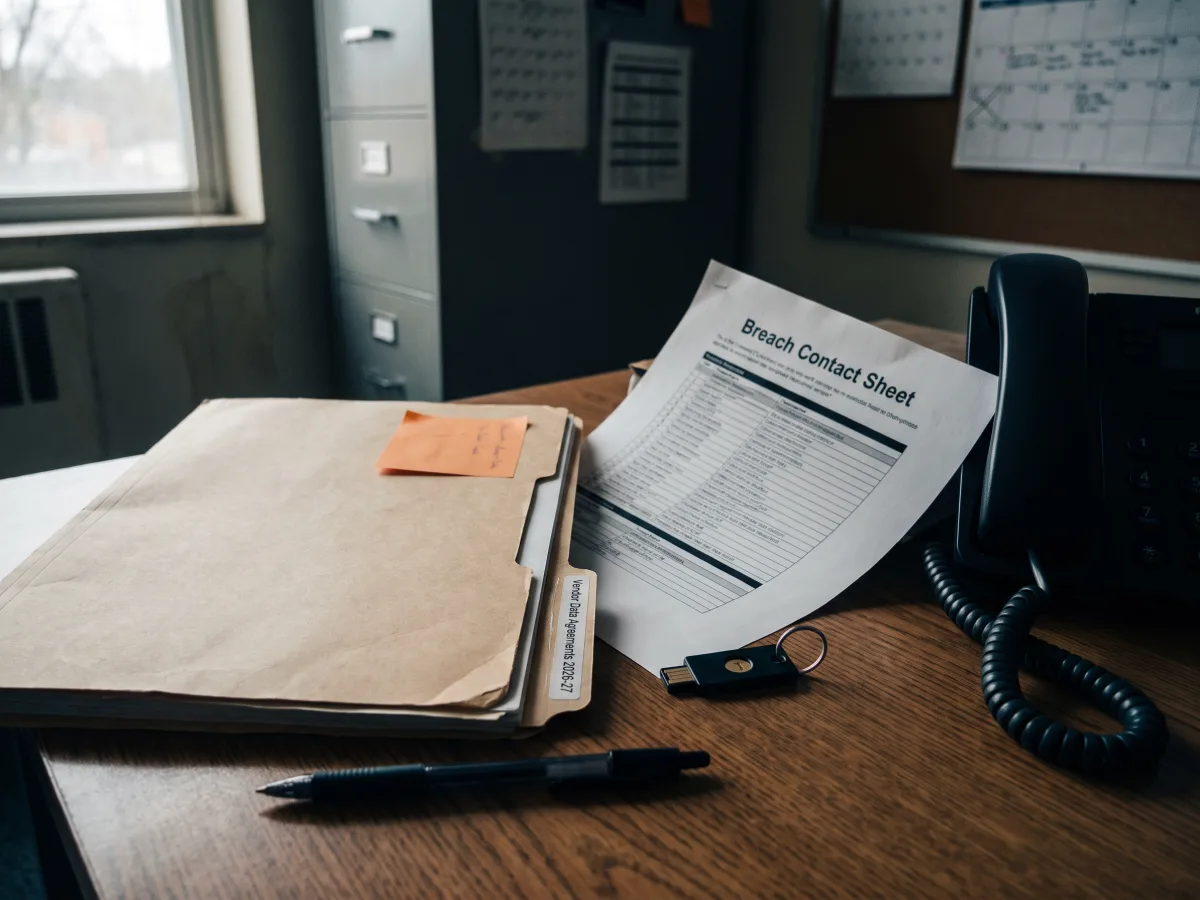
The rest of the notices take longer, and the schools that move fastest have the contact sheet written before they need it. Ours fits on 1 page, with the TEA report, the Cyber Command form, the insurance carrier, outside counsel, the parent letter owner, and the vendor’s security contact. Our Texas data breach response plan guide walks through the rest of the plan, and the state’s charter-specific duties are covered in our post on Texas Education Agency cybersecurity requirements for charter schools.
What can a small charter get free from TEA first?
More than most leaders know. TEA’s K-12 Cybersecurity Initiative got $55 million at the start and another $42 million from the 89th Legislature for September 2025 through August 2027. It pays for fully managed EDR from CrowdStrike or SentinelOne through DIR’s managed security services for school systems with 50,000 students or fewer. Each one gets 30 licenses or licenses for 30% of enrollment, whichever is larger. It also pays for a Texas Cybersecurity Framework assessment and help from the regional education service centers.
Here’s my honest advice. Sign DIR’s inter-local contract and take the free EDR and assessment before you pay anyone for those pieces, us included. Then spend your own budget on what TEA doesn’t cover, like the app inventory, MFA on every account, offboarding, logging, and backups you’ve actually restored. If you want a second set of eyes, our vCIO services include a yearly privacy and security roadmap, and our guide on how to conduct a cybersecurity risk assessment shows the steps if you’d rather start on your own. For budgeting the rest, see our post on what IT support costs a Texas charter school, or contact our team with a question about your own setup.
Questions charter leaders ask about student data
Does FERPA apply to Texas charter schools?
Yes, FERPA applies to any school that receives U.S. Department of Education funds, and Texas open-enrollment charters take federal money such as Title I. Any vendor that sees education records needs to stay under the school’s direct control, which in practice means a signed agreement.
How quickly does a Texas charter school have to report a data breach?
Texas Education Code 11.175 says as soon as practicable after discovery, reported to TEA. The Texas Cyber Command’s reporting page lists 48 hours for local entities, and schools use the same form, so plan on 48 hours and notify affected parents after the report.
Can a teacher use a free app without approval?
Not safely. A free sign-up usually means the vendor’s terms apply instead of a school agreement, so the school can’t show direct control under FERPA or enforce the 60-day deletion rule in Texas Education Code 32.156. Put every student app through an approval list.
What should a student data privacy agreement cover?
It should cover what data the vendor collects, the school purpose it can be used for, a ban on sale and targeted ads, security duties, breach notice timing, subcontractor rules, and deletion on request. Keep the signed copy with the app inventory and review it every year.
Is the free TEA endpoint protection enough on its own?
No, it covers servers and the devices that touch sensitive data, and it doesn’t touch vendor risk, MFA, or account cleanup. Take it, then put your own budget into the controls it leaves out, starting with MFA on every staff and vendor account.
Who should own student data privacy at a small charter?
One named person, usually the cybersecurity coordinator or operations director, with the superintendent or executive director signing off. The IT provider runs the controls and produces the evidence, but a person inside the school has to own the app list and the breach decisions.
Send us your current app list, or tell us you don’t have one yet. We’ll map which apps hold student records, check MFA and offboarding on the accounts that reach them, and give you a written list of fixes in priority order.
Book a Student Data Privacy Review