
A Fort Worth small business should budget about $40 to $90 per user per month for monitored cybersecurity in 2026, or $125 to $200 per user when security comes inside fully managed IT. Defense suppliers and plants with shift-floor networks pay more.
Those bands come from the Texas price ranges we published in October 2026, and Tarrant County gets no discount on them, since Fort Worth providers hire security staff from the same Dallas-Fort Worth labor pool that BLS reports as a single metro. If you’re shopping for the service rather than a budget figure, start with our cybersecurity services in Fort Worth page. What follows sorts businesses by headcount, the way Texas SB 2610 began doing on September 1, 2025.
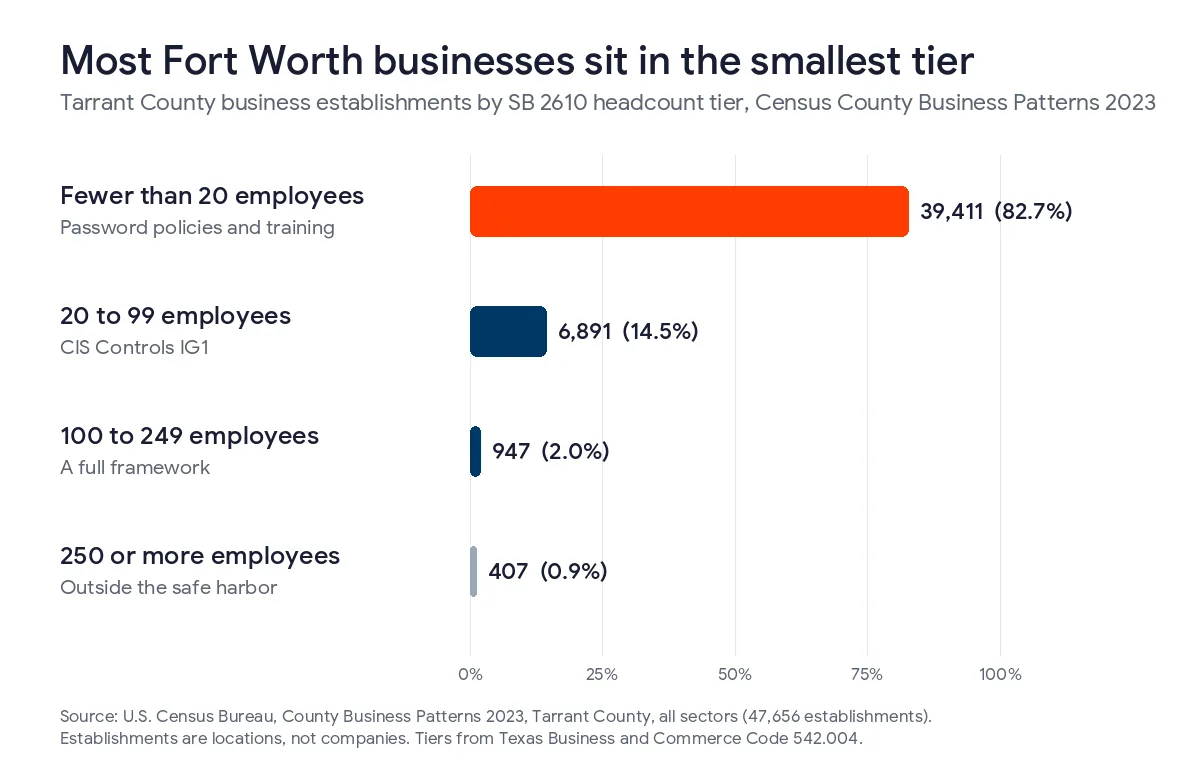
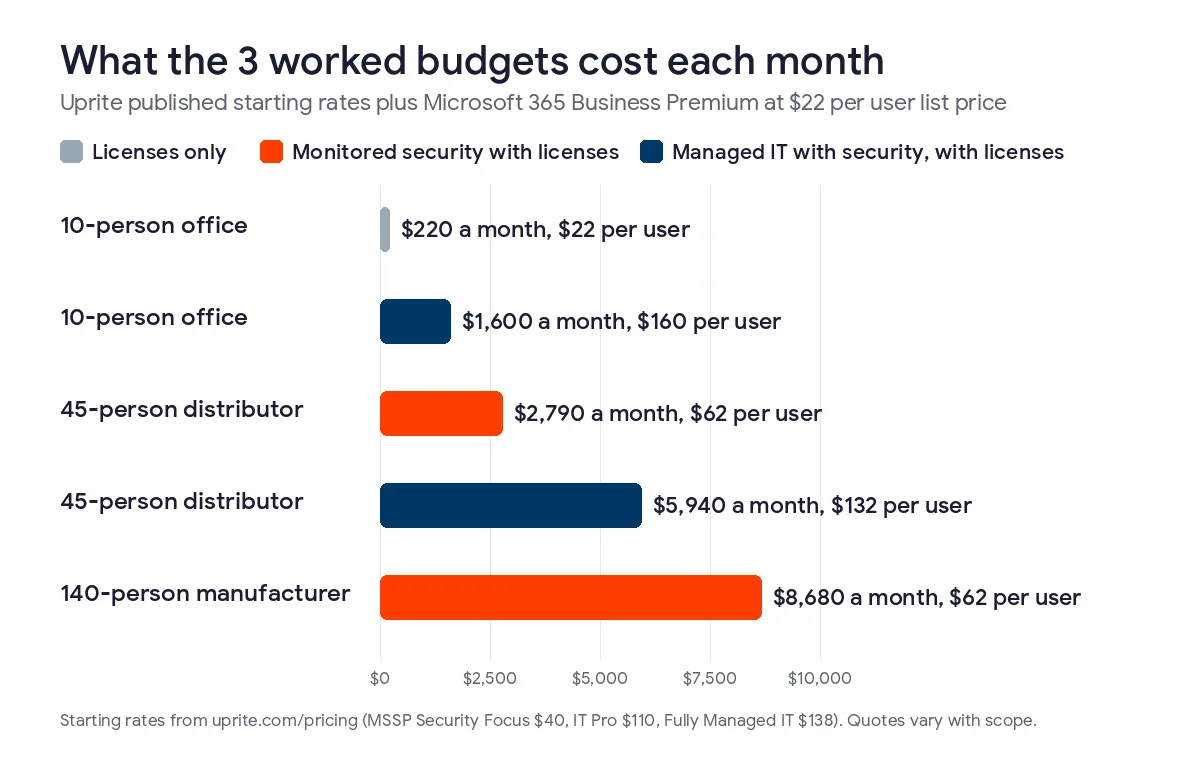
For a 10-person office in Fort Worth, the realistic range runs from $220 a month in Microsoft licenses to about $1,600 a month for fully managed IT with 24/7 response. A 45-person company that already has IT help spends close to $2,800 a month once monitored security and licenses are added, and a 140-person plant spends about $8,700 before CMMC or plant-network projects. Census data puts 82.7% of Tarrant County business locations in the smallest SB 2610 tier.
What does cybersecurity cost for a Fort Worth small business?
A small-business cybersecurity budget pays for 2 different things. Licenses such as Microsoft 365 Business Premium buy the software that blocks attacks on laptops, mailboxes and sign-ins, while people at a provider or on staff watch the alerts that software raises and respond when something gets past it. In most quotes we review, the people cost far more than the licenses.
| Budget line | 2026 cost | What it buys |
|---|---|---|
| Microsoft 365 Business Premium | $22 per user per month at list | Defender for Business, Intune device management, Entra ID P1 sign-in policies and Defender for Office 365 Plan 1 |
| Monitored security on its own | $40 to $90 per user per month | A security operations team watching alerts around the clock, plus firewall, SIEM and vulnerability scanning |
| Security inside fully managed IT | $125 to $200 per user per month | The help desk, device management, backups and the security stack from one provider |
| Regulated or defense work | $175 to $300 per user per month | HIPAA, CMMC or plant networks, where evidence and segmentation add labor |
| CMMC Level 1 self-assessment | About $5,977 a year | DoD’s own estimate for a small contractor handling federal contract information |
| CISA vulnerability scanning | $0 | Ongoing scans of internet-facing systems for critical infrastructure organizations, a group that includes many metal, machinery and aerospace shops |
Those per-user bands match our Texas cybersecurity pricing tiers, and Uprite’s published starting rates fall inside them, with MSSP Security Focus at $40 per user, IT Pro at $110 and Fully Managed IT at $138 on our pricing page. Microsoft licensing is billed on top of each of those plans, so a quote that leaves the license line out will look about $22 per user cheaper than it really is.
Why does Texas law sort the budget by headcount?
Texas SB 2610 took effect on September 1, 2025, and it gives businesses with fewer than 250 employees a defense against exemplary damages after a breach. To earn it, a company has to run a security program that matches an industry framework, scaled to its size. Chapter 542 of the Business and Commerce Code sets 3 tiers.
- Fewer than 20 employees need simplified requirements, including password policies and employee security training.
- Companies with 20 to 99 employees need moderate requirements, including the CIS Controls Implementation Group 1.
- Companies with 100 to 249 employees need a full framework such as the NIST Cybersecurity Framework, NIST SP 800-171 or the ISO 27000 series.
The law doesn’t hand out money or require anyone to opt in. It’s still the cleanest way we’ve found to size a budget, because it tells a small company what “reasonable” looks like in writing. We walk through the statute itself in our SB 2610 compliance guide.
We counted how many Fort Worth area businesses land in each tier. The Census Bureau’s 2023 County Business Patterns file lists 47,656 business establishments in Tarrant County, sorted by employee count.
| SB 2610 tier | Tarrant County establishments, 2023 | Share | Named requirement |
|---|---|---|---|
| Fewer than 20 employees | 39,411 | 82.7% | Password policies and training |
| 20 to 99 employees | 6,891 | 14.5% | CIS Controls IG1 |
| 100 to 249 employees | 947 | 2.0% | A full framework |
| 250 or more employees | 407 | 0.9% | Outside the safe harbor |
Read the table with one caveat. Census counts establishments, which are locations, so a company with 3 shops in Arlington, Haltom City and Burleson shows up 3 times, and its headcount for the law is the total. Even so, 99.1% of Tarrant County business locations fall under the 250-employee line. For almost every Fort Worth business reading this, the question isn’t whether SB 2610 fits. It’s which of the 3 tiers you’re budgeting for.
What should each tier budget?
Below are 3 worked budgets, one per tier. Each uses Uprite’s published starting rates and Microsoft’s $22 list price for Business Premium. Your quote will move with seat count, compliance scope and how much IT you already run in house, but the math shows where the money goes.
Under 20 employees, a 10-person office
Take a 10-person CPA firm near Sundance Square or a title office in Southlake. Business Premium for all 10 people costs $220 a month at Microsoft’s list price, or $2,640 a year, and it already enforces password rules and multifactor sign-in through Entra ID while Defender for Office 365 Plan 1 filters phishing mail. That covers most of what SB 2610 names for this tier, except the training, and nobody is paid to read the alerts the tools produce.
Our IT Essentials plan, built for teams under 12, adds business-hours support and the Microsoft Defender stack for $910 a month, or $1,130 with licenses, and its monitoring sends alerts without a response team acting on them. Fully Managed IT at $138 per user comes to $1,380 a month, which is $1,600 with licenses and $19,200 a year, and for that price an engineer acts on an alert at 2 a.m. on a Sunday. I’d rather show an owner that gap in dollars than sell the cheaper plan and hope the weekend stays quiet.
20 to 99 employees, a 45-person distributor
The middle tier changes the shape of the budget, because CIS IG1 is a list of 56 specific safeguards that runs from an asset inventory and secure configurations to automated backups and audit log management. Most 45-person companies in Fort Worth already pay for IT in some form, either a staff administrator or an outside provider, so the practical question is what to add on top.
Adding MSSP Security Focus at $40 per user costs $1,800 a month, and Business Premium for all 45 people adds $990, which puts the security line at $2,790 a month or $33,480 a year. That works out to about $62 per user, near the middle of the monitored band. A company that would rather hand over all of IT could take IT Pro at $110 per user instead, which comes to $5,940 a month with licenses, or about $132 per user with the help desk included.
100 to 249 employees, a 140-person manufacturer
A Tarrant County plant with 140 people usually has an IT manager and 1 or 2 technicians on staff. SB 2610 expects a full framework at this size, and a shop that handles Department of Defense work is already measured against NIST SP 800-171 through its contract clauses. Monitored security at $40 per user is $5,600 a month, and licenses for every employee add $3,080, for a total of $8,680 a month or $104,160 a year.
In practice plants rarely license every person, since machine operators often share a kiosk login or never use company email, so the license line can come down by a third. The line that usually goes up is the plant network, because separating production equipment from the office network is a project priced on its own, and that work is what pushes plant budgets into the $200 to $300 band.
| Worked budget | Monthly | Yearly | Per user per month |
|---|---|---|---|
| 10-person office, licenses only | $220 | $2,640 | $22 |
| 10-person office, Fully Managed IT with licenses | $1,600 | $19,200 | $160 |
| 45-person distributor, monitored security with licenses | $2,790 | $33,480 | $62 |
| 45-person distributor, IT Pro with licenses | $5,940 | $71,280 | $132 |
| 140-person manufacturer, monitored security with licenses | $8,680 | $104,160 | $62 |
What pushes a Fort Worth security budget higher?
Three conditions push Fort Worth budgets above those examples more than anything else, and all 3 are common in Tarrant County.
Defense and aerospace contracts
Fort Worth’s supply chain runs through aerospace, and many 30-person machine shops carry DFARS clauses in the purchase orders they get from larger primes. In its CMMC final rule, published in October 2024, DoD estimated what a small contractor would pay for the assessment alone, at about $5,977 a year for Level 1, $37,196 over 3 years for a Level 2 self-assessment and $104,670 over 3 years for a Level 2 certification. Those figures exclude the cost of actually meeting the 110 NIST SP 800-171 requirements, which is usually the larger bill.
The Pentagon suspended CMMC Phase II in July 2026, pausing the move to third-party certification, but self-assessments and the older DFARS 7012 obligations stayed in force. We cover what a Level 2 shop should spend in our guide to CMMC for Fort Worth aerospace suppliers and in the wider CMMC compliance cost breakdown for DFW.
Night shifts and plant networks
An office that empties at 6 p.m. still needs monitoring, and CISA and the FBI have warned that ransomware crews pick holidays and weekends when offices are closed. A plant running a second shift has people signing in, machines talking to servers and vendors connecting remotely all night, which raises the alert volume and makes a bad containment call more expensive, because isolating the wrong machine can stop a production line. Our managed security services in Fort Worth page explains how we handle that trade-off.
Insurance and regulated data
Cyber insurers now ask for multifactor sign-in, endpoint detection and tested backups before they’ll quote, and a renewal can force a purchase you’d planned for next year. Health data adds HIPAA, and a tax practice falls under the FTC Safeguards Rule. We list the carrier requirements in our cyber insurance readiness guide for Dallas-Fort Worth.
What does an unbudgeted breach cost under Texas law?
The cost that surprises owners isn’t the ransom. It’s the deadlines. Under Section 521.053, a business must notify affected people within 60 days of determining a breach happened. If 250 or more Texans are involved, the Attorney General must hear about it within 30 days.
Missing the individual deadline carries a civil penalty of up to $100 per person for each day of delay, capped at $250,000 per breach. The math reaches that cap fast. A Fort Worth dental practice with 2,000 patient records that stalls for 30 days is looking at $6 million on paper, which the cap cuts to $250,000. A separate penalty of $2,000 to $50,000 per violation applies to the rest of the chapter, including the duty in Section 521.052 to keep reasonable security procedures.
SB 2610 doesn’t change any of that. The safe harbor blocks exemplary damages in a lawsuit, and it does nothing about the Attorney General’s penalties or the actual damages a court awards. That’s the honest limit of the law, and it’s why we budget for the program and not just the paperwork.
The losses are already large. The FBI’s 2025 Internet Crime Report ranked Texas second in the country for both complaints and reported losses, with 97,912 complaints and $1,825,636,181 lost.

Where can a Fort Worth business save without cutting protection?
There are real savings in most security budgets we review. These 5 usually come first.
- Use the license you already pay for. Many offices pay for Business Premium and leave Defender for Business, Intune and Entra ID sign-in policies switched off.
- Enroll in free scanning if you qualify. CISA’s Cyber Hygiene services scan internet-facing systems at no cost for critical infrastructure organizations. Critical manufacturing, which covers metals, machinery and transportation equipment, is one of the 16 sectors.
- Size the framework to the tier. A 12-person office doesn’t need NIST SP 800-53, and paying a consultant to map one adds cost without adding protection.
- Stop paying twice for the same tool. Companies that buy security from one vendor and IT from another often end up with 2 endpoint agents and 2 email filters.
- Ask for a line-item quote. A single per-user number hides whether 24/7 response, backup testing and incident response are inside it.
The CIS IG1 safeguard list and the NIST Cybersecurity Framework are both free to read, and either one turns a vague quote into a checklist you can hold a provider to. Our Fort Worth cybersecurity checklist for small businesses walks the same controls in order, and our guide to phishing attacks on Fort Worth businesses covers the attack most of this budget is built to stop. To compare the firms themselves, see our ranking of the best cybersecurity companies in Fort Worth.
If you’re planning the rest of the year’s technology spend too, our guide to IT budget planning in Fort Worth puts security next to hardware, licensing and support. For the support side alone, see managed IT pricing in Fort Worth.
Send us your headcount and any security quote you already have, and we’ll show you which SB 2610 tier you fall in and what a 12-month budget looks like at our published rates.
Get My Security BudgetFort Worth cybersecurity budget questions
How much should a small business in Fort Worth spend on cybersecurity each year?
A 10-person Fort Worth office should plan on about $2,640 a year for security licenses alone, or about $19,200 for fully managed IT with 24/7 response included. A 45-person company adding monitored security spends about $33,500 a year.
Is cybersecurity cheaper in Fort Worth than in Dallas?
Not by much, because providers in both cities hire security staff from the same Dallas-Fort Worth labor market. BLS doesn’t even publish a separate Fort Worth wage series for these jobs. Our rates are the same on both sides of the metroplex.
Is a Fort Worth business legally required to have a cybersecurity program?
Texas requires reasonable procedures to protect sensitive personal information under Section 521.052, without naming a specific program. SB 2610 is voluntary, but following its tier gives a business under 250 employees a defense against exemplary damages.
Do Fort Worth defense suppliers still need to budget for CMMC?
Yes, because Phase II was suspended in July 2026 but self-assessments and DFARS 7012 duties still apply. DoD estimates a Level 1 self-assessment at about $5,977 a year for a small contractor, before any remediation work.
What does Microsoft 365 Business Premium leave out?
Business Premium includes strong tools but nobody to watch them. At $22 per user it bundles Defender for Business, Intune, Entra ID P1 and email filtering, and it leaves out round-the-clock monitoring, incident response and backup testing.
Can a company with fewer than 20 employees use the SB 2610 safe harbor?
Yes, if its program follows a recognized framework and includes at least password policies and employee security training. That’s the lightest of the 3 tiers, and it covers 82.7% of Tarrant County business locations.