
MDR in Dallas runs about $10 to $25 per endpoint per month in 2026 for small and midsize companies, and Uprite’s 24/7 SOC-backed plan for Dallas starts at $40 per user.
That range only helps if you know what an endpoint is on the quote in front of you. Our page on managed detection and response in Dallas explains what the service does. Our ranking of the best MDR providers in Dallas shows which local firms put a price in writing. This guide is about the bill. We count devices the way a DFW office actually owns them, price what it would cost to watch them with your own staff at Dallas pay, and show which federal and Texas rules are quietly pushing local firms to buy MDR in the first place.
Budget $10 to $25 per endpoint each month, and count servers, virtual machines, and shop-floor PCs before you compare quotes. One in-house security analyst costs a DFW employer about $191,000 a year with benefits and covers only 21% of the hours in a year. The FTC Safeguards Rule, SEC Regulation S-P, HIPAA, and DFARS 7012 all reward a company that can spot an intrusion quickly, and Texas gives you 30 days to tell the Attorney General.
How much does MDR cost per endpoint in Dallas?
Managed detection and response, or MDR, pairs security software on each device with a team of analysts who watch its alerts day and night and step in when something looks wrong. A Dallas quote usually lands between $10 and $25 per endpoint per month for companies with 20 to 250 people. That’s our estimate, and it matches the per-endpoint band in our MSP vs MSSP comparison.
Vendors publish the software price. They rarely publish the analyst price. Our Houston MDR pricing guide lists the CrowdStrike, SentinelOne, and Microsoft list prices side by side, so we won’t repeat them here. The Dallas question is simpler. How many endpoints do you really have?
Here’s what the range comes to for 3 typical North Texas offices. The device counts are illustrations, not client data.
| Example company | Endpoints counted | Monthly at $10 | Monthly at $25 |
|---|---|---|---|
| 25-person CPA firm in Frisco | 25 laptops and 2 servers, 27 in all | $270 | $675 |
| 60-person mortgage broker in Irving | 60 laptops, 12 shared desktops, 4 servers, 76 in all | $760 | $1,900 |
| 140-person parts supplier in Fort Worth | 140 staff devices, 55 shop-floor PCs, 9 servers, 16 virtual machines, 220 in all | $2,200 | $5,500 |
Look at the Fort Worth row. Headcount says 140. The quote says 220. That gap is where budgets go wrong, and it’s the first thing we check when a Dallas owner sends us a competing proposal.
What counts as an endpoint on a Dallas MDR quote?
An endpoint is any device that runs the provider’s agent and sends it alerts. Laptops and desktops are obvious. Servers, virtual machines, and the PC bolted to a CNC machine are easy to miss, and each one is billed. Phones and Microsoft 365 accounts may be priced on another line or left out completely.
| Device or account | Usually on the endpoint count | What to ask |
|---|---|---|
| Staff laptops and desktops | Yes | Are Macs priced the same as Windows machines? |
| Physical servers | Yes | Is a server billed at the workstation rate or a higher server rate? |
| Virtual machines and cloud servers | Usually | Is each virtual machine its own endpoint, or is the host counted once? |
| Shop-floor, kiosk, and front-desk PCs | Often missed | Can older or locked-down machines run the agent at all? |
| Phones and tablets | Sometimes | Are mobile devices included, extra, or out of scope? |
| Microsoft 365 sign-ins and email | Rarely, often a separate add-on | Who watches for risky sign-ins and new forwarding rules? |
That last row matters more than it looks. A lot of break-ins now start with a stolen Microsoft 365 password, not malware on a laptop. Endpoint-only MDR can miss the first 2 or 3 days of that story. If identity monitoring isn’t on the quote, ask for it in writing or assume you don’t have it.
Pricing per user works differently. It counts people, so 3 devices for one person still bill as 1 user. Uprite’s MSSP Security Focus plan is priced this way, at $40 per user per month, and it watches endpoints, sign-ins, email, and logs together. For the Irving broker above, that’s $2,400 a month against $760 to $1,900 for endpoint-only coverage. It costs more because it covers more. Compare the scope line by line before you compare totals.
Why doesn’t a Dallas company just hire its own analyst?
Because 1 analyst covers about a fifth of the year. DFW has plenty of security talent. The BLS May 2025 wage survey for Dallas-Fort Worth-Arlington counts 7,080 information security analysts with a mean salary of $133,790. That’s 5.4% above the Houston mean of $126,880, so Dallas is the pricier metro of the 2 for this job.
Salary isn’t the full cost. BLS’s Employer Costs for Employee Compensation put private-industry pay and benefits at $46.89 an hour in June 2026, with $32.82 of that in wages. The ratio is 1.43. Apply it and a DFW analyst at the mean costs about $191,320 a year, or $15,943 a month.
Now count hours. A year has 8,760 of them. After vacation, holidays, sick days, and training, a full-time analyst works about 1,840. That’s 21% coverage. The other 79% includes every night and every weekend, which is when intruders prefer to work.
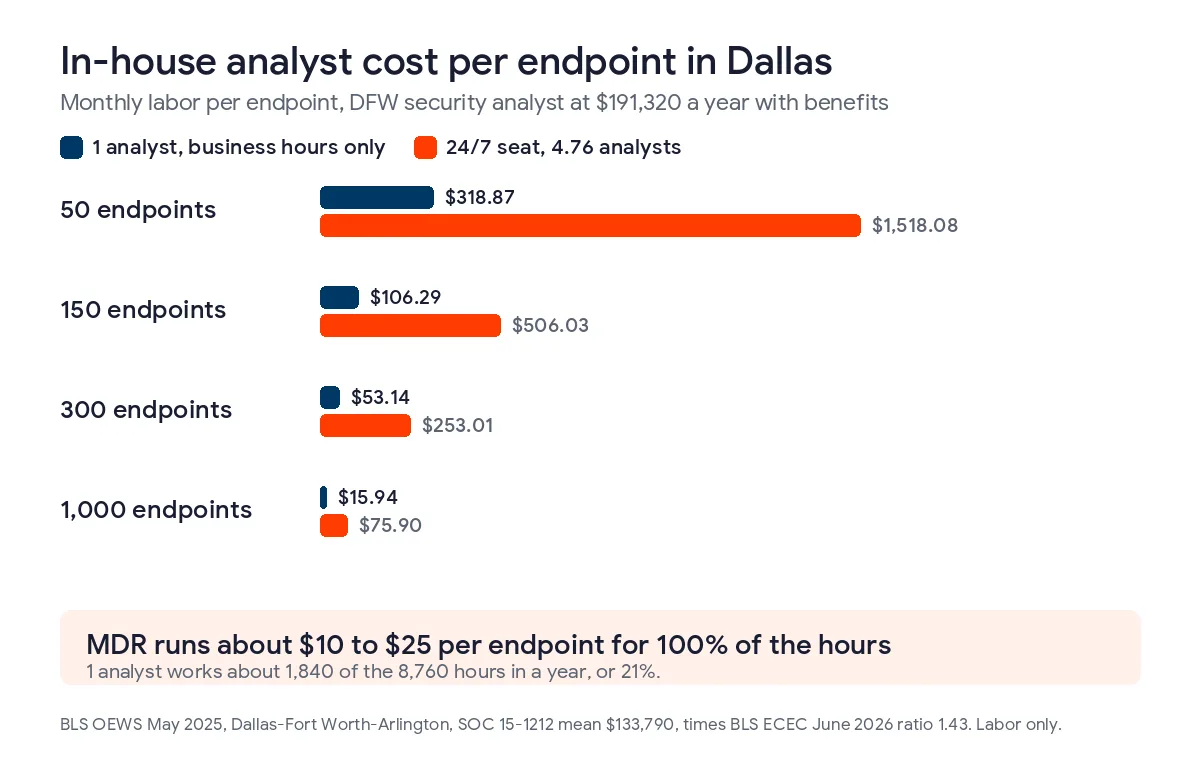
| Option | Annual cost in DFW | Hours covered | Per endpoint per month at 150 endpoints |
|---|---|---|---|
| 1 in-house analyst, business hours | About $191,300 | 21% of the year | $106 |
| In-house seat staffed 24/7, 4.76 analysts | About $910,800 | 100% | $506 |
| MDR from a provider | $18,000 to $45,000 | 100%, shared analyst team | $10 to $25 |
The analyst figures are labor only. They leave out the software, the log storage, a manager, and turnover. Even so, a 24/7 seat built at DFW pay doesn’t fall to $25 per endpoint until you have about 3,000 endpoints. Very few companies in the 20 to 250 employee range get anywhere near that. The honest case for an in-house analyst is different. Hire one to run your program and work with the MDR team, not to replace it.
Which rules push Dallas companies to buy MDR?
No federal rule says “buy MDR.” Several of them make it the cheapest way to meet a monitoring or reporting duty, and DFW has a lot of the businesses those rules cover. Mortgage lenders, auto dealers, investment advisers, clinics, and defense suppliers all show up in the table below.
| Rule | Who it hits in DFW | What it asks for | Where MDR fits |
|---|---|---|---|
| FTC Safeguards Rule, 16 CFR 314.4(d)(2) | Mortgage brokers, auto dealers, tax preparers, and other non-bank lenders | Continuous monitoring, or else a yearly penetration test and vulnerability scans every 6 months | Supplies the detection half of continuous monitoring. You still need vulnerability scanning to catch risky changes |
| FTC Safeguards notice duty, 16 CFR 314.4(j) | The same firms | Tell the FTC within 30 days of finding an event that involves 500 or more consumers | The deadline stays the same, but faster detection shortens how long data sits exposed before the clock starts |
| SEC Regulation S-P, 17 CFR 248.30 | Registered investment advisers and broker-dealers | A written program to detect, respond to, and recover from unauthorized access, plus customer notice within 30 days | Provides the detection and response steps the program has to describe |
| HIPAA Security Rule, 45 CFR 164.308(a)(1)(ii)(D) | Clinics, dental groups, and their business associates | Regular review of system activity, such as logs and access reports | Analysts review the activity daily and keep the record |
| DFARS 252.204-7012 and NIST SP 800-171 | Aerospace and defense suppliers across Tarrant County | Monitor systems to detect attacks, keep an incident-handling capability, and report to DoD within 72 hours | Covers the monitoring and gives you a team to call in the first hour |
| Texas Business and Commerce Code 521.053 | Any business holding Texans’ personal data | Notify the Texas Attorney General within 30 days when a breach involves 250 or more Texans | Fewer days between break-in and discovery means less data walks out |

A few details change the math. The FTC’s continuous-monitoring choice comes from the text of 16 CFR 314.4, and Section 314.6 exempts firms holding data on fewer than 5,000 consumers from that testing cadence. A small Richardson tax practice may not owe it. A busy Irving mortgage shop almost certainly does.
For advisers, the SEC’s amended Regulation S-P applied to larger firms from December 3, 2025, and to smaller ones from June 3, 2026. If you run a registered advisory firm in Uptown or Plano, your incident response program is already due. Defense suppliers should read requirements 3.6.1 and 3.14.6 in NIST SP 800-171 and the 72-hour reporting clause in DFARS 252.204-7012. Healthcare practices can find the activity-review requirement in 45 CFR 164.308.
Texas adds its own deadline. Under Section 521.053, a breach involving at least 250 Texans has to reach the Attorney General within 30 days of the date you determine it happened. Our CMMC compliance cost guide for DFW covers the defense side in more depth.
What do DFW breach notices show about detection?
On November 6, 2026, we downloaded the Texas Attorney General’s data breach list. It held 692 notices posted from April 1, 2025, through November 3, 2026. We kept the ones filed by organizations with a North Texas address. There were 85 of them, with 29 in Dallas, 8 each in Irving and Plano, 7 in Fort Worth, and the rest spread across 19 other DFW cities.
Healthcare filed the most. Medical providers accounted for 28 of the 85 notices, retailers and merchants filed 21, and financial services and insurance firms filed 8 between them. The 85 notices covered 1,673,803 Texans. The median notice covered 3,034 people, and 20 notices topped 10,000. Social Security numbers were involved in 66.
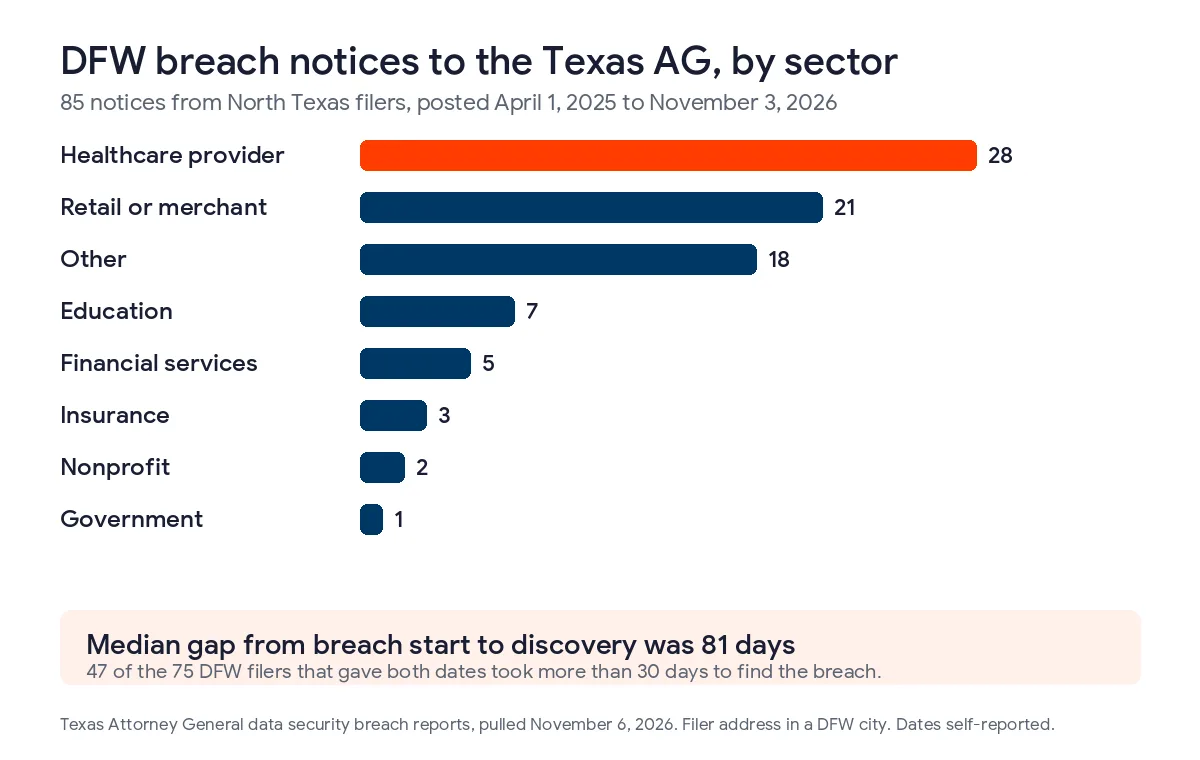
Speed is the part that ties back to MDR. 75 DFW filers listed both the date the breach started and the date they found it. The median gap was 81 days. 47 of them took more than 30 days to notice, and only 12 caught it within a day. Across all Texas-based filers who gave both dates, the median was 61 days, so North Texas ran slower than the state as a whole.
Read that with care. The dates are self-reported, the address is the filer’s headquarters rather than the breached office, and a few filers clearly logged the day an investigation finished instead of the day of discovery. Still, a quarter of a year is a long time for someone to sit inside a network. The 24/7 eyes that MDR adds are meant to shrink exactly that gap.
What raises or lowers a Dallas MDR quote?
Two quotes for the same 80 endpoints can differ by $1,000 a month. These are the 5 items that usually explain it.
- Response authority. A provider allowed to isolate a laptop at 3 AM without phoning you does more work than one that only sends an email, and it should charge more.
- Sources beyond the endpoint. Microsoft 365 sign-ins, firewall logs, and cloud accounts add data for analysts to read, and they often add a line item.
- Log retention. Keeping 90 days of logs costs less than keeping a year, and HIPAA or a defense contract may decide which one you need.
- Minimums and onboarding. A 30-endpoint office can hit a monthly minimum that makes its per-endpoint price look high, and some providers charge a setup fee.
- Incident response hours. Some plans include a block of hands-on recovery time. Others bill it hourly once an incident is confirmed.
Ask each provider to fill in the same 5 rows. The cheaper quote often turns out to be the one that stops at the alert.
Is Microsoft Defender enough for a small Dallas office?
It’s a good start, not a finished answer. Microsoft lists Defender for Business at $3.00 per user per month on its own, and it’s already included in Microsoft 365 Business Premium. That gives a 20-person Addison office solid endpoint protection for about $60 a month. What it doesn’t give you is a person reading the alerts at 2 AM on a Sunday.
That’s the gap MDR fills. If you already pay for Business Premium, a provider can usually run MDR on top of the Defender agent you own instead of installing a second one. Our guide to EDR vs MDR vs XDR walks through which pieces you may already have. For the wider budget, including firewalls, training, and backups, see our Dallas cybersecurity cost guide.
How does Uprite price MDR for Dallas companies?
We price per user, not per endpoint. MSSP Security Focus starts at $40 per user per month on our pricing page, and it covers endpoints, Microsoft 365 sign-ins, email, and logs, with a 24/7 SOC and a 5-minute average response time. We don’t sell a standalone per-endpoint MDR line, so if you only want device coverage, ask any provider for an endpoint-only price and compare it fairly against ours.
Here’s how to tell which model suits you. If your company has a lot of devices per person, as in manufacturing, labs, and shared clinic workstations, per-user pricing usually comes out ahead. If it’s mostly 1 laptop per person and you only need devices watched, a per-endpoint quote can be cheaper. Run both numbers. Our Dallas vCISO pricing guide covers the advisory side if you also need someone to own the program.
MDR pricing questions from Dallas buyers
How much does MDR cost per endpoint in Dallas?
Plan on about $10 to $25 per endpoint per month for a company of 20 to 250 people in 2026. Servers, virtual machines, identity monitoring, and longer log retention push a quote toward the top of that range or add separate line items.
Do servers cost more than laptops on an MDR quote?
Sometimes, and you should ask before you sign. Some providers bill a server at the same rate as a workstation, while others charge a higher server rate. Virtual machines raise the same question, because each one may count as its own endpoint.
Does the FTC Safeguards Rule make a Dallas lender buy MDR?
No, but it requires continuous monitoring or a yearly penetration test plus vulnerability scans every 6 months. MDR covers the detection side of continuous monitoring. Firms holding data on fewer than 5,000 consumers are exempt from that testing duty under 16 CFR 314.6.
Is 1 in-house analyst cheaper than MDR in Dallas?
Not for round-the-clock coverage. A DFW security analyst costs about $191,000 a year with benefits and works roughly 21% of the hours in a year. Staffing 1 seat around the clock takes about 4.76 analysts, which is close to $911,000 a year.
Does MDR watch Microsoft 365 accounts?
Only if the plan says so. Many MDR quotes cover devices alone and price Microsoft 365 sign-in and email monitoring as an add-on. Since many break-ins start with a stolen password, get identity coverage written into the scope.
Send us your device list, or just your headcount and number of servers. We’ll show you what MDR should cost for your Dallas office both per endpoint and per user, along with what each option covers.
Get a Dallas MDR Estimate