Houston E&P companies use managed AI to reduce downtime in 3 places, failing field equipment, the IT and OT systems watching it, and the hours staff lose hunting for information. An outside provider runs the data, security, and governance underneath, and the operator keeps every engineering call.
I pulled the 2026 annual reports of 23 oil and gas producers headquartered in the Houston area and read every sentence that mentions artificial intelligence. Of those 23, 13 bring it up. Not one says it uses AI to predict equipment failure or cut downtime. I checked twice. That gap is the honest place to start, and it’s exactly why our oil and gas IT services in Houston begin with the data path from the field, not with the model.
Bias disclosed. I run a managed IT company, so I have a stake in you deciding AI needs managing. Fair enough. But the filings are public, the wage math below comes from federal data, and every number links to its source.
Only 4 of 23 Houston-area E&P annual reports filed in 2026 say the company uses AI in its own business, and none ties it to downtime. The gains that do exist come from 3 places, equipment alerts built on clean historian data, faster response when IT or OT systems fail, and engineers finding answers without digging through shared drives. Each one needs data plumbing, security, and governance before a model helps. That’s the managed part, and it’s where most small-operator pilots stall.
What does managed AI mean for an oil and gas company?
Managed AI for oil and gas is an arrangement where an outside provider runs the AI tools a producer uses, along with the data connections, access controls, and monitoring those tools depend on, under a monthly agreement. The operator keeps ownership of its data and of every engineering and safety decision the AI informs.
Same idea as managed IT. Somebody else patches the servers. You still decide where to drill.
In practice the managed part covers 5 jobs.
- Getting field data out of SCADA and the historian and into something an AI tool can read, without opening a door back into the control network. What to watch at that boundary is in our guide to SCADA security for Houston operators.
- Who gets which AI tool, and what it’s allowed to see. Copilot included.
- Someone on the alerts at 2 a.m. on a Sunday, because a model that flags a failing compressor into an empty inbox is a very expensive log file.
- Model checkups. They drift.
- The paperwork your auditor, insurer, and board will eventually ask for.
What it doesn’t cover matters just as much. Here’s the line. A managed AI provider like us doesn’t write the physics model of your electric submersible pumps, and shouldn’t pretend to. That belongs to your lift vendor or your production engineers. Our job is making sure their model gets clean data on time and that a human being acts on what it says. Nothing fancier.
What are Houston E&P companies actually saying about AI?
Mostly that it’s a risk. In the 2026 annual reports of 23 Houston-area producers, AI shows up more often as an attacker’s tool than as an operating tool, and 10 of the 23 don’t mention it anywhere in hundreds of pages.
Here’s how I counted. Using the SEC’s EDGAR full-text search, I pulled every 10-K filed between January 1 and September 29, 2026 by a company under the crude petroleum and natural gas industry code with its head office in Houston or The Woodlands. That returned 34 filers. I set aside 5 royalty trusts, a mineral owner, 2 refiners, a midstream partnership, and 3 companies that don’t really produce oil or gas, then added ConocoPhillips, which the SEC still classifies under petroleum refining. That left 23 companies that operate or own producing wells. Small sample. Clean one.
| What the 2026 annual report says about AI | Houston-area producers | Count |
|---|---|---|
| The company uses AI in its own business | Chord Energy, Magnolia Oil and Gas, Murphy Oil, Occidental | 4 |
| The company has a written AI policy or guidelines | Amplify Energy, Crescent Energy | 2 |
| Machine learning appears only inside a security product | PEDEVCO | 1 |
| AI appears only as a cyber threat or a technology risk | ConocoPhillips, Coterra, EOG Resources, Evolution Petroleum, Prairie Operating, W&T Offshore | 6 |
| No mention of AI or machine learning | APA, Battalion Oil, EON Resources, Epsilon Energy, PrimeEnergy, Ring Energy, Sable Offshore, Talos Energy, US Energy, VAALCO | 10 |
| AI tied to equipment failure, predictive maintenance, or downtime | None | 0 |
Chord Energy put it plainly. “Presently, we employ a limited array of artificial intelligence technology in our business,” reads Chord’s 10-K. Murphy Oil went further. Its annual report says the business increasingly uses AI and machine learning to automate certain tasks, then spends a full paragraph on what could go wrong, including AI agents “capable of independently executing tasks, interacting with systems, or initiating actions” and “the use of unapproved AI tools within the organization.” Fair worries, all of them. Occidental says it uses AI-based tools “to strengthen its defenses and support business operations,” in its own filing.
Crescent Energy is the one I’d hand to a board. Crescent’s 10-K describes an acceptable use policy “with supplemental AI Use Guidelines that applies to all employees.” A governance control, written down, in an SEC filing. Rare.
Now the caveat. It’s real. A 10-K is a lawyered risk document, not a technology roadmap. A company can talk about automation on every earnings call and still say nothing about it to the SEC, so the filings undercount use. What they don’t undercount is worry. When a public company’s lawyers decide which AI risks to put in writing, they pick deepfakes, phishing, bad outputs, and tools nobody approved. ConocoPhillips, the biggest name on the list, mentions AI exactly once in its 10-K, as something that may sharpen what cybercriminals can do. Nobody picked downtime. Not one company.
That tells you where the managed work is. Not in the model. Around it.
Which kinds of downtime can AI actually reduce?
Three kinds, and each needs different help. Equipment downtime is a pump or compressor that quits. Systems downtime is the SCADA server, historian, network, or office software going dark. Decision downtime is the hours your people lose looking for what they need before they can act.
| Kind of downtime | What it looks like at a Houston producer | Where the AI usually lives | What has to be true first |
|---|---|---|---|
| Equipment | An ESP trips or a compressor goes down on a Permian pad overnight | The lift or automation vendor’s platform, or analytics on your historian | Clean historian tags, a reliable link from the pad, and a failure history somebody actually logged |
| Systems | The SCADA server, historian, VPN, or production accounting system is offline, sometimes from ransomware | Monitoring and endpoint detection tools with machine learning built in | An asset inventory, a segmented OT network, and a person watching alerts around the clock |
| Decision | An engineer spends an afternoon finding the last workover report on a well that changed operators twice | Microsoft 365 Copilot or an agent over your well files | Cleaned-up SharePoint permissions, labeled files, and a written AI policy |
Most vendor pages lump all 3 together and quote one big percentage. Don’t let them. Each kind has a different owner, a different data source, and a different way of breaking. Different fixes, too.
Equipment downtime
Everybody means this one. A model watches pressure, motor current, vibration, and temperature on an ESP or a compressor and warns you days before it fails, so a crew pulls it on a schedule instead of at midnight. When it works, the savings are real. The federal maintenance guide that Pacific Northwest National Laboratory wrote for the Department of Energy estimates predictive maintenance saves 8% to 12% over a preventive program, and potentially 30% to 40% over running equipment until it breaks. Real, but modest. Those numbers date to 2010 and describe federal facilities, not well pads. I still trust them more than a vendor’s 50%, because whoever wrote them had nothing to sell you.
Systems downtime
Less glamorous. Arguably more common at a small operator.
When the historian server fills its disk or ransomware locks the production accounting system, every well keeps pumping and nobody can see any of them. Blind, not broken. The AI here is mostly built into tools you may already own, like endpoint detection that flags a process acting strangely, or monitoring that notices a disk trending toward full before it takes the historian down. Shortening this kind of outage is less about the model and more about who picks up the alert at 3 a.m. We average a 5.06-minute first response across our clients, and I’d take that number over most AI features on the market. Our write-up on ransomware aimed at Houston energy companies shows how these outages usually start.
Decision downtime
Nobody puts this one on a dashboard. An engineer needs a workover report. A landman needs a division order from 2014. Somebody spends an afternoon in SharePoint and 3 shared drives, and at Harris County oil and gas extraction pay, which the BLS put at an average of $6,021 a week in 2025, that 4-hour afternoon costs roughly $600 in wages before anyone has decided anything. Small number. It adds up.
Copilot and custom agents can cut that search to minutes. They can also hand a summer intern the executive compensation spreadsheet if your permissions are a mess, which is why our managed AI services for Houston companies start with a permissions review before a single license gets assigned. Permissions first. Always. Enterprise Copilot lists at $30 per user per month, as our AI enablement pricing breakdown shows, so it’s worth knowing what it can read first.
Why do predictive maintenance pilots stall at smaller operators?
Because the data isn’t ready, and nobody’s job is getting it ready. The model is usually the easy part.
Harris County had 424 oil and gas extraction establishments in 2025 employing 33,022 people, according to the BLS Quarterly Census of Employment and Wages. One county holds 28.3% of every private extraction job in the country, and about half of the Texas total. But Harris County isn’t where the wells are. It’s where the head offices are, which means the data has to travel from the Permian, the Eagle Ford, or the Haynesville before anyone in a Houston office can use it for anything.
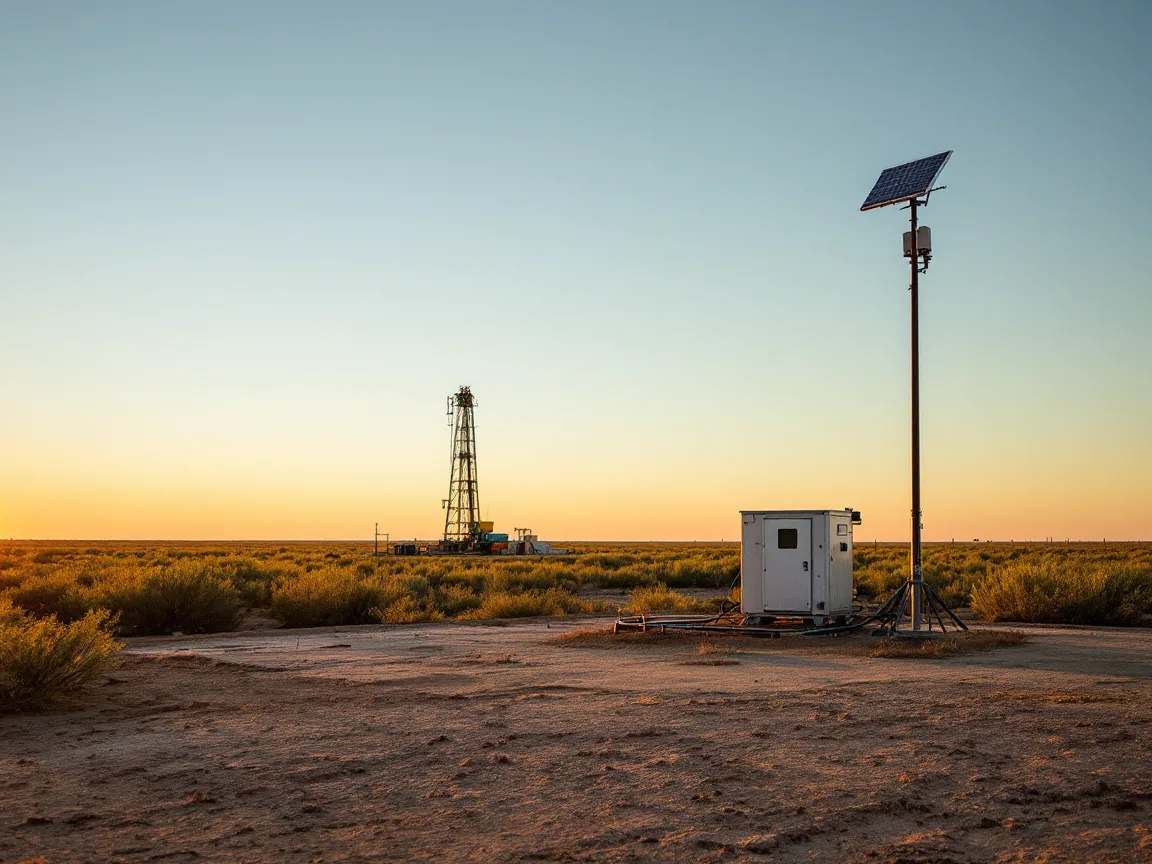
That trip is where pilots die. Quietly, usually. Here’s what usually turns up when you trace that path for a mid-size producer.
- Historian tags nobody standardized, so the same motor current is PMP_03_AMPS on one pad and ESP3_MotorCurrent on the next.
- Cellular or radio links that drop several times a day. The model sees gaps. It reads them as events.
- Failure history kept in a field supervisor’s spreadsheet, or in their head. A model can’t learn from a failure nobody logged.
- Acquired wells, each bringing another SCADA vendor, another naming scheme, and another set of default passwords someone forgot to change.
- Nobody on staff whose actual job is the data pipeline.
That last one hurts most. A data scientist in the Houston metro earned an average of $116,010 in May 2025, per BLS occupational wage data. Add benefits at the private-sector ratio in the BLS employer cost release, $46.89 in total compensation for every $32.82 in wages, and one hire runs about $166,000 a year. The whole metro had 4,060 data scientists that year, across every industry, and you’d be competing with the majors for them. Good luck with that. And after all that, you’d still need someone to keep the feed alive, secure it, and watch it on weekends.
| How you staff it | What it costs you | What you get | Where it tends to break |
|---|---|---|---|
| Hire a data scientist | About $166,000 a year loaded, at the Houston average | Models built around your own wells and data | One person, no nights or weekends, and the program walks out the door if they do |
| Buy the vendor’s AI module and stop there | A license, plus your engineers’ time | Failure prediction on that vendor’s equipment | Nobody owns the data feed, the security around it, or the office side of AI |
| Run a managed AI program | A monthly fee inside a managed IT agreement, scoped in writing | Data plumbing, security, governance, Copilot, and someone watching the alerts | It relies on your engineers or vendor for the physics of your equipment |
Most producers will end up with some mix of the second and third rows. That’s fine. The mistake is buying the second row and assuming it includes the third. It doesn’t.
What does federal guidance say about putting AI near SCADA?
Keep a human in charge, keep the data flowing outward, and keep a way to run without the AI. Simple rules. That’s the core of the joint guidance CISA, the NSA, and the FBI published on December 3, 2025 with cyber agencies from Australia, Canada, Germany, the Netherlands, New Zealand, and the UK.
The document is called Principles for the Secure Integration of Artificial Intelligence in Operational Technology. It runs 25 pages. It’s the most useful thing I’ve read on this topic from anyone without a product to sell, and its 4 principles translate cleanly to a producer running a few hundred wells out of a Houston office.
| CISA principle | What it means for a Houston producer |
|---|---|
| 1. Understand AI | Know which tools in your stack already use it, including features your SCADA and lift vendors switched on in their last update |
| 2. Consider AI use in the OT domain | Ask whether the problem needs AI at all, since a setpoint alarm is cheaper than a neural network |
| 3. Establish AI governance and assurance frameworks | Name an owner for every AI tool, test it before production, and write down what the vendor, integrator, and managed provider each answer for |
| 4. Embed oversight and failsafe practices | Keep a person in the loop on anything that touches a setpoint, and keep the manual procedure alive |
Three lines from it belong on the wall of every operations center in town. The guidance tells operators to “prefer push-based or brokered architectures that move required features or summaries out of OT without granting persistent inbound access.” It tells them to “ensure there are failsafe mechanisms that revert to traditional automation or manual for any AI-enabled system processes.” And it says, flatly, “Ultimately, humans are responsible for functional safety.” Read that last one again.
A fourth line matters to anyone hiring help. Operators, the guidance says, must define roles and responsibilities with the AI system manufacturer, the OT supplier, “and any system integrator or managed service provider.” Translation? The federal government expects you to have a written answer to who owns what. Most small operators don’t have one yet.
It also names drift. A model gets less accurate as the data it sees moves away from the data it learned on, and in an oilfield that happens constantly. Upsize a pump, bolt on an acquisition, switch chemical programs, and last year’s model may quietly start guessing. Somebody has to check. If your OT program already follows NIST SP 800-82, this guidance slots into it, and our piece on where OT and IT convergence leaves gaps for Texas energy companies covers the network side.
What can’t AI fix for a Houston producer?
Weather, mostly. And the grid.
In February 2021, Texas natural gas production fell by a record 4.3 billion cubic feet a day, or 15%, largely from freeze-offs, where water and other liquids freeze at the wellhead or in gathering lines and block the flow, according to the US Energy Information Administration. No model stops water from freezing. Physics wins. In July 2024, Hurricane Beryl cut power to 2.2 million CenterPoint customers, about 90% of the utility’s customers, according to the Public Utility Commission of Texas. Most of greater Houston went dark, head offices included.

What managed IT and AI can do is shorten the recovery. Know within minutes which sites lost communications. Fail the historian over to a copy that isn’t sitting in the flooded building. Tell field crews which wells to check first. That’s triage, not prediction, and on the worst week of your year it’s worth more than any model. Our breakdown of IT downtime cost in Texas shows why outage length, not the hourly rate, drives the bill.
There’s a quieter limit too. CISA warns that leaning on AI can cost operators “valuable skills for safely operating equipment manually or without the AI functionality.” Run the manual drill anyway. Twice a year. Your pumpers will grumble, and they’ll be glad in February.
Where should a Houston E&P start with managed AI?
With an inventory, not a purchase. Whatever AI for oil and gas means at your company, you can’t manage what you haven’t listed. These 7 steps are the order we use, and the first 4 don’t require buying anything.
- List every AI feature you already run, including the ones inside SCADA, lift, endpoint security, and Microsoft 365 that switched on by default.
- Pick one downtime problem with a dollar figure attached, like one compressor fleet or one recurring failure in one field.
- Trace the data path from that equipment to your office, and fix the gaps before buying anything.
- Write the AI policy and name an owner for each tool. Crescent did it in a 10-K. You can do it in a Word document, and our AI acceptable use policy template for Texas companies gets you most of the way.
- Clean up SharePoint permissions before Copilot goes to anyone, and use a Copilot governance checklist to decide who can build agents.
- Decide, in writing, who watches the alerts at night.
- Review each model every quarter, and retire whatever nobody uses.
Texas adds one wrinkle. The Texas Responsible Artificial Intelligence Governance Act, House Bill 149, took effect January 1, 2026 with no small-business exemption. Most of its heavier duties land on government agencies and healthcare, not producers. But the act gives a defense to a company that substantially complies with the NIST AI Risk Management Framework or another recognized framework, so the inventory and policy in steps 1 and 4 do double duty. Our TRAIGA guide for Texas businesses has the details. Cheap insurance.
Which Houston producers get the most from managed AI?
The ones with more data than people. That usually means an independent with somewhere between 12 and 300 Microsoft 365 users, the range our managed AI program is built for, and it tends to look like one or more of these.
- An operator that grew by acquisition and now runs 2 or 3 SCADA platforms that don’t talk to each other.
- A team with an IT manager but no data engineer, and a lift vendor asking for a cleaner feed.
- Engineers and landmen who already paste company data into free AI tools because nobody gave them an approved one.
- A board or lender asking what the AI policy is. Murphy’s lawyers aren’t the only ones worried about unapproved tools.
- Head office in Houston, wells somewhere with bad cell coverage.
Sound familiar? Then the order above applies to you.
How Uprite Runs Managed AI for Houston Oil and Gas
Uprite Services is a managed IT, cybersecurity, and AI provider that has supported Texas businesses since 1999, with a Houston office at 5718 Westheimer Rd. We support 2,227 users and 444 servers across our clients, average a 5.06-minute first response, and hold a 98.4% satisfaction rating. For oil and gas companies, managed AI sits on top of that work, not beside it. Foundation first.
Concretely, we trace and secure the path from your field data to your office, keep AI tools on push-only connections that never reach back into the control network, run a Copilot and AI readiness assessment with permissions cleanup, write the AI policy with you, and watch the alerts around the clock. We don’t build pump models. We make sure the people who do get clean data and a human on the other end of every alert.
We’ve done the unglamorous version of this for a Texas oil and gas company whose core operational platform couldn’t be replaced or taken offline. The oil and gas IT modernization case study walks through how we stabilized the servers, backups, and security around that platform without disrupting it. That’s the foundation any AI program sits on. For the full picture across the state, our oil and gas IT services for Texas operators page lists what each package includes.
What Houston Operators Ask Before Turning AI On
Can AI predict ESP failures for a small operator?
Sometimes, if the data exists. A failure model needs months of clean, consistent readings from the pump and a logged history of past failures to learn from. Plenty of smaller operators have the first and not the second, so the honest first project is usually logging failures properly for 6 months.
Should an AI tool connect straight into our SCADA network?
Not with inbound access. The December 2025 federal guidance says to push the data out of the OT network instead of giving the AI tool a persistent way in. Push, don’t pull.
How is managed AI different from the AI our lift vendor sells?
Your lift vendor’s AI predicts problems on its own equipment. Managed AI is everything around it, meaning the data feed, the network security, who can use which tools, Copilot, the written policy, and someone actually watching the alerts at night. You usually need both, and they should have a written line between them.
Is Microsoft 365 Copilot worth $30 a user for engineers and landmen?
Only if your SharePoint permissions are clean. If well files, division orders, and land records are organized and properly locked down, Copilot can turn an afternoon of searching into a few minutes. If they aren’t, it will surface things nobody meant to share. We’d run a readiness review first, then license a small group, measure the time saved, and only then decide on the rest of the company. Measure, then buy.
Does the Texas AI law apply to an oil and gas producer?
Yes, TRAIGA has no size threshold, but a producer’s direct duties are light. Most disclosure rules target government agencies and healthcare. The practical move is an AI inventory and a written policy aligned to the NIST AI Risk Management Framework, which the law recognizes as a defense.
Will AI replace our pumpers or control room staff?
Unlikely, if you follow the federal guidance. It says humans are responsible for functional safety and warns against letting manual skills fade. AI can tell a pumper which wells to visit first. It shouldn’t decide on its own to change a setpoint. People stay in charge.
What does a managed AI provider need from us to get started?
Three things, mostly. Admin access to Microsoft 365, a list of your SCADA and historian systems with whoever supports each one, and a single person on your side who can make decisions without calling a meeting. Everything else we can work out together once we start.
Running production from a Houston office and wondering what AI should touch first? Get an assessment. We’ll trace your field data path, show you what Copilot could read on day one, and tell you which downtime you can realistically shorten this year.
Get an Assessment