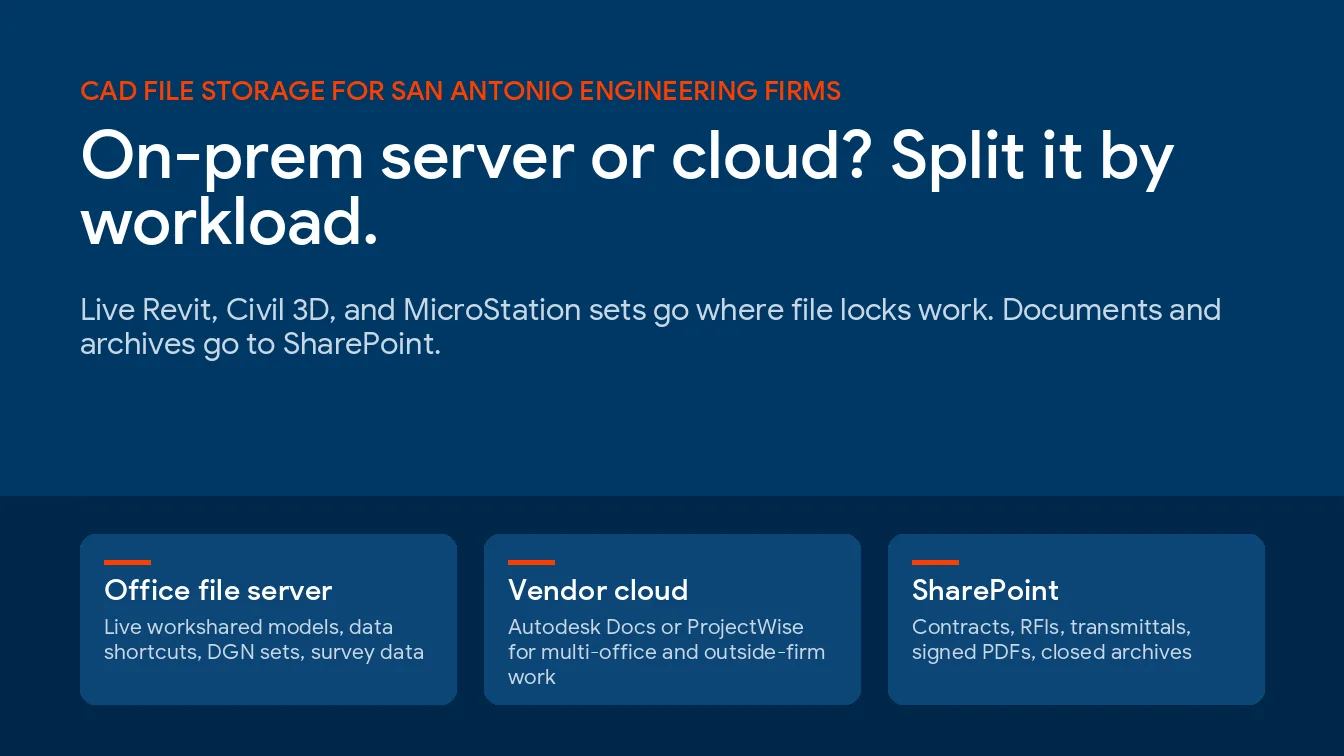
Short version. A NASA-area aerospace subcontractor in Texas pays $150 to $330 per user per month for managed IT in 2026. The spread is not about company size. It is set by which safeguarding clause your prime flowed down to you. Federal Contract Information only lands near $150. Controlled Unclassified Information pushes past $215. ITAR technical data pushes past $250. Budget one-time program costs on top.
Aerospace IT support in Texas costs $150 to $330 per user per month in 2026, with most NASA-area subcontractors paying $215 to $285 once Controlled Unclassified Information is in scope. One-time compliance program work adds $18,000 to $120,000 in the first year, depending on how much of your network the contract actually touches.
Those bands sit above the open Texas market, which our statewide managed IT cost guide tracks at $125 to $225 per user. Aerospace suppliers pay more. Sometimes a lot more. Not because the help desk is different, but because the contract came with homework attached.
I have sat across the table from a lot of Clear Lake shop owners holding two proposals that are $180 per user apart. Same headcount. Same office. Same Microsoft tenant. Neither vendor could explain the gap, and neither had read the flow-down clauses in the subcontract. That is where the money is.
So this guide is organized around clauses, not company sizes. Find the rung you are actually on and the price follows.
What Aerospace IT Support Costs in Texas Right Now
Aerospace managed IT bills as one recurring per-user charge that bundles the help desk, patch management, endpoint detection and response, backup, identity administration, and the control evidence your prime asks for at audit time. The compliance work is not an add-on service. It is a permanent operating tax on every ticket, every change, and every new laptop. Budget it as overhead.
Here is where Texas aerospace suppliers land in 2026, sorted by what data actually flows into their network.
| What your contract puts on your network | Per user per month | What the rate carries |
|---|---|---|
| Nothing federal. Commercial work only | $150 to $175 | Help desk, Microsoft 365 management, EDR, backup, one office network |
| Federal Contract Information only, FAR 52.204-21 flowed down | $150 to $185 | Above, plus access control, media handling, documented flaw remediation |
| Controlled Unclassified Information, DFARS 252.204-7012 flowed down | $215 to $285 | Above, plus a segmented enclave, evidence collection, SPRS score maintenance, 72-hour incident process |
| ITAR technical data in the environment | $250 to $330 | Above, plus end-to-end encryption, key custody, US-person access enforcement |
| Prime-specific terms above the federal floor | $290 and up | Above, plus whatever the supplier security addendum demands |
Software licensing sits outside all of those numbers. If your enclave runs in Microsoft 365 GCC High, plan on roughly $35.80 per user for Business Premium, $65.20 for G3, and $97.50 for G5 at reseller planning prices as of July 2026. That is on top of the managed IT rate, every month, for every person inside the boundary.
The Clause Ladder. Why Your Subcontract Sets Your IT Price
Most pricing guides sort by headcount. That fails here. A 12-person machine shop holding ITAR drawings pays more per user than a 90-person firm doing commercial work only, because those drawings drag an export-control regime onto every laptop, file share and backup target in the building.
Four rungs. Each one adds a real, priceable set of controls.
Rung 1. Federal Contract Information Only
If any federal contract information lives on or moves through your systems, FAR 52.204-21 applies and sets 15 basic safeguarding controls. The clause flows down to subcontractors at every tier where that information resides or transits, with a narrow carve-out for commercially available off-the-shelf items, which means a third-tier shop machining a bracket for a second-tier supplier on a federal program is very likely in scope without ever having read the prime contract.
This is the cheap rung. Most of the 15 controls are things a competent provider already does. Access control, authentication, media sanitization, malicious code protection, flaw remediation. What changes is that you now have to prove it, which means documentation and a repeatable process.
Expect $150 to $185 per user, and a one-time documentation pass of $4,000 to $12,000.
Rung 2. Controlled Unclassified Information
The moment a prime flows down DFARS 252.204-7012, your cost structure changes shape. You owe the 110 controls in NIST SP 800-171, a cloud service that meets FedRAMP Moderate or equivalent, and cyber incident reporting to the Department of Defense inside 72 hours.
You also owe a score. The DoD assessment methodology weights each of the 110 controls at 1, 3 or 5 points, starting from 110 and subtracting for every unmet requirement, which is why a genuinely unprepared environment can score as low as negative 203. That number goes into the Supplier Performance Risk System, and your prime can see it before award. They do look.
This is the rung where most NASA-area suppliers actually live. Budget $215 to $285 per user, plus a one-time gap assessment, system security plan and remediation program of $18,000 to $45,000. Add $25,000 to $75,000 if the answer is a purpose-built enclave rather than hardening what you already own.
Rung 3. ITAR Technical Data
Since March 2020, 22 CFR 120.54 has said that sending unclassified technical data abroad is not an export if it stays end-to-end encrypted and nobody in the middle holds the means to decrypt it. Read that second half again. Your cloud provider cannot hold the keys.
That single sentence rewrites an IT budget. Server-side encryption where the platform can decrypt on request does not qualify. Neither does a helpdesk technician who can read a file to troubleshoot it. You are now buying key custody, US-person access enforcement, and an identity system that can prove who touched what. All of that costs money.
Plan on $250 to $330 per user. The premium is mostly labor, because somebody has to administer an environment they are deliberately locked out of.
Rung 4. Whatever Your Prime Adds On Top
Primes write their own supplier security addenda, and those routinely exceed the federal floor. I have seen requirements for 12-month log retention, named security contacts with 24-hour reachability, annual penetration tests, and hardware attestation on every endpoint touching the program.
None of that is in a regulation. All of it is in a contract you signed. Price it separately, and read the addendum before you price anything else. That order matters.
What the 2026 CMMC Pause Changed, and What It Did Not
On July 13, 2026, DoD Chief Information Officer Kirsten Davies signed a policy memorandum titled “Removing Barriers to Defense Industrial Base Expansion,” released under publication case 26-P-1023 alongside an implementation memo from the undersecretary of defense for acquisition and sustainment. Together they suspended Phase 2 of the CMMC program and placed all pending and future CMMC milestones in abeyance. Phase 2 would have required a third-party assessment from an accredited C3PAO before you could win covered work, starting November 10, 2026.
A 60-day CMMC Reform Task Force was stood up the same week to collect industry feedback and recommend what replaces it. As of early September 2026 those recommendations have not been published, so anything you read about the shape of the replacement program is speculation. WilmerHale’s client alert has the cleanest summary of what the two memos actually say.
A lot of suppliers read that as a reprieve. It is not.
Here is what actually moved and what did not.
| Requirement | Status after July 13, 2026 | Budget effect |
|---|---|---|
| C3PAO third-party assessment for Level 2 | Suspended pending review | Defers the largest single line item |
| DFARS 252.204-7012 safeguarding and 72-hour reporting | Unchanged, it is a contract clause | None. Keep spending |
| NIST SP 800-171 implementation | Unchanged | None. Keep spending |
| SPRS self-assessment score on file | Unchanged | None. Keep spending |
| FAR 52.204-21 basic safeguarding | Unchanged | None. Keep spending |
| Prime-imposed supplier security terms | Unchanged, and in some cases tightening | Rising |
So the pause is a cash-flow event, not a compliance holiday. The certification bill moved. The security bill did not.
The Center for Strategic and International Studies made the point that stuck with me. The readiness gap that made CMMC necessary in the first place did not close on July 13. Your prime knows that too, which is why several of them are now writing assessment expectations directly into subcontracts instead of waiting for the government to do it for them.
If you want the control-by-control view rather than the budget view, our CMMC and NIST 800-171 compliance guide for Texas walks the 110 requirements, and the Houston defense supplier page covers the local assessment landscape.
Read the DoD Cost Numbers Carefully
The CMMC final rule, effective December 16, 2024, published cost estimates that get quoted constantly and understood rarely. For a small entity, DoD estimated $5,977 a year for a Level 1 self-assessment and affirmation, $37,196 over three years for a Level 2 self-assessment, and $104,670 over three years for a Level 2 certification assessment. The C3PAO fee inside that last number is $31,234, priced as a 3-person team for 120 hours.
Now the part almost nobody quotes. The rule states plainly that there are no engineering costs associated with Level 1 because it assumes the contractor has already implemented the applicable security requirements. Footnote 47 repeats the assumption. Read that twice.
Those figures price the audit. Not the security. If you are starting from a flat network, a shared administrator password and a consumer backup product, the $104,670 is the bill that arrives after you have already spent the real money. Independent estimates for small manufacturers put implementation somewhere between $75,000 and $240,000 over 9 to 18 months, and the single biggest lever is how much of your network you can push outside the assessment boundary.
Scope reduction is the cheapest security control ever invented. Three workstations and a segmented enclave beat a hardened 60-node flat network on both cost and risk, every single time.

A First-Year Budget for a 40-Person NASA-Area Subcontractor
Take a realistic profile. Forty people, 28 of them with managed computers, an office off NASA Parkway, a shop across the water, CUI in scope, no ITAR yet, one prime relationship. Here is what year one looks like.
| Line item | Year 1 | Notes |
|---|---|---|
| Managed IT, 28 users at $245 per user per month | $82,320 | Mid-band Rung 2 rate |
| Microsoft 365 GCC High G3, 12 users in the enclave | $9,389 | Only the people who touch CUI need it |
| Gap assessment, SSP and POA&M | $28,000 | One-time, front-loaded in months 1 to 3 |
| Enclave build and data migration | $42,000 | One-time, the biggest swing factor |
| Second site network and secure connectivity | $14,400 | Build plus 12 months of circuit |
| SPRS scoring support and annual affirmation | $6,000 | Recurring, small, easy to forget |
| Year 1 total | $182,109 | Roughly $542 per user per month, blended |
| Year 2 run rate | $112,109 | One-time items drop out |
That year-one number scares people. It should not. Look at year two. It drops by 38%.
The pattern is consistent across every aerospace supplier I have priced. Compliance is a capital event followed by an operating expense, and the mistake owners make is treating the capital event as the run rate. They see $182,000, decide they cannot afford the program, and walk away from the contract that would have paid for it several times over.
Hiring This In-House Costs More Than Owners Expect
The alternative is building the capability internally. The Bureau of Labor Statistics publishes what that actually costs here.
In the Houston-Pasadena-The Woodlands metro, the May 2025 Occupational Employment and Wage Statistics put mean annual wages at $62,700 for computer user support specialists, $108,200 for network and computer systems administrators, and $126,880 for information security analysts. Wages are not the whole cost. BLS employer cost data for the fourth quarter of 2025 shows total compensation running $46.15 an hour against $32.36 in wages, a load factor of 1.43.
| Role | Houston metro mean wage | Fully loaded at 1.43x |
|---|---|---|
| Computer user support specialist | $62,700 | $89,661 |
| Computer network support specialist | $76,560 | $109,481 |
| Network and computer systems administrator | $108,200 | $154,726 |
| Information security analyst | $126,880 | $181,438 |
| Computer and information systems manager | $182,200 | $260,546 |
A CUI environment realistically needs an administrator and a security analyst. That is $336,164 a year fully loaded, for 40 hours a week of coverage, before tools, before licensing, before the first vacation request lands on your desk. Spread across 28 supported users it works out near $1,000 per user per month. Almost nobody budgets that.
Then there is the size problem. Harris County had 27 private aerospace product and parts manufacturing establishments in 2025, employing 1,060 people at an average annual wage of $125,819, which works out to 39 employees per firm. Those figures come from the BLS Quarterly Census of Employment and Wages. A 39-person company does not carry a $336,000 security payroll. The math does not work, which is why nearly every supplier in this corridor buys the capability instead of building it.
The realistic middle path is co-managed IT, where your internal person keeps the work they are good at and a provider carries monitoring, evidence collection and after-hours coverage.

Five Cost Drivers You Only See Near Johnson Space Center
Count the aerospace roster the Bay Area Houston Economic Partnership publishes and you get past 50 companies, packed into a handful of small cities between Houston and Galveston Bay. Most are not primes. They are the shops, labs and engineering firms that sit two and three tiers down, and they share five cost drivers you will not find in a generic pricing guide.
- One location is usually three. An office near NASA Parkway, a shop or lab across the channel, and engineers badged into a customer facility where they cannot bring their own laptop. Each site is a separate network with separate controls. Two sites can add $1,000 to $1,600 a month before anybody logs in.
- Access control becomes an export control. Under the ITAR encryption carve-out, who can decrypt is a legal question answered by your identity system. Conditional access policies, US-person attributes and privileged access management stop being nice to have.
- Key custody moves in-house. If your provider can decrypt your technical data, you have not met 120.54. That changes which platforms you can buy and who can administer them, and it usually costs more.
- The 72-hour clock is real. DFARS 7012 requires reporting a cyber incident to DoD within 72 hours. You are not buying an incident response plan. You are buying a rehearsed one, with a medium assurance certificate already provisioned.
- Flow-down is asymmetric. Primes flow the clause down. They do not flow the budget down. Every supplier I work with has absorbed the cost inside an existing price, which is why scope reduction matters more here than anywhere else.
What You Can Cut, and What You Cannot
Some of this budget is negotiable. Some of it is not, and the difference is worth knowing before you start trimming.
| Cuttable | Not cuttable |
|---|---|
| Enclave size. Push people and systems outside the boundary | The 110 NIST 800-171 controls inside whatever boundary remains |
| GCC High seat count. License only the people who touch CUI | FedRAMP Moderate or equivalent for the cloud that holds it |
| Premium hardware refresh cycles | Multifactor authentication and endpoint detection |
| Third-party assessment timing, while Phase 2 is suspended | Your SPRS score and annual affirmation |
| On-site visit frequency at the second location | 72-hour incident reporting readiness |
One more piece of honesty. If a provider quotes you $160 per user for a CUI environment, they have either not read your subcontract or they plan to bill the compliance work separately once you have signed. Ask which. The answer tells you everything you need to know about the rest of the proposal.
For a broader look at what a Bay Area supplier should expect from a local provider, we published a Clear Lake and Webster managed IT overview and a review of the IT support companies serving the Bay Area.
Questions NASA-Area Aerospace Suppliers Ask About IT Cost
How much does aerospace IT support cost per user in Texas?
Texas aerospace suppliers pay $150 to $330 per user per month in 2026. Most NASA-area subcontractors land at $215 to $285 once Controlled Unclassified Information is in scope. ITAR technical data pushes the rate toward $330. Software licensing and one-time program work are billed separately.
Why is aerospace IT more expensive than standard managed IT?
Because the contract, not the company, sets the control set. A commercial firm buys support. An aerospace subcontractor buys support plus documented evidence for 110 NIST 800-171 controls, a 72-hour incident process, and in ITAR environments, key custody the provider cannot break.
Did the CMMC pause in July 2026 lower our IT costs?
It deferred one line item. Two DoD memos dated July 13, 2026 suspended Phase 2 third-party assessments, which removes the six-figure C3PAO event for now. DFARS 252.204-7012, NIST 800-171 implementation, your SPRS score and FAR 52.204-21 all still apply exactly as before.
What does a NIST 800-171 program cost a small aerospace shop?
Plan on $18,000 to $45,000 for a gap assessment, system security plan and remediation, plus $25,000 to $75,000 if you build a separate enclave. Independent estimates for small manufacturers run $75,000 to $240,000 all in over 9 to 18 months.
Does ITAR really mean our IT provider cannot decrypt our files?
Correct, if you are relying on the 22 CFR 120.54 encryption carve-out. The rule requires end-to-end encryption where no third party holds the means to decrypt, cloud providers included. Server-side encryption with provider-held keys does not qualify.
Should we hire an internal IT person instead?
Rarely as a full replacement. A systems administrator and a security analyst cost about $336,000 a year fully loaded at Houston metro wage rates, for weekday coverage only. Co-managed IT keeps your internal person and adds specialist depth for a fraction of that. Those wage rates come from the federal series we break down county by county in what 2026 hiring data says about in-house IT in Bay Area Houston.
How do we lower the cost without losing the contract?
Shrink the assessment boundary. Move people, systems and data that never touch CUI outside the enclave, then license and harden only what remains. Scope reduction routinely cuts implementation cost by 40% to 60% and lowers ongoing per-user spend at the same time.
Get a Real Number for Your Contract
Send us the flow-down clauses from your subcontract and your headcount. We will map which rung you are on, size the enclave, and give you a per-user rate and a first-year program cost, line by line. There is no pressure to switch providers. Uprite is 20-plus years into supporting Texas businesses, triages incoming issues within 10 minutes, and stands behind every engagement with a 120-day satisfaction guarantee.
Start with our Houston managed IT services team, or compare published rates in the Texas MSP Pricing Index.